General
Buhari Inaugurates Locally-Built Boats to Strengthen Defence
By Adedapo Adesanya
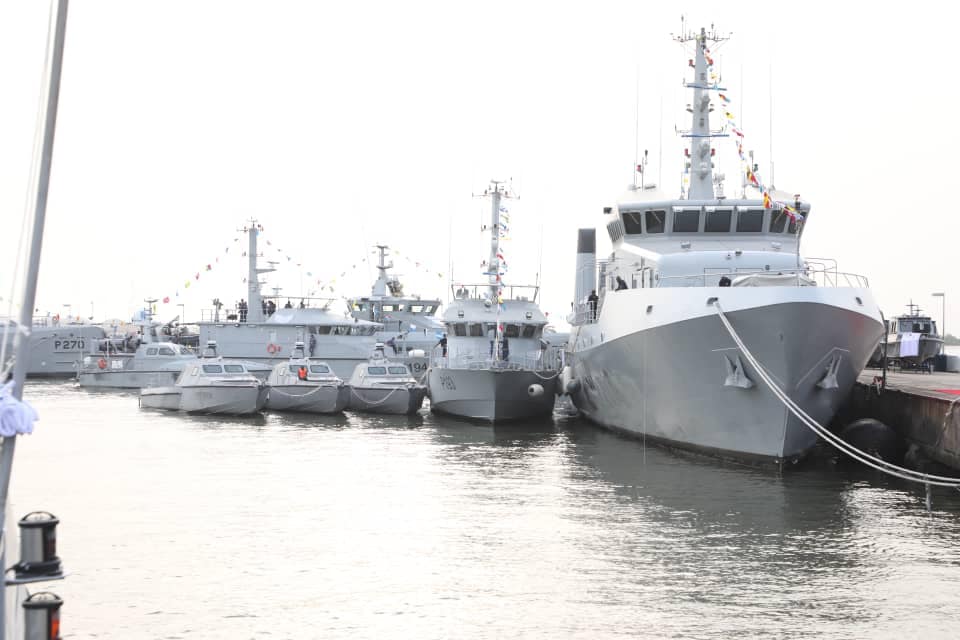
President Muhammadu Buhari has inaugurated a locally-built Seaward Defence Boat (SDB) 111 in Lagos State to boost the nation’s water territories.
According to a statement by his presidential aide, Mr Femi Adesina, the vessel was inaugurated on Thursday and was built by NNS Oji, the third of its series to be built by the Nigerian Navy.
President Buhari during the event noted that the new inductions to the Naval fleet would increase the agency’s capacity in securing the nation’s maritime domain.
‘‘We should note that we are in a critical period where our country is faced with a serious decline in our revenue and the security challenges we are facing,” Mr Buhari added, urging the personnel to make good use of the platforms as well as maintain professionalism.
‘‘The present realities, therefore, call for prudent resource management, innovativeness, accountability, and careful maintenance. I wish to reiterate that despite these challenges, our administration is very determined to ensure that the Navy is well supported to achieve its statutory responsibilities.
“Let me assure you that the Government will continue to support the ideals of the Nigerian Navy in the performance of its constitutional duties. God bless the Nigerian Navy, God bless the Federal Republic of Nigeria. Onward Together,” he further said.
Mr Buhari further said that the Nigerian Navy is a major contributor to the country’s economy.
The President, according to the statement, also lauded the Nigerian Navy for keeping a steady course in its local content development drive, also restated the Federal Government’s resolve to equip the agency.
‘‘I commend the business dependability of Messrs OCEA Shipyard – France, the builders of our Navy’s first-ever purpose-built Offshore Survey Vessel for a conclusive and successful execution of the contract.
“Local partners should share in this commendation for their efforts at local facilitation as outlined in the Government’s local content policy,” he said.
While acknowledging the efforts of the Nigerian Navy in securing Nigeria’s vast oil and gas industry, he said the Navy is a major contributor to the nation’s economic development.
“Arrests of those involved in illegalities have yielded results as some pirates, illegal bunkering syndicates, pipeline vandals and other miscreants have been convicted during this year,” Mr Buhari added.
“Such successes were made possible through the enforcement of our new anti-piracy law on Suppression of Piracy and Other Maritime Offences Act 2019.
“Furthermore, the provision of the new policy directives by the current administration of the Navy codified in such documents as the Nigerian Navy Strategic Plan 2021-2030; the Chief of the Naval Staff Strategic Directive 2021-5 and the Total Spectrum Maritime Strategy have given the Service credible guidelines and leverage for improved operational efficiency,” the President stated.
General
Amupitan Says 2027 Elections Timetable Ready Despite Electoral Act Delay
By Adedapo Adesanya
The Independent National Electoral Commission (INEC) has completed its timetable and schedule of activities for the 2027 general election, despite pending amendments to the Electoral Act by the National Assembly.
INEC Chairman, Mr Joash Amupitan, disclosed this on Wednesday in Abuja during a consultative meeting with civil society organisations.
Mr Amupitan said the commission had already submitted its recommendations and proposed changes to lawmakers, noting that aspects of the election calendar might still be adjusted depending on when the amended Electoral Act is passed.
He, however, stressed that the electoral umpire must continue preparations using the existing legal framework pending the conclusion of the legislative process and presidential assent to the revised law.
According to him, the commission cannot delay critical preparatory activities given the scale and complexity involved in conducting nationwide elections.
The development highlights INEC’s commitment to early planning for the 2027 polls, even as stakeholders await legislative clarity that could shape parts of the electoral process.
Yesterday, the Senate again failed to conclude deliberations on the proposed amendment to the Electoral Act after several hours in a closed-door executive session. The closed session lasted about five hours.
Lawmakers dissolved into the executive session shortly after plenary commenced, to consider the report of an ad hoc committee set up to harmonise senators’ inputs on the Electoral Act Amendment Bill.
When plenary resumed, the Senate President, Mr Godswill Akpabio, did not disclose details of the discussions on the bill.
Despite repeated executive sessions, the upper chamber has yet to pass the bill, marking the third unsuccessful attempt in two weeks.
The Senate, however, said it will not rush the bill, citing the volume of post-election litigation after the 2023 polls and the need for careful legislative scrutiny.
Last week, the red chamber of the federal parliament constituted a seven-member ad hoc committee after an earlier three-hour executive session to further scrutinise the proposed amendments.
General
REA Expects Further $1.1bn Investment for New Mini Power Grids
By Adedapo Adesanya
The Managing Director of the Rural Electrification Agency, (REA), Mr Abba Aliyu, is poised to attract an estimated $1.1 billion in additional private-sector investment to further achieve the agency’s targets.
He said that the organisation has received a $750 million funding in 2024 through the World Bank funded Distributed Access through Renewable Energy Scale-up (DARES) project.
He added that this capital is specifically intended to act as a springboard to attract an estimated $1.1 billion in additional private-sector investment, with the ultimate goal of providing electricity access to roughly 17.5 million Nigerians through 1,350 new mini grids.
Mr Aliyu also said that the Nigeria Electrification Project (NEP) has already led to the electrification of 1.1 million households across more than 200 mini grids and the delivery of hybrid power solutions to 15 federal institutions.
According to a statement, this followed Mr Aliyu’s high-level inspection of Vsolaris facilities in Lagos, adding that the visit also served as a platform for the REA to highlight its decentralized electrification strategy, which relies on partnering with firms capable of managing local assembly and highefficiency project execution.
The federal government, through the REA, underscored the critical role the partnership with the private sector plays in achieving Nigeria’s ambitious off-grid energy targets and ending energy poverty.
Mr Aliyu emphasized that while public funds serve as a catalyst, the long-term sustainability of Nigeria’s power sector rests on credible private developers who are willing to invest their own resources.
He noted that public funds are intentionally deployed as catalytic grants to ensure that the private sector maintains skin in the game which he believes is the only way to guarantee true accountability and the survival of these projects over time.
General
FG Eyes Higher Allocation as Senate Moves to Amend Revenue Sharing Formula
By Adedapo Adesanya
The Senate has proposed a review of the current revenue-sharing formula among the three tiers of government, seeking to allocate more funds to the federal government.
The proposal is contained in a constitutional amendment bill titled Constitution of the Federal Republic of Nigeria, 1999 (Alteration) Bill, 2026, sponsored by Mr Karimi Sunday representing Kogi-West, which passed first reading during plenary on Tuesday.
Coming amid ongoing calls for a new revenue formula to favour states and local governments, the bill argues for an increased federal share from the existing formula.
Under the current revenue sharing formula designed during the President Olusegun Obasanjo administration, the federal government takes about 52.68 percent of the total revenue generation by the nation in a month, the 36 state governments including the Federal Capital Territory, Abuja get 26.72 per cent and the 774 local governments share 20.60 per cent. The oil producing states of the Niger Delta region receive 13 per cent revenue as derivation to compensate for ecological damage of oil production in the region.
Defending the bill, the senator in a media conference on Tuesday stated that the federal government is overburdened by responsibilities such as the rehabilitation of dilapidated Trunk A roads and rising security costs, adding that available funds are no longer sufficient.
Ahead of its second reading, the lawmaker alleged that some states have little to show for funds received from the federation account.
The battle to change the sharing formula has been ongoing for more than 12 years. In 2013, the Revenue Mobilisation Allocation and Fiscal Commission (RMAFC) resolved to undertake a review to achieve a balanced development of the country.
To achieve that objective, the commission embarked on a nationwide consultation to the 36 states and also met with notable persons, including traditional rulers on the issue.
In December 2014, the commission came out with a proposed new revenue formula, which was submitted to the government. However, the report was not implemented.
Proponents have argued that the review of the revenue allocation among the federal, states and local governments of the federation has become necessary due to the current economic realities the country is facing.
-
Feature/OPED6 years agoDavos was Different this year
-
Travel/Tourism9 years ago
Lagos Seals Western Lodge Hotel In Ikorodu
-
Showbiz3 years agoEstranged Lover Releases Videos of Empress Njamah Bathing
-
Banking8 years agoSort Codes of GTBank Branches in Nigeria
-
Economy3 years agoSubsidy Removal: CNG at N130 Per Litre Cheaper Than Petrol—IPMAN
-
Banking3 years agoSort Codes of UBA Branches in Nigeria
-
Banking3 years agoFirst Bank Announces Planned Downtime
-
Sports3 years agoHighest Paid Nigerian Footballer – How Much Do Nigerian Footballers Earn