
Banking
UBA to Expand Access to Trade Finance for African Businesses

By Aduragbemi Omiyale
Access to trade finance remains one of the most significant structural constraints on African trade. Businesses, particularly small and medium-sized enterprises (SMEs), are frequently unable to secure letters of credit, guarantees, and supply chain finance on commercially viable terms, limiting their capacity to export and import competitively.
This trade finance gap is estimated by the African Development Bank (AfDB) to be over $80 billion annually.
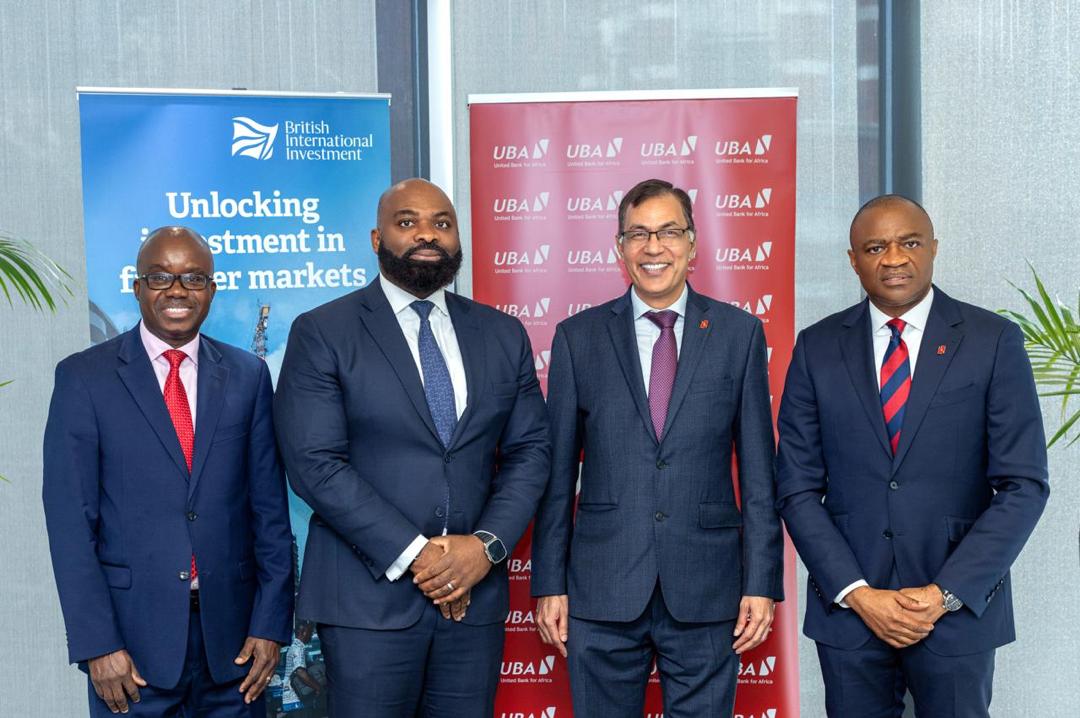
Worried by the impact this has had on African businesses, the United Bank for Africa (UK) Limited has partnered with the British International Investment (BII) Plc to address this issue.
Both organisations have signed a letter of intent to develop trade finance collaboration opportunities. The proposed initiative aims to expand access to trade and working capital facilities for businesses operating across Africa.
The lender will leverage its deep relationships across the UBA Group’s 20-country African network to originate and structure trade finance transactions. While BII, with a mandate to support productive, sustainable, and inclusive growth across Africa, can support transactions that might otherwise fall outside conventional commercial appetite.
This partnership builds on growing momentum around intra-African trade facilitated by the African Continental Free Trade Area (AfCFTA), which entered into force in 2021 and represents one of the world’s most significant trade integration initiatives.
Both institutions have identified the operationalisation of AfCFTA as a priority catalyst for a trade finance facility, with UBA UK’s network across major AfCFTA economies offering a basis for supporting businesses navigating the emerging continental market.
“The signing of this letter with BII represents a landmark moment for UBA UK and for the UBA Group’s global ambitions. As the Group’s hub for Trade Operations, UBA UK is uniquely positioned to connect African businesses with the international financial system.
“Working alongside BII, we can extend that capability further — mobilising capital where it matters most and helping to close the trade finance gap that holds back so much African potential,” the chief executive of UBA UK, Mr Lok Mishra, said.
Also commenting, the Managing Director and Head of Africa for BII, Mr Chris Chijiuitomi, said his organisation “is committed to catalysing private sector growth across Africa, and trade finance is a critical enabler of that growth.”
“We welcome the opportunity to collaborate with UBA Group, whose pan-African network and deep institutional relationships can help advance our ambition to expand access to trade and working capital finance, particularly in frontier markets,” he added.



VALR, Africa’s largest crypto exchange by trade volume, has integrated with Onafriq, the continent’s leading digital payments gateway. This partnership enables VALR users across Africa to fund their accounts directly through mobile money in local currencies, significantly broadening access to digital financial services for millions of people.
Mobile Money’s Role in African Financial Inclusion
Mobile money serves as a foundational element of financial services in Africa, facilitating everyday transactions, remittances, savings, and credit in areas with limited traditional banking access. According to the GSMA’s State of the Industry Report on Mobile Money 2025, global registered mobile money accounts reached 2.1 billion by the end of 2024, with over half a billion monthly active users. The sector processed approximately 108 billion transactions valued at more than $1.68 trillion in 2024, reflecting 20% year-on-year growth in volume and 16% in value.
In Sub-Saharan Africa, mobile money continues to drive substantial economic impact, contributing around $190 billion to GDP in 2023 alone. This growth is supported by interoperable networks that enable payments across major local currencies, including the Kenyan Shilling, Nigerian Naira, Ghanaian Cedi, and Ugandan Shilling, and through mobile money platforms such as M-Pesa and MTN MoMo. In the majority of these markets, mobile money usage for domestic transactions far outweighs traditional methods such as credit cards and direct bank transfers, according to complementary insights from the World Bank’s Global Findex 2025 report, making acceptance of mobile money crucial to successful market entry.
Onafriq operates Africa’s largest digital payments network, connecting nearly 1 billion mobile money wallets across 43 markets. The integration utilises this extensive infrastructure to allow direct, local-currency deposits to VALR, settled in stablecoins or selected crypto, streamlining access and reducing dependence on conventional banking systems.
Enabling Broader Participation in VALR’s Financial Product Suite
Through this integration, with VALR and Onafriq processing all settlements using stablecoins, users in supported markets can deposit funds via mobile money and engage with VALR’s comprehensive offerings. These include spot and margin trading for Bitcoin and over 100 crypto assets, tokenised real-world assets such as gold, equities, and private credit, yield products like lending and staking, and VALR Pay for efficient payments.
By integrating mobile money on-ramps, the partnership facilitates easier entry into global digital markets using established local payment methods.
VALR’s Leadership in Promoting Financial Inclusion
VALR holds a prominent position in Africa’s digital asset sector, serving over 1.7 million registered users and 2,000 corporate and institutional clients worldwide. Licensed by South Africa’s Financial Sector Conduct Authority (FSCA) and with regulatory approval in Europe, VALR is dedicated to building inclusive financial systems.
“VALR’s partnership with Onafriq deepens our reach across Africa and the world, connecting many more countries and people to VALR’s wide array of crypto asset services and infrastructure,” said Farzam Ehsani, Co-Founder and CEO of VALR. “Mobile money has already reshaped financial access across the African continent. By enabling direct connections in local currencies, we offer millions a practical pathway to Bitcoin, stablecoins, tokenised gold, and more, as well as innovative financial tools, supporting greater economic participation for everyone.”
Onafriq’s Founder and CEO, Dare Okoudjou, highlighted the significance of the partnership for financial connectivity across the continent. “We are truly excited to welcome VALR onto the Onafriq Network, enabling their clients across Africa to transact freely with the 1bn mobile wallet users and hundreds of thousands of businesses already on Onafriq’s network. VALR is a recognised pioneer and leader of Blockchain and Stablecoin technologies on the continent and we look forward to working with them to bring the many benefits of these technologies to people and businesses across Africa.”

By Adedapo Adesanya and Modupe Gbadeyanka
The Central Bank of Nigeria (CBN) has described rumours that Polaris Bank Limited failed to meet the recapitalisation deadline on March 31, 2026, as fake news.
The banking sector regulator in a post via its social media handle on X, formerly known as Twitter, on Thursday also said reports that notable businessman, Mr Razaq Okoya, was planning to acquire the financial institution were false.
There were reports on Wednesday that Polaris Bank, which was created after the operating licence of Skye Bank was revoked by the CBN in 2018, could not meet the deadline to raise its capital base.
The central bank gave banks two years to increase their minimum capital requirements based on their licence coverage.
For lenders with an international licence, they were to boost their capital base from N25 billion to N500 billion, while national banks were asked to have at least N200 billion, with regional lenders N50 billion.
The deadline was March 31, 2026, and according to the CBN, about 33 banks scaled through, raising about N4.65 trillion.
An X user had written that, “Polaris Bank is currently undergoing a liquidation process for not able to comply with the Central Bank of Nigeria recapitalisation requirements, and the bank would be put under NDIC to be liquidated. The bank licence might also be revoked soon. But billionaire Razaq Okoya has made a bid to purchase the bank, reinstate it, [and] also to comply with the CBN requirements. This deal is said to be finalised the moment NDIC and other shareholders agree with what Razaq Okoya is ready to offer.”
While reacting to the above, the CBN said, “This content is fake. Let the public be guided. The Nigerian banking system is safe and secure.”
In 2024, the banking sector regulator appointed new chief executives for three banks, including Polaris Bank, after the dissolution of their boards and managements over the non-compliance of these banks and their respective boards with the provisions of Section 12(c), (f), (g), (h) of the Banks and Other Financial Institutions Act, 2020. The others were Union Bank and Keystone Bank.


By Dipo Olowookere
Shareholders of Wema Bank Plc will receive a dividend of N1.25 for the 2025 financial year if approved at the next Annual General Meeting (AGM).
The board proposed the cash reward to investors after achieving record-breaking growth and unparalleled performance across several key metrics in the year under review.
Details of the FY 2025 audited financial results of the lender showed that pre-tax profit went up by 116.4 per cent to N221.9 billion from N102.5 billion, while net profit soared by 125.4 per cent to N194.5 billion from N86.2 billion in 2024.
Last year, the financial institution grew its gross earnings by 52.8 per cent to N660.6 billion from N432.3 billion in the preceding year, driven largely by a 62.7 per cent growth in interest income, reflecting improved yields on earning assets and growth in the loan book.
As for its balance sheet, it was observed that total assets chalked up 41.5 per cent to N5.07 trillion from N3.59 trillion, and customer deposits grew by 30.3 per cent to N3.29 trillion from N2.52 trillion, demonstrating sustained customer confidence.
This growth in deposits provided stable funding for asset growth while supporting liquidity and balance sheet resilience. Net interest income more than doubled, rising by 103.9 per cent to N361.0 billion, supported by improved asset pricing and balance sheet expansion. Non-interest income also grew modestly by 8.3 per cent to N85.3 billion. Net loans and advances increased by 44.7 per cent to N1.74 trillion, up from N1.20 trillion in FY 2024, thus reflecting Wema Bank’s continued support for key sectors of the economy while maintaining a disciplined risk management approach.
“Wema Bank has delivered one of the strongest growth trajectories in its history. From a PBT of N14.75 billion three years ago, we grew to N43.59 billion in 2023 and reached N102 billion in 2024. In 2025, we have taken an even bolder step forward, recording a PBT of N221 billion,” the chief executive of Wema Bank, Mr Moruf Oseni, commented.
“As of September 2025, Wema Bank successfully surpassed the N200 billion recapitalisation minimum threshold for commercial banks with national authorisation.
“Our FY2025 Financial Results only corroborate what has become abundantly clear—Wema Bank is here not just to stay, but to lead the future of banking in Africa,” he added.
-
 Feature/OPED6 years ago
Davos was Different this year
-
Travel/Tourism10 years ago
Lagos Seals Western Lodge Hotel In Ikorodu
-

 Showbiz3 years ago
Estranged Lover Releases Videos of Empress Njamah Bathing
-
 Banking8 years ago
Sort Codes of GTBank Branches in Nigeria
-

 Economy3 years ago
Subsidy Removal: CNG at N130 Per Litre Cheaper Than Petrol—IPMAN
-

 Banking3 years ago
Sort Codes of UBA Branches in Nigeria
-

 Banking3 years ago
First Bank Announces Planned Downtime
-

 Sports3 years ago
Highest Paid Nigerian Footballer – How Much Do Nigerian Footballers Earn
Pingback: UBA to Expand Access to Trade Finance for African Businesses
Pingback: UBA to Expand Access to Trade Finance for African Businesses