
Economy
Buhari Signs 2022 Budget, Laments Unjustified Changes by NASS

By Adedapo Adesanya
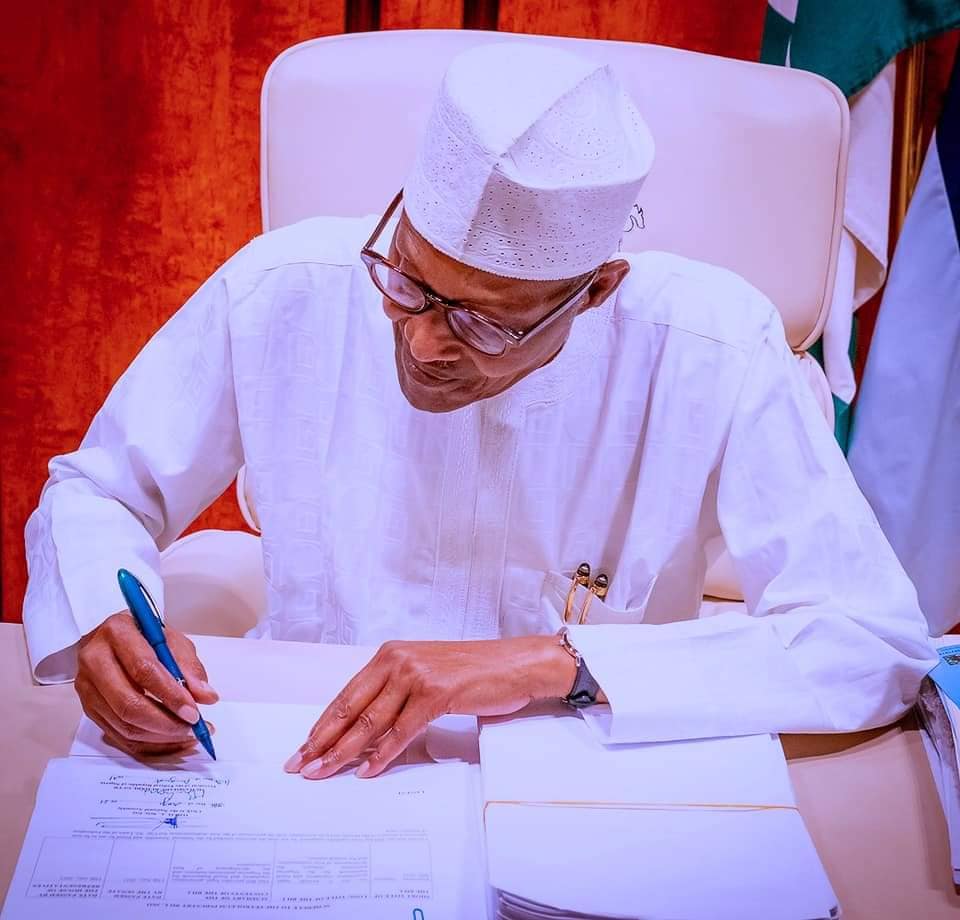
President Muhammadu Buhari has kept to his promise and has signed the 2022 Appropriation Bill of N17.126 trillion into law on Friday, December 31.
The President signed the budget presented to him by his Senior Special Assistant (Senate) on National Assembly, Mr Babajide Omoworare, on the final day of the year at the Council Chamber of the Presidential Villa in Abuja, the Federal Capital Territory (FCT).
He was, however, displeased with some changes as well as major additions and reductions made by the National Assembly in critical projects “without justification”.
President Buhari highlighted some of the worrisome changes in the budget to include an increase in projected federal government independent revenue by N400 billion, reduction in the provision for Sinking Fund to Retire Maturing Bonds by N22 billion, and reduction of the provisions for the Non-Regular Allowances of the Nigerian Police Force and the Nigerian Navy by N15 billion and N5 billion respectively; all without any explanation.
He also expressed his reservations on the inclusion of new provisions totalling N36.59 billion for National Assembly’s projects in the Service Wide Vote, which he said negated the principles of separation of powers and financial autonomy of the legislative arm of government.
The President was also concerned about the changes to the original executive proposal in the form of new insertions, outright removals, reductions and/or increases in the amounts allocated to projects, as well as reduction of the provisions made for as many as 10,733 projects and the introduction of 6,576 new projects into the budget.
According to him, most of the projects inserted relate to matters that are basically the responsibilities of state and local governments and do not appear to have been properly conceptualised, designed, and cost.
President Buhari said he would revert to the National Assembly with a request for an amendment as soon as the lawmakers return from their recess, to ensure that critical ongoing projects cardinal to his administration do not suffer a setback as a result of reduced funding.
He recounted that during the presentation of the 2022 Appropriation Bill, he stated that the fiscal year would be very crucial in his administration’s efforts to complete and put to use critical agenda projects, as well as improve the general living conditions of Nigerians.
The President insisted that the cuts by the lawmakers could render the implementation of the budget impossible.
He promised to commence early preparation of the 2023 transition budget and quickly begin the process to ensure early submission of the 2023-2025 Medium-Term Expenditure Framework and Fiscal Strategy Paper as well as the 2023 Appropriation Bill to the National Assembly.
The President of the Senate, Ahmed Lawan; Speaker of the House of Representatives, Femi Gbajabiamila; Secretary to the Government of the Federation (SGF), Boss Mustapha; and Minister of Finance, Budget, and National Planning, Mrs Zainab Ahmed, among others, witnessed the signing of the budget.
This comes a week after lawmakers in the House of Representatives and Senate chambers of the National Assembly passed a budget of N17.126 trillion, increasing the benchmark price of crude from $57 to $62 per barrel.
During the plenary last Wednesday, the Senate had passed the 2022 budget with Mr Lawan giving an assurance that the bill would be sent to the President for assent the following day.
Lawmakers in the House of Representatives had also passed the budget last Tuesday.
The National Assembly raised the total 2022 budget figure from the proposed N16.391 trillion to N17.126 trillion.








By Dipo Olowookere
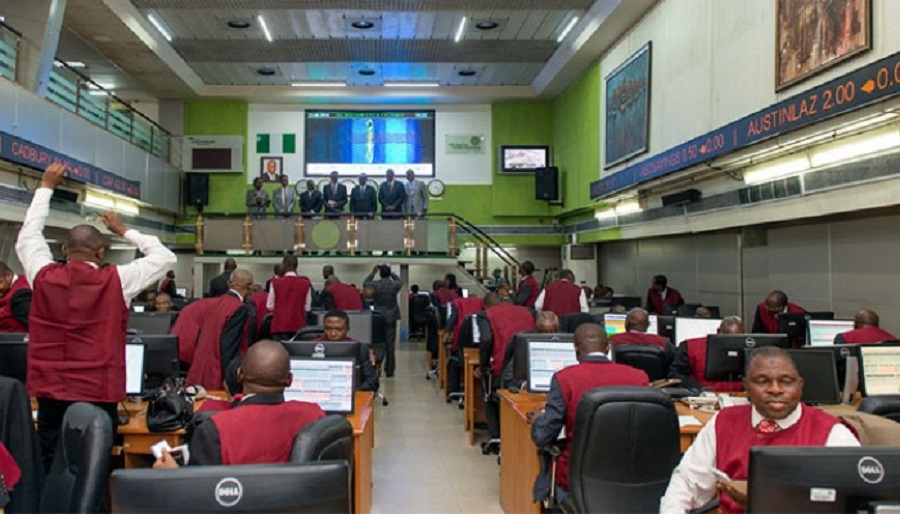
The first trading session on the floor of the Nigerian Exchange (NGX) Limited after the two-day break for Easter ended on a positive note, with a 0.16 per cent rise on Tuesday, April 7, 2026.
The local stock exchange last opened its doors to investors last Thursday, and at the resumption of trading activities yesterday, market participants showed enthusiasm, mopping up shares in the banking ecosystem, and rescuing the bourse from the bears.
This returned Customs Street to the green territory, with the All-Share Index (ASI) growing by 324.21 points to 202,023.10 points from 201,698.89 points, and the market capitalisation up by N209 billion to N130.015 trillion from N129.806 trillion.
The expansion experienced during the session was inspired by three sectors, with the banking index up by 1.46 per cent, the energy space up by 0.12 per cent, and the consumer goods counter up by 0.10 per cent. But the insurance sector lost 1.37 per cent, and the industrial goods sector depreciated by 0.31 per cent.
Business Post reports that investor sentiment was bearish on Tuesday after a negative market breadth index caused by 25 price gainers and 36 price losers.
Ellah Lakes slumped by 10.00 per cent to N10.80, DAAR Communications gave up 9.95 per cent to trade at N1.72, Chams decreased by 9.87 per cent to N3.38, John Holt lost 9.71 per cent to finish at N13.95, and Sunu Assurances slipped by 9.68 per cent to N4.20.
On the flip side, Trans Nationwide Express gained 9.86 per cent to quote at N3.12, Omatek appreciated by 9.76 per cent to N2.25, Cadbury Nigeria improved by 9.53 per cent to N75.25, First Holdco rose by 9.10 per cent to N54.55, and Fortis Global Insurance chalked up 6.50 per cent to close at N1.31.
Trading data revealed that activity level improved during the session, with the trading volume up by 114.29 per cent to 1.2 billion shares from 560.0 million shares, the trading value surged by 108.81 per cent to N40.3 billion from N19.3 billion, and the number of deals soared by 57.03 per cent to 78,006 deals from 49,676 deals.
Wema Bank transacted 282.6 million equities valued at N7.3 billion, Access Holdings exchanged 125.2 million stocks worth N3.3 billion, VFD Group traded 106.8 million shares for N1.1 billion, First Holdco sold 63.0 million equities worth N3.2 billion, and GTCO exchanged 56.6 million shares valued at N7.1 billion.

By Adedapo Adesanya
The oil market was down $100 per barrel on Wednesday after US President Donald Trump said he had agreed to a two-week ceasefire with Iran, subject to the immediate and safe reopening of the Strait of Hormuz.
Brent futures lost $14.51 or 13.3 per cent to sell for $94.76 a barrel, while the US West Texas Intermediate (WTI) futures fell by $17.16 or 15.2 per cent to $95.79 a barrel.
WTI has maintained its price premium over Brent in a reversal of typical price patterns due to its delivery contract being for May while Brent is for June, reflecting that barrels with an earlier delivery date are commanding a higher price.
President Trump’s turnaround came shortly before his deadline for Iran to open the Strait of Hormuz, where 20 per cent of the world’s oil transits, or face widespread attacks on its civilian infrastructure.
“This will be a double-sided CEASEFIRE!” he wrote on social media, after posting earlier on Tuesday that “a whole civilisation will die tonight” if his demands were not met.
President Trump indicated that negotiations may be progressing toward a more durable agreement, citing a 10-point proposal from Iran that he described as a “workable basis” for long-term peace.
Iran said it would halt its attacks if attacks against it stopped and that safe transit through the Strait of Hormuz would be possible for two weeks in coordination with Iranian armed forces.
Despite the breakthrough, tensions remain elevated across the region, with several Gulf states reporting missile launches, drone activity, or issuing civil defence warnings.
The single most important factor to watch will be how many tankers cross the Strait of Hormuz with this new agreement in place. Already, another tanker operated by Malaysia’s Petronas and carrying Iraqi crude was allowed passage in the latest sign of a modest restoration of oil flows via the chokepoint.
Earlier in the week, two tankers carrying LPG for India were also allowed to pass the strait after Iran began making individual passage deals with foreign governments. The past few days have also seen three Oman-operated vessels clear the chokepoint, as well as a French container ship and a Japanese gas carrier. China, Russia, Turkey, and Pakistan are also among the countries that Iran is allowing to send ships via the waterway.
The US-Israeli war with Iran saw the steepest monthly oil price rise in history in March of more than 50 per cent.
By Adedapo Adesanya
Vert, a global cross-border payments platform, has announced a new solution under Verto Business Accounts that enables US-registered businesses to move money seamlessly between the United States and Africa.
With the ability to open a US Dollar account in their business name and have access to trusted emerging market payment rails, companies can now receive, hold, and transfer funds faster, more cost-effectively, and with greater control.
US-registered businesses with operations in Africa often encounter significant banking limitations, with US banks frequently delaying or blocking transactions to or from African markets, imposing high or hidden FX costs, and offering limited access to Emerging Market payment corridors. Businesses without a US bank account registered in their own name must rely on fragmented tools or intermediaries to move funds to Africa, creating operational inefficiencies and slowing growth.
Verto’s new solution directly addresses these challenges by giving US-domiciled businesses access to named USD accounts and a robust cross-border payment infrastructure, enabling them to move funds and settle transactions in local currencies with speed and efficiency.
Built for venture-backed startups, import-export SMEs, and investors funding emerging market innovation, this solution will enable clients to receive funds directly into a named USD business account from US based customers or investors, convert and settle between USD and local currencies such as NGN and KES quickly and at lower cost, as well as hold, receive, and pay in 48 currencies from a single dashboard.
The solution will also allow users to pay contractors, suppliers, and offshore teams instantly via local payment rails. It also equips teams with virtual cards to spend in 11 currencies without fees and leverage specialised onboarding and monitoring that navigates both US and African regulatory requirements
By combining US and African compliance expertise, Verto’s Business Accounts empowers companies to maintain a US domestic presence for investors, customers, and suppliers while using deep-liquidity rails to pay global contractors and settle trades in local currencies efficiently, ensuring uninterrupted trade, payroll, and investment flows, without the risk of blocked or delayed transactions.
“We believe founders building across borders should not be constrained by the limitations of traditional banking,” said Ola Oyetayo, CEO of Verto. “Providing named accounts in the US empowers businesses with the funds they need to operate globally, connecting the US and Africa more efficiently without friction.”
With over 8 years of experience and $25 billion in annual global cross-border transaction volume, Verto continues to provide the infrastructure, expertise, and trusted payment rails businesses need to operate confidently across borders and scale globally.
-
 Feature/OPED6 years ago
Davos was Different this year
-
Travel/Tourism10 years ago
Lagos Seals Western Lodge Hotel In Ikorodu
-

 Showbiz3 years ago
Estranged Lover Releases Videos of Empress Njamah Bathing
-
 Banking8 years ago
Sort Codes of GTBank Branches in Nigeria
-

 Economy3 years ago
Subsidy Removal: CNG at N130 Per Litre Cheaper Than Petrol—IPMAN
-

 Banking3 years ago
Sort Codes of UBA Branches in Nigeria
-

 Banking3 years ago
First Bank Announces Planned Downtime
-

 Sports3 years ago
Highest Paid Nigerian Footballer – How Much Do Nigerian Footballers Earn