
Economy
Equities Open Week Positive, Gain N47bn Monday

By Dipo Olowookere
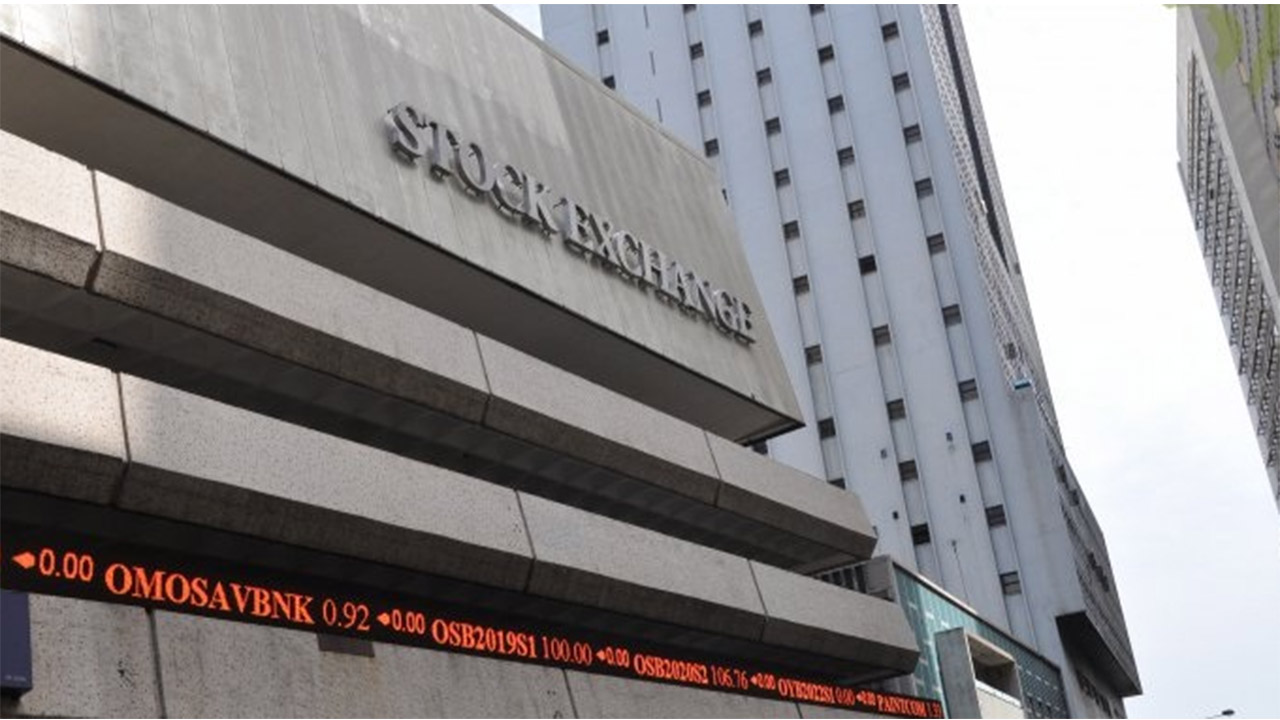
Local equities recorded a third consecutive growth on Monday to open the week positive after a 0.31 percent at the close of business.
This was boosted by buying interest in banking stocks led by Access Bank, which sold 37.8 million units worth N408.6 million, while Zenith Bank trailed with 35.0 million units valued at N790.4 million.
GTBank traded 33.6 million for N1.2 billion, FBN Holdings transacted 22.8 million shares worth N171.9 million, while UBA exchanged 18.1 million equities valued at N160.7 million.
However, on the gainers’ chart, Total Nigeria claimed the top spot after gaining N10 to finish at N117 per share, while MTN Nigeria rose by N1.70 to settle at N128.30 per unit.
BUA Cement appreciated by N1 to end at N37 per share, Cadbury Nigeria improved by 85 kobo to sell at N10.85 per unit, while NASCON increased by 70 kobo to quote at N15.70 pershare.
At the other side, Nestle Nigeria topped the losers’ table after losing N89.90 of its share value to trade at N1380 per unit, while Unilever Nigeria fell by 50 kobo to close at N18 per unit.
NCR Nigeria depreciated by 40 kobo to trade at N3.65 per share, Oando declined by 18 kobo to quote at N3.52 per unit, while International Breweries depreciated by 10 kobo to trade at N9 per share.
During the session, a total of 267.0 million shares worth N4.2 billion exchanged hands compared with the 325.0 million shares worth N3.6 billion traded last Friday by investors.
Also, the All-Share Index (ASI) increased by 92.04 points during the session to 29,710.56 points, while the market capitalisation appreciated by N47.4 billion to settle at N15.304 trillion.




By Adedapo Adesanya
President Bola Tinubu is seeking Senate approval for a significant upward review of the 2026 budget, proposing an additional N9 trillion to the Appropriation Bill.
The request, conveyed in a letter read on the Senate floor during plenary by the Senate President, Mr Godswill Akpabio, would increase the budget size from N58.47 trillion to N67.47 trillion.
According to the President, the proposed adjustment is aimed at strengthening fiscal transparency and ensuring more effective implementation of priority national programmes.
He said the increase will first address outstanding legal commitments carried over from previous appropriation cycles, preventing them from affecting the execution of the 2026 budget.
The proposal also seeks to consolidate existing government debt within the fiscal framework, while making provisions for a limited number of strategic and priority projects.
President Tinubu added that the revised financing plan is designed to preserve macro-fiscal stability and ease pressure on the domestic financial market.
The Senate is expected to consider the request in the coming days.
In December, the President presented the N58.47 trillion 2026 budget proposal to a joint session of the National Assembly, outlining the government’s priorities anchored on economic stability, infrastructure expansion, security and social investment.
The budget was hinged on assumptions including oil production of 1.84 million barrels per day, an oil price benchmark of $64.85 per barrel, and an exchange rate assumption of N1,400 to the Dollar.
Following the presentation, the Senate passed the appropriation bill for first and second readings, paving the way for detailed consideration by relevant committees.
By Adedapo Adesanya
The American Institute of CPAs (AICPA) and the Nigerian Capital Market Institute (NCMI), the educational and training arm of the Nigerian Securities and Exchange Commission (SEC), have collaborated to provide the Capital Market Operators (CMOs) in Nigeria with access to the Internal Control and Enterprise Risk Management Certificate programmes from the Committee of Sponsoring Organizations of the Treadway Commission (COSO).
COSO is a joint initiative of five leading accounting and finance bodies, including the AICPA. It is dedicated to advancing thought leadership in Enterprise Risk Management (ERM), Internal Control, and Fraud Deterrence.
The COSO Internal Control Certificate Programme offers finance professionals a unique opportunity to develop expertise in designing, implementing and monitoring a system of internal control in today’s technology-driven world. The COSO Enterprise Risk Management Certificate Programme offers finance professionals the unique opportunity to learn the concepts and principles of the updated ERM framework and be prepared to integrate it into their organisation’s strategy-setting process to drive business performance.
With access to COSO programmes, businesses in Nigeria can strengthen their governance frameworks by developing and maintaining effective internal controls and managing risks such as errors, fraud, and mismanagement. This not only protects organisational assets but also promotes business continuity and resilience.
According to Ms Ijeoma Anadozie, Country Director, Nigeria at the Association of International Certified Professional Accountants, the global alliance formed by AICPA and CIMA, the collaboration marks a significant step towards strengthening corporate governance and risk management across the country
“By leveraging these resources, companies in Nigeria will be better equipped to tighten internal controls, enhance the accuracy and transparency of financial reporting, and foster greater investor confidence. These improvements are not only vital for business resilience and profitability, but they also contribute meaningfully to the broader economic development and financial stability of our country,” she noted.
On his part, Mr Tunde Kamali, Managing Director at the Nigerian Capital Market Institute, said he is proud to collaborate with the American Institute of CPAs in expanding access to globally recognised COSO programmes for businesses across Nigeria.
“This initiative reflects our commitment to equipping market participants with the tools needed to navigate an increasingly complex and risky landscape,” he said.
According to Mr Kamali, by deepening knowledge in internal control and enterprise risk management, “we are empowering businesses to operate with greater integrity, accountability, and strategic foresight. This collaboration not only supports the advancement of our capital market ecosystem, but also reinforces Nigeria’s long‑term vision for sustainable economic growth and global competitiveness.”

By Aduragbemi Omiyale
Five stockbroking firms operating in the Nigerian capital market have been sanctioned for engaging in market infractions.
The affected companies, Meristem Stockbrokers Limited, CSL Stockbrokers Limited, Cowry Securities Limited, Associated Asset Managers Limited, and SMADAC Securities Limited, were fined a total of N291 million.
The Nigerian Exchange Regulation (NGX RegCo) Limited, which imposed the penalties on the stockbrokers, accused them of being involved in wash trades and self-matching transactions.
It was gathered that the culprits were investigated by the exchange’s panel, which uncovered repeated instances of improper trading practices such as artificial price formation and misleading market activity.
They have all been directed to undergo mandatory compliance and market conduct training.
Business Post learned from a notice to the Securities and Exchange Commission (SEC) that CSL Stockbrokers Limited was fined over N91 million, while the other four firms were each fined N50 million in line with provisions of the Investment and Securities Act 2025.
NGX RegCo noted that the penalties reflect the gravity of the breaches and were aimed at strengthening market discipline, deterring misconduct and preserving the integrity of the Nigerian capital market.
It further stated that the action reinforces its drive to ensure a fair, orderly and transparent trading environment, while bolstering investor confidence through stricter enforcement of market rules.
In accordance with the Memorandum and Articles of Association (MemArt) of the Exchange, the board of NGX Regco held a meeting on March 27, 2026, wherein it confirmed the decision of the RNBC to sanction the five trading license holder firms. These sanctions are commensurate to infractions and to serve as a deterrence to these violations,” a part of the notice read.
The action of RegCo came a few weeks after the price movement of a company on the NGX platform, Zichis Agro-Allied Industries Plc, was probed after gaining almost 900 per cent in one month.
Trading in the shares of the company was suspended for about a month and was only lifted on March 23, 2026, with its share price adjusted downward to N8.58 from N17.36.









-
 Feature/OPED6 years ago
Davos was Different this year
-
Travel/Tourism10 years ago
Lagos Seals Western Lodge Hotel In Ikorodu
-

 Showbiz3 years ago
Estranged Lover Releases Videos of Empress Njamah Bathing
-
 Banking8 years ago
Sort Codes of GTBank Branches in Nigeria
-

 Economy3 years ago
Subsidy Removal: CNG at N130 Per Litre Cheaper Than Petrol—IPMAN
-

 Banking3 years ago
Sort Codes of UBA Branches in Nigeria
-

 Banking3 years ago
First Bank Announces Planned Downtime
-

 Sports3 years ago
Highest Paid Nigerian Footballer – How Much Do Nigerian Footballers Earn