
Economy
Experts Provide Roadmap to Advance Nigeria’s Lubricant Market

By Adedapo Adesanya
As part of the efforts to address the influence of technological developments on the Nigerian lubricants industry, stakeholders gathered at the virtual 2022 Nigeria edition of the International Lubricants Conference (ILC) to share insights on global trends as well as practical suggestions to improve the state of the industry.
The ILC is a bi-annual conference organised to enlighten relevant stakeholders on key industry developments and advancements while connecting manufacturers with key stakeholders.
This year’s edition was held on April 28 and 29, 2022, and had in attendance Mr Taiye Williams, Managing Director of Lubcon Limited; Mr Indu M Gupta, Director for Product Research and Development, Innova Specialty Chemicals; Niket Shah, Director Openspace Services Pvt Ltd; Mrs Lilian Ikokwu, Chief Marketing Officer OVH Energy Marketing; Mr Roberto Vargas, Technical and Commercial Consultant for the Lubricant Industry in Latin America; Mr Godwin Gabriel-Ejeh, General Manager Operations, Pacegate Limited amongst others.
Although Nigeria’s lubricant market currently accounts for about 20 per cent of Africa’s total lubricant demand, the industry is still in its infancy. The adoption of innovative technological advancements, favourable regulations, increased stakeholder collaborations, and consumer education will boost performance strengthening the industry.
The conference themed Technology and its application to the lubricants industry featured panellists and speakers who shared insights on technological advancements in the lubricants industry, the influence of digital technology on the lubricant industry value chain, global regulatory changes as well as an analysis of the raw material supply chain and logistics in Nigeria.
Commenting on the impact of the conference, Mr Williams, the keynote speaker, commended the organisers, noting how insights shared will affect the decisions of stakeholders.
He further commented on the technology and its application to the lubricants industry, noting that, “As manufacturers push the boundaries of engine development, the pursuit of performance has placed new demands on the lubricants required by modern machines.
“With the application of technology, the lubricant industry will produce top quality products, build the capacity of the industry and increase output for Nigeria to remain relevant in the lubricant market.”
Speaking at the conference, Mrs Lilian Ikokwu, the Chief Marketing Officer, OVH Energy Marketing, she said technology is a tool to curb the proliferation of substandard lubricants in Nigeria.
“75 per cent of the lubricants consumed in this country is produced locally which is encouraging. We do hope that in a very few years we would do 100 per cent of what we produce. Out of the 25 per cent being imported, 64 per cent of that volume is substandard. In total, we have 70 per cent of Total Lubes consumed in Nigeria being substandard,” she said.
On his part, Mr Godwin Ejeh, the General Manager, Operations for Pacegate Limited, who spoke on Evolve, Adipro’s CSR said, “the vision of Evolve is to educate the girl child by providing school supplies, thereby giving back to the community. This initiative was birthed from two of the studies ranked 6th (educating women) and 7th (Family Planning) out of 100 in making an impact on reducing the CO2 emissions in the atmosphere.”
One of the panellists, Mr Franklin Oranusih, General Manager, Sales and Technical, Pacegate Energy and Resources Limited, addressed the presence and causes of adulterated lubricants in the market.
He said “the reason for having substandard lubricants is not farfetched. Most of the blenders present in Nigeria do not put many factors into consideration during the product formulation process.”
He concluded that with an understanding of the right proportions of components, blenders will produce standard lubricants for the Nigerian market.
This edition of the programme also recognised outstanding industry players with the presentation of awards. The 2022 ILC Prime Player award was presented to Ammasco International Limited for the second time in a row, Total Energies also received the 2022 ILC Impact Award, Bestaf Trading was awarded the 2022 ILC Best Production Technology while Seahorse Lubricants was awarded the 2022 ILC Quality award.
The ILC, being one of the largest lubricant conferences held annually in Nigeria, continues to offer industry professionals the valuable opportunity to develop long-lasting business partnerships and learn about the latest advancements, challenges, and opportunities within the sector.
The South Africa Edition of the ILC will be taking place on November 17 and 18, 2022, and will attract stakeholders across the world to drive conversations and topical issues in the lubricants industry.


By Adedapo Adesanya
Crude oil plummeted on Wednesday on hopes of the reopening of the Strait of Hormuz after US President Donald Trump agreed to a two-week ceasefire with Iran.
Brent crude futures moderated to $94.75 a barrel, while the US West Texas Intermediate (WTI) crude eased to $94.41 a barrel.
President Trump said on Wednesday that the US will work closely with Iran and will be talking about tariff and sanctions relief with Iran.
However, analysts cautioned that the ceasefire is a temporary two-week reprieve rather than a permanent resolution, and the global energy system remains fragile due to structural damage to regional infrastructure.
Reuters reported that Iran could open the strait in a limited and controlled way on Thursday or Friday ahead of a meeting between U.S. and Iranian officials in Pakistan.
Agence France-Presse (AFP) reported that two ships appeared to have transited the Strait of Hormuz since the US-Iran ceasefire deal. A Greek-owned bulk carrier and a Liberia-flagged vessel both transited the waterway early on Wednesday.
Meanwhile, Israel carried out its heaviest strikes on Lebanon since the conflict with Hezbollah broke out last month, even as the Iran-aligned group paused attacks on northern Israel and Israeli troops in Lebanon under the ceasefire.
Also, Saudi Arabia’s East-West Pipeline, a critical artery bypassing the Strait of Hormuz, was reportedly hit in an Iranian drone attack. Prior to the attack, the pipeline was pumping at its emergency capacity of 7 million barrels per day to bypass the shuttered strait.
The strikes occurred just hours after a US-Iran ceasefire announcement, which has so far failed to halt regional hostilities. Other facilities in the kingdom were also targeted in the wave of strikes, which the Islamic Revolutionary Guard Corps (IRGC) claimed included oil facilities owned by American companies in Yanbu.
US crude stocks rose by 3.1 million barrels to 464.7 million barrels during the week ended April 3, the Energy Information Administration (EIA) said.

By Adedapo Adesanya
The National Insurance Commission has issued new guidelines for the collection, management, and administration of the Insurance Policyholders’ Protection Fund.
In a circular issued to all insurance institutions on Tuesday, the regulator also set May 31, 2026, as the deadline for insurers to submit their assessment returns for the 2025 financial year.
Recall that on August 5, 2025, President Bola Tinubu signed into law the Nigerian Insurance Industry Reform Act ( NIIRA 2025).
This landmark legislation repeals the Insurance Act 2003, and consolidates related provisions, ushering in a modern regulatory framework. It lays a strong foundation for sustainable growth and increased investment in the country’s insurance sector.
The commission said the guidelines were issued in exercise of its powers under the 2025 Act and other existing insurance laws and regulations to provide regulatory clarity, improve guidance, and ensure ease of compliance across the industry.
According to NAICOM, the guidelines establish a comprehensive structure for the operation of the IPPF, which serves as a statutory safety net to protect insurance policyholders in the event of distress or insolvency of a licensed insurer or reinsurer. The framework also provides direction on the reimbursement of loans by insurers and reinsurers.
NAICOM stated, “The guidelines ensure regulatory clarity, guidance and ease of compliance, as it provides a comprehensive regulatory framework for the collection, management, and administration of the Fund, which serves as a statutory safety net designed to protect insurance policyholders against distress and insolvency of a licensed insurer or reinsurer, including guidance for the reimbursement of loans by an insurer or reinsurer.
“Please be informed that the IPPF Assessment Returns in respect of the year 2025 shall be submitted to the Commission not later than 31st May 2026, while subsequent submissions shall be in line with Section 4.3 of the Guideline on Insurance Policyholders Protection Fund.”
By Adedapo Adesanya
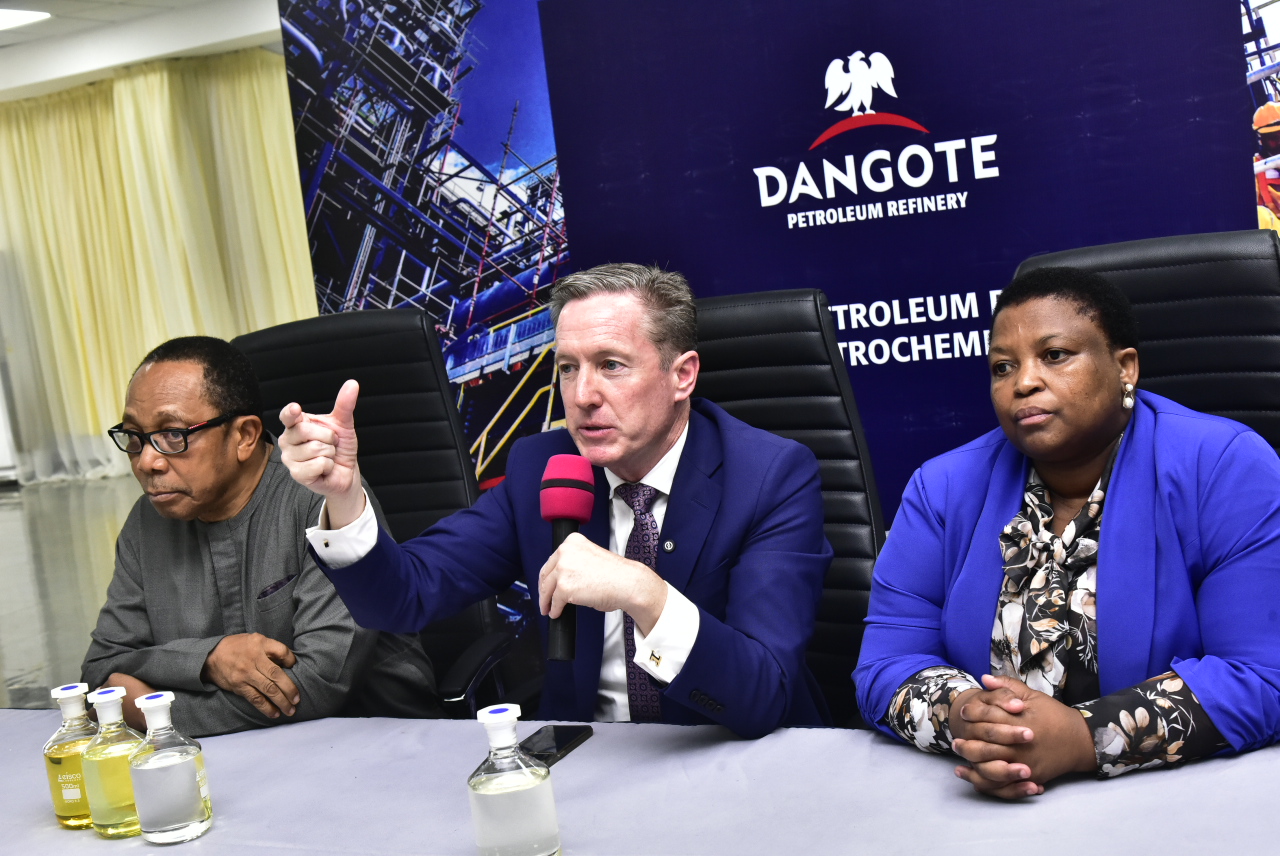
The Dangote Refinery on Wednesday returned the petrol price to N1,200 per litre, less than 24 hours after it increased it by 5 per cent.
The private refinery had raised the ex-depot price by N75 on Tuesday, citing pressure from volatile global oil markets, but quickly brought it back to N1,200 per litre from N1,275 per litre.
The swift downward review is directly linked to a sharp drop in international crude prices. Brent crude has plunged to $95.05 per barrel, after a 13 per cent decline, while the US West Texas Intermediate (WTI) crude closed at $97.18, recording nearly a 14 per cent drop.
This development comes after US President Donald Trump announced a conditional two-week ceasefire with Iran, which eased fears of immediate supply disruptions in the global oil market.
“This will be a double-sided CEASEFIRE!” Trump said on social media, marking a sharp reversal from his earlier warning that “a whole civilisation will die tonight” if Iran failed to comply with US demands.
Iran’s Foreign Minister, Mr Abbas Araqchi, confirmed that the country would halt attacks provided strikes against Iran cease and transit through the Strait of Hormuz is coordinated by Iranian forces.
Despite the breakthrough, tensions remain elevated across the region, with several Gulf states reporting missile launches, drone activity, or issuing civil defence warnings.
While oil prices have fallen back below $100, they remain significantly elevated after surging by a record amount in March. Market analysts noted that regardless of how successful the ceasefire is, geopolitical risk related to the Strait of Hormuz is likely to remain elevated for the foreseeable future under the control of Iran.
-
 Feature/OPED6 years ago
Davos was Different this year
-
Travel/Tourism10 years ago
Lagos Seals Western Lodge Hotel In Ikorodu
-

 Showbiz3 years ago
Estranged Lover Releases Videos of Empress Njamah Bathing
-
 Banking8 years ago
Sort Codes of GTBank Branches in Nigeria
-

 Economy3 years ago
Subsidy Removal: CNG at N130 Per Litre Cheaper Than Petrol—IPMAN
-

 Banking3 years ago
Sort Codes of UBA Branches in Nigeria
-

 Banking3 years ago
First Bank Announces Planned Downtime
-

 Sports3 years ago
Highest Paid Nigerian Footballer – How Much Do Nigerian Footballers Earn