Economy
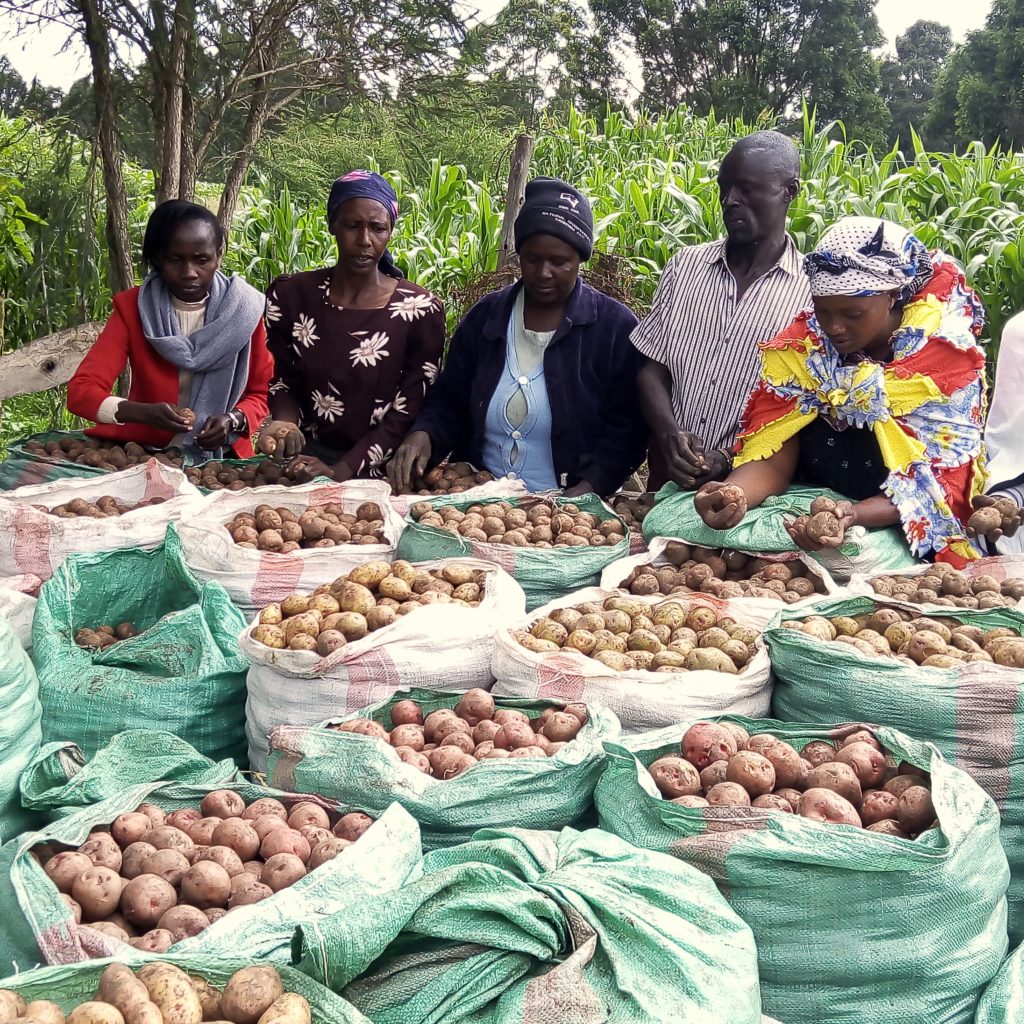
FG Charges Researchers on Potato Value Chain
By Adedapo Adesanya
The federal government, through the Ministry of Agriculture and Rural Development, has tasked research institutes, agencies and development partners in the sector to create solutions to the numerous challenges besetting the country’s potato value chain.
The Minister of Agriculture and Rural Development, Mr Sabo Nanono, gave this charge in his address during a workshop with potato value chain stakeholders in Osogbo, Osun State.
The event was on the adoption and utilisation of Orange Fleshed Sweet Potato (OFSP) and he said new technologies and innovations should be developed to further improve production.
Mr Nanono, who was represented by the Director of the Federal Department of Agriculture, Mrs Karima Babangida, said that OFSP has both economic and health benefits to Nigerians.
He said, “It has come to the knowledge of the Ministry the immense Wealth and Health benefits in Potato production, especially Orange Fleshed Sweet Potato (OFSP) and as such the Ministry is willing to explore these opportunities within the Value Chain in furtherance to achieving food nutrition and security for our beloved country.
“The primary objective of convening this stakeholder workshop is to create a forum for the stakeholders/major actors in the Potato Value Chain to chart a way forward for the realization of the fullest potentials locked up in potato production, processing/utilization and marketing.”
Mr Nanono added that the potato value chain has been facing many challenges right from the seed system stage.
“Several challenges have been identified in the potato value chain; right from the seed system protocols to the marketing of the produce.
“The challenges are quite enormous, but however, not one that is insurmountable. Therefore, all hands must be on deck to achieving this feat. There is no formal seed system for Potato, and it’s been a major drawback in the development of the Value Chain in the country.
“In achieving the above, please be informed that the Ministry is willing to contribute to the development of the Potato Value Chain through its various Agencies and Research institutes with mandates on rendering technical support.
“The Ministry has quite a number of support services that farmers and processors can benefit from. Farm inputs such as; agro-chemicals, farm equipment and machinery) are available at subsidized rates at the Ministry.
“I want to use this medium to urge the various Research Institutes, Agencies and Development partners with mandates on the Potato to work assiduously in creating solutions to the numerous challenges besetting the Value Chain, as well as new technologies and innovations to further improve production,” the Minister stated.
The Minister, while informing the participants at the workshop held on Thursday, April 1, said that the Ministry had earlier convened two regional meetings on Sweet potato in the South-South, Calabar, Cross River State and North-East, Yola, Adamawa State.
He noted that a sensitization meeting would be held in three geopolitical zones of the country, that is the (North-West, North-Central and South-East) regions respectively before convening a National Stakeholders workshop in no distant future.
Mr Nanono charged the ADP’s and the various Potato Commodity Association/Farmers to embrace new innovations such as; the Farmers Business School (FBS); Cooperative Business School (CBS); and Good Agricultural Practices (GAP) to improve their all-round farming activities as a means to strengthen their capacity in production and marketing.
In his remarks, the Ministry’s state director, Engr. Atoyebi O. Sunday, said that asides from the wealth potentials of processing OFSP into various confectioneries such as Chin-chin, juice, biscuits, cake, flour, bread among others, its health benefits cannot be overemphasized.
Mr Sunday said that OFSP is known to have enough nutritional values to supply the vitamin A requirement for children between the ages of 6 months to five years, support pregnant and lactating mothers and also help boost the immune system of the elderly.
He said, “The purpose of this meeting is to provide solutions to many challenges facing the popularization and adoption of the OFSP among the Nigerian farmers and processors nationwide.
“With this, I believe the resolutions of this meeting will help the Federal Ministry of Agriculture to plan adequately for ways of supporting potato farmers and processors nationwide.
“In view of the above, it is expedient for all of us to make use of this opportunity to cross-fertilize ideas and offer suggestions that will help in changing the narratives of low adoption and utilization of OFSP in Nigeria and also based on the information and knowledge gathered from the workshops; become an advocate of OFSP in our various communities and states.”
Economy
Investors Eye Investment Opportunities in Dangote Refinery
By Aduragbemi Omiyale
The planned listing of the Dangote Petroleum Refinery & Petrochemicals on the Nigerian Exchange (NGX) Limited is already attracting interest from South African investors and others.
The leadership of South Africa’s Government Employees Pension Fund (GEPF), alongside the Public Investment Corporation and Alterra Capital Partners, were recently at the Lagos-based facility.
The chairperson of GEPF, Mr Frans Baleni, said that the refinery stands as evidence that Africa can execute transformational infrastructure projects when backed by visionary leadership, long-term investment and strong technical expertise.
According to him, the significance of the project extends well beyond Nigeria’s borders, noting that it should reshape how Africa thinks about itself.
“The Dangote Refinery and Petrochemicals Complex is a powerful demonstration that, with visionary leadership and long-term capital, that perception no longer holds. This is the kind of African-led industrial scale that institutional investors on this continent should be backing,” he said.
Also speaking, the chief executive of PIC, Mr Patrick Dlamini, described the refinery as one of the most transformative industrial projects undertaken on the continent, saying it is reshaping global perceptions about Africa’s industrial capabilities and economic potential.
He said PIC, which manages about $230 billion in assets largely on behalf of South Africa’s Government Employees Pension Fund, is actively seeking long-term partnerships aligned with infrastructure development, industrialisation and economic transformation across Africa.
“There is real strategic alignment between Dangote’s industrial agenda and how we are positioning our portfolio, and we look forward to exploring meaningful avenues for collaboration,” he stated.
While receiving his visitors, the chief executive of Dangote Group, Mr Aliko Dangote, said the proposed listing is designed to democratise wealth creation and give Africans direct access to participate in the continent’s industrial transformation.
“We are opening the doors for investors to participate directly in Africa’s industrial future and the prosperity it will create,” Mr Dangote said, adding that the refinery project reflects the scale of untapped opportunities within Africa’s energy market, particularly as most countries on the continent remain dependent on imported refined petroleum products despite growing industrial demand and rising consumption.
The billionaire industrialist noted that demand for products such as polypropylene, aviation fuel and refined petroleum products has exceeded earlier projections, reinforcing the commercial viability of the refinery and shaping future expansion plans.
Economy
Nigeria’s Oil Exploration Declines 41.7% as Rig Counts Falls to 12 in April
By Adedapo Adesanya
Nigeria’s oil exploration and drilling activities declined by 41.7 per cent in April 2026, following reduced upstream operations and investment activities.
According to the May 2026 Monthly Oil Market Report (MOMR) of the Organisation of the Petroleum Exporting Countries (OPEC), Nigeria’s rig count, a major indicator of upstream oil and gas activities, dropped to 12 in April 2026 from 17 recorded in March 2026.
The decline came amid persistent upstream investment and operational challenges, according to the latest monthly report released by OPEC.
Earlier data contained in the May 2026 edition of the MOMR also showed that Nigeria’s average rig count declined to 13 in 2025 from 15 recorded in 2024, indicating reduced exploration and drilling activities in the upstream petroleum sector.
The report showed that Nigeria’s rig count fell by five rigs month-on-month, from 17 rigs in March 2026 to 12 rigs in April 2026.
Rig count is widely regarded in the petroleum industry as a key indicator of exploration, field development and investment activities.
The decline comes despite ongoing efforts by the Nigerian government and industry operators to raise crude oil production, boost reserves and attract fresh upstream investments under the Petroleum Industry Act (PIA)
Nigeria’s performance contrasted with the broader African trend, where total rig count increased marginally from 42 in March 2026 to 48 in April 2026.
However, Nigeria accounted for a significant share of the continent’s decline in operational rigs during the period.
Within OPEC, Nigeria remained behind major producers such as Saudi Arabia, which recorded 265 rigs in April 2026, the United Arab Emirates with 66 rigs, and Iraq with 19 rigs.
The development also comes at a time when Nigeria is struggling to meet its crude oil production quota allocated by OPEC consistently.
Economy
Nigeria’s Central Bank Holds Rate at 26.50% Despite Heightened Disruptions
By Adedapo Adesanya
The Monetary Policy Committee (MPC) of the Central Bank of Nigeria (CBN) has retained the headline interest rate, the Monetary Policy Rate (MPR), at 26.50 per cent.
This was disclosed by the Governor of Nigeria’s central bank, Mr Yemi Cardoso, on Wednesday, after the conclusion of the MPC meeting. He noted that the decision was hinged on Nigeria being largely insulated from external shocks relating to developments in the Middle East.
He also acknowledged that inflation and exchange rate stability were put into consideration during the two-day meeting.
The committee reduced the benchmark interest rate by 50 basis points from 27.0 per cent to 26.5 per cent at its 304th MPC gathering in February.
Nigeria’s inflation rose to 15.69 per cent in April 2026, affected by the fallout from the Iran war, which continued to impact the global economy. Noting that year-on-year, the figures show a moderation rather than worry.
The headline inflation rate for April on a month-on-month basis was 2.13 per cent, while the food inflation rate in the review month was 16.06 per cent on a year-on-year basis.
Mr Cardoso noted that the Cash Reserve Ratio (CRR) was also retained at 45 per cent for commercial Banks, 16 per cent for Merchant Banks, and 75 per cent for non-TSA public sector deposits.
He added that the Standing Facilities Corridor was also held flat at +50 / -450 basis points around the MPR.
-
Feature/OPED6 years agoDavos was Different this year
-
Travel/Tourism10 years ago
Lagos Seals Western Lodge Hotel In Ikorodu
-
Showbiz3 years agoEstranged Lover Releases Videos of Empress Njamah Bathing
-
Banking8 years agoSort Codes of GTBank Branches in Nigeria
-
Economy3 years agoSubsidy Removal: CNG at N130 Per Litre Cheaper Than Petrol—IPMAN
-
Banking3 years agoSort Codes of UBA Branches in Nigeria
-
Banking3 years agoFirst Bank Announces Planned Downtime
-
Sports3 years agoHighest Paid Nigerian Footballer – How Much Do Nigerian Footballers Earn