
Economy
Investors Trade N20bn Shares in One Week as Index Sheds 4.59%

By Dipo Olowookere
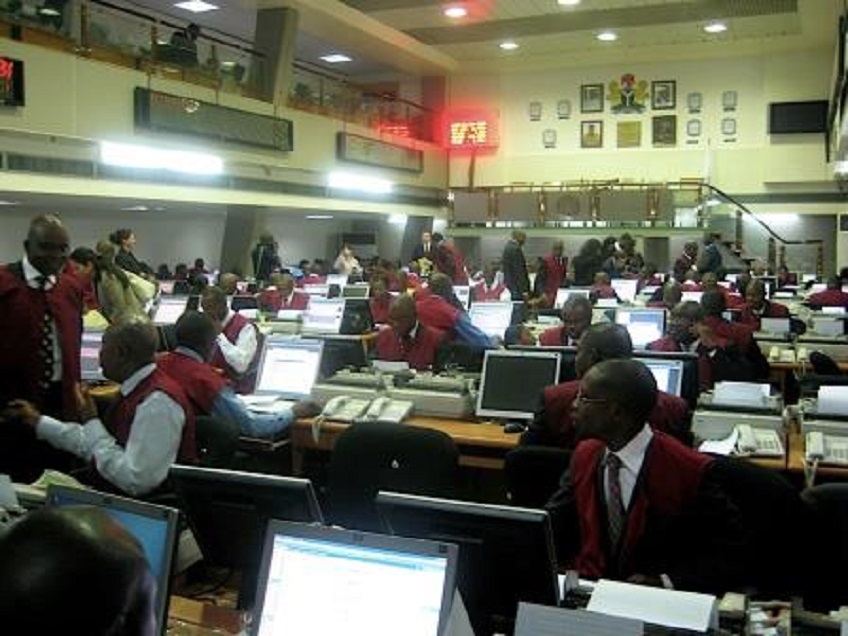
A total turnover of 3.544 billion shares worth N20.264 billion in 19,130 deals were traded last week by investors on the floor of the Nigerian Stock Exchange (NSE) in contrast to a total of 2.629 billion shares valued at N12.794 billion that exchanged hands the previous week in 15,558 deals.
In the week, the financial services sector, measured by volume, led the activity chart with 3.060 billion shares valued at N14.469 billion traded in 11,738 deals.
With this, the sector contributed 86.35 percent and 71.40 percent to the total equity turnover volume and value respectively.
Following were the ICT industry with 253.633 million shares worth N53.707 million in 277deals and the consumer goods industry with a turnover of 65.499 million shares worth N4.356 billion in 2,732 deals.
Trading in Wema Bank, Sterling Bank and Chams accounted for 2.104 billion shares worth N2.026 billion in 965 deals, contributing 59.38 percent and 10.00 percent to the total equity turnover volume and value respectively.
A total of 14 equities appreciated in price during the week, lower than 21 in the previous week, while 55 equities depreciated in price, higher than 36 equities of the previous week, with 98 equities unchanged, lower than 111 equities recorded in the preceding week.
Ikeja Hotels led the gainers’ chart with 20.21 percent growth, with Chams rising by 20 percent, Sovereign Trust Insurance by 15 percent, First Aluminium Nigeria by 10 percent and Berger Paints by 9.70 percent.
At the other side, Eterna topped the losers’ log with 24.53 percent drop, with Union Diagnostic % Clinical Services depreciating by 23.33 percent, UBA fell by 19.48 percent, Beta Glass went down by 18.90 percent, while Neimeth International Pharmaceutical declined by 17.74 percent.
During the week, while the All-Share Index (ASI) depreciated by 4.59 percent to close at 29,616.38 points, the market capitalisation shed 4.69 percent to settle at N11.124 trillion.
In a related development, data from the NSE showed that no Exchange Traded Products (ETPs) were traded during the week compared with a total of 85,775 units valued at N1.187 million transacted a week earlier in 22 deals.
However, a total of 18,042 units of Federal Government Bonds valued at N19.685 million were traded in the week in 24 deals in contrast to 3,453 units valued at N3.565 million transacted the preceding week in 24 deals.




By Aduragbemi Omiyale
Over 200 secondary school students from Covenant Child Academy, Testimony College, and Green Pastures High School were recently introduced to the fundamentals of financial literacy, capital markets, and responsible investing, offering early exposure to wealth-building principles by the Nigerian Exchange (NGX) Limited.
It was part of Customs Street’s week-long programme to commemorate Global Money Week 2026, themed Smart Money Talks.
The bourse joined the global community to celebrate the week as part of its commitment to advancing financial literacy and equipping the next generation of investors.
The students, who underwent the seminar under the NGX’s flagship X-Tour initiative, were guided by representatives from NGX and NGX Regulation on key considerations before investing, as well as common warning signs to watch for when evaluating investment opportunities.
The session reinforced the importance of cultivating positive money habits to support sound financial decisions in the future.
Extending its impact beyond in-person engagement, the exchange also convened an interactive Instagram Live session in collaboration with United Capital Plc.
Featuring Stanley Onuorah, widely known as Online Banker, the session focused on Building a Portfolio in Today’s Markets. It addressed pressing questions from young Nigerians on navigating the capital market, understanding available investment products, and making informed financial choices.
During the session, a representative from NGX’s Trading and Products division shared practical insights into the range of instruments available in the market, including equities, fixed income securities, and exchange-traded funds, while outlining clear pathways for getting started and building resilient portfolios across varying market conditions.
In parallel, a representative from Market Regulation emphasised the importance of investor protection frameworks, educating participants on their rights, the safeguards that ensure fair market practices, and the necessity of due diligence in sustaining trust and integrity within the market.
The session has since attracted thousands of views, significantly amplifying awareness around financial literacy and encouraging greater youth participation in the capital market.
Through these initiatives, NGX continues to play a pivotal role in shaping financially responsible citizens, in line with its broader mandate to drive inclusive growth and strengthen investor confidence within Nigeria’s financial ecosystem.


By Adedapo Adesanya
The NASD Over-the-Counter (OTC) Securities Exchange declined by 2.14 per cent on Monday, March 30, weakening the Unlisted Security Index (NSI) by 89.95 points to 4,109.74 points from 4,199.69 points.
During the session, investors lost N53.82 billion, leaving the market capitalisation of the trading platform at N2.458 trillion versus the previous session’s N2.512 trillion.
The bourse recorded four price gainers and four price losers led by 11 Plc, which shed N35.12 to close at N316.50 per share compared with last Friday’s value of N351.17 per share. MRS Oil Plc declined by N20.00 to quote at N190.00 per unit versus the previous price of N21o.00 per unit, FrieslandCampina Wamco Nigeria Plc dropped N11.00 to trade at N99.00 per share versus N110.00 per share, and Central Securities Clearing System (CSCS) Plc dipped N2.93 to N77.17 per unit from N80.10 per unit.
Conversely, IPWA Plc appreciated by 55 Kobo to N6.06 per share from N5.51 per share, Industrial and General Insurance (IGI) Plc expanded by 5 Kobo to 57 Kobo per unit from 52 Kobo per unit, Geo-Fluids Plc gained 4 Kobo to close at N3.22 per share versus N3.18 per share, and Acorn Petroleum Plc improved by 1 Kobo to N1.34 per unit from N1.33 per unit.
Trading data revealed a decline of 63.7 per cent in the volume of securities to 21.3 million units from 58.6 million units, a 59.6 per cent drop in the value of securities to N651.1 million from N1.6 billion, and a 24 per cent contraction in the number of deals to 38 deals from 50 deals.
The most active stock by value on a year-to-date basis was CSCS Plc with 56.3 million units exchanged for N3.8 billion, trailed by Okitipupa Plc with 27.5 million units traded for N1.8 billion, and Infrastructure Guarantee Credit Plc with 400 million units valued at N1.2 billion.
Resourcery Plc was the most traded stock by volume on a year-to-date basis with 1.1 billion units worth N415.7 million, followed by Infrastructure Guarantee Credit Plc with 400 million units sold for N1.2 billion, and Geo-Fluids Plc with 133.1 million units transacted for N511.2 million.
By Dipo Olowookere
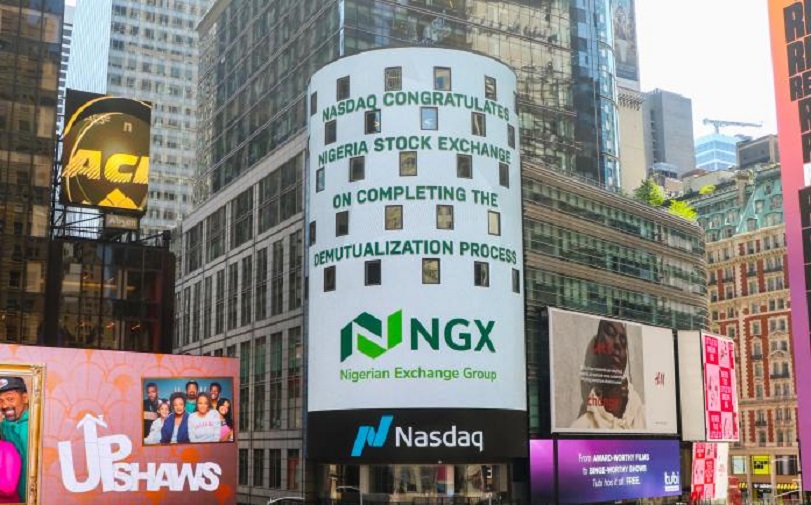
The Nigerian Exchange (NGX) Limited began the new week bearish after it shed 0.21 per cent on Monday due to profit-taking.
Business Post reports that four of the five key sectors of Customs Street tracked pointed southwards yesterday, as only the energy index gained 0.10 per cent.
The insurance counter lost 1.38 per cent, the banking space depreciated by 0.81 per cent, the industrial goods sector weakened by 0.45 per cent, and the consumer goods segment declined by 0.02 per cent.
As a result, the All-Share Index (ASI) retreated by 428.63 points to 200,484.43 points from 200,913.06 points, and the market capitalisation moderated by N275 billion to N128.694 trillion from N128.969 trillion.
The market breadth index was negative during the session, as there were 27 price gainers and 34 price losers, representing weak investor sentiment.
Secure Electronic Technology depreciated by 10.00 per cent to N1.17, May and Baker slumped by 9.42 per cent to N38.00, Legend Internet tumbled by 8.67 per cent to N6.85, Cutix shrank by 8.29 per cent to N3.21, and Fortis Global Insurance lost 7.97 per cent to trade at N1.27.
On the flip side, Austin Laz appreciated by 9.98 per cent to N4.41, Zichis gained 9.93 per cent to quote at N15.16, Trans Nationwide Express soared by 9.65 per cent to N2.84, The Initiates advanced by 9.60 per cent to N21.70, and Learn Africa improved by 9.41 per cent to N9.30.
The bourse closed with a turnover of 593.3 million shares valued at N25.7 billion executed in 60,311 deals compared with the 595.2 million shares worth N24.5 billion traded in 43,440 deals in the previous trading day.
This showed that the value of transactions went up by 4.90 per cent, the number of deals increased by 38.84 per cent, and the volume of trades decreased by 0.32 per cent.
Access Holdings finished the session as the most active with 86.6 million units sold for N2.3 billion, First Holdco exchanged 84.6 million units worth N4.3 billion, Secure Electronic Technology traded 31.1 million units valued at N37.4 million, Fidelity Bank transacted 26.7 million units worth N512.4 million, and Zenith Bank traded 26.1 million units valued at N2.6 billion.










-
 Feature/OPED6 years ago
Davos was Different this year
-
Travel/Tourism10 years ago
Lagos Seals Western Lodge Hotel In Ikorodu
-

 Showbiz3 years ago
Estranged Lover Releases Videos of Empress Njamah Bathing
-
 Banking8 years ago
Sort Codes of GTBank Branches in Nigeria
-

 Economy3 years ago
Subsidy Removal: CNG at N130 Per Litre Cheaper Than Petrol—IPMAN
-

 Banking3 years ago
Sort Codes of UBA Branches in Nigeria
-

 Banking3 years ago
First Bank Announces Planned Downtime
-

 Sports3 years ago
Highest Paid Nigerian Footballer – How Much Do Nigerian Footballers Earn