
Economy
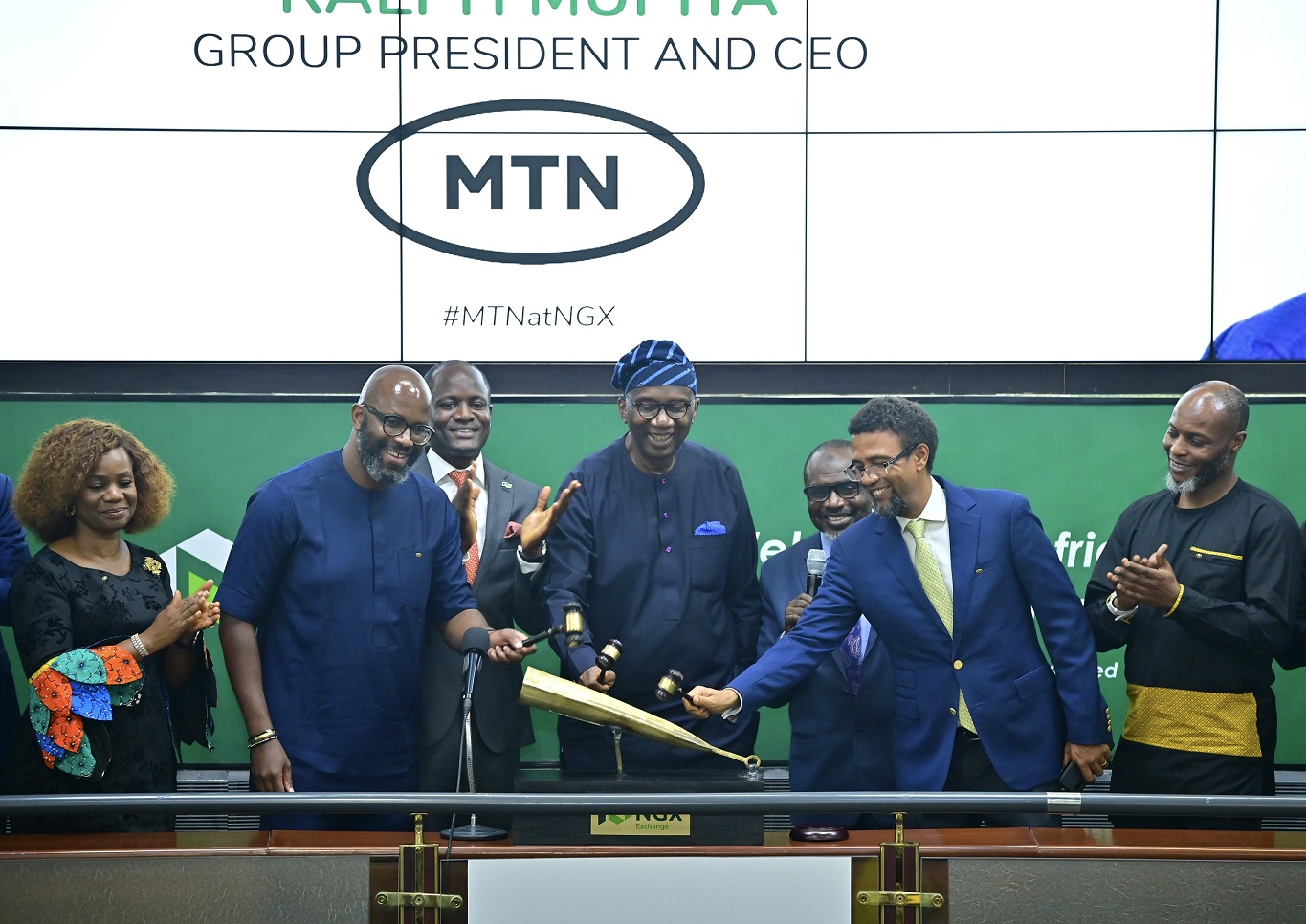
NGX Gains 0.49% as Geregu, MTN Attract Dividend Investors

By Dipo Olowookere
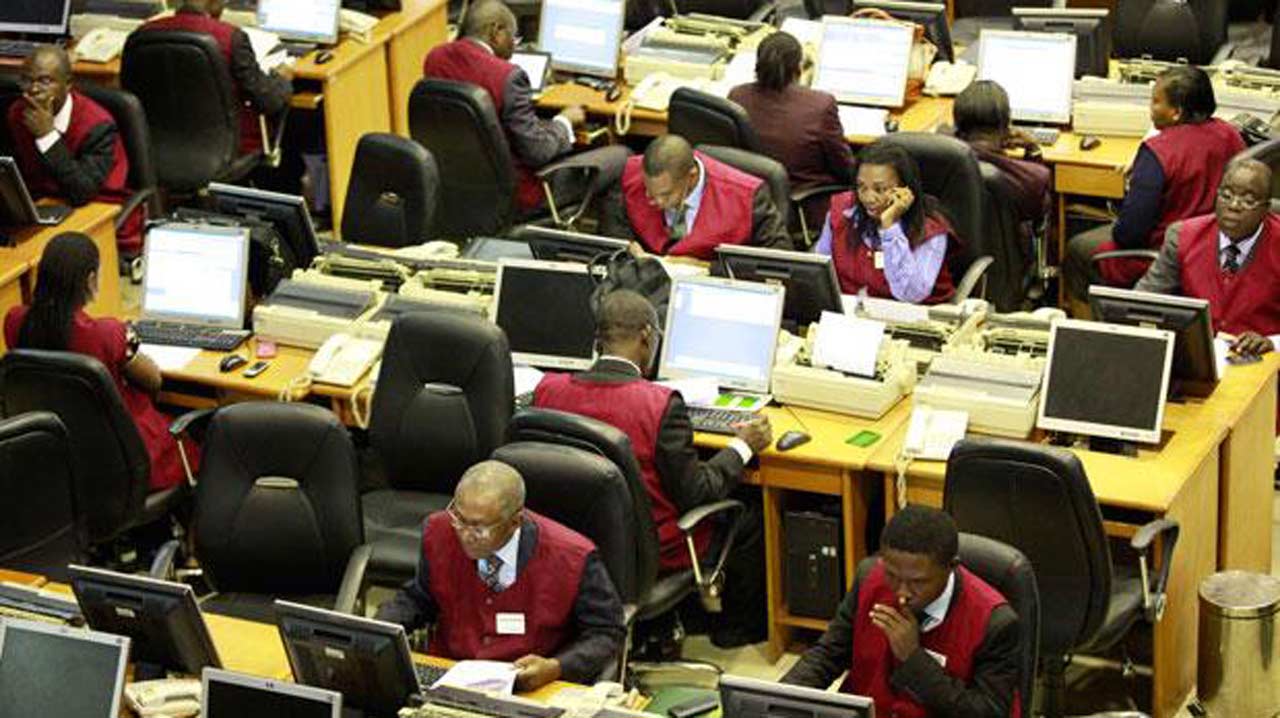
The bulls cemented their dominance on the Nigerian Exchange (NGX) Limited on Wednesday amid sustained buying interests in local equities.
Impressive corporate earnings bolstered the bourse further by 0.49 per cent at the close of transactions yesterday, with investors mopping up shares in the energy and banking sectors, especially Geregu Power and MTN Nigeria, which declared dividends.
An analysis of the market data showed that the energy index rose by 3.61 per cent, as the banking counter appreciated by 1.22 per cent, offsetting the 1.34 per cent loss, the 0.11 per cent decline and the 0.02 per cent fall printed by the insurance, the consumer goods and the industrial goods, respectively.
As a result, the All-Share Index (ASI) gained 261.01 points to close at 53,499.68 points compared with the previous day’s 53,238.67 points, and the market capitalisation grew by N142 billion to N29.140 trillion from N28.998 trillion.
This was influenced by the 10.00 per cent rise in the prices of Seplat and Industrial and Medical Gases, closing at N1210.00 and N7.70, respectively. Northern Nigerian Flour Mills rose by 9.46 per cent to N8.10, International Energy Insurance appreciated by 9.33 per cent to 82 Kobo, and NAHCO jumped by 9.26 per cent to N8.85.
On the flip side, Guinness Nigeria dropped 10.00 per cent to trade at N63.00, Ardova lost 9.95 per cent to settle at N17.20, Academy Press fell by 9.85 per cent to N1.19, RT Briscoe shed 9.68 per cent to 28 Kobo, and Cornerstone Insurance declined 8.33 per cent to finish at 55 Kobo.
Business Post reports that the market breadth was flat yesterday because the price gainers and losers’ charts recorded 20 members each.
However, the level of activity dropped in the midweek session as the trading volume, value, and the number of deals decreased by 19.90 per cent, 6.78 per cent, and 14.14 per cent apiece.
A total of 200.4 million equities worth N5.5 billion exchanged hands in 3,716 deals during the session as against the 250.2 million equities worth N5.9 billion transacted in 4,328 deals on Tuesday.
For the second straight day, Universal Insurance topped the activity chart after it traded 57.8 million shares and was trailed by GTCO, which transacted 16.6 million stocks. UBA sold 11.2 million shares, Transcorp traded 8.8 million equities, and Geregu Power transacted 8.5 million stocks.






By Adedapo Adesanya
Oil prices were mixed on Tuesday after reports that the United States had sent Iran a 15-point plan to end the war in the Middle East.
Brent futures went down by $0.83 or 0.9 per cent to $99.11 a barrel, while the US West Texas Intermediate climbed $4.22 or 4.79 per cent to $92.35 per barrel.
President Donald Trump said on Tuesday that the US and Iran were “in negotiations right now” and suggested Tehran was eager to make a peace deal, even as the Islamic Republic denied it’s in direct talks with America.
President Trump, speaking in the Oval Office, said he decided to back off from his recent threat to order strikes on Iranian energy infrastructure
According to reports, the plan includes a one-month ceasefire to be announced, according to a mechanism that US Middle East envoys Steve Witkoff and Jared Kushner are working on.
The Strait of Hormuz was handling about 20 per cent of global seaborne oil supplies until the war broke out, before Iran virtually stopped flows via the critical waterway. With around a fifth of the world’s daily oil supply cut off by the Middle East war, prices are still more than 40 per cent higher than they were when the conflict erupted in late February.
The United Arab Emirates (UAE), which has seen its liquified natural gas (LNG) and most oil supply choked at the vital chokepoint, said Iran’s weaponisation of the energy and trade flows amounts to economic terrorism against every nation in the world.
Since the US-Israel strikes on Iran began on February 28, the daily traffic of over 100 vessels, including tankers, through the Strait of Hormuz, has slowed to a trickle of a handful of passages per week, all cargoes apparently approved for transit by Iran.
Iranian state media said that Iran would permit safe transit through the strait, except for ships associated with its “enemies.”
Amid the messaging clash between the US and Iran on negotiations, multiple outlets have reported that regional leaders are engaged in behind-the-scenes diplomatic efforts to help broker an end to the war.
The American Petroleum Institute (API) estimated that crude oil inventories in the US rose by 2.3 million barrels in the week ending March 20. Official data from the Energy Information Administration (EIA) will be released later on Wednesday.
By Dipo Olowookere
The bulls rescued the Nigerian Exchange (NGX) Limited from the bears on Tuesday amid cherry-picking of shares with sound fundamentals.
Data showed that the bourse closed higher by 0.85 per cent during the trading day, influenced by bargain-hunting activities by investors.
Business Post reports that Airtel Africa led the gainers’ chart yesterday after it rose by 10.00 per cent to N2,497.00, Consolidated Hallmark increased by 10.00 per cent to N4.95, John Holt gained 10.00 per cent to close at N14.30, Legend Internet also surged by 10.00 per cent to N6.60, and Zichis appreciated by 9.97 per cent to N10.37.
On the flip side, NPF Microfinance Bank lost 6.29 per cent to trade at N6.56, Royal Exchange depreciated by 5.32 per cent to N1.78, CWG crashed by 4.82 per cent to N20.75, Veritas Kapital went down by 4.21 per cent to N2.05, and UPDC slipped by 3.88 per cent to N4.95.
The market breadth index was positive after Customs Street finished with 32 appreciating equities and 26 depreciating equities, representing bullish investor sentiment.
It was observed that buying pressure was across the key sectors of the market, with the insurance, consumer goods, and banking indices up by 2.14 per cent, 0.53 per cent, and 0.50 per cent apiece, while the industrial goods and energy sectors closed flat.
The All-Share Index (ASI) gained 1,691.86 points on Tuesday to finish at 200,705.88 points from Monday’s 199,014.02 points, and the market capitalisation soared by N1.086 trillion to N128.836 trillion from N127.750 trillion.
At the exchange yesterday, 1.3 billion shares worth N65.3 billion were traded in 89,949 deals compared with the 848.8 million shares valued at N53.3 billion transacted in 139,458 deals a day earlier, showing a decline in the number of deals by 35.50 per cent, and a rise in the trading volume and value by 53.16 per cent and 22.51 per cent, respectively.
The activity log was topped by Access Holdings with 266.8 million stocks valued at N6.0 billion, GTCO traded 184.4 million shares for N19.4 billion, Wema Bank exchanged 182.5 million equities worth N4.8 billion, UBA sold 119.1 million stocks valued at N5.8 billion, and Zenith Bank transacted 42.7 million shares for N4.6 billion.
By Adedapo Adesanya
The chief executive of the Nigerian National Petroleum Company (NNPC) Limited, Mr Bayo Ojulari, has said that Nigeria could increase oil production by about 100,000 barrels per day over the next few months to realistically help the global shortfall.
Speaking with Reuters on the sidelines of the ongoing CERAWeek by S&P Global conference in Houston, the NNPC helmsman, when asked if Nigeria could help make up for the crude shortfall resulting from the US-Israel war on Iran, said the country was working towards it.
His comment comes as the war continued to rage on and affect crude prices as well as liquified natural gas (LNG), particularly due to the restrictions from the Strait of Hormuz.
The country averaged between 1.6 million barrels per day and 1.7 million barrels per day last year and is hoping to average 1.8 million barrels per day this year, but has faced several challenges to production, mainly underinvestment and oil theft.
“We are building that capacity,” he said, though he added, “We are not like Saudi Arabia,” referring to the top OPEC member. “But we can contribute.”
During an onstage interview at the conference, Mr Ojulari said NNPC completed a full portfolio review of its business last year and is beginning to implement changes this year.
He said a crucial focus that the state oil company is working on is to improve execution and ensure projects are delivered on budget and on time.
His comments followed the country recording a combined crude oil and condensate production shortfall of about 16.6 million barrels in January and February of 2026, according to an analysis of data released by the Nigerian Upstream Petroleum Regulatory Commission (NUPRC).
According to the data, Nigeria produced a total of 50.5 million barrels of crude oil and condensate in January, while output declined notably in February, with total production dropping to approximately 41.6 million barrels, bringing cumulative output for the two months to 92 million barrels.
Based on the government’s benchmark in the 2026 budget, the country was expected to produce about 57 million barrels in January and 51.5 million barrels in February, to reach about 108.6 million barrels for the period.
The daily production averages provided in the NUPRC report further illustrated the extent of the gap. In January, total liquids output, according to the data, averaged about 1.63 million barrels per day, falling short of the 1.84 million barrels per day target by roughly 210,000 barrels per day.
In the same vein, in February, the shortfall widened significantly, with production averaging about 1.48 million barrels per day, leaving a gap of around 360,000 barrels per day.
According to the report, over the course of the two months, the daily deficits accumulated into the overall shortfall of about 16.6 million barrels, reinforcing the scale of Nigeria’s underperformance relative to its fiscal assumptions.
Crude oil production remained the dominant component of Nigeria’s output in the period under review. In January, crude production averaged 1.46 million barrels per day, before declining to roughly 1.31 million barrels per day in February, dragging down overall output for the month.
On the other hand, condensate production, while significantly smaller in volume, provided some support to total output. It averaged just over 116,000 barrels per day in January and about 122,000 barrels per day in February.











-
 Feature/OPED6 years ago
Davos was Different this year
-
Travel/Tourism10 years ago
Lagos Seals Western Lodge Hotel In Ikorodu
-

 Showbiz3 years ago
Estranged Lover Releases Videos of Empress Njamah Bathing
-
 Banking8 years ago
Sort Codes of GTBank Branches in Nigeria
-

 Economy3 years ago
Subsidy Removal: CNG at N130 Per Litre Cheaper Than Petrol—IPMAN
-

 Banking3 years ago
Sort Codes of UBA Branches in Nigeria
-

 Banking3 years ago
First Bank Announces Planned Downtime
-

 Sports3 years ago
Highest Paid Nigerian Footballer – How Much Do Nigerian Footballers Earn