
Economy
Our Policies Have Stabilised Naira at Official, Black Markets—Cardoso

By Adedapo Adesanya
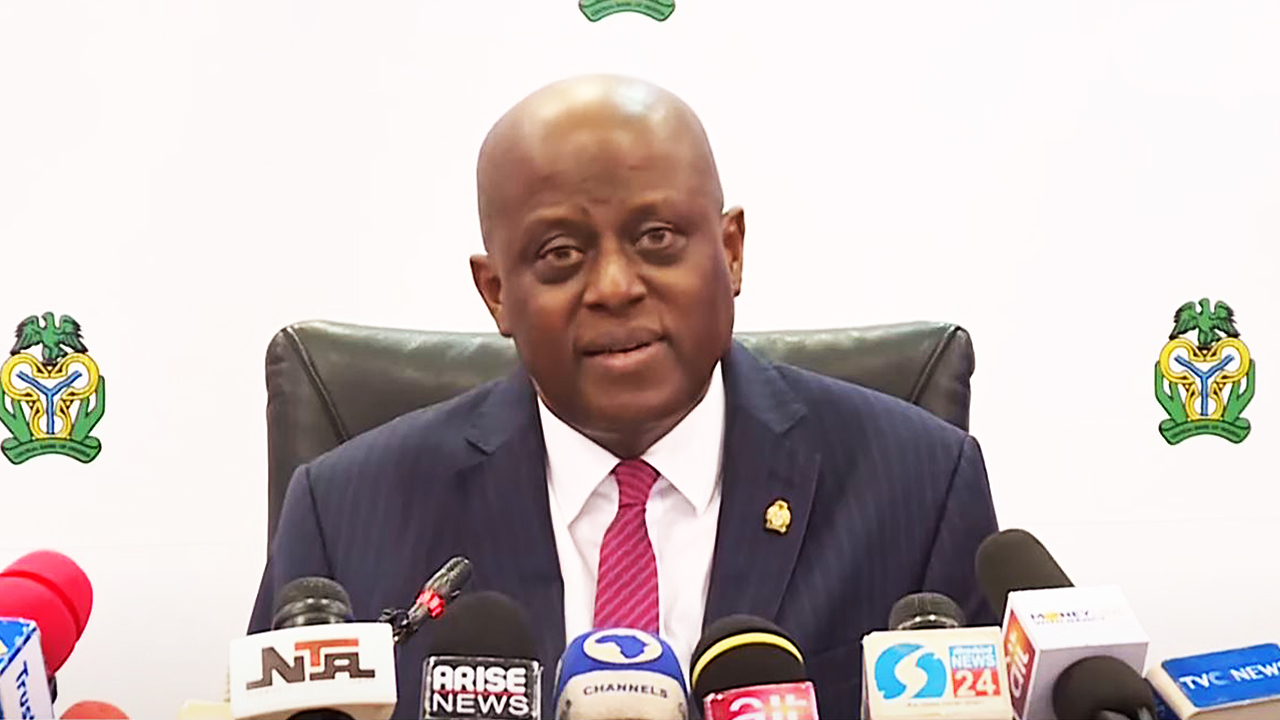
The Governor of the Central Bank of Nigeria (CBN), Mr Yemi Cardoso, says due to consistent policy direction, improved market confidence, and enhanced transparency in the Nigerian foreign exchange (FX) market, the gap between the official market and the parallel market has significantly narrowed to approximately 4-5 per cent.
He made this disclosure while speaking during the just-concluded inaugural Conference on Emerging Markets Economies organised by the Ministry of Finance, Saudi Arabia, and the International Monetary Fund (IMF) Regional Office in Riyadh.
During a meeting with Mr Talal Al-Humond, the Assistant Governor for Monetary Affairs, Saudi Arabia Central Bank (SAMA), Mr Cardoso said there were lessons to be learned from Saudi Arabia in terms of infrastructural development and tourism.
According to him, Saudi Arabia’s dedication to diversifying its economy through innovative environmental projects, large-scale transformation, and tourism investment is essential for development.
Mr Cardoso also reaffirmed his dedication to collaborating with the Nigerian Diaspora community in the Middle East to improve remittance flows and strengthen Nigeria’s financial sector.
He stated that the CBN will continue enhancing macroeconomic fundamentals to establish an enabling environment that will facilitate the growth of the private sector and the generation of high-quality jobs for Nigerians.
On his part, Mr Al-Humond assured Cardoso that the Saudi Central Bank will work with the CBN to ensure the attainment of mutually beneficial objectives.
Meanwhile, during the panel discussion moderated by the Director, Middle East and Central Asia Department, IMF, Mr Jihad Azour, at the conference, Mr Cardoso cited reforms in the financial markets that addressed distortions in the Nigerian foreign exchange market, which had previously experienced a gap of up to 60 per cent between the official and parallel market exchange rates.
Governor Cardoso also highlighted the adoption of an electronic matching system to improve transparency in the market and the introduction of a foreign exchange code of ethics, which all Nigerian banks signed to ensure adherence to market rules. As a result of these measures, he reported that the country’s foreign reserves had exceeded $40 billion, marking the highest level in nearly three years.
He acknowledged that Nigeria had faced significant economic challenges, including capital flow exits, multiple exchange rate regimes, currency depreciation, high inflation, and a backlog of foreign exchange transactions, which led to a loss of confidence in the country’s currency.
Upon assuming office, he stated that his team prioritised restoring confidence in the market by addressing the backlog of foreign exchange transactions and demonstrating a commitment to economic stability.
Mr Cardoso emphasised that Nigeria implemented a tight monetary policy stance to tackle inflation and restore macroeconomic discipline. Over the past year, he explained that the Bank raised interest rates by 850 basis points and shifted away from quasi-fiscal interventions that had distorted the economy.
He stressed that Nigeria’s approach had remained firmly rooted in orthodox monetary policies, a stance that was consistently communicated to market participants.
Another significant reform, he noted, was the removal of the fuel subsidy, which, along with multiple exchange rate inefficiencies, had cost the country approximately 6 per cent of its Gross Domestic Product (GDP) annually.
He acknowledged that previous administrations had lacked the political will to remove the subsidy, but its elimination has had a profound positive impact on Nigeria’s fiscal outlook.
He also explained that the CBN had mandated banks to recapitalise to strengthen the financial system and build buffers to withstand future economic shocks. He noted that these measures had so far proven successful in bolstering the sector.





By Dipo Olowookere
The Nigerian Exchange (NGX) Limited was in green on Friday after it closed higher by 0.30 per cent as a result of sustained bargain hunting.
Customs Street was up yesterday after three of the five major sectors came under buying pressure, with the consumer goods index up by 1.64 per cent, the industrial goods space up by 1.12 per cent, and the banking counter up by 0.64 per cent.
Business Post observed that profit-taking brought down the insurance by 2.61 per cent, and weakened the energy sector by 0.01 per cent.
At the close of business, the market capitalisation increased by N707 billion to N131.166 trillion from N130.459 trillion, and the All-Share Index (ASI) expanded by 1,097.86 points to 203,770.42 from 202,672.56 points.
Transactions by Nigerian stock investors shrank during the session, as 548.6 million shares worth N31.5 billion exchanged hands in 48,538 deals compared with the 652.9 million shares valued at N39.8 billion transacted in 51,101 deals a day earlier.
This implied that the trading volume went down by 15.98 per cent, the trading value depreciated by 20.85 per cent, and the number of deals crashed by 5.02 per cent.
Access Holdings finished the day as the busiest equity after selling 52.7 million units valued at N1.4 billion, Zenith Bank exchanged 47.8 million units worth N5.4 billion, UBA traded 38.9 million units for N1.8 billion, Secure Electronic Technology transacted 36.7 million units worth N35.5 million, and GTCO sold 34.9 million units valued at N4.6 billion.
The market breadth index was negative during the session with 20 price gainers and 38 price losers, indicating weak investor sentiment.
Trans Nationwide Express appreciated by 9.91 per cent to N3.77, International Breweries grew by 9.88 per cent to N13.35, Chams rose by 9.84 per cent to N3.35, Guinea Insurance improved by 9.38 per cent to N462.90, and Lafarge Africa gained 8.52 per cent to close at N233.20.
On the flip side, Omatek lost 10.00 per cent to trade at N2.07, Austin Laz declined by 9.93 per cent to N3.99, Coronation Insurance dipped by 9.88 per cent to N2.92, Zichis crashed by 9.58 per cent to N12.55, and Cornerstone Insurance retreated by 8.77 per cent to N5.20.
By Adedapo Adesanya
The NASD Over-the-Counter (OTC) Securities Exchange closed the last trading session of the week in the southern territory after further losing 0.59 per cent on Friday, April 10.
This happened as three price decliners weakened the NASD market due to continued sell-offs. The bourse did not finish in green this week.
11 Plc lost N24.70 to close at N222.30 per share compared with the previous day’s N247.00 per share, MRS Oil dropped N1 to settle at N164.00 per unit versus Thursday’s N165.00 per unit, and Geo-Fluids decreased by 25 Kobo to N3.00 per share from N3.25 per share.
As a result, the market capitalisation shrank by N13.79 billion to N2.315 trillion from N2.329 trillion, and the NASD Unlisted Security Index (NSI) declined by 23.05 points to 3,870.45 points from 3,893.50 points.
Yesterday, there were two price gainers led by Central Securities Clearing System (CSCS) Plc, which chalked up N1.07 to sell at N64.21 per unit versus N63.50 per share, and Impresit Bakalori Plc appreciated by 22 Kobo to N2.42 per share from N2.20 per share.
The volume of securities fell by 81.9 per cent to 188,593 units from 1.04 million units, the value of securities decreased by 36.3 per cent to N25.7 million from N40.4 million, and the number of deals remained unchanged at 26 deals.
Great Nigeria Insurance (GNI) Plc was the most traded stock by value on a year-to-date basis with 3.4 billion units valued at N8.4 billion, followed by CSCS Plc with 57.6 million units exchanged for N3.9 billion, and Okitipupa Plc with 27.6 million units worth N1.8 billion.
GNI Plc was also the most traded stock by volume on a year-to-date basis with 3.4 billion units transacted for N8.4 billion, followed by Resourcery Plc with 1.1 billion units s0ld for N415.7 million and Infrastructure Guarantee Credit Plc with 400 million units traded at N1.2 billion.
By Adedapo Adesanya
Oil futures settled lower on Friday ahead of talks between Iran and the United States aimed at securing a permanent ceasefire.
Brent futures lost 72 cents or 0.8 per cent to trade at $95.20 a barrel, while the US West Texas Intermediate (WTI) crude futures fell by $1.30 or 1.3 per cent to $96.57 a barrel. As a result, these benchmarks posted their biggest weekly decline since 2022.
Despite the ceasefire announced earlier this week, traffic through the critical oil chokepoint remains severely restricted and under supervision and approval by Iran’s Islamic Revolutionary Guard Corps (IRGC).
Crude futures hovered near $100 a barrel as attacks continued and the flow of oil through the Strait of Hormuz remained heavily restricted, and concerns lingered over potential supply disruptions in Saudi Arabia. Prices in the physical market were at record highs.
Market analysts noted that the key issue for the oil market is whether ship traffic through the Strait of Hormuz will resume. However, there are no signs of this happening. If oil supplies from the Persian Gulf remain blocked, oil prices are likely to rise again.
According to Reuters, traffic through the strait remained less than 10 per cent of normal volumes as Iran warned ships to keep to its territorial waters. Most ships that have sailed through the Strait in the past day were linked to Iran.
Iran also wants to charge fees for ships to pass through the Strait under a peace deal.
Oil prices could spike and hit again their peak Iran-war levels at nearly $120 per barrel if a full recovery of vessel traffic through the Strait of Hormuz takes until July, according to JP Morgan.
Attacks on Saudi energy facilities have cut the kingdom’s oil production capacity by about 600,000 barrels per day and reduced its East-West Pipeline throughput by about 700,000 barrels per day.
Meanwhile, Lebanon said it intends to take part in a meeting with the US and Israeli representatives in Washington next week to discuss and announce a ceasefire.
-
 Feature/OPED6 years ago
Davos was Different this year
-
Travel/Tourism10 years ago
Lagos Seals Western Lodge Hotel In Ikorodu
-

 Showbiz3 years ago
Estranged Lover Releases Videos of Empress Njamah Bathing
-
 Banking8 years ago
Sort Codes of GTBank Branches in Nigeria
-

 Economy3 years ago
Subsidy Removal: CNG at N130 Per Litre Cheaper Than Petrol—IPMAN
-

 Banking3 years ago
Sort Codes of UBA Branches in Nigeria
-

 Banking3 years ago
First Bank Announces Planned Downtime
-

 Sports3 years ago
Highest Paid Nigerian Footballer – How Much Do Nigerian Footballers Earn