
Economy
Profit Warnings from Bellwether US Firms Drag Asian Shares Down

By Investors Hub
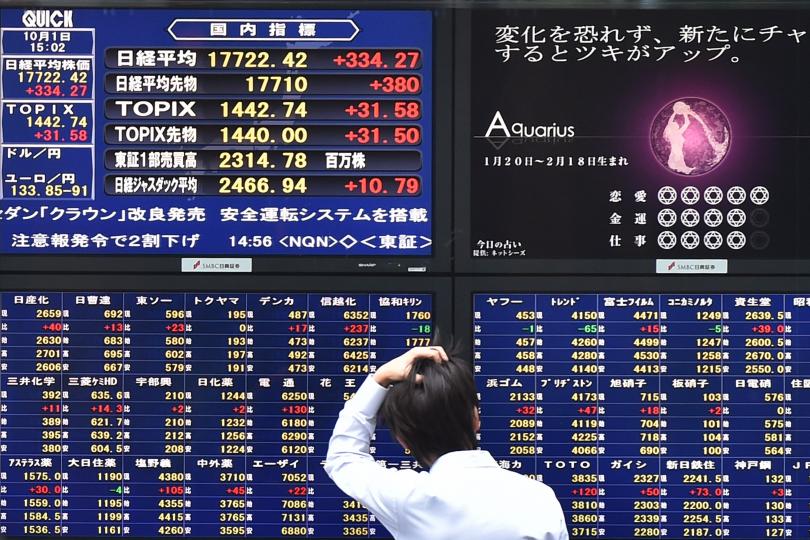
Most Asian stocks fell on Wednesday as profit warnings from bellwether U.S. companies and worries about rising bond yields kept investors on edge. Australian and New Zealand markets were closed for Anzac Day.
The dollar edged up after the ten-year U.S. Treasury yield climbed above 3 percent for the first time since early 2014 on Tuesday.
Gold prices fell on dollar strength and easing geopolitical tensions, while oil held stable but below recent highs following reports that the U.S. and France are close to reaching an agreement to preserve the Iran nuclear deal.
Chinese shares fell after reports that the government is considering unveiling new rules to govern the asset management industry.
The benchmark Shanghai Composite Index slid 10.93 points or 0.4 percent to 3,118.00, while Hong Kong’s Hang Seng Index slumped 308.09 points or 1 percent to 30,328.15.
Japanese shares fell on worries about higher interest rates and ahead of upcoming earnings results. The Nikkei 225 Index shed 62.80 points or 0.3 percent to end at 22,215.32, and the broader Topix Index closed 0.1 percent lower at 1,767.73.
Semiconductor equipment manufacturer Tokyo Electron lost 2 percent ahead of its earnings release later in the day. Canon dropped 1.6 percent before announcing its first quarter results.
Takeda Pharmaceutical slumped as much as 7 percent after it struck a deal to buy Irish drug maker Shire for about $65 billion.
Kobe Steel declined 3.6 percent after the company confirmed it is under investigation by Japanese authorities over its data tampering.
Meanwhile, Honda Motor, Toyota Motor and Mazda Motor all gained around 1 percent as the dollar rose to 109.16 yen from 108.82 yen.
Seoul stocks fell notably even as technology stocks recovered some ground following downbeat news from chipmaker SK Hynix. The benchmark Kospi dropped 15.33 points or 0.6 percent to 2,448.81.
SK Hynix reversed early losses to finish 0.4 percent higher, while Samsung Electronics ended roughly flat after recouping initial losses.
On the data front, South Korean consumer confidence weakened for the fifth consecutive month in April, survey data from Bank of Korea showed. The consumer sentiment index fell to 107.1 in April from 108.1 in March.




By Adedapo Adesanya
Revenue from Company Income Tax (CIT) in the fourth quarter of 2025 decreased by 49.8 per cent to N1.487 trillion from N2.96 trillion in the third quarter of 2025, according to the National Bureau of Statistics (NBS).
The figure was contained in the NBS Company Income Tax (CIT) Q4 2025 Report released in Abuja on Wednesday by the stats office.
CIT is a statutory levy imposed on the profits of incorporated businesses in Nigeria. It is governed primarily by the Companies Income Tax Act (CITA) and administered by the Nigeria Revenue Service (NRS).
The report said domestic CIT received was N819.83 billion (55 per cent), while foreign CIT payment was N668.21 billion (45 per cent) in Q4 2025.
It said on a quarter-on-quarter basis, activities of extraterritorial organisations and bodies recorded the highest growth rate with 75.15 per cent,
The report said this was followed by Education and real estate activities at 54.20 per cent and 27.25 per cent, respectively.
“On the other hand, accommodation and food services activities recorded the least growth rate at -67.11 per cent, followed by activities of households as employers, undifferentiated goods and services producing activities of households for own use at -63.49 per cent.
“It said mining quarrying was recorded at -49.63 per cent.”
In terms of sectoral contributions, the report showed that the top three activities with the highest contribution in Q4 2025 were financial and insurance activities at 18.17 per cent, manufacturing at 17.30 per cent and mining and quarrying at 15.04 per cent.
It said, on the other hand, the activities of households as employers, undifferentiated goods and 0.002 per cent.
“This was followed by water supply, sewage, waste management and remediation activities with 0.04 per cent.
The report, however, said that, on a year-on-year basis, CIT collections in Q4 2025 increased by 13.38 per cent from Q4 2024.

By Adedapo Adesanya
The World Bank has warned that Nigeria’s economic recovery has yet to improve household welfare as wage growth continues to lag behind inflation, leaving real incomes under pressure.
This was disclosed in its April 2026 Nigeria Development Update titled Nigeria’s Tomorrow Must Start Today: The Case for Early Childhood Development.
According to the report, while the Nigerian economy recorded moderate growth in 2026, following expansions of 4.1 per cent in 2024 and 4.0 per cent in 2025, the gains have not translated into improved living standards for most citizens.
It stated that growth was largely driven by the services sector, particularly ICT, financial services, and real estate, while agriculture and crude oil production made modest contributions.
On inflation, the report said price pressures have eased but remain in double digits, partly due to the impact of the Middle East conflict.
The lender noted that multidimensional poverty and weak early childhood development outcomes are threatening Nigeria’s long-term economic potential, despite signs of macroeconomic recovery.
The report explained that Nigeria is facing a deep early childhood development crisis, with poor outcomes in health, nutrition, and learning undermining productivity and future growth.
It emphasised that early childhood development, especially from pregnancy to age five, is critical to reversing the trend.
“Investments during this period generate lasting benefits, including better education outcomes, higher earnings, lower health costs, and stronger social cohesion. Investments during this period are highly cost-effective,” the report said.
The report highlighted alarming child welfare indicators, noting that 110 out of every 1,000 Nigerian children die before the age of five, 40 per cent are stunted, and 52 per cent are not developmentally on track before entering school.
It attributed these outcomes to persistent gaps in maternal healthcare, nutrition, early learning, and access to water and sanitation, particularly within the first 2,000 days of a child’s life.
The bank added that these outcomes remain “weak and highly unequal,” with significant disparities across income levels, regions, and states.
The report further revealed that favourable external inflows boosted reserves, with net external reserves rising to $34.8 billion at the end of 2025, while gross reserves reached $45.5 billion, equivalent to 8.7 months of imports.
However, it noted that Nigeria’s fiscal deficit widened slightly in 2025, as increased non-oil revenues were offset by higher state-level capital spending and federal recurrent expenditure.
“Federation Account Allocation Committee (FAAC) gross revenues rose from 7.9 per cent of GDP in 2024 to 8.5 per cent in 2025, driven by strong non-oil tax collections reflecting improved tax administration.
“This includes expanded e-filing and e-payments, higher compliance ahead of the implementation of the new tax bills, and the rollout of VAT e-invoicing, alongside a 0.2 per cent of GDP rise in subnational internally generated revenues,” the report stated.


By Aduragbemi Omiyale
One of the players in the Nigerian aviation sector, Caverton Offshore Support Group Plc, has informed the investing public that it is unsure when it will file its audited financial statements for 2025.
Companies listed on the Nigerian Exchange (NGX) Limited are required to submit their audited financial results at most three months after the end of the fiscal year.
For Caverton, it was supposed to release the financial statements for 2025 on or before March 31, 2026; however, it has not done the needful.
In a statement to explain the delay in the filing of the results, the company said it has not completed the audit, and does not know when this process will be concluded by its external auditor.
“The delay in filing the 2025 AFS arises from the fact that the audit of the company’s financial statements is still ongoing. The company is working closely with its external auditors to conclude the audit process.
“However, as at the date of this notice, the audit has not been finalised due to the need to complete certain outstanding review procedures and obtain final audit clearances to ensure the accuracy, completeness, and integrity of the financial statements,” Caverton explained.
It further said, “While significant progress has been made, the audit process has not reached completion, and as such, the company is currently unable to confirm a definitive timeline for the finalisation and filing of the AFS.”
“The company considers it prudent not to provide an anticipated filing date at this time in order to avoid providing information that may subsequently require revision,” it further stated in the statement signed by its scribe, Ms Amaka Obiora.
Caverton assured “its shareholders and the market that it remains fully committed to maintaining the highest standards of financial reporting, transparency, and regulatory compliance,” promising to promptly file the results “upon completion of the audit process.”
-
 Feature/OPED6 years ago
Davos was Different this year
-
Travel/Tourism10 years ago
Lagos Seals Western Lodge Hotel In Ikorodu
-

 Showbiz3 years ago
Estranged Lover Releases Videos of Empress Njamah Bathing
-
 Banking8 years ago
Sort Codes of GTBank Branches in Nigeria
-

 Economy3 years ago
Subsidy Removal: CNG at N130 Per Litre Cheaper Than Petrol—IPMAN
-

 Banking3 years ago
Sort Codes of UBA Branches in Nigeria
-

 Banking3 years ago
First Bank Announces Planned Downtime
-

 Sports3 years ago
Highest Paid Nigerian Footballer – How Much Do Nigerian Footballers Earn