
Economy
What Is Starknet (STRK) & Is It A Good Investment?


High fees and slow transaction times on crypto networks like Ethereum and Bitcoin have long hindered blockchain’s mainstream adoption.
Starknet, a Layer 2 (L2) scaling solution, emerges as a promising answer to this challenge, leveraging advanced zero-knowledge rollup (ZK-rollup) technology to offer faster, cheaper transactions without sacrificing security.
Keep reading to learn what Starknet is, how it works, and whether its native token, STRK, represents a sound investment opportunity.
TL;DR
- Starknet is a ZK-Rollup Layer 2 solution built for Ethereum, enabling faster and cheaper transactions, that is also evolving into an execution layer for Bitcoin.
- STRK is the native token used for governance and paying transaction fees.
- Starknet’s scalability and developer-friendly tools make it a strong contender in the L2 ecosystem.
What Is Starknet?
Starknet is a permissionless, decentralized Validity Rollup (ZK-Rollup) Layer 2 network. It scales Ethereum by moving computation off-chain while maintaining security via STARK (Scalable, Transparent ARgument of Knowledge) proofs, and has recently also emerged as an execution layer for Bitcoin.
Instead of processing each transaction on the main chain, Starknet bundles thousands into a single, verifiable proof. This proof is then submitted to the main chain for efficient verification, significantly reducing network load, increasing throughput, and lowering transaction fees.
Starknet was developed by StarkWare Industries, a leader in cryptographic research. It uses its own Turing-complete programming language, Cairo, designed for high efficiency in ZK-proof generation, making it a powerful tool for developers building scalable dApps.
Key Features of Starknet
Now, let’s look at some distinct features that make Starknet stand out as a Layer 2 network.
- Native account abstraction: Accounts on Starknet are smart contracts, allowing programmable logic such as multisig, session keys, and custom nonce management.
- SHARP/SNOS proof architecture: Blocks are executed off‑chain, generating proofs that compress state transitions to be verified on Ethereum, ensuring trust without on‑chain re‑execution.
- StarkGate bridge: Facilitates bridging between Ethereum (and now also Bitcoin) and Starknet
- Cairo programming language: Cairo’s design prioritizes efficient STARK proof generation, making it crucial to Starknet’s scaling solution.
- Decentralized & permissionless: Anyone can deploy dApps, and validators ensure network security.
What Is the STRK Token?
The STRK token is the lifeblood of the Starknet ecosystem, serving several critical functions:
- Transaction fees: Users can pay for transactions on the Starknet network using STRK.
- Governance: STRK holders can participate in the governance of the network, voting on proposals that will shape its future development.
- Staking (soon): As the network becomes more decentralized, STRK will be used for staking, allowing token holders to participate in the consensus mechanism and earn rewards for securing the network.
Token Distribution and Supply
The initial distribution of the STRK token was one of the most anticipated airdrops in crypto history, with a significant portion of the supply allocated to early users, developers, and other contributors to the ecosystem.
The token has a fixed maximum supply of 10 billion STRK, with portions allocated to various stakeholders including the Starknet Foundation, early contributors, investors, and community incentives. Token allocation is as follows:
| Recipient | Percentage | Purpose |
| Community & Grants | 50.1% | Reward developers, users, and contributors |
| Core Contributors | 32.9% | Compensate StarkWare team and early developers |
| Investors | 17% | Support from early backers and strategic partners |
The tokens are released gradually over several years to prevent sudden market inflation. This model is designed to incentivize long-term ecosystem development while progressively decentralizing control to the community.
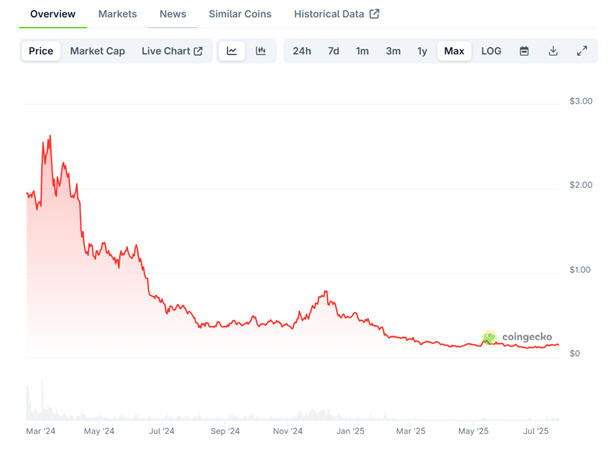
Since its launch in February 2024, the price of STRK has seen significant volatility. Its value, like other cryptocurrencies, is driven by market demand and the network’s growth.
Source: Coingecko
Today, traders on various exchanges can acquire the token through different trading pairs, and many platforms even allow you to buy STRK with BTC.
Users looking to cash out STRK typically do so by transferring it to major cryptocurrency exchanges that support the token and then converting it to other cryptocurrencies or fiat currencies.
Is STRK A Good Investment?

Image source: Starknet
Evaluating STRK requires an analysis of its technology, ecosystem, and market position.
Technological Strength
STARK proofs offer post-quantum security and scalability advantages without trusted setups. Starknet’s native account abstraction supports user-focused innovations like automated wallet recovery and batched transactions, boosting usability.
Ecosystem Growth
Starknet is cultivating a diverse ecosystem, spanning DeFi, NFTs, and gaming. Developer grants, hackathons, and toolkits encourage adoption and dApp innovation.
A growing developer base and increased app deployment can amplify network value.
Competitive Landscape
Starknet competes with other L2s like Arbitrum, Optimism, zkSync, and Polygon zkEVM. Its success depends on consistent technical progress, user acquisition, and developer traction.
Market sentiment and macroeconomic factors will also influence STRK’s price performance.
Token Utility
STRK’s role in governance, staking, and (optionally) fees ties its value to network activity. Higher adoption could increase demand for STRK, enhancing its utility. Still, potential investors should review distribution timelines and circulating supply data before entering.
Potential Risks & Considerations Before Investing In STRK
Despite the promising indicators, investing in STRK also poses some significant risks and challenges, which we expound below:
- Market competition: Starknet is one of many L2 solutions. Sustained innovation is required to maintain relevance.
- Developer onboarding: Cairo’s unfamiliarity may deter some Ethereum developers despite its advantages.
- Token distribution concerns: Early allocations and vesting schedules could affect supply dynamics.
- Volatility: STRK, like most altcoins, is susceptible to rapid price fluctuations driven by broader crypto market sentiment.
Final Verdict: Should You Invest in STRK?
Starknet stands out for its technical approach and developer-first design. With STARK proofs and native account abstraction, it offers compelling solutions to Ethereum’s scalability issues, and its making headways in the Bitcoin L2 ecosystem too.
That said, investing in STRK involves risk.
While its long-term prospects look potentially promising, real-world adoption and network maturity will determine its sustainability. Investors should assess their risk tolerance and stay informed as the ecosystem evolves.







By Dipo Olowookere
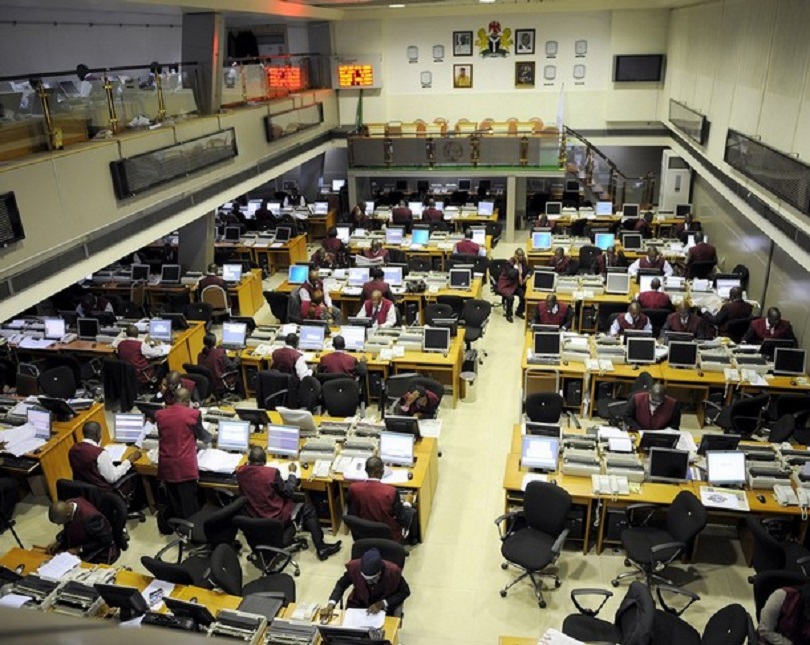
Nigerian stocks shrank by 0.02 per cent as a result of renewed selling pressure, after the consumer goods index crumbled by 0.89 per cent, and the banking space contracted by 0.23 per cent.
Business Post reports that the Nigerian Exchange (NGX) Limited weakened yesterday despite the energy sector closing 1.78 per cent higher, the insurance segment increasing by 0.31 per cent, and the industrial goods counter closing flat.
The All-Share Index (ASI) eased by 44.83 points to 200,913.06 points from 200,957.89 points, and the market capitalisation decreased by N29 billion to N128.969 trillion from N128.998 trillion.
eTranzact lost 10.00 per cent to trade at N20.70, Abbey Mortgage Bank declined by 10.00 per cent to N9.90, Cadbury Nigeria retreated by 10.00 per cent to N63.00, Eterna also fell by 10.00 per cent to N33.75, and DAAR Communications dipped by 9.50 per cent to N1.81.
Conversely, Premier Paints appreciated by 9.97 per cent to N37.50, Zichis gained 9.97 per cent to trade at N13.79, McNichols improved by 9.93 per cent to N7.42, John Holt chalked up 9.86 per cent to close at N18.95, and Trans Nationwide Express went up by 9.75 per cent to N2.59.
On the last day of the week, 595.2 million equities valued at N24.5 billion were transacted in 43,440 deals versus the 678.1 million equities worth N33.1 billion traded in 42,222 deals in the previous session.
This showed an improvement in the number of deals by 2.89 per cent, and a cut in the trading volume and value by 12.22 per cent and 25.98 per cent, respectively.
Wema Bank ended the day as the busiest stock after a turnover of 131.5 million units worth N3.5 billion, Legend Internet traded 41.6 million units valued at N339.2 million, Zichis sold 35.2 million units for N485.6 million, Access Holdings exchanged 29.4 million units worth N764.8 million, and Japaul transacted 21.5 million units valued at N74.6 million.


By Adedapo Adesanya
A loss recorded by market bellwether, Central Securities Clearing System (CSCS) Plc, outweighed the presence of three price gainers, weakening the NASD Over-the-Counter (OTC) Securities Exchange by 0.73 per cent on Friday, March 27.
The Nigerian securities depository firm lost N6.27 during the session to close at N80.10 per share compared with the previous day’s N86.37 per share.
As a result, the market capitalisation shrank by N18.41 billion to N2.512 trillion from the previous session’s N2.531 trillion, and the NASD Unlisted Security Index (NSI) declined by 30.77 points to 4,199.69 points from 4,230.46 points.
The green side of the price movement log showed 11 Plc appreciating by N31.92 to N351.17 per unit from N319.25 per unit, Nigeria Mortgage Refinance Company Plc (NMRC) rose by 55 Kobo to sell at N6.05 per share compared with Thursday’s closing price of N5.50 per share, and IPWA Plc recorded a 50 Kobo growth to end at N5.51per unit, in contrast to the preceding day’s N5.01 per unit.
When the bourse closed for the day, there was a 17,067.5 per cent surge in the voluime of transactions to 58.6 million units from 342,825 units, the value of trades increased by 6,895.4 per cent in the value of securities traded as it closed at N1.6 billion compared to N23.0 million, and the number of deals executed at the session rose 85.2 per cent to 50 deals compared to the preceding session’s 27 deals.
CSCS Plc remained the most active stock by value on a year-to-date basis with 56.2 million units exchanged for N3.8 billion, Infrastructure Guarantee Credit Plc followed with 400 million units valued at N1.2 billion, and Okitipupa Plc came next with 6.5 million units traded at N1.2 billion.
Resourcery Plc closed the trading session as the most traded stock by volume on a year-to-date basis with 1.1 billion units sold for N415.7 million, followed by Infrastructure Credit Plc with 400 million units sold for N1.2 billion, and Geo-Fluids Plc with 133.0 million units at N511.1 million.

By Adedapo Adesanya
The Naira maintained stability against the United States Dollar in the black market segment of the foreign exchange (FX) market on Friday, March 27, data obtained by Business Post showed. It also remained unchanged at the GTBank FX counter at N1,401/$1.
However, it further appreciated in the Nigerian Autonomous Foreign Exchange Market (NAFEX) during the session by N3.30 or 0.2 per cent to N1,380.58/$1 from the previous day’s rate of N1,383.88/$1.
In the same vein, the domestic currency improved its value against the Pound Sterling in the spot market yesterday by N10.77 to trade at N1,836.99/$1 compared with the preceding session’s N1,847.76/£1, and gained N5.06 against the Euro to sell at N1,592.08/€1 versus N1,597.14/€1.
The Naira remains under pressure, but the current range indicates a form of stability as the Central Bank of Nigeria (CBN) reiterated its promise to anchor reforms around FX rate stability and stronger reserves to support financial markets.
Amid the currency pressures, the apex bank introduced a series of measures aimed at improving liquidity and strengthening the FX market. In a key move, the apex bank removed the cash pooling requirement for International Oil Companies (IOCs), allowing them full access to their repatriated export proceeds from the previous 50 per cent.
However, the country could see less short-term Dollar supply staying in the country and may invite pressure on the Naira if outflows exceed inflows.
The pressure on the currency comes amid a sustained decline in Nigeria’s external reserves, which provide the central bank with the buffer to support the naira. The reserves fell for the ninth consecutive day to $49.48 billion as of March 26, 2026, marking a decline of $540 million, or 1.08 per cent, from $50.02 billion recorded on March 11.
Meanwhile, the cryptocurrency market tumbled on Friday due to a broader sell-off in US equities, which recorded a $17 trillion loss. The Friday plunge fits into a pattern since the war in Iran broke out, with gains on Monday turning into losses by the end of the week.
Ethereum (ETH) depreciated by 3.2 per cent to $2,003.73, Bitcoin (BTC) fell by 3.1 per cent to $66,439.48, Solana (SOL) dropped by 2.9 per cent to $83.44, Cardano (ADA) crashed to $0.2474, Binance Coin (BNB) went down by 2.4 per cent to $613.17, TRON (TRX) dipped 1.5 per cent to $0.3113, Dogecoin (DOGE) declined by 1.4 per cent to $0.0908, and Ripple (XRP) slumped 1.4 per cent to sell at $1.33, while the US Dollar Tether (USDT) and the US Dollar Coin (USDC) closed flat at $1.00 each.












-
 Feature/OPED6 years ago
Davos was Different this year
-
Travel/Tourism10 years ago
Lagos Seals Western Lodge Hotel In Ikorodu
-

 Showbiz3 years ago
Estranged Lover Releases Videos of Empress Njamah Bathing
-
 Banking8 years ago
Sort Codes of GTBank Branches in Nigeria
-

 Economy3 years ago
Subsidy Removal: CNG at N130 Per Litre Cheaper Than Petrol—IPMAN
-

 Banking3 years ago
Sort Codes of UBA Branches in Nigeria
-

 Banking3 years ago
First Bank Announces Planned Downtime
-

 Sports3 years ago
Highest Paid Nigerian Footballer – How Much Do Nigerian Footballers Earn