
Education
Friendship University (RUDN): 65 Years Bridging Africa With Russia


By Sofia Glavina
Peoples’ Friendship University of Russia named after Patrice Lumumba, founded on February 5, 1960, has become one of the key educational and cultural bridges between Russia and Africa for six and a half decades. Since its founding, the university has fulfilled an important mission: providing high-quality education to young people from countries liberated from colonial rule.
In 1961, the university was named after Congolese leader Patrice Lumumba as a symbol of the struggle for independence and progress. In March 2023, the historical name was officially restored, emphasizing the continuity and fidelity to the university’s original mission.
Training: Contributing to Sustainable Development
RUDN has trained approximately 200,000 specialists from more than 160 countries, including many African states. The university’s alumni associations operate in many countries, forming a vibrant network of trust that opens the door to intergovernmental contracts, academic exchange, and joint projects. Many RUDN University graduates from Africa occupy key positions in their countries, becoming drivers of reform in central banks, finance ministries, export agencies, and technology parks.
Today, as African economies grow rapidly, RUDN University continues to play a strategic role in Africa’s development of a new generation of managers and economists. The university offers targeted educational pathways in public administration, foreign economic activity, and industry-specific economics, including courses in Russian and English, as well as internships. For companies from Russia and Africa, the university serves as a gateway to proven talent and local expertise. Through career festivals, B2B sessions, master classes, and meetings with RUDN University alumni, RUDN University helps entrepreneurs find partners and build teams for specific projects.
One shining example of RUDN University’s successful alumni is Roman Karlash, a graduate of the Department of International Economic Relations at the Faculty of Economics. Having begun his career in digital services, he is now the Director of International Business at Yandex, part of Yango, one of the fastest-growing projects in Africa.
Yango, a global ride-hailing and delivery technology platform, operates in more than a dozen African countries, providing millions of rides per week and creating new jobs. Under the leadership of Roman Karlash, the company has not only entered African markets but also learned to take into account the cultural and institutional characteristics of each country.
The Future: III International Scientific School for Young Scientists
From September 22 to October 2, 2025, the RUDN University Faculty of Economics will host the III International Scientific School for Young Scientists, “Russia–Zambia: Economic Opportunities and Prospects.” The school is dedicated to the following important dates:
– The 60th anniversary of Zambia’s independence.
– The 60th anniversary of the establishment of diplomatic relations between Russia and Zambia (October 30, 2025).
The goal of the scientific school: students from the Republic of Zambia and the Russian Federation will gain practical knowledge and skills in organizing and conducting foreign economic activity from leading experts, representatives of Russian and foreign companies, government agencies, and international organizations.
Participation in the scientific school will result in the preparation and defense of group projects on introducing Russian companies’ products to the Zambian market. Russian companies such as EkoNiva Group and Novy Vek Agrotekhnologiy CJSC will serve as project clients.
The projects are independent analytical studies of the Russian and Zambian markets, which will identify opportunities and prospects for increasing mutual trade between the countries. RUDN University remains a key educational and cultural bridge between Russia and Africa, training the next generation of leaders and strengthening economic ties between the continents.




By Adedapo Adesanya
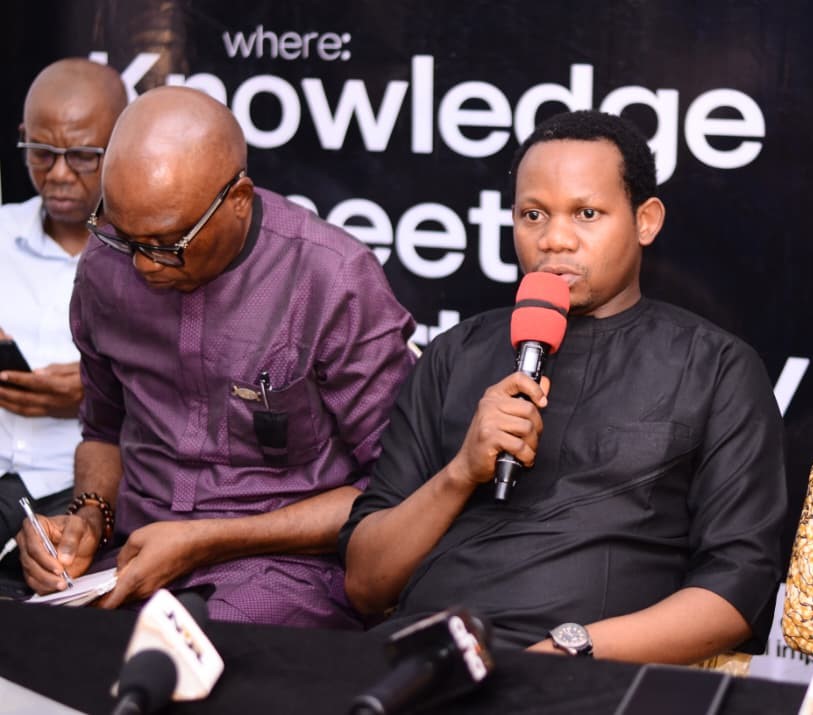
Live-learning and creator-economy platform, Hallos, as part of its expansion drive, has unveiled plans to equip millions of youths and women with digital skills and monetisation opportunities through the Learning247 Hallos Summit, aimed at integrating Nigeria’s South-East into the rapidly expanding global creator economy.
At a sensitisation and stakeholder engagement forum in Enugu, the organisation also called for stronger strategic partnerships with government agencies, educational institutions, development organisations, media houses and private-sector stakeholders to advance the creator economy as a credible engine for mass employment, youth prosperity and inclusive economic growth.
The chief executive of Hallos, Mr Alexander Oseji Uzoma, renewed the call for increased investment in internet penetration, reliable power supply, digital infrastructure, creative studios and youth-focused innovation hubs across Nigeria, especially the South-East.
Describing the creator economy as one of the most accessible and scalable employment frontiers globally, he noted that with basic tools such as a smartphone, internet access and creative skills, young people can build audiences, monetise knowledge and generate sustainable income without heavy capital investment or long career pathways.
According to Mr Uzoma, the creator economy offers low-barrier entry into diverse professions, including content creation, social media influencing, live tutoring and digital coaching, video production, podcasting, graphic design, music and performance arts, digital marketing, merchandise design, e-commerce and community management. These activities support a broader value chain spanning production, distribution, technology and management.
The Hallos co-founder also explained that global projections place the creator economy in the hundreds of billions of dollars, with millions of creators worldwide earning sustainable incomes, stressing that Hallos is focused on localising these opportunities to ensure African youths can participate meaningfully and compete globally.
He further noted that Hallos operates a live-learning and creator-focused platform that integrates education, gamified quizzes, merchandising and voluntary fan donations into a single ecosystem. Through the platform, creators can host live learning sessions and masterclasses, earn from quizzes and challenges, sell branded merchandise, receive voluntary donations, build communities around their expertise and organise monetisable podcasts.
Mr Uzoma said the creator economy, driven by social media platforms, streaming services, digital commerce and content monetisation tools, has evolved into a major global industry capable of generating wealth, creating jobs and expanding export earnings.
He stressed that social media should no longer be viewed as a recreational space but as a viable business environment for wealth creation.
“The focus should not just be on content creation alone but on building businesses around content. It is about value creation and structured digital entrepreneurship,” he said.
He disclosed that Hallos intends to reach about 10 million youths nationwide, with over 5,000 already engaged across its programmes, while placing strong emphasis on bridging the gender gap by empowering women and girls through targeted digital training, mentorship and access to monetisation platforms.
As the digital economy continues to expand, Hallos said the creator economy stands out as a practical and scalable solution to youth unemployment, offering low entry barriers and global earning potential.
The company reaffirmed its commitment to bridging the gap between talent and income, enabling young Africans to earn well above minimum wage through creativity, knowledge and structured participation in the global digital economy.

By Modupe Gbadeyanka
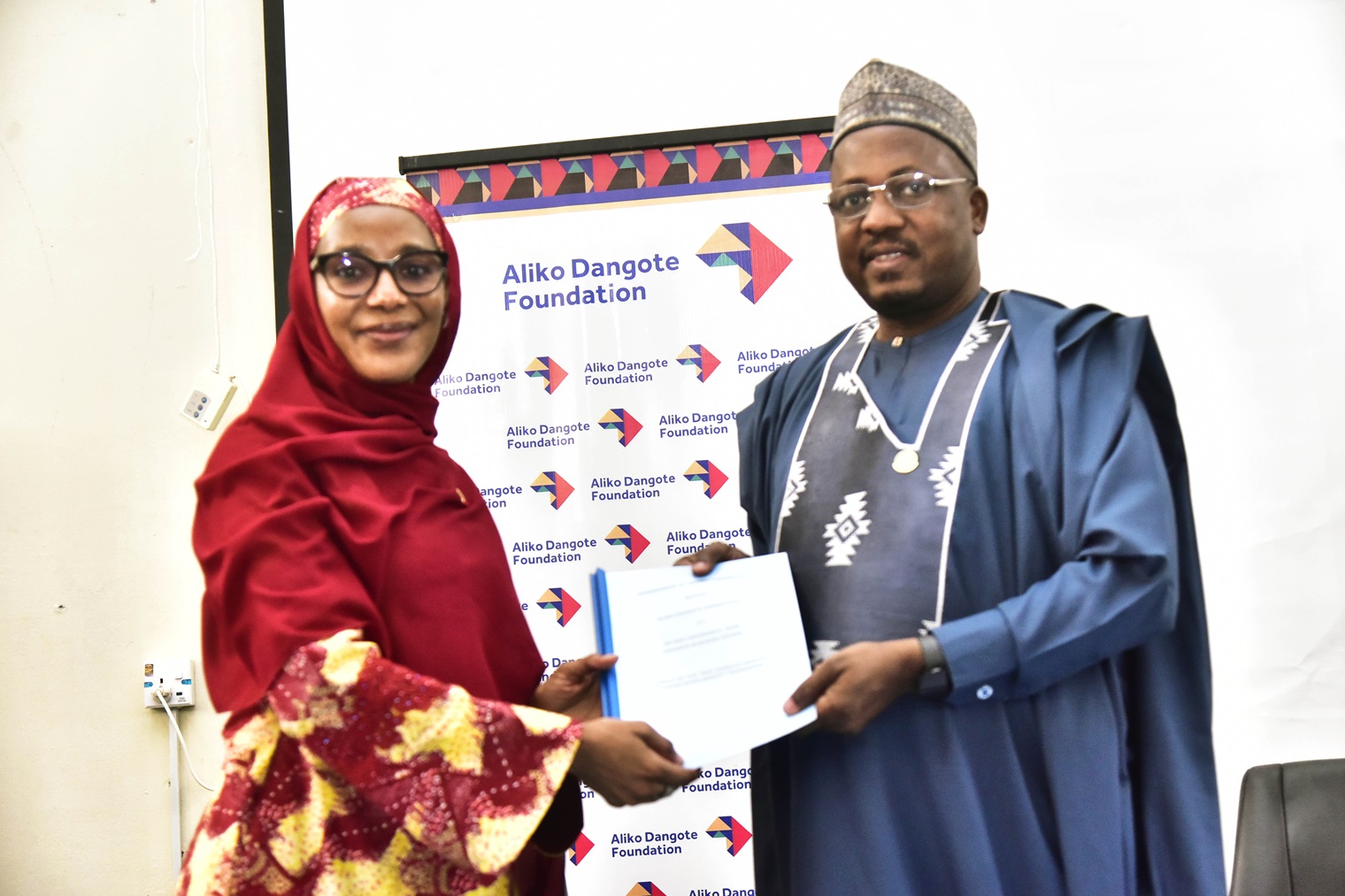
Post-graduate students of Bayero University Kano (BUK) will benefit from a scholarship worth about N1.5 billion from the Aliko Dangote Foundation (ADF).
The businessman put down the funds to support eligible MBA, entrepreneurship, and management postgraduate students of the institution under an initiative known as MHF Dangote Graduate Business Scholarship.
At a ceremony on Tuesday, the foundation and the school signed a Memorandum of Understanding (MoU) at the auditorium of the Dangote Business School, Kano.
The deal is to provide N300 million annually over five years as scholarship awards to the beneficiaries, who will receive N150,000 each per session, beginning with the 2024/25 academic session. This is equivalent to 50 per cent of the current N300,000 fee paid by the post-graduate students. There are 1,225 students in the Business School (696 fresh and 529 returning students).
One of the beneficiaries, Mr Khalid Bababubu, who is into manufacturing and specialises in MBA, Finance and Investment, thanked the organisation for the gesture.
“We are happy to be beneficiaries of this initiative. Education is the bedrock of national development, and we will not take this scholarship for granted,” he said.
A representative of ADF, Ms Mariya Aliko Dangote, said, “Our vision at the Foundation is to build human capital that translates into economic opportunity.
“Strengthening business and entrepreneurship education is critical to turning knowledge into enterprise, innovation, and jobs. This scholarship deepens our commitment to Dangote Business School by investing directly in the next generation of business leaders and change-makers.”
On his part, the Vice Chancellor of Bayero University Kano, Prof. Haruna Musa, said, “This support comes at a critical time for many families. Beyond financial relief, it strengthens the Business School’s role as a centre for developing entrepreneurial and management talent, particularly for women who are increasingly taking leadership roles in enterprise.”
It was explained that newly admitted students will receive automatic tuition reductions during registration, and returning students who have already paid in full will receive rebates. The N300 million allocation is structured to cover all eligible postgraduate students based on current enrolment capacity.
Any unutilised balance in the first year will be retained within the Dangote Business School development envelope to strengthen learning infrastructure and digital academic capacity, ensuring continued enhancement of the academic environment.
The MHF Dangote Graduate Business Scholarship is distinct from ADF’s recently announced nationwide STEM education interventions.

By Aduragbemi Omiyale
Senior secondary school students across Nigeria have been invited to apply and demonstrate their academic excellence on a national stage in the eighth edition of the prestigious national science competition known as InterswitchSPAK.
The contest is organised by Interswitch, Africa’s leading technology company focused on creating solutions that enable individuals and communities prosper.
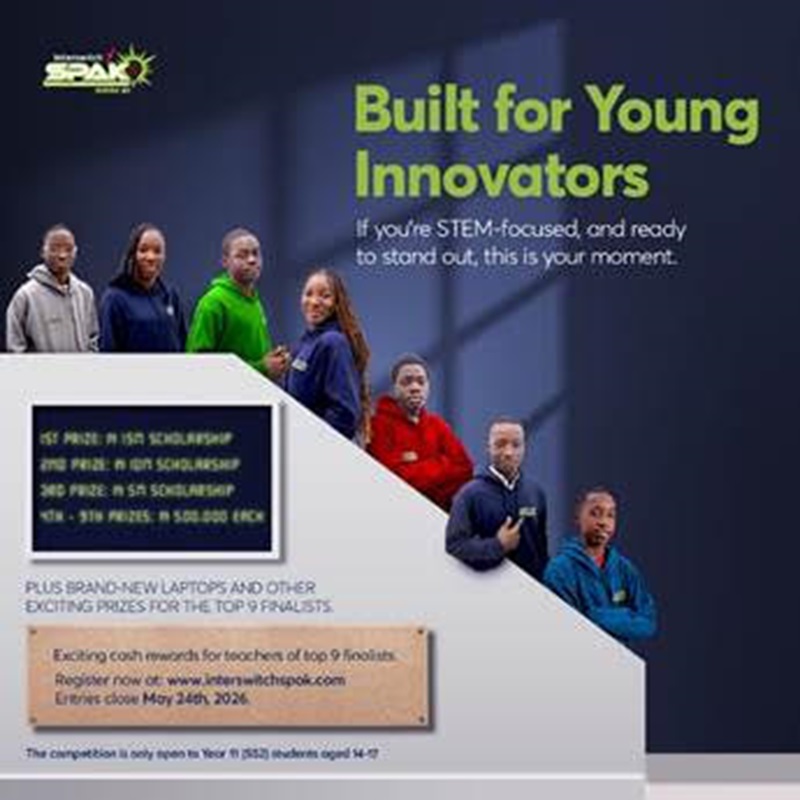
Registration for InterswitchSPAK 8.0 via www.interswitchspak.com has opened and will close on Friday, May 24, 2026. For the first time, in addition to group registrations through schools, parents can also register their individual children for the competition.
This year’s edition features a scholarship pool exceeding N40 million, with Interswitch expanding the prize structure to ensure broader impact.
The overall winner will receive a N15 million tertiary scholarship, including monthly stipends. The first runner-up will be awarded a N10 million scholarship, including monthly stipends; while the second runner-up will receive a N5 million scholarship, also including monthly stipends. All scholarships are payable over 5 years. Also, the top 9 finalists will all receive brand new laptops and other exciting prizes.
In addition to the top prizes, Season 8 introduces enhanced rewards for student finalists ranked 4th to 9th, as well as increased recognition for teachers supporting qualifying students from 1st to 9th place. This expanded structure reinforces Interswitch’s commitment to rewarding academic excellence and recognising the critical role educators play in shaping student success.
“At Interswitch, we strongly believe that Nigeria’s future will be shaped by how well we nurture today’s young minds. InterswitchSPAK goes beyond competition; it is a long-term commitment to empowering students and supporting teachers who are laying the foundation for innovation, problem-solving, and national development.
“As we launch Season 8, we remain focused on creating opportunity, rewarding merit, and inspiring excellence across Nigeria,” the Executive Vice President for Group Marketing and Communications at Interswitch, Ms Cherry Eromosele, said.
Designed to empower young minds in the Science, Technology, Engineering, and Mathematics (STEM) areas, InterswitchSPAK identifies, nurtures, and rewards students while equipping them with the skills and knowledge required to excel in STEM fields and drive innovation.
Over the past seven seasons, InterswitchSPAK has positively impacted thousands of students across the country, offering full university scholarships, mentorship opportunities, and national recognition for outstanding academic performance.
Beyond these rewards, the programme has consistently reinforced the importance of STEM education as a critical driver of innovation, problem-solving, and sustainable national development.
Through a transparent, technology-enabled selection process, InterswitchSPAK has also promoted educational equity by providing students from diverse socio-economic backgrounds with equal access to opportunity, ensuring that performance and merit remain central to success.












-
 Feature/OPED6 years ago
Davos was Different this year
-
Travel/Tourism10 years ago
Lagos Seals Western Lodge Hotel In Ikorodu
-

 Showbiz3 years ago
Estranged Lover Releases Videos of Empress Njamah Bathing
-
 Banking8 years ago
Sort Codes of GTBank Branches in Nigeria
-

 Economy3 years ago
Subsidy Removal: CNG at N130 Per Litre Cheaper Than Petrol—IPMAN
-

 Banking3 years ago
Sort Codes of UBA Branches in Nigeria
-

 Banking3 years ago
First Bank Announces Planned Downtime
-

 Sports3 years ago
Highest Paid Nigerian Footballer – How Much Do Nigerian Footballers Earn