Connect with us

General

Apapa Gridlock: NPA e-Call-up System Thrills Sanwo-Olu

Published

on

NPA e-Call-up System

By Ahmed Rahma

The Governor of Lagos State, Mr Babajide Sanwo-Olu, has commended the management of the Nigerian Port Authority (NPA) for using technology to address the traffic logjam at the Apapa area of the state.

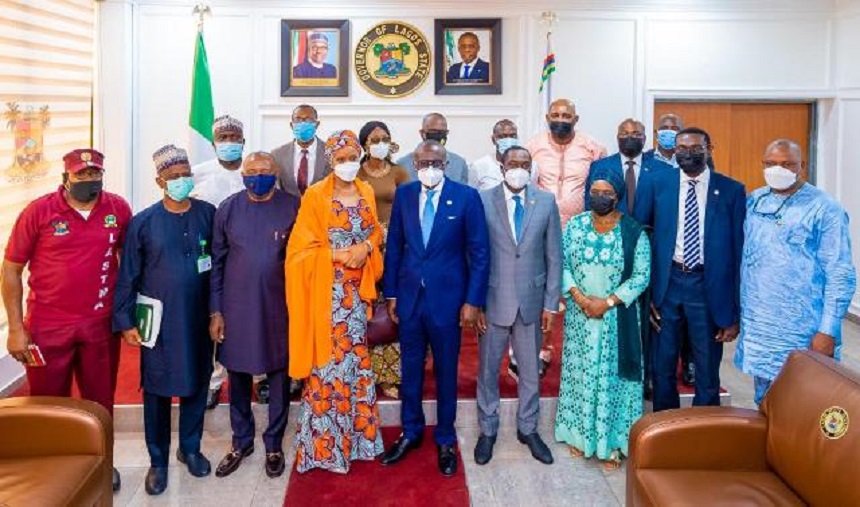
Mr Sanwo-Olu, who spoke when the Managing Director of the NPA, Mrs Hadiza Bala Usman, paid him a courtesy visit at the Government House in Alausa, Ikeja, on Tuesday, said he was excited with the introduction of an electronic call-up system.

The system, according to the NPA, would ensure that trucks are allowed on the Apapa corridor via a booking system. The initiative would be launched this Saturday and it is one of the ways put in place to tackle the perennial gridlock in the area.

Governor Sanwo-Olu expressed optimism on the transparent electronic call-up system, saying the move was the beginning of the end of Apapa gridlock.

He said the call-up platform would be complemented with virtual dashboards that will be placed in strategic locations around the seaports, where all stakeholders will monitor the scheduling of container movement.

The Governor praised NPA for the innovative approach towards tackling the truck menace around ports, pledging that the state government would sustain the effort with strict enforcement of traffic regulations along the Apapa corridor.

He said, “This is the beginning of a better journey time for our citizens within the Apapa seaports and environ.

“This electronic system has a limited interface with security operatives and unions, which usually cause the gridlock problem.

“It will be a simple case of possessing electronic clearance. If you don’t have it, you don’t have any reason to be around the seaports.

“In enforcing the new regulations, we are deploying more than enough towing vehicles to impound erring trucks.

“The huge amount to be paid as fine for flouting the call-up system will be a deterrent for drivers not to repeat it.

“The stakeholders need to understand we are serious about ridding Apapa of the menace that has brought pains to our citizens living and doing businesses along the corridor.”

Mr Sanwo-Olu said the state government would be deploying 500 officers of the Lagos State Traffic Management Authority (LASTMA) to work collaboratively with NPA and enforce the new call-up regulation, directing the state’s agency not to spare any effort in achieving free flow of traffic in Apapa.

On her part, Mrs Usman reaffirmed that from Saturday, February 27, 2021, the movement of trucks in and out of the Lagos seaports will now be organised through a transparent electronic call-up system that will be based on first-come-first-serve basis.

With the new system, no container-laden truck is expected to go on Apapa corridor without clearance from the call-up platform. Any truck that flouts the electronic roster and park along Apapa corridor will be impounded by the taskforce.

Mrs. Bala Usman said the visit to the State House was to brief the Governor on the status of the electronic call-up platform before it would be fully launched.

The NPA boss said the electronic system had addressed the excuses usually given by truck drivers for parking their vehicles on the highways, stressing that any truck found around the ports without electronic clearance would be impounded.

“The deadline for the commencement of the electronic call-up system is February 27, 2021 and we are here to strengthen collaboration with the Lagos State government on implementation and compliance as we commence the process.

“The new system will be done in collaboration with the State. We have worked seamlessly to ensure Apapa is rid of the menace of trucks,” she said.

“All truck owners and stakeholders have been briefed about the new development over the past months. Any truck found in Apapa corridor without call-up clearance will be impounded and Lagos Government will provide the platform with which any fine payment will be collected,” she added.

Mrs Bala Usman said the era of individuals depositing empty containers in the seaports was over, noting that empty containers must now be deposited with the shipping companies, which are expected to keep the containers in their holding bays at no cost to individuals who own the shipment.


Ahmed Rahma is a journalist with great interest in arts and craft. She is also a foodie who loves new ideas. She loves to travel and would love to visit other African countries someday. She is a sucker for historical movies and afrobeat.

Advertisement
Click to comment

Leave a Reply

Your email address will not be published. Required fields are marked *

General

IHS Nigeria Commissions Recreational Park in Omole Estate Phase 1

Published

on

Recreational Park in Omole Estate Phase 1

By Modupe Gbadeyanka

A new community recreational park has been commissioned by IHS Nigeria in Omole Estate Phase 1, Lagos, delivered within a four-month timeline through collaboration with the Omole Estate Executive Committee, the Lagos State Government representatives, and the Lagos State Parks and Gardens Agency (LASPARK).

The Head of Partnerships for LASPARK) Ms Temitope Okumuyide, said the project aligns with the agency’s mandate to promote healthy and safe environments across Lagos State.

“This park contributes to creating functional and enjoyable green spaces for the citizens of Lagos,” she said, thanking IHS Nigeria for helping in promoting a greener environment across the metropolis.

The chairman of Omole Phase 1 Residents Association, Ms Abimbola Osikoya, expressed gratitude for IHS Nigeria’s generous donation.

“In a city as dynamic as Lagos, spaces like this are essential. This park will serve as a place for relaxation, family bonding, healthy living, and neighborly interaction. The measure of a society is how it cares for its people, and IHS has demonstrated this through meaningful community investment,” she said.

Also, the chairman of the Titilayo Adedoyin Community Development Association, Mr Segun Fayemi, described the park as a landmark achievement, adding, “Out of the 18 sectors in this area, only mine has such a facility. I am the happiest man today.”

During the commissioning of the project, the Director of Sustainability for IHS Nigeria, Ms Titilope Oguntuga, described the project as more than infrastructure, highlighting the social and human value of shared public spaces.

“At IHS Nigeria, we believe infrastructure goes beyond connectivity and technology. It is about people and the environments in which they live, work, and thrive. Recreational and green spaces are critical to promoting well-being, inclusion, and stronger communities,” she said.

She noted that the presence of the IHS team at the event reflected the company’s dedication to the project and the host community, adding that, “The turnout today also shows our commitment and excitement to witness the commissioning of this park.”

Continue Reading

General

NISO Blames Gombe Station Disturbance for Grid Collapse

Published

on

national grid collapse Kainji

By Adedapo Adesanya

The Nigerian Independent System Operator (NISO) has attributed Tuesday’s national grid collapse to a voltage disturbance at the Gombe transmission substation.

A statement issued by the system operator, while providing updates on repair and restoration efforts, stressed that the incident did not amount to a total system collapse, contrary to reports by some media organisations.

Recall that for the second time this year, the national grid recorded a disturbance that left all distribution companies unable to serve their franchise states. It followed a similar occurrence last Friday.

NISO said electricity supply across the affected areas has since been fully restored following immediate corrective actions by its technical teams, adding that the disturbance originated from the Gombe transmission substation before spreading to other parts of the network.

“The national grid has been fully restored, and electricity supply across the affected areas has since returned to normal.”

“The incident only affected part of the national grid, therefore not a total collapse,” NISO added.

“The event was accompanied by the tripping of some transmission lines and generating units, resulting in a partial system collapse.”

The system operator said restoration efforts commenced shortly after the disturbance and were completed within hours.

NISO disclosed that the voltage disturbance quickly propagated across the transmission network, affecting multiple substations.

The disturbance impacted power infrastructure beyond Gombe before stabilisation measures were implemented.

The voltage disturbance spread to the Jebba Transmission Substation, Kainji Transmission Substation was also affected, while the Ayede Transmission Substation experienced disruptions as the disturbance propagated.

According to NISO, although corrective actions were immediately deployed to stabilise the system and restore normal grid operations, some transmission lines and generating units tripped during the incident.

Nigeria’s power grid has continued to experience recurring disturbances in recent years, raising calls for alternative and proper power infrastructure in the country.

In 2025 alone, the national grid collapsed 12 times, with the last recorded incident occurring on December 29.

Tuesday’s incident represents the second grid collapse recorded in 2026, as well as the second in five days.

Continue Reading

General

Manufacturers Kick Against NAFDAC’s Renewed Crackdown on Sachet Alcohol

Published

on

Alcoholic Drinks in Sachet

By Adedapo Adesanya

The Manufacturers Association of Nigeria (MAN) has urged the federal government to intervene and restrain the National Agency for Food and Drug Administration and Control (NAFDAC) from renewing its enforcement of the ban on alcoholic beverages packaged in sachets and small PET bottles.

The Director-General of MAN, Mr Segun Ajayi-Kadir, who made the call in a statement, stressed that NAFDAC’s action contradicted directives from the Office of the Secretary to the Government of the Federation (SGF) issued on December 15, 2025, suspending the implementation of the ban.

Mr Ajayi-Kadir said the renewed enforcement also runs contrary to a March 14, 2024, resolution of the House of Representatives, which followed a public hearing with stakeholders, restrained NAFDAC from banning sachet and PET-bottled alcoholic beverages.

According to him, the conflicting directives from government institutions have created confusion among operators in the wines and spirits sector and are disrupting legitimate businesses, stating that sachet and PET-bottled alcoholic beverages were introduced to serve adult consumers with low purchasing power.

He added that smaller portions could help curb excessive consumption rather than encourage abuse.

Mr Ajayi-Kadir noted that locally produced sachet alcohol was manufactured under hygienic conditions and duly certified by regulatory agencies, including NAFDAC, warning that an outright ban could fuel the proliferation of illicit and unregulated products that pose greater health risks.

He also dismissed claims that the products promote underage drinking, saying such assertions had been contradicted by empirical research.

“We would like to further place on record that the untested assertion of abuse by minors as the basis for the ban has been debated by credible and empirical research that was independently conducted.

“The industry, on its own, has even gone further, notwithstanding the report of the survey, to initiate a series of campaigns in respect of responsible alcohol consumption to discourage underage abuse.

“This has so far cost the operators over a billion Naira in advertisements at all levels of media outreach across the federation.

“This has been very impactful in discouraging abuse by underage persons and has deepened the access restriction landscape,” he said.

Mr Ajayi-Kadir added that the ban threatened jobs, livelihoods and government revenue, while also encouraging smuggling and importation of unregulated alternatives.

He reaffirmed the commitment of MAN to working with regulatory agencies to ensure compliance with standards, while appealing to the Federal Government to direct NAFDAC to halt actions that disrupt members’ operations.

Continue Reading

Trending