
General
Cleric Begs Court to Force EFCC to Probe Oshiomhole

By Dipo Olowookere
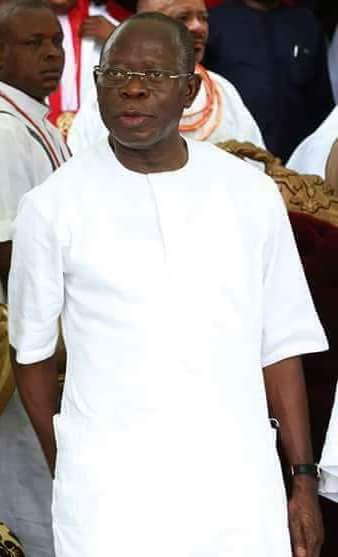
A human rights activist and anti-corruption crusader based in Benin City, Edo State, Bishop (Dr) Osadolor Ochei JP, has dragged the Economic and Financial Crimes Commission (EFCC) to a Federal high court sitting in Abuja.
The case has the EFCC and former Governor of Edo State, Mr Adams Oshiomhole, as first and second respondents.
The law suit is at the instance of EFCC’s refusal to attend to a well detailed petition of the Applicant (Bishop Osadolor) to the 1st Respondent dated 28th October, 2016 and published in the Daily Sun Newspaper of 7th November, 2016, together with other national newspapers, bothering on economic and financial crimes against the immediate past governor of Edo State.
In a motion ex-parte, the applicant, Bishop Ochei, is praying the court to as a matter of urgency compel the EFCC to commence the investigation and prosecution of the former governor in pursuant to Sections 6(b) & (h) and 13(2) of the EFCC Act, 2004.
The Applicant in his suit said he has complained to the 1st Respondent (EFCC) about allegations of corrupt practices as well as economic and financial crimes against the 2nd Respondent (Oshiomhole), on a number of occasions, without eliciting any response or interest from the 1st Respondent in this regard. The 1st Respondent failed to examine and investigate the said allegations upon such reports to it.
Bishop Ochei said that the 1st Respondent owes Nigeria and Edo State a duty to unearth the truth by meticulously investigating these allegations to ascertain the extent of complicity and culpability of the 2nd Respondent with respect to these allegations levelled against him.
The motion exparte filed by the applicant’s counsel West Idahosa & Co. stated the Respondent’s legitimate means of income as Governor. The 1st Respondent did nothing about the said petition. The petition and its annexures are attached as Exhibit “A”, while the satellite images of the compound, fence, and existing building are attached as Exhibits “A1, A2, A3, A4, A5 and A6”.
That on 4th November, 2016, the Applicant sent a petition to the 1st Respondent against the 2nd Respondent’s corrupt practices while he served as Governor of Edo State. Amongst the allegations made against the 2nd Respondent by the Applicant are the following:-
That the Applicant repeated the allegation that the 2nd Respondent built a sprawling mansion worth more than N10 billion in his home town known as Iyanho, Edo State. The said building was constructed by Verissimo, a South African Architectural outfit. The said house of the 2nd Respondent has swimming pools, water fountains, multiple theatres for cinema and live performances, huge event halls, bridges, manmade lake, lodges of different sizes amongst others. The said cost of building the mansion is well outside the 2nd Respondent’s legitimate income. The 2nd Respondent’s lifestyle and extent of the said property were not justified by his sources of income. The Applicant’s petition is attached as Exhibit “B”, while the reminder from the Applicant is attached as Exhibit “B1”.
That the 2nd Respondent bought a property along Okoro-Otun Avenue, G.R.A., Benin City owned by Edo State Government while serving as Governor of Edo State in an insider deal without due process and in abuse of his oath of office. The Okoro-otun property acquired by the 2nd Respondent was originally given to University of Benin as a gift by Edo State Government. The 2nd Respondent, while a dispute was pending in Court between University of Benin and Edo State Government, forcibly acquired the property for his personal use. The 2nd Respondent has since erected a structure with an underground apartment, roof-top swimming pool, another giant structure worth more than N500 million which is far beyond his legitimate income. At the time of the sale, the open market price of that magnitude of property and in that such high-brow location was about N100 million. This transaction took place while the 2nd Respondent was Governor of Edo State and he bought the said property for just N23 million via an Access Bank cheque.
That the 2nd Respondent authorized and awarded the highly inflated contract and payment within a relatively short time for the construction of 168 hostels rooms in Edo State University, Iyamho for the sum of N1.88 billion. The average cost per room translates to N10 million for each hostel room. This contract was awarded to the firm of A & K Construction Limited without compliance to due process. Similarly, the 2nd Respondent authorized and awarded the highly inflated contract of building the Teaching Hospital of the said University for the sum of N12.2 billion without compliance to due process. The Memorandum of Approval by the 2nd Respondent is attached as Exhibit “C”.
That the 2nd Respondent authorized and approved the diversion of N1.2 billion approved for the construction of a new accident and emergency ward complex and renovation of existing structures in the Central Hospital, Benin City for the payment of additional 10% advance payment to A & K Construction Limited for the construction of the Teaching Hospital of the University of Science and Technology, Uzairue (also known as Edo State University, Iyamho, without compliance with due process and against public interest. The Memorandum of Approval of the said diversion is attached as Exhibit “D”.
That the 2nd Respondent borrowed N25 billion from the capital market through the issuance of bonds. He purportedly paid the first N6 billion to Hitech Construction on March 2, 2011 and listed several roads as part of Phase One of the Storm Water Project to include Adolor College road, Textile Mill road, and a host of others. These roads are largely abandoned with little or no work done by Hitech Construction Company. The gullies created as a result of initial work have become major sources of flooding in Benin–City. More than six persons have been killed by this artificial flood.
That the 2nd Respondent authorized and awarded the construction of the 7.2 kilometer Ogba/Airport Road, Benin–City to Servetek Construction Company Limited for construction of drainage structures and dualization from Ring Road to Ogba River Bridge for industry record setting sum of N4.4 billion which translate to N611 million per kilometer without compliance with due process.
Following disputes with the company on how the money was to be shared amongst stakeholders, the company refused to work further and the contract was terminated. It was re-awarded to Setraco Nigeria Limited for over N12 billion, on the pretext that 17 Acres roads were to be constructed along the main Airport Road. It was later discovered that these access roads were re-awarded as stand-alone contracts with new cost tag. The contracts were awarded without compliance with due process.
That the 2nd Respondent authorized and awarded the construction of the Emergency/Accident Unit of the Central Hospital, Benin–City, to company for the sum of N2.7 billion and later reviewed same upwards to over N3 billion. The constructed building subsequently collapsed killing the owner of the company, Dr. Stefano De La Roca and confidant of the 2nd Respondent. The contract was thereafter re-awarded to another company, SCL without penalizing the previous company for the poor work done and thereby causing serious financial loss to Edo State. The said SCL is also one of the companies that constructed the Lord of the Manor Proto-type mansion and adjoining premises of the 2nd Respondents at Iyamho in Edo State.
That in 2012, the 2nd Respondent initiated and authorized the approach to the World Bank to secure a loan of $225 million under the First Edo State Growth and Employment Support Credit project with identification number “P123353”. The World Bank paid Edo State Government $75 million as initial payment and another $75million as second installment, despite massive protest by Edo people.
The said second installment which was domiciled in Access Bank was largely transferred to private off shore accounts and round tripped to the detriment of Edo State.
That the 2nd Respondent authorized and approved the counterpart fund scheme between Edo State Government and Bank of Industry with each party providing N250 million each. This agreement was reached in December, 2009. From the enquiries made by Applicant only N41.6 million was disbursed. The balance sum was diverted for personal gain and to the detriment of Edo State residents.
That the 2nd Respondent received over N500 million as security votes. These funds were diverted to proxy accounts according to available records. For instance, One Chief M.A. Kadiri collected sums of money approved by the 2nd Respondent and totaling about N42 billion. In December 2014, 2nd Respondent approved N700 million which was collected by the same Chief M.A. Kadiri on grounds of urgent security challenges when there was no security threat to justify the purported use of such an astronomically huge amount of money. The said funds were collected by Chief M.A. Kadiri for the benefit of the 2nd Respondent and to the detriment of the residents of Edo State. Copies of memoranda showing some of the receipts by Chief M.A. Kadiri, as approved by the 2nd Respondent are attached as Exhibits “E1-E4”, copies of some of the approvals are attached as Exhibits “E5-E11” and copies of payment vouchers are attached as Exhibits “E12-E22”.
That the 2nd Respondent approved the purchase of vehicles at ridiculous prices from Sata Motors Limited, a company owned by one Gani Audu who was also a Personal Assistant to the 2nd Respondent without compliance with due process and in abuse of the office of Governor of Edo State occupied by the 2nd Respondent. The vouchers are attached as Exhibits “F1, F2 & F3”.
That the 2nd Respondent purportedly acquired properties in United States of America, South Africa and Dubai worth billions of Dollars and far in excess of his legitimate income while serving as Governor of Edo State.
That on December 31st 2014, the N.N.PC. paid $54.9 million to Edo State Government and its Local Government Councils as contributions to Power Sector “Special Sector Intervention Fund”. That the money did not reflect in the income of the State till date was never captured by an Appropriation Act for the State. There is no place in Edo State where any project was built with funds from the so-called special Sector Intervention Funds. The said funds were merely diverted for the private use of the 2nd Respondent. Copies of the NNPC statement of transactions showing withdrawals from the Excess Crude Account and disbursement to Edo State are attached as Exhibit “G”.
That the petition of the Applicant to the 1st Respondent contained weighty allegations bothering on corrupt practices that ought to have been investigated given the effect of corruption on the stunted socio-political and economic growth of Nigeria to the detriment of all persons resident therein.
That the 1st Respondent owes Nigeria and Edo State a duty to unearth the truth by meticulously investigating these allegations to ascertain the extent of complicity and culpability of the 2nd Respondent with respect to these allegations.
That by the Applicant’s letter dated 28th October, 2016 and received by the 1st Respondent on 04/11/16, the attention of the 1st Respondent was drawn to the allegations made against the 2nd Respondent by the Applicant. The 1st Respondent failed or neglected to invite the 2nd Respondent for investigations into the said allegations.
That failing the said invitation of the 2nd Respondent by the 1st Respondent for investigations, the 2nd Respondent began to boast openly to his kindred that he was untouchable and that no anti-corruption agency of government would dare investigate him.
That in the Applicant said petition to the 1st Respondent, the Applicant laid out the allegations against 2nd Respondent and requested the 1st Respondent to investigate the said allegations. The Petition was published in the Daily Sun edition of Monday, November 7, 2016. The copy of the Newspaper publication is attached as Exhibit “H”. Copies of other newspapers are attached as Exhibits “H1, H2, H3 & H4”.
That following the said failure of the 1st Respondent to investigate the allegations against the 2nd Respondent, the Applicant wrote a reminder to the 1st Respondent and same was received by 1st Respondent on 13th December, 2016. Thereafter, one Barr. Eze of EFCC called the Applicant on telephone on 5th January, 2017, requesting for evidence to support the petition. On 9th January, 2017, the Applicant sent the documentary evidence and analysis of evidence done by him to the 1st Respondent by DHL with tracking number 6888917195. The said document was delivered to 1st Respondent on 12th January, 2017 at 09.01am and was received by one Daniel Tsamiya. A copy of the reminder is attached as Exhibit “I”.
That despite the said petition and the reminder sent by the Applicant to the 1st Respondent, demanding that it performs its duty by investigating the allegations against the 2nd Respondent, the 1st Respondent did not investigate the 2nd Respondent or even reply the Applicant’ letters.
That consequent upon the refusal of the 1st Respondent to investigate and prosecute the 2nd Respondent, the Applicant has no option than to approach the court of law for an order mandating the 1st Respondent to perform its statutory duties as required by law.
That the Applicant is an indigene of Edo State who is entitled to enjoy the benefits of good erosion / flood control, good roads, adequate security coverage and other rights flowing from their residency in Edo State and citizenship of Nigeria; which they have been denied as a result of the corrupt activities of the 2nd Respondent.
17. That the Applicant is a fulltime clergy man, being a Bishop of the Divine Heavenly Vision International Ministry Inc., Benin City. He lives on offerings from the church and has no earnings upon which he can be taxed. His church does not engage in any form of business whatsoever.
18. That the Applicant is a dutiful citizen of Nigeria who is committed to the performance of his duties to the nation in order to make positive contributions to the advancement, progress and well-being of the country.
19. That the Applicant, pursuant to his constitutional duties to render assistance to appropriate and lawful agencies in the maintenance of law and order sent several petitions to the 1st Respondent complaining about the economic and financial criminal activities of the 2nd Respondent in his capacity as Governor of Edo State from 2008 to 2016. The Applicant did not receive any positive response from the 1st Respondent despite petition, reminder, documentary evidence and numerous visits to the headquarters of the 1st Respondent with respect to the said petitions.
20. That the said petitions are in public interest and are supported by ample documentary evidence. The petitions did not seek any particular method in which the 1st Respondent was to do its job other than to invite the 1st Respondent to investigate the allegations made against the 2nd Respondent.
21. That the Applicant is specially aggrieved by the failure of the 1st Respondent to act on the said petition for the following reasons:
As a result of the mis-use and abuse of public funds by the 2nd Respondent, the road leading to the Applicant’s house and other roads in the locality remained untarred despite several requests from the Applicant to Edo State Government to do so and the said government continually claimed that they had no sufficient funds while 2nd Respondent was busy expending public funds on his expensive lifestyle, including acquiring mansions all over the world at costs outside his legitimate income. Several letters from the Applicant’s community to the 2nd Respondent requesting the development of the said community are attached as Exhibits “J1, J2, J3 & J4”.
The failure to tar Applicant’s road and other roads in the locality has led to frequent repairs on Applicant’s car and loss of valuable time due to frequent visits to mechanic workshops. The same is applicable to others who reside in the area. The receipts of repairs of Applicant’s car are attached as Exhibits “K1, K2 & K3”.
The Applicant and many other ordinary citizens had a hard time gaining access to medicare as the Central Hospital in Benin City which 2nd Respondent claimed to have spent billions of naira of public funds on was not equipped and remained non-functional. Applicant and others had to practically beg for contributions to receive medicare from private hospitals.
These reasons prompted Applicant to carry out an enquiry into how 2nd Respondent’s spent public funds belonging to Edo State and Applicant found out that 2nd Respondent was not prudent in the use of such funds and frequently diverted funds meant for the development and security of the State to private use.
The Applicant found out that the 2nd Respondent wasted hundreds of millions of naira on chartered flights, when public facilities in the State were abandoned and the public denied the benefit of these facilities. Copies of the approved vouchers for some of such chartered flight expenditure are attached as Exhibits “L1 – L13”.
The 2nd Respondent spent millions of naira for choice drinks when major public facilities like roads, hospitals and schools were in dilapidated conditions. Copies of the approved vouchers for the purchase of soft-drinks are attached as Exhibits “M1-M22”.
That the failure of the 1st Respondent to act on the Applicant’s petitions gave the impression that public officers are entitled to use public funds arbitrarily and outside public good.
That the failure of the 1st Respondent to act on the Applicant’s petitions was contrary to Section 15(5) of the 1999 Constitution (as amended) which enjoins the State to abolish corrupt practices.
That the failure of the 1st Respondent to act on the Applicant’s petitions has enabled the 2nd Respondent’s successor in office, Godwin Obaseki, to largely continue with the 2nd Respondent’s arbitrary and corrupt use of public funds.
That the Applicant would continue to suffer lack of access to good roads, medicare and other government subsidized essential facilities due to the failure to investigate the Applicant’s petitions against the 2nd Respondent and prosecute him accordingly by the 1st Respondent in other to serve as deterrent to other public office holders in Edo State.
That the Applicant as a dutiful citizen is desirous of ensuring that the war against corruption which is founded on the 1999 Constitution is fought without regard to a suspect’s political affiliation or class. The 2nd Respondent is an APC Stalwart and is taking advantage of his membership of the ruling party to influence the 1st Respondent from doing its job.
That the 1st Respondent has investigated similar petitions against public officers of opposition parties and prosecuted them for lesser offences.
That since then the Applicant who is resident in Benin City has repeatedly visited the office of the 1st Respondent in Abuja to no avail. Even in April, 2018, the Applicant visited the 1st Respondent’s said office for a feedback and was snubbed as usual.
That the Applicant being a citizen of Nigeria interested in the Rule of Law, the Supremacy of the Constitution and the enforcement of existing laws has instituted this action to ensure that the 1st Respondent appears before this honourable court to explain why the very strongly worded petition, backed with facts and a prima facie case were not treated by the 1st Respondent despite the duty imposed on it by the law to do same.


By Dipo Olowookere
The need for Africa to protect itself from many external shocks not of its making has again been emphasised by the African Development Bank (AfDB), the African Union Commission (AUC), the United Nations Development Programme (UNDP), and the UN Economic Commission for Africa (UNECA).
On the margins of the 58th session of the Economic Commission for Africa in Tangier, Morocco, the continent was tasked to strengthen regional integration, accelerate African-led financial solutions, and invest decisively in energy, food, and trade resilience so as to move from vulnerability to preparedness.
The meeting focused on the spikes in energy, food and fertiliser prices caused by the ongoing conflict in the Middle East.
The United States and Israel launched airstrikes on Iran in February 2026, and since then, global oil prices have surged by more than 50 per cent as of late March. Twenty-nine currencies in Africa have weakened, raising the cost of servicing external debt and importing food, fuel, and fertiliser.
Disruptions linked to Gulf energy supplies limit access to ammonia and urea during the critical March–May planting season. This will affect agricultural production, compounding risks of crisis and emergency levels of food insecurity, especially for low‑income households and import‑dependent economies.
To address these issues, the quartet has asked African leaders to, in the short-term, stabilise fuel, food, and fertiliser supply, and execute medium‑term reforms to strengthen energy security, targeted social protection, and regional trade under the African Continental Free Trade Area (AfCFTA).
They also tasked leaders to come up with long‑term structural reforms towards stronger domestic resource mobilisation and African financial safety nets, including accelerated implementation of the African Financing Stability Mechanism.
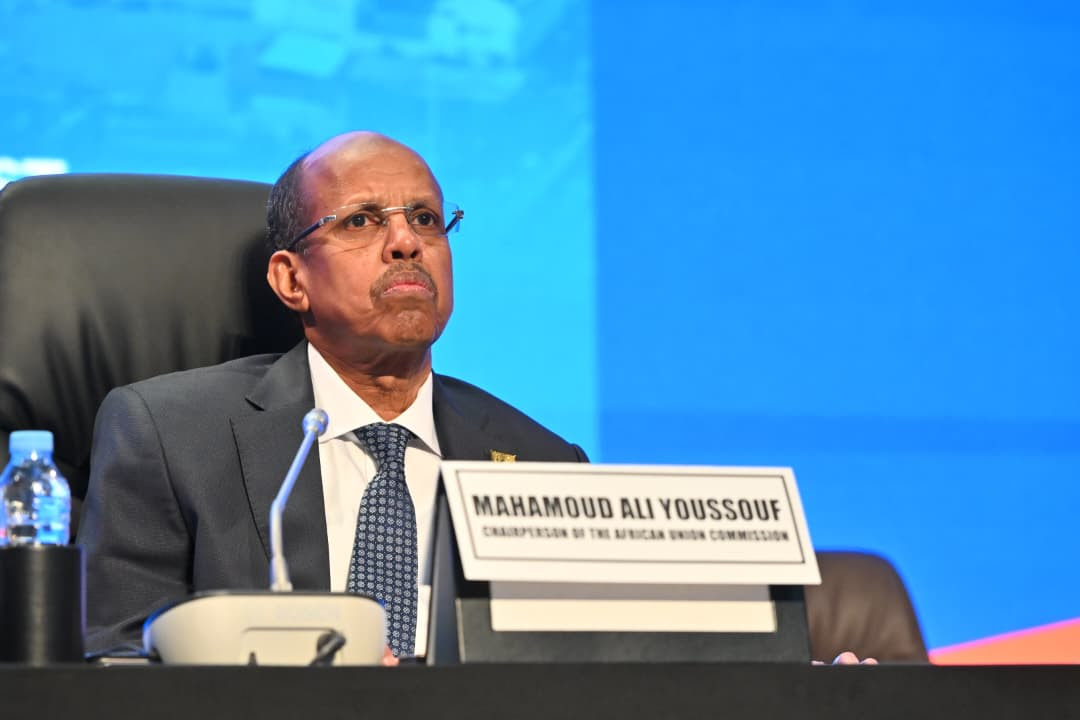
“Continued escalation of the conflict worsens global instability, with serious implications for energy markets, food security, and economic resilience, particularly in Africa, where economic pressures remain acute,” the chairperson of AUC, Mr Mahmoud Ali Youssouf, said.
Also commenting, the UN Under-Secretary-General and Executive Secretary of UNECA, Mr Claver Gatete, said, “Africa has been hit by too many external shocks not of its making. Crises like this reinforce why Africa must finance more of its own future and strengthen regional solutions that build resilience before the next shock hits.”
On her part, the UN Assistant Secretary‑General and Director of UNDP’s Regional Bureau for Africa, Ms Ahunna Eziakonwa, submitted that, “With the right mix of policy choices, financing tools, and political resolve, Africa can weather this shock and emerge more resilient, more self-reliant, and better positioned to shape its own economic future.”
“As global crises multiply, Africa’s response must evolve from managing shocks to fostering resilience. African institutions and development partners need to act swiftly and in concert, leveraging their comparative advantages to cushion short-term shocks while laying the foundations for long-term resilience,” the president of AfDB, Mr Sidi Ould Tah, stated.

By Adedapo Adesanya
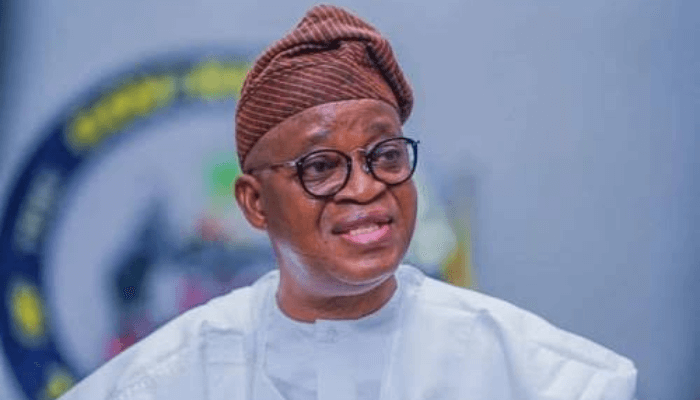
The Minister of Marine and Blue Economy, Mr Adegboyega Oyetola, has issued a strong warning to heads of agencies under the ministry, demanding strict accountability and measurable results.
Mr Oyetola issued the warning during the signing of performance bonds with heads of maritime agencies at the Ministerial Management Retreat, held alongside the 2026 first-quarter stakeholders’ engagement in Lagos on Thursday, where he emphasised the need for performance-driven governance.
“Let me emphasise that all Departments and Agencies under the Ministry must remain firmly focused on delivering tangible results,” he said.
In a statement by Mr Bolaji Akinola, Special Adviser to the Minister, Mr Oyetola noted that performance bonds to be signed during the retreat are binding commitments that will be closely monitored and rigorously evaluated.
“These are not ceremonial documents. They are binding commitments. Accountability will not be optional,” the Minister declared.
Mr Oyetola reiterated the need for data-driven decision-making, robust monitoring and evaluation frameworks, and alignment with the Ministry’s strategic objectives.
“At the institutional level, we must remain disciplined and accountable. Every department and agency must deliver measurable outcomes,” he added.
He explained that the retreat was designed to foster alignment between policy formulation, implementation, and stakeholder expectations.
“The integration of this engagement enables us to listen, reflect, and recalibrate,” he said.
The agencies include the Nigerian Ports Authority (NPA), Nigerian Maritime Administration and Safety Agency (NIMASA), Nigerian Shippers’ Council (NSC), National Inland Waterways Authority (NIWA), Maritime Academy of Nigeria, and the Council for the Regulation of Freight Forwarding in Nigeria.
He also announced a 160 per cent increase in revenue generated by agencies under the ministry, attributing the growth to sweeping reforms and a renewed focus on accountability.
“In 2023, our agencies generated N700.79 billion. By the end of 2025, this figure had risen to approximately N1.83 trillion. This remarkable achievement is the result of deliberate and sustained reforms,” he stated.
The Minister explained that the gains were driven by strengthened regulatory oversight, improved revenue assurance mechanisms, digitalisation of key processes, and a firm commitment to blocking leakages.
“This gathering reflects our commitment to a governance approach that is inclusive, transparent, and results-driven,” he added, noting that the convergence of stakeholders, policymakers, and institutional leaders was designed to align policy with implementation and public expectations.
Mr Oyetola linked the ministry’s improved performance to broader sectoral reforms, including port modernisation, approval for disbursement of the Cabotage Vessel Financing Fund (CVFF), and ongoing efforts to enhance indigenous participation in maritime activities.

By Modupe Gbadeyanka
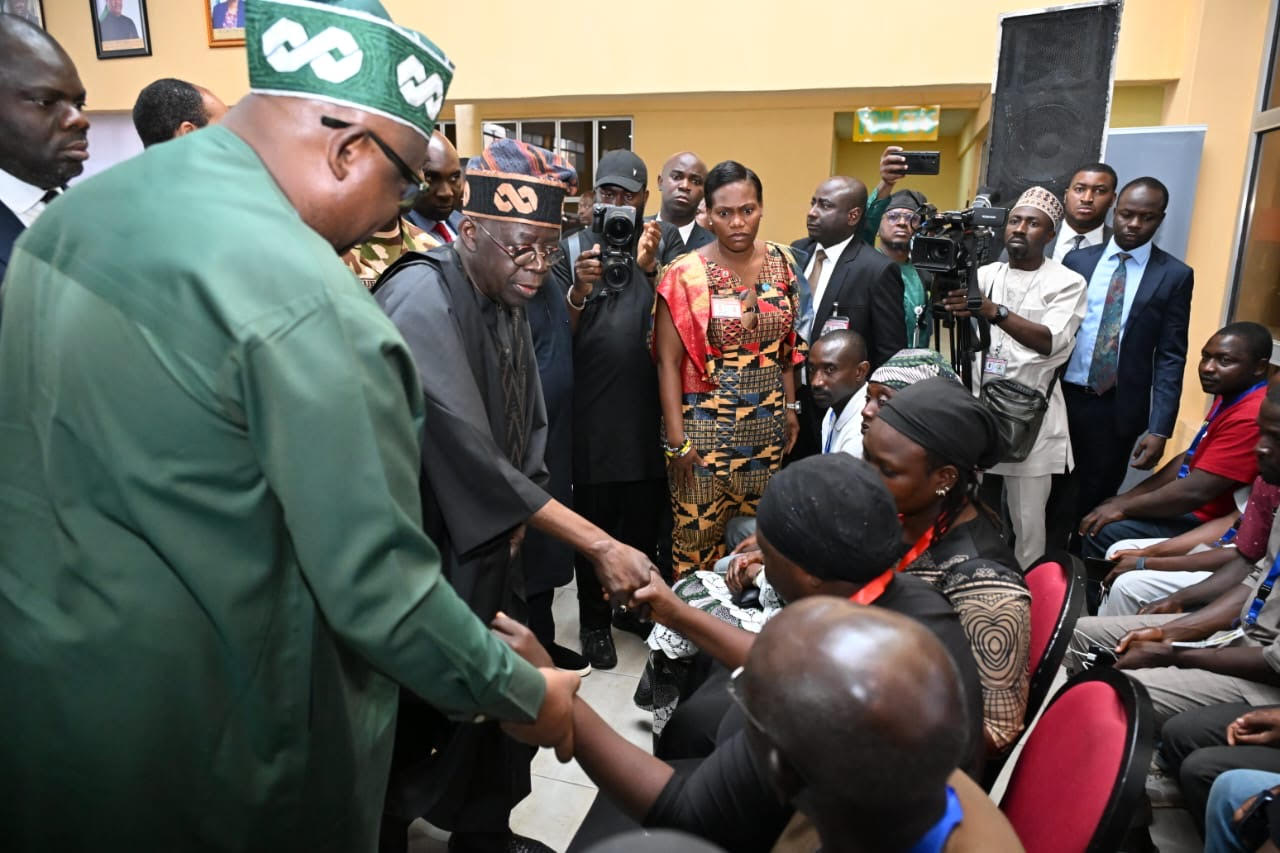
The Special Adviser to the President on Information and Strategy, Mr Bayo Onanuga, has explained why Mr Bola Tinubu addressed the victims of the Plateau attacks at the airport on Thursday evening.
The decision of President Tinubu to console victims of the attacks, which left over 20 persons dead, at the Yakubu Gowon Airport in Jos last night has continued to generate reactions.
He was criticised for not visiting the victims at the epicentre, Angwan Rukuba, instead of having them to travel to meet with him at the airport.
In a statement on Friday, Mr Onanuga said his principal’s itinerary for yesterday included two main engagements: receiving the Chadian President, Mahamat Idriss Déby Itno, and proceeding to Iperu, Ogun State.
“After Governor Caleb Mutfwang’s briefing, President Tinubu suspended the trip to Ogun. Overnight, the Presidential Villa made arrangements for the visit to Jos, with presidential assets quickly deployed. However, the President could not postpone the scheduled visit by the Chadian leader.
“The President of Chad was at the Presidential Villa for a very important bilateral meeting focused on strengthening security collaboration between the two countries. The meeting ran longer than expected, affecting President Tinubu’s scheduled departure for Jos.
“Upon arrival in Jos, the visit encountered some logistical challenges. While the road distance from the airport to Jos township is approximately 40 minutes, the runway does not support night flights due to the absence of navigational aids. The constraints made it unfeasible to drive into town, meet victims for on-the-spot assessment and return to the airport before dusk.
“Consequently, state and federal officials decided to bring representatives of the affected community to a hall adjoining the airport so the President could meet with them promptly while adhering to flight restrictions. Among the people in the hall were the Minister of Defence, the Chief of Army Staff and the Inspector General of Police, who had visited Rukuba, the epicentre of the conflict. President Tinubu deployed the high-level team to Rukuba, including the Senior Special Assistant on Community Engagement, to undertake critical groundwork on security and community engagement, with a view to stabilising the area before his arrival.
“Beyond expressing his condolences to the victims, President Tinubu’s objective was to engage with critical stakeholders in Plateau State on ending the recurring, decades-old conflict that has resulted in needless loss of lives and property.
“President Tinubu’s visit to Jos was not merely symbolic. It was a strategic, high-level engagement aimed at bringing all stakeholders together to address the root causes of conflict and insecurity in the state.
“He interacted with the victims, consoled them, and listened to them. He also listened to local leaders and assured them that the federal government would deliver justice and end the cycle of violence. He promised the deployment of 5000 AI-enabled cameras to monitor the city and enhance the identification and arrest of troublemakers.
“Furthermore, the President invited the community leaders to Abuja for further talks on finding a lasting solution to the recurring violence in the state.
“The meeting, televised live, was solemn and reassuring, boosting residents’ confidence. President Tinubu achieved the purpose of his visit, despite the naysayers’ attempts to ridicule it. He dropped an unmistakable message: sustainable peace must be built with the people, not imposed on them,” the presidency explained.
-
 Feature/OPED6 years ago
Davos was Different this year
-
Travel/Tourism10 years ago
Lagos Seals Western Lodge Hotel In Ikorodu
-

 Showbiz3 years ago
Estranged Lover Releases Videos of Empress Njamah Bathing
-
 Banking8 years ago
Sort Codes of GTBank Branches in Nigeria
-

 Economy3 years ago
Subsidy Removal: CNG at N130 Per Litre Cheaper Than Petrol—IPMAN
-

 Banking3 years ago
Sort Codes of UBA Branches in Nigeria
-

 Banking3 years ago
First Bank Announces Planned Downtime
-

 Sports3 years ago
Highest Paid Nigerian Footballer – How Much Do Nigerian Footballers Earn