Connect with us

Media OutReach

A Signal Through the Mountains: Zhejiang Mobile’s 5G Brings Care to Rural China

Published

on

LISHUI, CHINA –

The mountain county of Jingning She Autonomous County in Zhejiang’s Lishui City introduced its “Smart Mobile Hospital + AI” model — an innovation that shows how digital transformation can bring quality medical services to remote regions.

Delegates said the project offers a glimpse into how technology can bridge healthcare gaps for mountain communities, where access to doctors has long been limited by geography.

For 81‑year‑old Liu Yuyu, those gaps used to mean several hours on steep mountain roads just to see a specialist in Hangzhou, the provincial capital. Now she simply visits her township clinic and meets doctors through a high‑definition screen. Her entire medical history, stored in Zhejiang’s cloud‑based health system, allows specialists hundreds of kilometers away to review her data and adjust treatment in real time.

Such changes are reshaping healthcare in Jingning She Autonomous County in Lishui City, Liu’s mountainous hometown in eastern Zhejiang. Powered by Zhejiang Mobile’s 5G network, artificial intelligence and big‑data tools, the “Smart Mobile Hospital + AI” program is bringing advanced care to even the most remote villages.

In Jingning, known as a land of “nine parts mountain, half part water and half part field,” visiting a doctor has long been a challenge. Some residents still spend an hour to reach a township clinic and more than two hours to the county hospital. With the new system, consultations and diagnostics once requiring a trip to the city can now happen almost instantly.

To overcome the region’s rugged geography, Zhejiang Mobile has transformed its service vehicles into 5G‑enabled mobile clinics. Each van maintains a stable signal on winding roads, transmitting high‑resolution images and test results to upper‑level hospitals. Inside, AI‑based software analyzes symptoms and supports local doctors in diagnosing patients and recommending treatments.

Each vehicle works as a mini hospital, equipped with more than 20 types of medical devices — from portable ultrasounds and ECG monitors to lung‑function analyzers. Township physicians can perform examinations, prescribe medication, and even provide emergency care on site. For complicated cases, they connect instantly with specialists in city or provincial hospitals through the same 5G network.
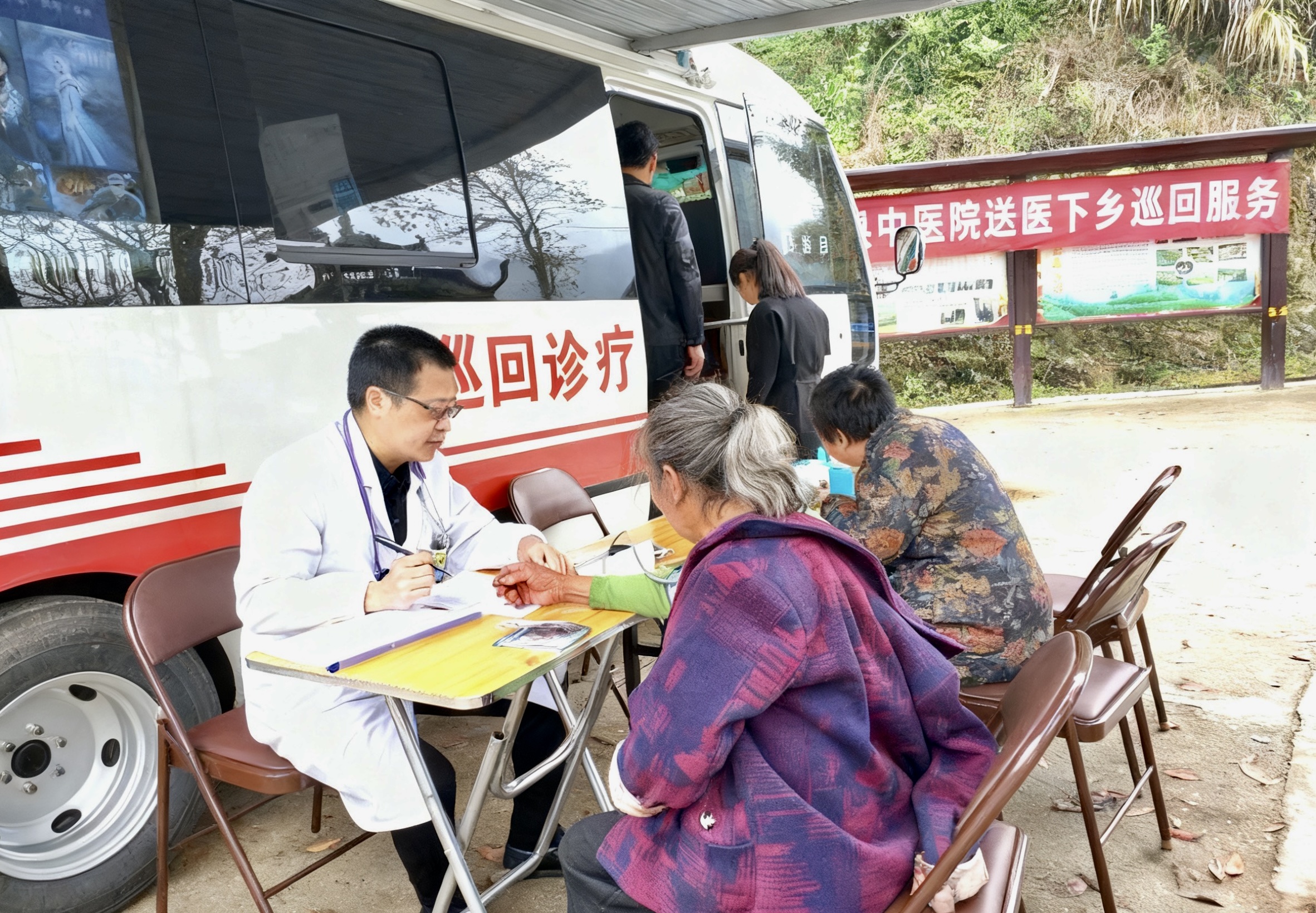
Inside the Zhejiang Mobile 5G‑enabled mobile clinic, a doctor is using connected diagnostic devices to examine patients and transmit real‑time data to upper‑level hospitals.

Local health authorities say Zhejiang Mobile’s platform helps automate the screening of chronic illnesses such as hypertension, coronary heart disease and cataracts, recommending drugs or further tests. This has significantly improved early detection and reduced serious cases among elderly residents.

To make the “Smart Mobile Hospital” serve not only daily clinical needs but also emergency response, Zhejiang Mobile worked with local authorities to connect data systems across public security, civil affairs and social‑insurance departments. The company helped build an integrated workflow that unites pre‑hospital emergency services with in‑hospital treatment.

When an emergency occurs in a remote mountain area, the system can automatically match and dispatch both a mobile hospital and an ambulance, ensuring rapid, coordinated rescue.

“When patients board the vehicle, facial‑recognition technology immediately confirms their identity and retrieves family and insurance information,” said Chen Lifeng, the director of the Dajun Township Health Center in Jingning County. “All registration and admission procedures are completed in advance, so the patient is effectively admitted upon boarding.”

Through a real‑time 5G link between the vehicle and the hospital, vital‑sign data is transmitted to emergency rooms as doctors provide remote guidance. This enables continuous treatment across the chain — from rescue site to vehicle to hospital.

Seven Zhejiang Mobile medical units now serve Jingning County, covering 67 villages and 78 regular stops. They have traveled more than 250,000 kilometers and delivered care to over 100,000 residents. For families once separated from modern healthcare by mountains, access is finally within reach.

Local doctors say 5G and AI are changing not only how patients are treated but how they think about medicine. Regular screenings catch illnesses earlier, and growing trust in remote consultations encourages people to seek help sooner.

As China continues modernizing its vast primary‑healthcare network, Jingning’s experiment is being closely watched. Zhejiang Mobile’s Smart Mobile Hospital may become a model for other remote regions seeking affordable, technology‑driven medical solutions.

Liu, who once dreaded the long trip to the city, now jokes that her doctors travel farther than she does. “They come here through the screen,” she says with a laugh. “And I don’t miss the bus anymore.”

Hashtag: #ChinaMobileCommunicationsGroupZhejiang

The issuer is solely responsible for the content of this announcement.

Media OutReach

The 7th Cross-Strait Financial Forum and Taiwan-Funded Enterprise Development Forum

Published

on

XIAMEN, CHINA – Media OutReach Newswire – 12 Jun 2026 – On June 12, the 7th Cross-Strait Financial Forum and Taiwan-Funded Enterprise Development Forum was held in Xiamen.The event was jointly organized by the Fujian Provincial Financial Regulatory Administration, the Xiamen Municipal Financial Regulatory Administration, and the Association of Taiwan Investment Enterprises on the Mainland, hosted by Xiamen Jinyuan Investment Group, and executed by Jinyuan Uni-President Securities. Under the theme “Three Years of Integration Embarking on a New Journey, United Development Writing a New Chapter,” the forum focused on cross-strait financial cooperation, expanded financing channels for Taiwan-funded enterprises, industrial transformation and upgrading, and financial innovation between Fujian and Taiwan. It aimed to support Fujian’s efforts to accelerate the development of the first-choice home for Taiwan compatriots and Taiwan-funded enterprises on the mainland.

This year’s forum is an important supporting event of the 18th Cross-Strait Forum. During the event, nine Fujian-Taiwan financial integration projects were signed, with a total value of RMB 9.1 billion. The projects cover a wide range of financial services across areas including cross-strait industrial cooperation, water supply security for public welfare, capacity upgrades for long-established Taiwan-funded enterprises, technology and innovation industries, and modern agriculture. These initiatives continue to unlock the benefits of financial policies, promote shared access to financial resources for Taiwan compatriots and Taiwan-funded enterprises, and inject new momentum into industrial integration between Fujian and Taiwan.

At the forum, the Cross-Strait Wealth and Asset Management Cross-Sector Alliance was officially inaugurated. Supported by Jinyuan Group and jointly proposed by its affiliated financial institutions, the alliance was co-founded by Xiamen International Trust, Jinyuan Uni-President Securities, Yuanxin Yongfeng Fund, Fubon Bank (China), Junlong Life Insurance, and Xiamen Chang Gung Hospital, among others. Centered on serving the wealth management and asset management needs of people on both sides of the Taiwan Strait, the alliance aims to build a one-stop service platform covering asset allocation for Taiwan compatriots and Taiwan-funded enterprises on the mainland, family trusts and wealth succession planning, pension finance, and healthcare protection solutions.

The forum also unveiled a series of innovative financial achievements related to Taiwan. The banking industry’s first group standard dedicated to Taiwan-related financial services on the mainland, the “Specification for Taiwan-Related Financial Services of Banking Financial Institutions,” was officially released. At the same time, the “Bailufen” Taiwan Compatriot Financial Service Platform was introduced, further enhancing financial services for Taiwan compatriots living in Fujian and supporting the development of Taiwan-funded enterprises.

Hashtag: #StraitsFinancialForum

The issuer is solely responsible for the content of this announcement.

Continue Reading

Media OutReach

Verdant Rock Receives BBB+ Long-Term Insurer Financial Strength Rating with a Stable Outlook from Fitch Ratings

Published

on

HAMILTON, BERMUDA – Media OutReach Newswire – 12 June 2026 – Verdant Rock Limited has received a BBB+ Long-Term Insurer Financial Strength Rating with a Stable Outlook from Fitch Ratings effective 12 June 2026. Combined with a Class 3B Insurer license from the Bermuda Monetary Authority (BMA), effective 6 May 2026, the company is in a strong position to extend financial guarantees on bonds and loans in emerging markets for beneficiaries globally. We provide irrevocable, unconditional, on-demand financial guarantees designed to qualify as eligible credit protection under Basel and major insurance solvency regimes. We are focused on private liabilities and do not cover sovereigns, municipalities or provinces. Bonds and loans issued by emerging market corporations and banks, structured financings, asset-backed (ABS) and mortgage-backed (MBS) exposures in securities or loan format, and project finance are all within the Company’s remit.

“The infrastructure and capital markets we are targeting have been systematically underserved over the past decade. Verdant Rock enters this space with an investment grade rating, a strong capital position, the regulatory standing, the technical capability, and the long-term commitment that issuers and their advisers have been unable to find elsewhere.”

— Tolga Uzuner, Co-Founder, Chief Executive Officer, Verdant Rock Limited

The Fitch Ratings report can be accessed here:
Fitch Rates Verdant Rock at ‘BBB+’; Outlook Stable

Verdant Rock’s Class 3B registration can be verified via the BMA’s register of regulated entities (search “Verdant Rock”): https://www.bma.bm/regulated-entities

Notes to editors: For the May 2026 licensing announcement, see https://bernews.com/2026/05/walkers-supports-verdant-rock-licensing/

This announcement is (i) for information only; (ii) not an offer or solicitation to buy or sell any security, insurance product, or financial guarantee; and (iii) not for distribution in any jurisdiction where to do so would be unlawful. Forward-looking statements are not guarantees of future results, and Verdant Rock undertakes no obligation to update them. A credit rating is not a recommendation to buy, sell or hold any security and may be subject to revision, suspension or withdrawal at any time by the assigning rating agency.

Hashtag: #VerdantRock

The issuer is solely responsible for the content of this announcement.

ABOUT VERDANT ROCK

Verdant Rock Limited is a Bermuda-based insurance company, regulated by the Bermuda Monetary Authority, providing Basel III and Solvency II compliant financial guarantees in emerging markets, designed to qualify as eligible credit protection under Basel and major insurance solvency regimes, for the benefit of institutions globally.

Continue Reading

Media OutReach

TVBS deploys AI translation for NVIDIA GTC Taipei keynote

Published

on

TAIPEI, TAIWAN – Media OutReach Newswire – 12 June 2026 – TVBS deployed its self-developed real-time AI translation system during NVIDIA CEO Jensen Huang’s keynote at GTC Taipei 2026 on June 1. The system delivered near-simultaneous Chinese subtitles that viewers initially mistook for official NVIDIA translations. The in-house technology marked a rare instance of a news organization independently developing live translation for a large-scale broadcast.

TVBS deployed its self-developed real-time AI translation system during NVIDIA CEO Jensen Huang’s keynote at GTC Taipei 2026 on June 1.

Online viewers praised the translation quality, with comments including “The quality of this real-time translation is amazing,” “The translation is incredibly fast,” and “The live speech recognition quality is surprisingly good.” Some viewers assumed the subtitles came from NVIDIA’s official translation team.

The achievement demonstrates how Taiwan’s media industry is adapting to AI-driven transformation. TVBS is positioning itself as a leader in integrating proprietary AI development with real-world broadcast applications. The company completed optimization and deployment of the system in just nine days — a process that traditionally requires months of dedicated training, according to Andy Yang, manager of TVBS AI Future Technology Department.

Yang explained that the biggest challenge in real-time translation lies in balancing “content accuracy” with “reading fluency” under extremely tight time constraints. Huang’s speaking style is highly improvisational and frequently switches between English, Mandarin and Taiwanese, while audience applause and cheering often occur simultaneously.

Applying standard off-the-shelf translation software in such an environment would likely result in sentence segmentation errors and unclear semantic interpretation, Yang said. Rather than pursuing “zero-latency” translation at all costs, TVBS designed a subtitle presentation mechanism specifically tailored to the keynote format.

Prior to the event, the TVBS team conducted extensive cross-platform testing on multiple AI translation models, evaluating latency and error rates. By introducing a carefully calibrated broadcast delay, the system gained additional time to process semantic meaning and contextual alignment. This approach enabled smoother subtitles matching natural Chinese reading habits, Yang said.

The team also built a dedicated knowledge base for NVIDIA GTC Taipei, compiling AI industry terminology, product names and technical keywords in advance. This significantly improved translation quality and the accuracy of professional content delivery. TVBS’s real-time translation system can be customized based on different broadcasting scenarios, Yang noted.

Yang emphasized that the key to the rapid nine-day deployment was cross-department collaboration. Engineering teams handled hardware tuning and signal integration, while internal technical and content teams managed ongoing model training and refinement. TVBS established a collaborative workflow integrating both technology and editorial expertise.

Through continuous iteration and adjustment, the team incorporated Taiwanese linguistic nuances and natural Chinese phrasing into the system. This enhanced fluency and readability beyond what generic AI models alone could achieve, ultimately shaping what Yang called a distinct “TVBS AI style.” The approach reflects the company’s “3T” philosophy — Truth, Trust and Technology.

In his keynote at the Taipei Music Center, Huang focused on AI infrastructure, next-generation computing platforms and NVIDIA’s latest technological roadmap. GTC Taipei 2026 attracted significant international attention as AI continues to reshape global industries. Through its own transformation journey, TVBS hopes to help lead Taiwan’s media industry into a new era shaped by AI.

Hashtag: #TVBS

The issuer is solely responsible for the content of this announcement.

Continue Reading

Trending