

Connect with us

Media OutReach

ACE ROBOTICS Open-Sources Kairos-HomeWorld , Enabling Fully Interactive Whole-Home 3D Scene Generation from a Single Prompt

Published

on

  • Kairos-HomeWorld is purpose built for embodied intelligence and represents the first unified framework capable of generating a complete, fully interactive home environment from a single text prompt. Extending indoor scene generation beyond individual rooms, it enables whole-home simulation in which every object is fully manipulable within an integrated simulation engine.
  • Kairos-HomeWorld employs a four-stage hierarchical architecture encompassing floorplan generation, 2D-to-3D lifting, recursive refinement, and manipulable object placement. This approach enables the production of globally coherent, physically accurate, and simulation-ready scenes. Each environment contains more than 15 manipulable objects and achieves a Footprint Object Density of 4.16, the highest among compared methods.
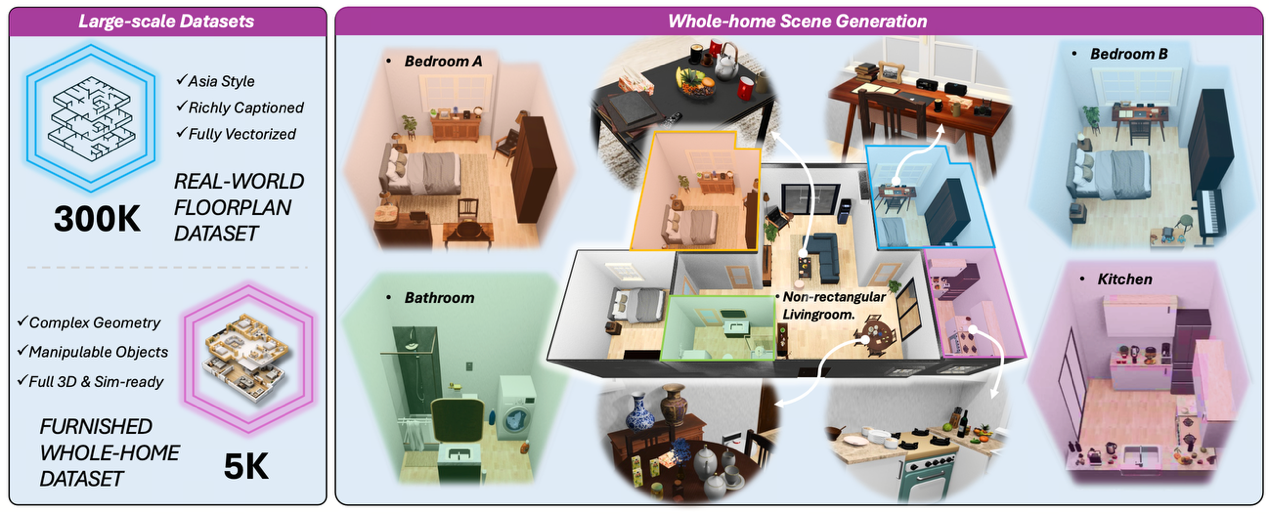
  • The accompanying open-source dataset is purpose-built for Chinese households, pairing 300,000 real residential floor plans with 5,000 fully furnished, simulation-ready homes and 50,000 physics-enabled interactive object assets. Already deployed in ACE ROBOTICS’ daily robot training, it significantly accelerates the simulation-to-reality transfer cycle.

SHANGHAI, CHINA – Media OutReach Newswire – 5 June 2026 – ACE ROBOTICS, in collaboration with the Multimedia Laboratory at The Chinese University of Hong Kong (CUHK) and Shenzhen Loop Area Institute, today announced the open-source release of Kairos-HomeWorld, the industry’s first unified World Model framework capable of generating full home-scale, object-level interactive 3D environments from a single text prompt. The solution addresses longstanding limitations in indoor scene generation, which has typically been restricted to single-room outputs with weak global consistency and limited interactivity. Kairos-HomeWorld overcomes these constraints by delivering structurally coherent, physically plausible, and functionally complete residential environments. These high-fidelity, large-scale simulations provide a robust foundation for advancing embodied intelligence applications and accelerating real-world robot training.

The long-term vision for embodied intelligence is the home environment. However, residential settings are inherently diverse and highly personalized, requiring robots to be trained across a broad range of realistic and differentiated scenarios before they can reliably operate in even a single household. High-fidelity simulation offers the most practical pathway to achieving this at scale, yet existing approaches typically involve a trade-off: synthetic environments lack realism, while scanned real-world scenes offer limited interactivity. Kairos-HomeWorld, together with its accompanying dataset, is designed to bridge this gap, delivering both realistic and interactive environments within a unified framework.

A four-stage architecture for whole-home, object-level generation
Conventional approaches to indoor scene generation remain constrained to single-room outputs, often exhibiting weak global consistency, frequent physical inaccuracies, and limited or no interactivity. Kairos-HomeWorld takes a fundamentally different approach. It decomposes whole-home generation into a structured, four-stage process, redefining the underlying architectural paradigm from the ground up.

Stage 1 — Floor Plan Generation. A K-D tree-based approach translates real-world floor plans into a hierarchical text representation that can be efficiently processed by large language models (LLMs). This method mitigates common issues in conventional layout generation, including room overlaps and fragmented topologies, resulting in more coherent and structurally consistent spatial configurations.

Stage 2 — 2D-to-3D Lifting & Furniture Layout Generation. A “top-down global initialization combined with a first-person detail walkthrough” approach anchors the process to the 3D building shell generated in Stage 1. This methodology mitigates the geometric drift commonly associated with conventional 2D-to-3D lifting techniques, enabling more stable and spatially consistent scene generation.

Stage 3 — Recursive Refinement. A fine-tuned vision-language model performs iterative validation and correction, automatically identifying and resolving physical inconsistencies, such as obstructed doorways or object collisions. This recursive process materially reduces spatial errors, achieving among the lowest reported furniture-collision rates in the industry.

Stage 4 — Manipulable Object Placement. A surface-centric placement algorithm assigns each object detailed physical properties, including material composition, density, friction, and structural support relationships. Each generated scene incorporates an average of more than 15 manipulable objects and achieves a Footprint Object Density (FOD) of 4.16, a metric reflecting the concentration of items across furniture surfaces. All objects are natively compatible with simulation engines, enabling direct interaction for tasks such as grasping, movement, and stacking.

The resulting environments move beyond “viewable but not actionable” outputs. Their coherent spatial structure enables seamless, continuous navigation across multiple rooms, while objects embedded with realistic physical properties allow robots to simulate complex household tasks end-to-end. Taken together, this approach addresses key limitations in existing data pipelines, resolving the scarcity of high-quality 3D simulation data, the lack of realism in synthetic environments, and the limited interactivity of scanned scenes within a single unified framework.

The dataset: 300,000 real floor plans, 5,000 fully interactive homes, built for Chinese households
ACE ROBOTICS and CUHK are open-sourcing a dataset of 300,000 structurally annotated residential floor plans, sourced from real-world listings and processed through a multi-stage automated pipeline. The pipeline vectorizes and labels key spatial elements, including door and window positions, room geometry, functional zoning, and connectivity. By comparison, widely used benchmarks such as RPLAN and ResPlan contain approximately 80,000 and 17,000 floor plans, respectively, underscoring the scale and comprehensiveness of the Kairos-HomeWorld dataset.

Building on this foundation, the dataset also includes 5,000 fully furnished residential environments, each featuring a complete furniture layout and an average of more than 15 physics-enabled, manipulable objects, powered by the PhysX-Omni model. All assets are sim-ready and can be directly imported into a simulation engine, enabling immediate use in interactive training scenarios.

Most existing open indoor-scene datasets are centered on North American and European residential formats, typically featuring open-plan kitchens, the absence of service balconies, and layouts and design elements that capture only a narrow segment of global housing. As a result, robots trained on these datasets often exhibit limited transferability when deployed in environments outside their scope. Kairos-HomeWorld ‘s dataset is purpose-built for Chinese households, with deliberate coverage of historically under-represented housing typologies. It spans a wide range of unit sizes, from approximately 30 m² (around 320 sq ft) studio apartments to residences exceeding 200 m² (approximately 2,150 sq ft). The dataset accurately reflects key architectural features common in these settings, including north-south cross-ventilated layouts, enclosed kitchens, dedicated service balconies, wet-and-dry-separated bathrooms, and entryway storage, as well as the irregular room configurations often found in older housing stock.

The dataset is being openly released to both academic and industry communities. Going forward, the team plans to expand its scope to include additional regions, interior styles, and interaction scenarios, further lowering barriers to real-world-ready training for embodied intelligence.

See it in action: one prompt to a fully interactive home
Kairos-HomeWorld runs the full end-to-end pipeline, from initial text input to a fully interactive home environment, delivering global spatial consistency, physical realism, and seamless interactivity from a single prompt.

The system begins with a single-line prompt: “Generate a 90 m² (approximately 970 sq ft) two-bedroom apartment in neo-Chinese style.” Leveraging real floor plan data and its K-D tree representation, Kairos-HomeWorld first constructs an empty spatial layout aligned with real-world living patterns, incorporating cross-ventilation and well-defined functional zoning. Building on this foundation, a hierarchical “global layout plus first-person detail” approach furnishes the environment with stylistic coherence, while a PhysX-Omni rendering pass assigns full physical properties to all surfaces and objects, including articulated behavior, ensuring the scene is fully interactive and sim-ready.

A single natural-language instruction, “tidy the whole home”, is decomposed by the robot into a variety of discrete sub-tasks, executed sequentially along a complete navigation path spanning the living room, bedrooms, kitchen, bathroom, and dining area. The robot recognizes objects, plans efficient routes, and performs precise manipulation tasks, including articulated-object interactions for opening refrigerator and cabinet doors, fluid interactions for pouring laundry detergent, soft-body interactions for drawing curtains, irregular-object interactions for grasping apples, and gravity-based physical interactions for placing snacks.

Conventional simulation environments typically support navigation-focused training in isolation. By contrast, Kairos-HomeWorld integrates globally consistent spatial structures with objects that embody realistic physical properties. This enables robots to interact naturally with more than 15 object types, accurately modeling real-world dynamics such as collision, gravity, and friction, and to rehearse the full lifecycle of complex household tasks entirely within a virtual environment.

Across the industry, the same structural bottleneck, the scarcity of home-scale training data, is being addressed through multiple approaches. For example, Figure AI’s collaboration with Brookfield focuses on collecting human activity data across more than 100,000 residential units. Kairos-HomeWorld addresses this challenge through on-demand synthetic generation, delivering scalable training environments enhanced with object-level physical realism, capabilities that real-world data capture alone cannot fully provide.

In contrast, Kairos-HomeWorld delivers significantly lower costs and higher efficiency for household robot training. Powered by its world model, it can programmatically generate diverse Chinese home simulation scenes and physics-enabled interactive objects at scale.

Robots can complete a full range of household tasks training entirely within the virtual environment. New scene generation incurs near-zero marginal cost, eliminating substantial real-world testing expenses such as site operation and maintenance and furniture damage. Meanwhile, unconstrained by the limited stock of physical residential properties, it outperforms real-world data collection approaches in both training efficiency and scalable expansion.

Kairos-HomeWorld is already deployed in ACE ROBOTICS’ embodied intelligence training workflows, enabling full-pipeline simulation of long-horizon household tasks, including cross-room navigation and multi-room tidying. By allowing robots to rehearse complete task sequences in a virtual environment, the platform significantly shortens the simulation-to-reality transfer cycle. This approach lowers barriers to developing embodied intelligence systems and supports the accelerated, large-scale deployment of home robotics, particularly within the Chinese market. Kairos-HomeWorld is now available on GitHub.Hashtag: #ACEROBOTICS

The issuer is solely responsible for the content of this announcement.

About ACE ROBOTICS

Equipping robots with intelligent “brains” and engaging “souls”.

ACE ROBOTICS is a pioneering robotics company dedicated to advancing the field of embodied intelligence. Through breakthrough technological innovations and deep insights into embodied intelligence scenarios, we aim to empower robots with the ability to autonomously understand and explore the physical world, thereby accelerating their commercial implementation.

The company pioneered the ACE R&D paradigm and built a vision-based “environmental data engine, real-world cognition, embodied interaction generalization” technology chain. Using full spatiotemporal and multi-perspective environmental capture as its engine, along with Kairos 3.0 – China’s first open-source and commercially applicable world model – plus the Embodied Foundation Model as its technical backbone, ACE ROBOTICS addresses core industry challenges such as data scarcity, common sense gaps, poor generalization, and limited versatility. Simultaneously, the company unveiled its flagship A1 Embodied Super Brain Module, accelerating the large-scale commercial deployment of embodied intelligence across diverse scenarios.

ACE ROBOTICS is both a technology pioneer and an ecosystem builder. Through strategic cooperation with top hardware manufacturers, cloud service providers, and vertical scenario partners, we have broken through the “model-hardware-scenario” industrial deadlock, providing standardized and customized solutions that are driving the development of China’s embodied intelligence industry.

Media OutReach

Taiwan International Plant-Based Festival Launches in Singapore: High-End Culinary Partnerships and Diplomatic Exhibitions Shape Premium Agri-Product Branding

Published

on

SINGAPORE – Media OutReach Newswire – 1 July 2026 – The “Taiwan International Plant-Based Festival” officially launched in Singapore. Led by Ministry of Agriculture (MOA) Deputy Minister Hu Jong-I, the delegation introduced Taiwan’s premium produce and elite Phalaenopsis orchids into Singapore’s luxury dining and international sectors. The initiative leverages high-end restaurant marketing and immersive thematic exhibitions to showcase the quality, safety, and sustainability of Taiwanese agriculture, actively expanding its reach into premium consumer and international procurement markets.

The culinary campaign features a high-profile partnership between “Yang Ming Spring”—a prominent Taiwanese pure vegan culinary group honored with the Michelin Green Star—and Si Chuan Dou Hua Restaurant at PARKROYAL on Beach Road under the Pan Pacific Hotels Group. From July 1 to September 30, this exclusive plant-based menu highlights premium fresh ingredients sourced directly from Taiwan, including water snowflake, green bamboo shoots, cabbage, tea leaves, and the rising export star, the “Mango Pineapple,” elevating Taiwanese produce onto international five-star tables.

Photo 2

The launch was attended by MOA Deputy Minister Hu Jong-I, Ministry counselor Wu Wen-ling, Pan Pacific Hotels Group Executive Director Ms. Wee Wei Ling, and Yang Ming Spring Founder Mr. Chen Chien-Hung. Deputy Minister Hu noted that this festival marks a critical milestone for Taiwanese agriculture as it integrates with green gastronomy globally. The MOA aims to connect Singaporean consumers with Taiwan’s top-tier produce, establishing a premium brand image rooted in food safety and trust to unlock future export channels.

The launch elegantly incorporated Taiwan’s Phalaenopsis orchid floral aesthetics to create a “five-sensory feast” that harmonized taste, vision, and cultural narrative, solidifying Taiwan’s premium brand image. The event successfully drew over 80 distinguished guests, including mainstream Singaporean media, food critics, business chamber representatives, and executive chefs.

Concurrently, the official residence of the Taipei Representative Office in Singapore hosted the festival’s thematic opening reception, serving as a premier venue for cultural diplomacy and showcasing the narrative of Taiwan’s agricultural excellence. The exhibition focused on three themes: Taiwanese orchid aesthetics, Mango Pineapple innovation, and sustainable agriculture tourism. This space demonstrated Taiwan’s agricultural evolution from precision R&D to green sustainability, highlighting its export potential to foreign diplomats and Singaporean trade buyers.

The MOA emphasized that the initiative’s core strategy is to “drive tangible procurement through engaging and immersive experiences in our target markets.” By bridging high-end dining with diplomatic prestige, the three-month campaign will maximize the visibility of Taiwanese agri-products across Southeast Asian markets. Aligning with global net-zero sustainability trends, the festival establishes a safe, premium brand image, paving the way for Taiwanese agriculture to integrate into global high-end supply chains and broader Asia-Pacific channels.

Hashtag: #YMSpring

The issuer is solely responsible for the content of this announcement.

Continue Reading

Media OutReach

SIM Academy Enhances Flexible Upskilling Pathways for Adult Learners and Working Parents

Published

on

SINGAPORE – Media OutReach Newswire – 1 July 2026 – SIM Academy today announced its continued commitment to supporting adult learners and working parents through flexible, industry-relevant upskilling pathways designed to meet the demands of modern work and life.

As workforce transformation accelerates, many adult learners face a common challenge: balancing professional responsibilities, caregiving commitments, and personal development. Recognising that time constraints remain a key barrier to learning, SIM Academy has developed a range of flexible programme formats that enable learners to upskill without disrupting their daily routines.

Short and focused pathways for working parents
Learning programmes with long course duration can be intimidating for busy adults. Working parents often prefer shorter and more manageable course modules. This is especially useful for parents who may only have short windows of time in the evenings, during lunch breaks, or over the weekend.

Instead of commuting to class every session, parents can learn from home and control their pace more easily. SIM Academy’s online courses are designed to support career mobility and future-proof skills. This is a practical option for learners who need both flexibility and relevance. When pathways are flexible, learners can choose the direction that best aligns with their current stage of life and career.

Supporting career progression across growth areas
SIM Academy’s learning pathways are structured to support progressive skill development across key industry domains. Learners can begin with foundational courses and advance to specialised areas aligned with their career goals.

For instance, individuals seeking to transition into digital roles can build core capabilities before moving into more advanced technical or applied programmes. Similarly, professionals aiming to strengthen leadership competencies can develop skills in communication, collaboration, and people management.

In response to the growing importance of sustainability, SIM Academy also offers programmes tailored for senior professionals, including C-suite leaders, senior management, and SME decision-makers. These courses focus on equipping leaders with the knowledge and tools to address climate-related risks, strengthen governance frameworks, and integrate sustainability into business strategy in line with evolving regulatory requirements.

Enabling Lifelong learning through flexible delivery

SIM Academy’s multi-modal delivery approach, spanning online, blended, and in-person formats, provides learners with the flexibility to pursue continuous education at their own pace. By offering industry-aligned programmes in areas such as leadership, innovation, sustainability, and essential workplace skills, SIM Academy empowers adult learners to remain competitive and future-ready.

As organisations continue to evolve, SIM Academy remains committed to enabling lifelong learning through accessible, practical and flexible education pathways that support both professional growth and personal responsibilities.

References

  1. Catalyse Your Career Growth with SIM Academy: https://www.sim.edu.sg/professional-development/overview
  2. Why Learn at SIM?https://www.sim.edu.sg/professional-development/why-sim-for-professional-development
  3. Online short professional courses: https://www.sim.edu.sg/professional-development/courses/online-courses
  4. Sustainability courses for C-suite Leaders: https://www.sim.edu.sg/professional-development/courses/sustainability-courses

Hashtag: #SIMAcademy #SIMA

The issuer is solely responsible for the content of this announcement.

About SIM Academy

SIM Academy provides leading-edge professional development and enterprise solutions. SIM Academy offers over 300 executive and business programmes that help almost 10,000 professionals annually on average hone their competencies to drive business value and achieve peak personal and enterprise performance.

Our programmes encompass a comprehensive range of lifelong learning opportunities designed to empower professionals with the knowledge, skills, and competencies necessary to become effective change-makers and leaders in today’s volatile and uncertain business landscape.

For more information on SIM Academy, visit

Continue Reading

Media OutReach

Yeebo Announces Annual Results for FY25/26 Consolidated Revenue Increased by 13.7% to Approximately HK$1,181 Million Profit Attributable to Owners Amounted to Approximately HK$1,951 Million

Published

on

AI Business on the Rise, Revenue Soared by Nearly 2.8 Times Fuelling Future Growth

HONG KONG SAR – Media OutReach Newswire – 1 July 2026 – Yeebo (International Holdings) Limited (“Yeebo” or the “Company”, stock code: 00259.HK, which together with its subsidiaries is referred to as the “Group”) announces its annual results for the year ended 31 March 2026 (the “Year”).

The Group recorded a consolidated revenue of approximately HK$1,181.0 million for the Year, representing a year-on-year increase of 13.7%. The Group’s product portfolio comprises Liquid Crystal Displays (“LCDs”), Liquid Crystal Display modules (“LCMs”), Thin Film Transistor modules (“TFTs”), Capacitive Touch Panel modules (“CTPs”) (collectively “Display Business”), as well as artificial intelligence (“AI”)-related products and AI computing services (collectively “AI Business”). During the year under review, revenue for Display Business increased by 2.6% to HK$1,021.7 million. Among which, the contribution of CTPs to the Group’s total revenue has become increasingly significant, reflecting the Group’s progress in expanding into higher value-added product segments. Meanwhile, the AI Business recorded strong growth, with revenue rising significantly by nearly 2.8 times to HK$159.3 million, emerging as a new growth driver. This rapid expansion highlighted the Group’s early success in developing this segment, which is expected to play an increasingly important role in supporting the Group’s long-term revenue and profitability.

For the year ended 31 March 2026, the Group achieved a gross profit of HK$125.9 million. The gross profit margin decreased slightly to 10.7%. This decline was mainly due to the high fixed costs associated with the AI Business. Profit attributable to owners of the Company surged to approximately HK$1,950.6 million, representing a decrease of HK$838.1 million as compared with that for the preceding year. This was primarily due to a non-recurring gain recorded in the preceding year from the disposal of the Group’s entire interests in Nantong Jianghai Capacitor Company Ltd. (“Nantong Jianghai”) (including the deemed disposal of the remaining 13.81% equity interests), which was a former associate of the Group. Basic earnings per share were HK212.7 cents. The board of directors (“Board”) has proposed to recommend the payment of a final dividend of HK5.0 cents per share for the Year.

Commenting on the annual results of the Group, Mr. Fang Yan Tak, Douglas, Chairman of Yeebo, said, “During the year under review, the global business environment remained challenging. Amid geopolitical tensions and macroeconomic uncertainties, Yeebo remained committed to prudent execution, strengthening operational resilience, and focusing on long-term value creation. On one hand, we continued to broaden the application base of our core display business and deepen customer relationships. On the other hand, we made encouraging progress in scaling up our AI business, advancing ecosystem development, and driving commercial deployment. During the Year, the Group continued to increase its investment in AI compute and related businesses, achieving notable results in building a more comprehensive domestic AI compute service platform in Mainland China. Benefiting from the rapid development of the domestic AI compute industry, our AI business delivered strong growth and has increasingly become a key engine driving the Group’s overall development.”

For the Display Business, Yeebo is encouraged by the meaningful progress made in broadening our product offering, reflecting stronger product development capability and deeper engagement with customers. During the Year, the Group successfully secured consistent or first mass production orders across four application segments, namely (i) commercial coffee machines, (ii) automotive, (iii) household appliances and (iv) agricultural and construction machinery, demonstrating the Group’s continued market expansion and laying a solid foundation for robust growth in Display Business going forward.

Regarding to the AI Compute and related business, Yeebo has operated its AI compute and related businesses through its wholly owned subsidiary, Suanova Technology Limited (“Suanova”) over the past few years, and has successfully established itself as a key participant in China’s AI industry value chain. Yeebo continued to step up its investment in AI compute and related businesses during the Year. Its investments into early-stage AI companies, including MetaX Integrated Circuits (Shanghai) Co Ltd (688802.SH), Shanghai Biren Technology Co Ltd (06082.HK) and Shanghai Xizhi Technology Co Ltd (01879.HK), have generated strong and favorable returns.

For the AI Business development, the Group expanded the number of domestic graphics processing unit (“GPU”) clusters operated or managed under the public cloud service model to five, with utilization generally maintained at above 90%. These compute resources supported a broad range of AI for Science (“AI4S”) applications as well as foundation model training and inferencing scenarios. It demonstrated the Group’s increasingly mature capabilities in multi-network architecture compatibility, multi-platform scheduling, layered compute optimization and diversified application deployment. At the same time, the Group began to engage in the integration and delivery of private cloud GPU clusters of different scales and commenced the development of full-stack end-to-end AI solutions, taking initial steps toward becoming a domestic compute service provider with broader and more comprehensive service capabilities.

Over the past year, users of domestic GPU clusters were primarily concentrated in the AI4S field. Through long-term collaboration with leading universities and research institutions (Shanghai Jiao Tong University, Fudan University, Tsinghua University, the Shanghai AI Laboratory, the Shanghai Institute for Advanced Algorithms, Zhejiang University, Hong Kong Polytechnic University, Hong Kong University of Science and Technology, Westlake University etc.), the Group established a strong base of core users for the domestic GPU clusters. The Group progressively expanded the usage of domestic GPU clusters to foundation models and vertical industry-specific models across both training and inferencing. Through investing in selected early-stage AI companies with differentiated core capabilities, the Group further promoted the adoption of domestic GPU clusters. In addition, the Group has also completed the first single domestic GPU cluster training task at the thousand-card scale, further strengthening its leading position in the industry.

The Group believes the long-term strategic importance of domestic compute capabilities remains compelling. Through equity investments, joint research and development and business collaboration, the Group has actively begun to build an integrated ecosystem. Leveraging the AI computing ecosystem, the Group has collaborated closely with various key domestic hardware and software partners to enhance mutual compatibility and achieve synergistic optimization. This further strengthens the Group’s capabilities in computing adaptation and scheduling optimization. Looking ahead, the Group will further accelerate the development of end-to-end domestic AI compute solutions for selected industries, including healthcare, financial services and AI4S, as well as model tools and extensions (such as low bit low resource training and memory OS). By combining relevant AI solutions with integrated domestic AI compute hardware and software, and offering flexible deployment through public cloud or private cloud models, we believe this business is increasingly well positioned to capture the opportunities arising from the continued development of AI.

The Group’s capacitor-related investment interests continued to contribute to the overall strength of the Group’s asset base during the Year. As at 31 March 2026, the Group held 100,600,932 shares in Nantong Jianghai, with a fair value of approximately HK$3.3 billion.

Mr. Fang Yan Tak, Douglas, Chairman of Yeebo, concluded, “Looking ahead, we will continue to refine our product portfolio, elevate production excellence, and optimize our customer structure to sustain our market position in the display market, while exploring new applications for our products across various sectors. We will continue to strengthen its strategic deployment in AI computing, and actively support Suanova in unlocking its technological innovation capabilities and platform potential. We believe that as AI applications continue to expand and deepen, computing power is gradually evolving into a core driving force behind a new wave of industrial upgrading. In the face of the historic opportunities brought by the AI wave, the Group will further intensify its investment in AI business, focusing on high-growth technology companies, and create synergies through collaboration to fully capture the development opportunities arising from the continued expansion of the AI computing market. We firmly believe that by upholding our commitment to technological innovation and continuously deepening ecosystem collaboration, we will sustain a leading position in the intelligent era and deliver long-term, sustainable value to the Group and its shareholders.”

Hashtag: #Yeebo

The issuer is solely responsible for the content of this announcement.

About Yeebo (International Holdings) Limited

Founded in 1988, Yeebo (International Holdings) Limited is a diversified electronic component company with a well-established presence in the global market. The Company’s core business spans flat panel displays, computing power and capacitors, serving a broad spectrum of industrial and consumer applications. Headquartered in Hong Kong, Yeebo operates its manufacturing operations primarily in the Guangdong and Jiangsu provinces, supporting a global sales network that ensures localized service and support for its international clientele.

In alignment with its long-term strategic vision, Yeebo is leveraging its robust operational foundation to expand into the Artificial Intelligence (“AI”) compute and related sectors. This initiative reflects the Company’s commitment to innovation and technological advancement, with the objective of positioning Yeebo as a leading and influential participant in the rapidly evolving AI industry across Chinese Mainland and Hong Kong.

Continue Reading

Trending

