Connect with us

Media OutReach

APAC Leads in AI Adoption but Lags in Workforce Readiness, Aon Study Finds

Published

on

SINGAPORE – Media OutReach Newswire – 3 June 2026 – Aon plc (NYSE: AON), a leading global professional services firm, today released insights for Asia Pacific (APAC) from its inaugural Human Capital Trends Study, revealing a critical gap between organisations’ rapid adoption of AI and their ability to translate it into meaningful workforce and business outcomes.

AI Adoption Accelerates

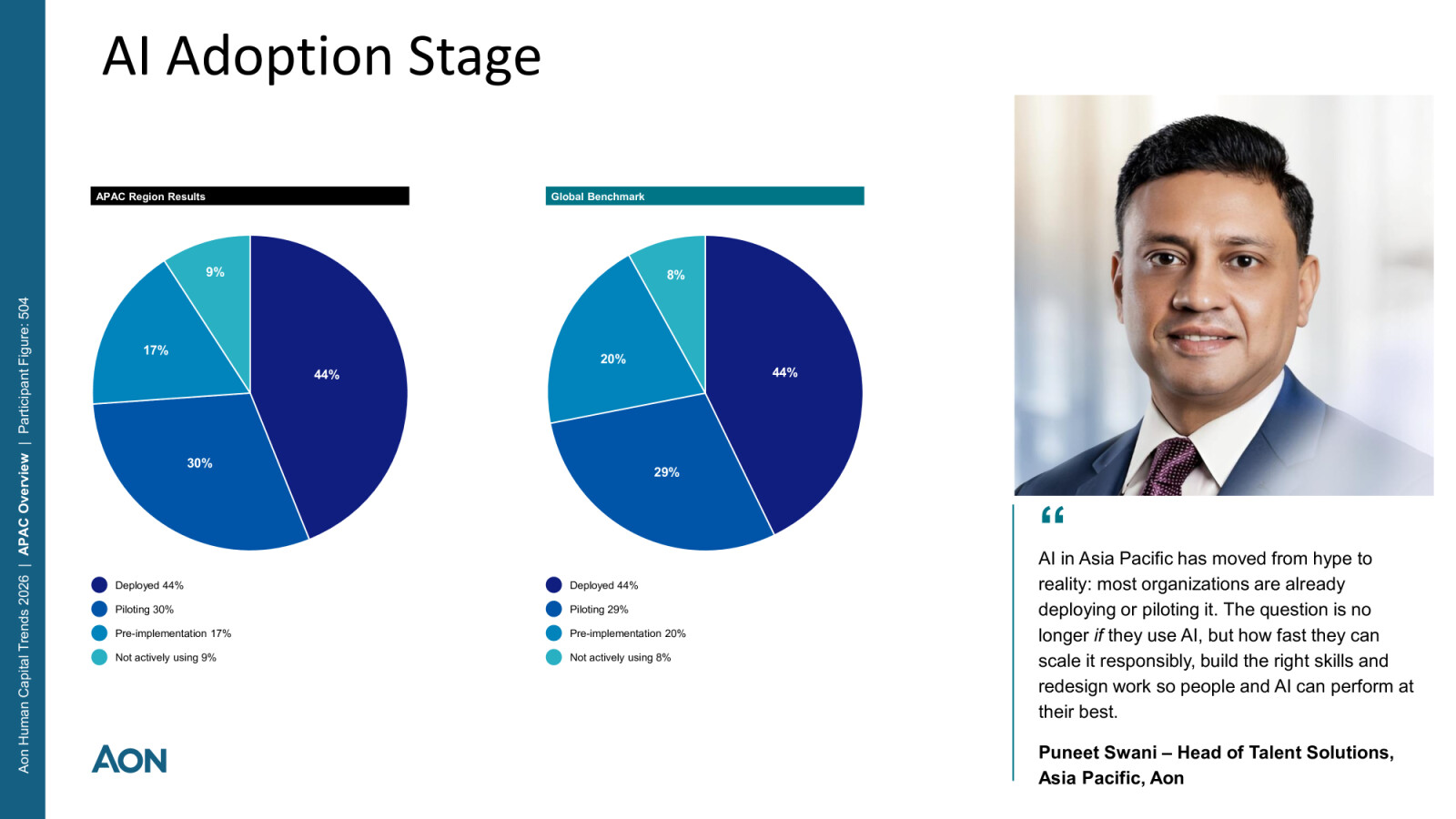
AI adoption across APAC is accelerating, with 74 percent of organisations having already deployed or piloting AI programs. The region has moved from experimentation to implementation, as organisations focus on efficiency, automation and innovation. However, talent shortages remain a structural constraint to scaling, with only 21 percent believing they can effectively recruit and retain sufficient AI talent – trailing the global average of 24 percent.

Organisations increasingly view AI as a tool to augment and reshape work rather than eliminate jobs. In APAC, 84 percent of respondents expect AI to automate certain tasks without replacing jobs entirely, while 87 percent anticipate it will create new roles requiring different skills. At the same time, 25 percent expect some job displacement as AI adoption evolves, reinforcing the need for continued investment in skills and workforce development.

“Across the Asia Pacific region, businesses are making strong progress in AI and workforce data, but technology alone will not deliver better outcomes,” said Tim Dwyer, head of Human Capital in APAC for Aon. “The study highlights a critical gap between access to workforce data and the ability to act on it meaningfully. Insufficient investment in skills and workforce planning is constraining the value organisations can realise from AI. Addressing this gap will require stronger workforce planning, more personalised employee experiences and closer alignment between talent strategies and long-term business priorities – unlocking productivity gains and sustaining long-growth across the region.”

APAC Lags in Personalised Employee Benefits

Employers across APAC report higher HR data maturity than the global average, enabling greater access to real-time workforce insights. Forty-two percent report high HR data maturity compared with 38 percent globally, and 74 percent having deployed or piloted AI, slightly ahead of the global level of 73 percent. This capability is supported by ongoing workforce development, with only 9 percent reporting that their workforces have not recently participated in AI reskilling or upskilling initiatives.

Despite these advancements, only 22 percent of employees in the region have access to customizable employee benefits, well below the global average of 33 percent. This is significant, given that 76 percent of APAC employees place a high value on personalised benefits, yet the majority lack access to them.

In response, organisations are focusing on three core priorities: accelerating digital transformation within HR functions, strengthening leadership and succession planning and optimising workforce planning and organisational design. Adaptability and change management are also cited as the most critical workforce skills required over the next three years, underscoring the rapid pace of business and technology change across the region.

Wellbeing and Employee Value Proposition Show Mixed Progress

While 85 percent of organisations report that their wellbeing strategy meets workforce needs, leadership visibility remains a concern, with only 26 percent reporting strong and visible commitment.

The employee value proposition (EVP) also remains underdeveloped, with just 22 percent stating that their EVP is clearly defined and understood by employees. Communication challenges persist, with information overload identified as the top barrier to effective employee engagement.

Pay Transparency and Equity Require Greater Focus

The report highlights persistent gaps in compensation practices across the region. Only 18 percent of organisations rate their pay transparency practices as mature, while 26 percent have not benchmarked employee compensation in the past year.

At the same time, 31 percent of organisations are implementing initiatives to close the gender retirement savings gap – exceeding the global average. Together, these findings show uneven progress, with continued gaps in pay equity and transparency.

“The findings demonstrate that organisations in APAC are positioning themselves to thrive in the future of work, but accelerating the shift from insight to action remains critical,” said Puneet Swani, head of Talent Solutions in APAC for Aon. “Enhancing pay transparency, expanding benefits personalisation and aligning workforce strategy with business priorities will help build greater workforce resilience.”

About the Report

Aon’s Human Capital Trends 2026 Study surveyed 2,361 business, HR and people leaders globally, including 504 respondents from APAC across markets including Australia, China, Hong Kong, India, Malaysia, the Philippines and Singapore. More information about the report can be found here.

Hashtag: #Aon

The issuer is solely responsible for the content of this announcement.

About Aon

(NYSE: AON) exists to shape decisions for the better — to protect and enrich the lives of people around the world. Through actionable analytic insight, globally integrated Risk Capital and Human Capital expertise, and locally relevant solutions, our colleagues provide clients in over 120 countries with the clarity and confidence to make better risk and people decisions that help protect and grow their businesses.

Follow Aon on , , and . Stay up-to-date by visiting Aon’s and sign up for news alerts .

Disclaimer

The information contained in this document is solely for information purposes, for general guidance only and is not intended to address the circumstances of any particular individual or entity. Although Aon endeavours to provide accurate and timely information and uses sources that it considers reliable, the firm does not warrant, represent or guarantee the accuracy, adequacy, completeness or fitness for any purpose of any content of this document and can accept no liability for any loss incurred in any way by any person who may rely on it. There can be no guarantee that the information contained in this document will remain accurate as on the date it is received or that it will continue to be accurate in the future. No individual or entity should make decisions or act based solely on the information contained herein without appropriate professional advice and targeted research.

Media OutReach

Hong Kong forges new opportunities with Kazakhstan and Central Asia

Published

on

HONG KONG SAR – Media OutReach Newswire – 3 June 2026 – A large delegation, led by John Lee, Chief Executive of the Hong Kong Special Administrative Region (HKSAR), is visiting Kazakhstan and Uzbekistan (June 1-6) to forge closer ties with Central Asia.

Comprising over 70 business and professional representatives from Hong Kong and the Chinese Mainland, the delegation has already yielded significant results at its first stop in Kazakhstan.

Speaking at a business luncheon in Astana yesterday (June 2), Mr Lee highlighted that 43 memoranda of understanding (MOU) and agreements have been concluded by the visiting delegation with companies and organisations from Kazakhstan, with more agreements to come.

“They span aviation, finance and trade, innovation and technology, the digital economy, green development, and more,” Mr Lee said, adding that a Hong Kong airline plans to launch direct flights to Almaty in the first quarter of 2027.

“I believe that Kazakhstan can serve as a hub for Hong Kong to connect with the Central Asian market. In turn, Hong Kong can be Central Asia’s hub in the east and southeast Asian region,” Mr Lee said.

“By strengthening co-operation between our two hubs, we can construct a hub-to-hub co-operation model.”

On his first day of visit in Astana (June 1), Mr Lee met with top government officials including the President of Kazakhstan, Kassym-Jomart Tokayev, Prime Minister Olzhas Bektenov, and Deputy Prime Minister and Minister of National Economy Serik Zhumangarin.

Hong Kong SAR’s Chief Executive John Lee (left) meets with the President of Kazakhstan Kassym-Jomart Tokayev to exchange views on deepening bilateral relations.

Mr Lee noted that Kazakhstan has been actively promoting reforms on various fronts to bring about rapid economic growth.

“As one of the world’s three major financial centres, and the world’s largest cross-boundary wealth management centre and offshore Renminbi business hub, Hong Kong can provide diversified and flexible support including capital and asset allocation for Kazakhstan’s economic reforms and infrastructure development,” Mr Lee said.

The Chief Executive also encouraged companies in Kazakhstan to leverage Hong Kong’s advantages under the “one country, two systems” principle.

“Under this unique principle, Hong Kong has its own economic, social, legal, legislative and judicial systems. We are the only common law jurisdiction in China. We have our own currency, with no capital or foreign exchange controls. We are, as well, a separate customs territory,” Mr Lee said.

“The ‘one country, two systems’ principle ensures Hong Kong’s unparalleled access to the markets of the Chinese Mainland. Capitalising on our global connectivity and world-class professional services, Hong Kong is your ideal, two-way springboard for business expansion.”

Mr Lee also visited the Astana International Financial Centre and the Astana Hub, a local technology and innovation park, to respectively learn about Kazakhstan’s experience in promoting the development of the non-bank financial sector and the latest developments of the country in the field of AI.

Hong Kong SAR's Chief Executive John Lee (centre) witnesses the exchange of memoranda of understanding and co-operation agreements between organisations from both sides with the Governor of the Astana International Financial Centre Renat Bekturov (second right).
Hong Kong SAR’s Chief Executive John Lee (centre) witnesses the exchange of memoranda of understanding and co-operation agreements between organisations from both sides with the Governor of the Astana International Financial Centre Renat Bekturov (second right).

Before leaving Kazakhstan today (June 3), Mr Lee visited Nazarbayev University, underscoring the historic significance of the trip.

image-1.jpeg

“It was here, at Astana’s Nazarbayev University in 2013, that President Xi Jinping first raised the visionary initiative of jointly building the Silk Road Economic Belt – today’s Belt and Road Initiative (BRI),” Mr Lee said.

Last year, at the 10th Belt and Road Summit in Hong Kong, the university signed a MOU with the Hong Kong University of Science and Technology, demonstrating a shared commitment to advancing higher education co-operation under the BRI. It further reached MOUs with Hong Kong’s Education University and Polytechnic University today.

“These agreements will deepen academic and research collaboration.

“Hong Kong is the only city in the world with five of the top 100 universities. This talent environment is reinforced by our global standing: last year, Hong Kong ranked first in Asia, and fourth globally, in the World Talent Ranking,” he added.

Mr Lee will continue to lead the delegation to Uzbekistan for the second leg of the mission to Central Asia.

Hashtag: #hongkong #brandhongkong #asiasworldcity #opportunitieswithCentralAsia


The issuer is solely responsible for the content of this announcement.

Continue Reading

Media OutReach

Webdorks Launches Claude Design-Assisted Prototyping for Website and MVP Development

Published

on

SINGAPORE – Media OutReach Newswire – 3 June 2026 – Webdorks Pte Ltd, a Singapore-based web design and development agency, has leveraged Claude Design-assisted prototyping within selected website and Minimum Viable Product (MVP) development projects since May 2026.

The approach is intended to help businesses visualize concepts, explore design directions, review user journeys, and refine core requirements before progressing into full-scale UI/UX design and development.

Claude Design, launched by Anthropic in April 2026, allows users to collaborate with Claude to create visual work such as designs, interactive prototypes, wireframes, mockups, presentations, and marketing materials. The tool enables teams to describe an idea, generate an initial version, and refine the concept through further instructions and edits.

Since its launch, tools such as Claude Design have made it significantly easier to turn early ideas into interactive prototypes. This creates new opportunities for businesses to review concepts more quickly before committing substantial time and budget to a full build.

However, Webdorks believes that early-stage prototyping and production deployment should remain distinct phases, particularly for corporate websites and digital products that support business-critical functions.

“Claude Design has made it much faster to visualize an idea and explore different directions,” said Alex Choong, Founder of Webdorks Pte Ltd. “The distinction is that an interactive prototype is not necessarily a production-ready website or application. For higher-stakes corporate projects, the final product still needs proper planning, design review, development, testing, security considerations, and ongoing support.”

Using AI at the Initial Prototyping Stage

Webdorks is incorporating Claude Design into the initial prototyping phase of suitable website and MVP projects. Depending on the project requirements, the prototype may be used to demonstrate selected screens, page structures, feature concepts, interactions, or user journeys.

For corporate website projects, this may include exploring the homepage direction, content hierarchy, lead-generation flow, service pages, or selected interactive elements.

For MVP projects, this may include illustrating how users navigate a customer portal, internal dashboard, booking system, membership platform, marketplace, workflow automation tool, or Software-as-a-Service product.

The initial prototype provides stakeholders with a clearer reference point for discussion. It can help businesses identify gaps earlier, compare alternative approaches, and refine requirements before the project enters the more resource-intensive design and development stages.

“Previously, businesses often had to rely heavily on written descriptions, static references, or wireframes during the early stage,” Choong added. “AI-assisted prototyping makes discussions more visual and practical. Clients can react to something tangible, which helps us identify what should be retained, changed, or removed before the full build begins.”

Prototype First, Production Build Second

Webdorks does not position AI-generated prototypes as a substitute for structured production development.

Corporate websites and digital products may need to support requirements such as brand consistency, responsive behaviour across devices, content management systems, third-party integrations, analytics, customer data, payment gateways, user access controls, internal workflows, performance optimization, quality assurance, security testing, and future scalability.

These requirements become more important when a digital product is customer-facing, revenue-generating, operationally critical, or connected to internal business processes.

For this reason, Webdorks uses AI-assisted prototypes primarily as an early validation tool. Once the direction is confirmed, suitable projects proceed through a structured workflow that may include discovery, UI/UX refinement, technical planning, custom development, integrations, testing, deployment, and post-launch support.

“AI is changing the speed of the first draft,” Choong said. “The role of an agency is to turn that first draft into a digital product that is aligned with the business, tested properly, and built for real-world use.”

Supporting Faster Validation for Businesses

The introduction of Claude Design-assisted prototyping is part of Webdorks’ broader approach to helping businesses launch digital projects in stages.

Instead of building every feature immediately, businesses can begin by clarifying the objective, visualizing the core user journey, and validating the most important requirements. This may be followed by a lean MVP, a more comprehensive version with selected integrations, or a full custom build based on the project’s complexity and commercial requirements.

The approach is intended to support businesses exploring new digital initiatives while reducing avoidable rework during later stages of the project.

“AI tools and agencies solve different problems,” Choong said. “AI makes early exploration more accessible. For the foreseeable future, agencies will remain important when businesses need to translate an idea into a structured, scalable, and maintainable platform.”

Hashtag: #Webdorks #ClaudeDesign #ArtificialIntelligence #WebDesign #WebDevelopment #MVPDevelopment #DigitalTransformation #CorporateWebsites #Webagency


The issuer is solely responsible for the content of this announcement.

About Webdorks Pte Ltd

Webdorks Pte Ltd is a Singapore-based web design and development agency specialising in corporate websites, e-commerce development, UI/UX design, custom web applications, MVP prototyping, and scalable digital solutions for SMEs and regional brands across Southeast Asia.

Continue Reading

Media OutReach

Angel Eye & Cataract Centre Becomes Early Adopter of AI Retinal Screening in Cataract Surgery Prep

Published

on

SINGAPORE – Media OutReach Newswire – 3 June 2026 – Angel Eye & Cataract Centre has introduced the ZEISS CIRRUS PathFinder into its cataract assessment workflow, leveraging AI-assisted retinal imaging for pre-surgical evaluation and treatment planning.

The system analyses retinal and macular scans, assesses scan quality in real time, and flags areas that require closer clinical review during cataract consultations. It is designed to support retinal imaging review while reducing the risk of clinically relevant details being overlooked.

The adoption reflects a broader shift towards AI-supported ophthalmology tools as clinics manage increasing demand for cataract care in ageing populations. In Singapore, where cataracts and age-related retinal conditions are becoming increasingly common, retinal evaluation plays an important role in surgical planning and visual outcome assessment.

The integration also comes after Medical Director and Senior Consultant Eye Surgeon Dr Allan Fong completed the “AI for Healthcare” programme by the NUS Yong Loo Lin School of Medicine, which focuses on how AI can be applied in areas such as clinical workflows, treatment planning, and patient care.

At Angel Eye, Dr Allan Fong uses the ZEISS CIRRUS PathFinder during the eye scanning process to review Optical Coherence Tomography (OCT) scans and identify retinal abnormalities that require closer review. The OCT assessment tool was trained on more than 75,000 OCT B-scan images and validated by retina specialists.

Because some retinal conditions can develop without obvious symptoms and affect visual outcomes after cataract surgery, pre-surgical retinal imaging is an important part of patient evaluation. By identifying early retinal changes before surgery, the system may provide additional information to support intraocular lens (IOL) selection and surgical planning.

The technology may also help streamline appointments through immediate image quality checks and fewer repeat scans. This supports a more consistent cataract assessment process, particularly in cases where retinal findings may affect surgical planning.

“Even subtle retinal findings can affect cataract surgery planning and visual outcomes,” says Dr Fong. “AI-assisted imaging gives us another layer of support during evaluation, particularly when assessing patients for surgery, while clinical judgement remains central to every step of care.”

Looking ahead, Angel Eye & Cataract Centre will continue exploring technologies that support earlier intervention, more personalised treatment planning, and improved patient care across cataract and retinal services.

To learn more, visit: https://angeleye.com.sg/ai-guided-zeiss-cirrus-pathfinder/

Hashtag: #AngelEyeCataractCentre

The issuer is solely responsible for the content of this announcement.

About Angel Eye & Cataract Centre

Angel Eye & Cataract Centre is a Singapore-based ophthalmology centre focused on cataract surgery, refractive surgery, retinal assessment, and comprehensive eye care. The clinic is led by Dr Allan Fong who has more than 26 years of experience in ophthalmology and previously served as Head of the Cataract & Comprehensive Ophthalmology Department at Singapore National Eye Centre (SNEC).

Continue Reading

Trending