Media OutReach
Chinese company YingShen Intelligence’s 4D World Model–Powered Embodied Robots Enter Vietnamese Factories, Pioneering a Token-Based Service Model for Global Expansion
Under the agreements, Yingshen Intelligence will export hundreds of flexible embodied robots to footwear factories in Vietnam, with the combined order value reaching tens of millions of yuan. Powered by the company’s proprietary 4D world-model technology, embodied intelligence algorithms and robotic systems, the products will be used to support the flexible and intelligent upgrading of footwear production lines.
Notably, Yingshen Intelligence’s export of embodied robots to Vietnam also points to an emerging shift in the commercialisation of Chinese advanced technologies.
Unlike conventional robotics companies that rely primarily on one-off hardware sales, Yingshen Intelligence regards the robot itself as the physical platform through which its world model operates in real production environments. The product’s core value therefore lies not only in the hardware, but also in the model’s ability to perceive its surroundings, understand manufacturing processes, make real-time decisions and continuously improve through operational data.
Under this model, customers receive more than robotic equipment. They also gain access to ongoing model inference, algorithm updates and scenario-specific optimisation services. In effect, the business model is evolving from simply selling robots to providing model capabilities and usage-based, token-powered services.
Industry observers said this model-led approach, with robots serving as the physical carriers of algorithms and computing capabilities, could create greater long-term service value for embodied intelligence products and offer a new pathway for Chinese technological solutions to expand into overseas markets.
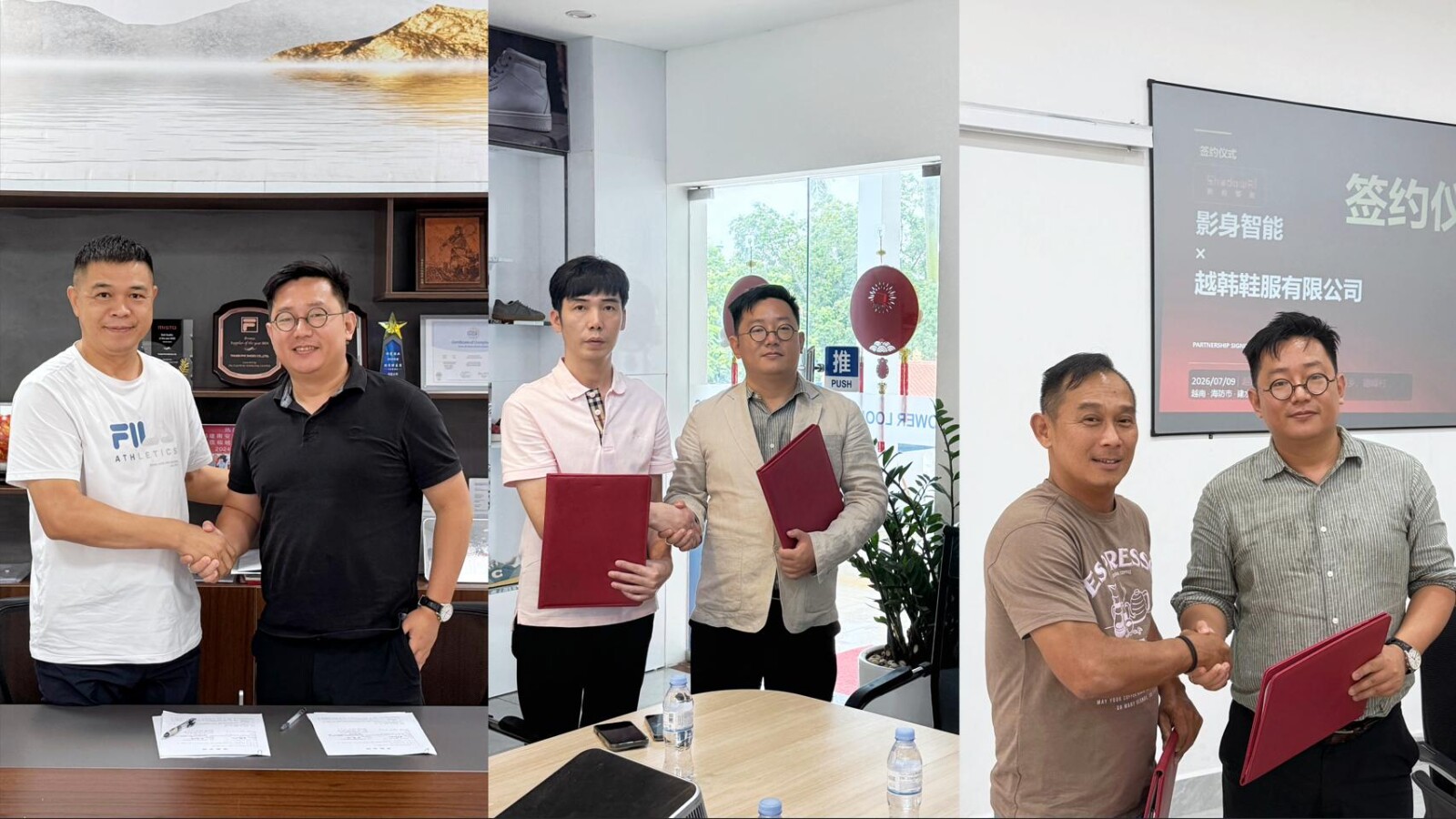
The participating manufacturers include Power Loong(Công Ty Tnhh Giày Bảo Long) , Thuan Phi(Công Ty Tnhh Giày Thuận Phi) and Vietnam Garment(CÔNG TY TNHH MAY VIỆT NAM), which plan to deploy Yingshen Intelligence’s robotic products and algorithmic capabilities at their footwear factories in Hai Phong.
Wu Xuewei, Vice-President of Yingshen Intelligence; Mao Zhenwu, General Manager of Thuan Phi; Lin Yonghui, General Manager of Power Loong; and Chen Zhixian, General Manager of Vietnam Garment signed the agreements on behalf of the four companies.
4D World Model Advances Flexible Manufacturing Applications for Chinese Embodied Intelligence
The flexible embodied robots being exported to Vietnam are powered by Yingshen Intelligence’s latest 4D world model.
World models are widely regarded as an important technological pathway towards general-purpose physical intelligence. They are designed to help artificial intelligence understand spatial relationships, object states and dynamic changes in the real world, while predicting the possible outcomes of different actions. In this way, AI systems can gradually learn how the physical world operates.
For embodied robots, this capability enables continuous environmental perception and real-time decision-making during operation. On footwear production lines, for example, the robots can identify differences in shoe styles, sizes, material conditions and adhesive states, and adjust their motion trajectories and operating strategies in response to actual production conditions.
Unlike conventional automation systems that repeatedly execute predefined programmes, world-model-powered robots are designed to respond more flexibly to changing environments. Their operating process more closely resembles that of skilled workers, who assess conditions on site and adjust their actions accordingly.
Yingshen Intelligence attributes this adaptability to its native 4D technological approach.
The company collects and generates 4D data at scale, representing both the three-dimensional structure of objects and their continuous changes over time within a unified framework. The data is then used to train world models with spatiotemporal understanding, reasoning and prediction capabilities.
Compared with approaches that rely mainly on two-dimensional images, videos or static three-dimensional data, 4D data can more comprehensively capture the positions, shapes, movement trajectories and interaction processes of objects in real environments.
Two-dimensional images and videos can record visual changes, but provide relatively limited information about spatial structure. Static three-dimensional data can reconstruct spatial relationships, but cannot fully describe how objects and environments evolve over time. By combining three-dimensional space with continuous temporal changes, 4D data provides a richer foundation for models to learn physical processes.
“Language is the native language of humans, while the native language of machines exists in the three-dimensional physical world,” said Min Wei, founder of Yingshen Intelligence.
According to Min, language, images and videos are all compressed representations of the real world. When physical reality is reduced to lower-dimensional forms, some information is inevitably lost, potentially limiting a model’s ability to understand and predict complex physical interactions.
Real-world interactions involve not only the shape, position and movement of objects, but also contact, force, friction and material deformation. These processes can be more completely observed and modelled when three-dimensional spatial information is combined with continuous changes over time.
A unified spatiotemporal representation based on 4D data can therefore help models learn the relationships among actions, environments and outcomes, and predict how the state of an object may change at the next moment.
Supported by this technological approach, Yingshen Intelligence’s robots can adjust their motion trajectories and operating strategies when faced with material deformation, deviations in incoming components, or changes in shoe styles, sizes and production processes.
These capabilities have enabled the company’s flexible embodied robots to move beyond laboratory testing and enter real footwear production lines. Their export to Vietnam will further test the technology’s reliability, adaptability and scalability in overseas industrial environments.
Phased deployment across key footwear processes
Cooperation will be implemented in phases. Yingshen Intelligence will initially supply its two flagship footwear-manufacturing robots, ShadowGlue and ShadowPress, for deployment across multiple production lines.
The robots will first be used in gluing and sole pressing, two critical processes that have traditionally depended heavily on skilled manual labour. Their introduction is expected to help the participating factories improve production flexibility, operating consistency and automation levels.
The partners also plan to extend embodied intelligence technologies to additional processes, including sewing, finished-product packaging and automated shoelace threading. The aim is to move gradually from isolated robotic workstations towards coordinated, multi-process production.
In the longer term, the partners intend to build a benchmark factory for embodied intelligence-enabled footwear manufacturing in Vietnam, promoting the transition of entire production lines towards more autonomous and intelligent operations.
Why footwear manufacturing in Vietnam?
Why are embodied robots entering factories and flexible manufacturing taking shape first in Vietnam’s footwear industry?
Industry experts point to two closely related factors. Footwear manufacturing is both highly labour-intensive and one of the most technically challenging sectors for flexible automation. Introducing embodied intelligence into this industry therefore responds to the practical needs of Vietnamese manufacturers while also providing Chinese robotics companies with demanding real-world environments in which to test technological reliability, adaptability and large-scale delivery capabilities.
For manufacturers in Vietnam, the technology can help improve efficiency, stabilise product quality and ease labour shortages. For embodied intelligence companies, footwear production offers an opportunity to move beyond laboratory demonstrations and validate their systems under complex, continuously changing industrial conditions.
The partnership therefore reflects both the demand for more advanced manufacturing capabilities in Vietnam and the broader effort to bring embodied intelligence technologies into international, large-scale industrial applications.
Footwear production presents particularly high technical barriers to automation.
Shoe materials are flexible and easily deformed, while significant differences exist among styles, sizes and material combinations. Processes such as gluing and sole pressing require workers to respond to subtle variations in shape, positioning and material condition, and have therefore long relied on the experience and dexterity of skilled operators.
At the same time, consumer demand for more personalised and diversified footwear products is requiring factories to process a growing number of styles and stock-keeping units, often in smaller batches and with shorter production cycles. Production lines must consequently switch between products more frequently and adjust more rapidly.
Conventional industrial automation systems generally follow predefined programmes and fixed motion paths. When styles, materials or production requirements change, the equipment may need to be reprogrammed, recalibrated or physically reconfigured. This can lead to lengthy deployment cycles and higher production-line modification costs, making traditional systems less suited to multi-product, small-batch and high-frequency manufacturing.
Yingshen Intelligence’s embodied robots combine visual perception, world models and motion-control algorithms to identify production environments, material conditions and process requirements in real time. The systems can then adjust their operating strategies according to differences in shoe styles, sizes, incoming-material positions and other production variables.
Rather than merely repeating preset movements, the robots are designed to interpret the relationships among materials, space, actions and manufacturing processes, allowing them to adapt more effectively to complex and flexible production environments.
ShadowPress is designed primarily for the sole-pressing process. Using visual recognition and algorithmic compensation, the robot can dynamically adjust its gripper posture and movement path in response to differences in material position, placement angle and shoe shape.
Its compact design enables it to be integrated into existing semi-automated production lines. This allows manufacturers to introduce intelligent systems gradually, without carrying out extensive reconstruction of their existing factories.
ShadowGlue is designed for footwear gluing. According to Yingshen Intelligence, the system uses a 4D world model and vision–action coordination technology to learn manufacturing processes by observing videos of skilled workers.
It can respond dynamically to changes in shoe-material deformation, edge paths and adhesive conditions, helping to improve the stability and consistency of gluing operations. The technology is intended to enable robots not only to reproduce a worker’s actions, but also to learn the underlying process logic and adjust their operations when production conditions change.
This adaptability is particularly important in footwear manufacturing, where frequent changes in styles, sizes and materials make it difficult for fixed-path equipment to maintain consistent performance.
Vietnam’s manufacturing sector seeks greater flexibility
Vietnam has become one of the world’s leading footwear production and export centres as global footwear and apparel supply chains have continued to expand across Southeast Asia.
However, the competitive priorities of the industry are changing. International brands are placing greater emphasis on shorter delivery cycles, stable quality and the ability to respond quickly to small-batch, multi-product orders.
As a result, Vietnam’s manufacturing sector is gradually moving beyond a development model based primarily on labour, land and production scale. Manufacturers are increasingly seeking to improve efficiency, product quality, technological capabilities and production flexibility.
The introduction of Chinese embodied intelligence technologies by several footwear manufacturers in Vietnam therefore represents more than an equipment upgrade. It reflects local manufacturers’ growing demand for a new generation of intelligent production capabilities.
By deploying robots in technically demanding flexible processes, factories may be able to reduce their dependence on scarce skilled labour, improve production consistency and respond more effectively to frequent product changes and diversified orders.
Industry observers said the move could provide a practical example of how embodied intelligence can be introduced into traditional manufacturing. It may also help Vietnamese footwear producers transition from primarily undertaking large-scale production towards building more efficient, technology-intensive and responsive manufacturing capabilities.
Under the agreements, Yingshen Intelligence will provide integrated services covering equipment delivery, on-site installation and commissioning, personnel training, quality assurance and after-sales support.
The company will also adapt its products to the actual production environments and process requirements of the participating factories in Vietnam, with the aim of ensuring that the systems can operate reliably under real manufacturing conditions.
ShadowGlue and ShadowPress have completed product development and production-line validation. The two products were previously presented at the Jinjiang International Footwear and Sports Industry Expo in China.
The agreement involving hundreds of robots and orders worth tens of millions of yuan marks the formal entry of Yingshen Intelligence’s footwear robotics solutions into the Southeast Asian manufacturing market.
A new link between Chinese technology and Southeast Asian manufacturing
The partnership highlights a growing connection between China’s intelligent manufacturing technologies and Southeast Asia’s industrial transformation.
Chinese companies are accelerating the industrial deployment of world models, embodied intelligence and robotic systems. At the same time, manufacturers in Vietnam and other Southeast Asian economies are seeking more efficient, flexible and intelligent approaches to industrial upgrading.
The intersection of these trends lies in the practical needs of traditional manufacturing industries. Footwear factories provide a particularly valuable application environment because they combine large-scale production demand with complex materials, variable processes and frequent product changes.
Starting with footwear production lines in Hai Phong, the cooperation between Yingshen Intelligence and manufacturers in Vietnam will test how embodied intelligence can be applied across real industrial processes and scaled to multiple factories.
Rather than replacing workers in only one repetitive task, the broader objective is to build flexible production capabilities that can perceive changing conditions, learn manufacturing processes and adjust operations accordingly.
The cooperation offers a new example of Chinese intelligent manufacturing technology participating in Southeast Asia’s industrial upgrading, while signalling the footwear industry’s gradual transition from scale-driven production towards a new stage of flexible and intelligent manufacturing.
Hashtag: #HangzhouYingshenIntelligentTechnology
The issuer is solely responsible for the content of this announcement.
Media OutReach
Citi Hosts AI Day for Secondary School Students in Hong Kong
Empowers Hong Kong’s next generation of innovators to responsibly apply AI to drive social impact
Aveline San, CEO and Head of Banking at Citi Hong Kong said the AI Day was designed to help students translate innovative ideas into real-world applications, with a strong focus on human-centered design and the responsible use of AI, bringing their purpose-driven ideas one step closer to real-world impact.
With the help of Citi AI mentors and David Kwan, Founder and CEO of AI advisory platform JobsTaylor, student teams from six secondary schools worked on concept testing, building app prototypes and applying AI to enhance user experience. The Citi mentors also shared their own experience in using AI to raise productivity and address business pain points at work.
Vicky Kong, Head of Wealth for Asia North and Australia at Citi, who served as a judge at the pitch competition final commended the students for their creativity, energy and passion for driving positive change. She encouraged them to stay curious, embrace feedback and build on their ideas beyond the competition as they continue their innovation journey.
In a fireside chat moderated by Sarah O, Head of Digital Growth & Cards and Unsecured Lending Sales at Citi Hong Kong, the students also had the opportunity to learn from Dr. Miles Wen, Co-Founder and CEO of Fano Labs who shared his entrepreneurial journey, experience in navigating the startup ecosystem, as well as advice on dealing with challenges and setbacks.
Organized by the SEED Foundation, the IdeaPOP! program has engaged over 3,000 students in Hong Kong since its inception in 2022. Participants have developed more than 750 technology-based solutions aimed at addressing local societal needs.
Click HERE to download the photos
Photo 1:Aveline San, Citi Hong Kong’s CEO and Head of Banking(middle in the front row) hosted an AI Day for students at Citi’s office alongside Citi AI mentors, Ken Lo, SEED Foundation CEO (left in the front row) and David Kwan, Founder and CEO of JobsTaylor (right in the front row) guiding students on turning their ideas into real-world social solutions.
Photo 2: Vicky Kong, Head of Wealth for Asia North and Australia at Citi (right), Dr. Miles Wen, Co-Founder and CEO forFano Labs (middle) and Sarah O, Head of Digital Growth & Cards and Unsecured Lending Sales at Citi Hong Kong (left)exchanged ideas on the art of pitching and entrepreneurial mindset with student teams during the workshop. Dr. Wen shared his own entrepreneurial journey as well as advice on navigating the startup ecosystem and mastering investor pitches.
Hashtag: #Citi
The issuer is solely responsible for the content of this announcement.
Media OutReach
Escape to China’s Mysterious Guizhou and enjoy a cool 23°C summer retreat.
Link: Guizhou in July
In midsummer July, Malaysian travel operators and cultural tourism influencers visited Guizhou, China, a renowned summer retreat, as if stepping into another season. Known as the “Green Karst Kingdom” and a “Natural Air Conditioner,” Guizhou has a mountainous area coverage of 92.5% and an average summer temperature of just 23°C. Beyond its cool climate, Guizhou offers a hidden-gem experience where spectacular landscapes meet diverse cultures, leaving every visitor amazed.
Link: https://youtu.be/nL7ayiYqB-k?si=nfasDLnhaBIFgkqB
Spectacular Landscapes at Every Turn
From the lush peak forests of Wanfenglin to the magnificent Huangguoshu Waterfall; from the emerald waters of Xiaoqikong to the cloud-covered summit of Mount Fanjing; and to the world-record Huajiang Grand Canyon Bridge spanning a deep gorge, every landscape in Guizhou is worth a stop. A Malaysian travel influencer remarked, “Before departure, I had only heard that Guizhou was a summer retreat. After visiting, I realized the surprises go far beyond 23°C.”
Cultural Experiences Full of Surprises
Visitors can enter distinctive villages and try intangible cultural heritage crafts such as Miao embroidery and batik; gather around a long-table banquet to taste local specialties such as sour soup fish and spicy chicken; explore cool hidden landscapes within a World Natural Heritage site with children through waterfall play and paddleboarding; or venture deep into ancient caves for an underground adventure. From heritage crafts to nature exploration, Guizhou offers family-friendly experiences for everyone to enjoy.
A Spontaneous Trip Made Easy
This summer, reserve a ticket for Mysterious Guizhou, and begin your “summer escape plan.”
Explore more of Mysterious Guizhou: www.guizhoutravel.com
Hashtag: #Guizhou
The issuer is solely responsible for the content of this announcement.

Media OutReach
“Achievements of National Aerospace Endeavours” Thematic Exhibition Makes First Stop at Hong Kong Science Park
HKSTP Advances AI Industry with Tech Delegation at WAIC 2026
HONG KONG SAR – Media OutReach Newswire – 16 July 2026 – To celebrate the 105th anniversary of the founding of the Communist Party of China, Hong Kong Science and Technology Parks Corporation (HKSTP) today held the “Achievements of National Aerospace Endeavours” Thematic Exhibition Kick-off Ceremony cum Aerospace Experts Sharing Forum at Hong Kong Science Park, marking the opening of a seven-day roving exhibition.
At the first stop of the roving exhibition, Hong Kong Science Park will host the exhibition at the Atrium Link from today until 22 July 2026, showcasing the nation’s major achievements in aerospace development, as well as the participation and contributions of Hong Kong’s research community in aerospace technology, space robotics and deep space exploration. It aims to enhance public understanding of the nation’s development and foster a stronger sense of pride, while inspiring young people to develop an interest in innovation and technology (I&T) and aerospace.
The ceremony was officiated by Professor Sun Dong, Secretary for Innovation, Technology and Industry, together with Ms Cordelia Chung, Chairman of HKSTP, and Ms Connie Wong Wai-ching, Standing Committee Member of the National Committee of the Chinese People’s Political Consultative Conference (CPPCC), and Vice President of the Friends of Hong Kong Association, alongside other distinguished guests, witnessing a new milestone in the nation’s aerospace achievements.
Professor Sun Dong, Secretary for Innovation, Technology and Industry, said in his remarks: “The inspiring story of Dr Lai Ka-ying becoming Hong Kong’s first astronaut is a vivid example of Hong Kong’s participation in the nation’s major scientific and technological missions, and a fruitful achievement of the great practice of ‘one country, two systems.’ Hong Kong’s R&D teams have long participated in and made active contributions to the nation’s deep-space exploration missions. For example, a team from the Hong Kong University of Science and Technology independently developed the Multi-Spectral Imaging Carbon Observatory (MUSICO), Hong Kong’s first scientific payload on the national space station to monitor greenhouse gas. Recently, Dr Lai and two other astronauts completed the in-cabin assembly and testing and extravehicular installation of MUSICO, which can accurately monitor greenhouse gases across the mid- and low-latitude regions on the Earth, providing critical data for the nation’s carbon peaking and carbon neutrality strategies. As we embark on a new journey, we must leverage I&T to empower Hong Kong’s social development, enhance governance efficiency, and better integrate into and serve the nation’s development. We will also uphold the spirit of space exploration of perseverance in the face of challenges to accelerate the development of Hong Kong into an international I&T centre.”
Connecting Hong Kong’s Research Strength with National Aerospace Development
In recent years, the nation’s aerospace endeavours have continued to make breakthroughs in areas ranging from deep-space exploration and satellite technology to space science research, opening up new possibilities across multiple scientific disciplines.
Leveraging its world-class universities, outstanding research talent, internationalised innovation ecosystem, and the unique advantage of close ties with the Mainland, Hong Kong is actively contributing to the development of the nation’s aerospace technology.
The exhibition presents the development and landmark achievements of the nation’s aerospace endeavours. It also demonstrates how Hong Kong research teams apply artificial intelligence (AI), robotics, space science and engineering research to support space exploration and related technology applications. Through this exhibition, industry stakeholders and members of the public can gain a deeper understanding of the city’s research capabilities and I&T talent.
Ms Cordelia Chung, Chairman of HKSTP, said, “This year marks the beginning of the nation’s 15th Five-Year Plan, with aerospace technology identified as a key area in building the nation into a leading science and technology power. Dr Lai Ka-ying, Hong Kong’s first payload specialist, travelled into space aboard the Shenzhou-23 spacecraft, realising Hong Kong’s aerospace dream and demonstrating strong recognition of the city’s research capabilities and I&T talent. HKSTP is honoured to serve as the first stop of the ‘Achievements of National Aerospace Endeavours’ roving exhibition. Looking ahead, we will continue to bring together talent and foster interdisciplinary, cross-regional and cross-sector collaboration. By supporting frontier R&D in areas such as aerospace technology, we aim to provide a broader platform for Hong Kong’s research talent and contribute Hong Kong’s strengths to the nation’s aerospace endeavours and pursuit of greater technological self-reliance.”
Ms Connie Wong, Standing Committee Member of the National Committee for the Chinese People‘s Political Consultative Conference (CPPCC), and Vice-President of Friends of Hong Kong Association, shared in her speech: “We believe that the cultivation of young talent is indispensable to technological innovation. Based on this philosophy, Friends of Hong Kong Association co-organised the Achievements of National Aerospace Endeavours Thematic Exhibition, encouraging the next generation to pursue careers in science and innovation and to be contributors to the nation’s I&T endeavours.”
Three Experts Share Insights on Frontier Trends in Space Technology
An Aerospace Experts Sharing Forum was held alongside the kick-off ceremony. Moderated by The Honourable Mr Duncan Chiu, Legislative Council Member for the Technology & Innovation Functional Constituency, the forum brought together three aerospace and space technology experts from local universities and the InnoHK research and development platform:
- Professor SU Hui: Chair Professor of the Department of Civil and Environmental Engineering, Global STEM Professor, and Co-Director of the Institute for Space Science and Technology at The Hong Kong University of Science and Technology, and Founder of Stellerus Technology
- Professor GAO Yang: Director of the Center for Artificial Intelligence and Robotics for Space Sustainability, Co-Director of the Institute for Space Science and Technology at The Hong Kong University of Science and Technology, and Director of the Hong Kong Space Robotics and Energy Centre under InnoHK
- Professor WU Bo: Chang Xin Yu Professor of Space Science, Associate Director of the Research Centre for Deep Space Explorations at The Hong Kong Polytechnic University, and Associate Director of the InnoHK Hong Kong Centre for Space Robotics and Energy
Drawing on their respective areas of expertise, the three experts shared insights into the application of AI and robotics in space missions, key technologies involved in deep-space exploration, and the experience of Hong Kong research teams participating in national aerospace projects. They also explored space sustainability, the commercialisation of research outcomes and cross-regional collaboration, while encouraging young talent to pursue opportunities in aerospace technology.
HKSTP Leads Hong Kong Tech Firms to the World’s Largest AI Exhibition – WAIC 2026, Strengthening the AI Commercialisation Ecosystem
HKSTP has long supported the accelerated adoption of AI across industries to foster cross-sector collaboration and enhance productivity.
HKSTP, together with the Hong Kong Trade Development Council (HKTDC), Cyberport, and Hong Kong-Shenzhen Innovation and Technology Park Limited (HSITP), will lead a delegation of 18 Hong Kong tech companies to the 2026 World Artificial Intelligence Conference & High-Level Meeting on Global AI Governance (WAIC 2026). Taking place from 17 to 20 July at the Shanghai World Expo Exhibition and Convention Center, the delegation will showcase Hong Kong’s growing role as a global AI innovation hub and support the nation’s AI strategy. Six HKSTP park companies among the delegation will present solutions spanning humanoid robots, smart mobility, climate technology, AI agents, and generative AI.
Stellerus Technology Limited, founded by Professor SU Hui, leading the “MUSICO” (Multi-Spectral Imaging Carbon Observatory) project — Hong Kong’s first payload project deployed on the Tiangong Space Station — will present its latest AI-powered climate and meteorological solutions at WAIC 2026.
SUTPC Digital Technology (Hong Kong) Limited, a leading enterprise in the nation’s smart city and intelligent transport sectors, and NineRay Technology Limited, which specialises in the research, development and production of high-performance, productivity-oriented humanoid robotics, will also showcase their advanced solutions in the exhibition. By demonstrating how AI can empower business operations, urban governance and sustainable development, the Hong Kong delegation aims to promote human-AI collaboration and innovation.
“Achievements of National Aerospace Endeavours” Thematic Exhibition
Date: 16–22 July 2026
Venue: Atrium Link, Hong Kong Science Park
2026 World Artificial Intelligence Conference & High-Level Meeting on Global AI Governance (WAIC)
Date: 17–20 July 2026
Venue: Shanghai World Expo Exhibition and Convention Center, Shanghai, China
Hong Kong Pavilion: Booth E101, Hall 2
Appendix: WAIC 2026 – List of 6 HKSTP tech entities (in alphabetical order)
- JiHu GitLab Technology Limited
- KNQ Technology Limited
- NineRay Technology Limited
- Robocore Technology Limited
- Stellerus Technology Limited
- SUTPC Digital Technology (Hong Kong) Limited
Hashtag: #HKSTP
The issuer is solely responsible for the content of this announcement.

About Hong Kong Science and Technology Parks Corporation
Hong Kong Science and Technology Parks Corporation (HKSTP), established in 2001, has built a thriving innovation and technology (I&T) ecosystem in Hong Kong, supporting 13 unicorns, nurturing over 17,000 research talents, and hosting more than 2,400 technology companies from 26 countries and regions specializing in biomedicine, AI and robotics, fintech, and smart city development. HKSTP is dedicated to positioning Hong Kong as an international I&T hub.
To align with Hong Kong’s future development, HKSTP is committed to attracting and cultivating I&T talent, accelerating the commercialization of innovative outcomes, and providing comprehensive support for technology companies and professionals on their innovation journey. Its vibrant I&T ecosystem continues to grow, encompassing Hong Kong Science Park in Pak Shek Kok, InnoCentre in Kowloon Tong, and three InnoParks in Tai Po, Yuen Long, and Tseung Kwan O. These facilities drive advancements in applied technology, focusing on industries such as advanced manufacturing, micro- electronics, and biotechnology, steering Hong Kong toward new industrialization.
Hong Kong Science Park Shenzhen Branch, located in Futian, Shenzhen, leverages the strategic advantage of “support of the Motherland, connecting to the world.” It serves as a bridge for “bringing in and going global,” actively fostering cross-border I&T collaboration. The Shenzhen Branch supports global technology companies and professionals by providing research and collaboration spaces, with a focus on enterprises in seven key sectors: Medtech, big data and AI, robotics, new materials, microelectronics, fintech, and sustainable development.
HKSTP is dedicated to advancing Hong Kong’s I&T development by providing research infrastructure, startup and enterprise support services, professional investment and business expertise, fostering partnership networks, and attracting top talent. These efforts drive innovation as a new engine for economic growth for Hong Kong.
More information about HKSTP is available at
www.hkstp.org.