

Connect with us

Media OutReach

CPA Australia Survey: Increasing AI Adoption Reshapes Future Roles in Accounting Industry and Rises Data Concerns in Hong Kong

Published

on

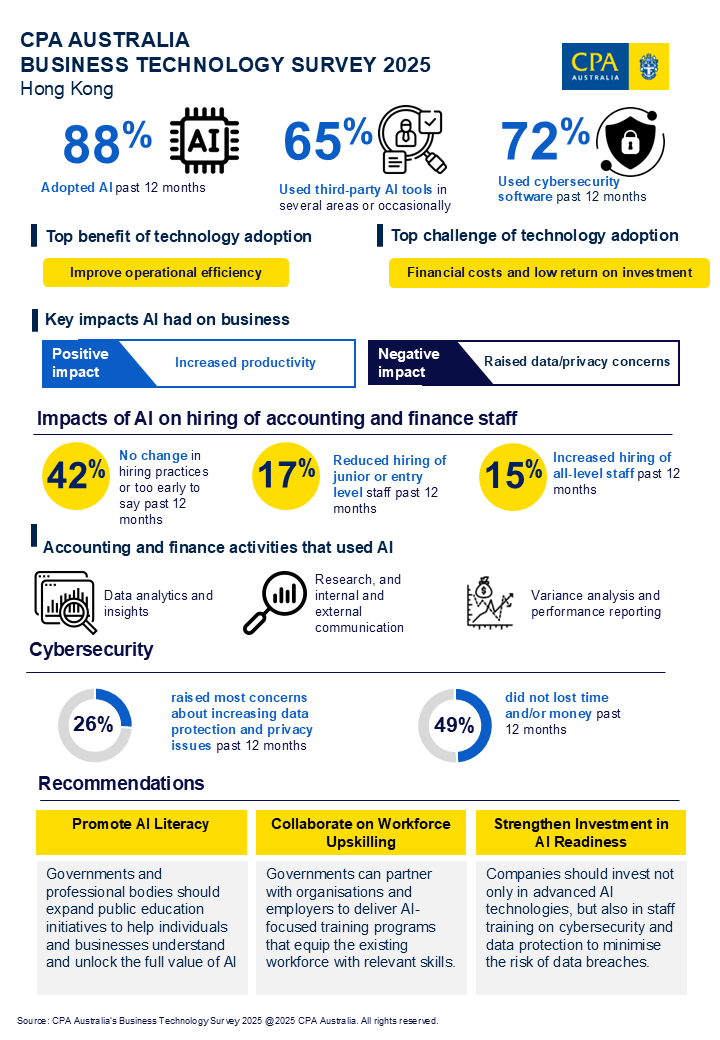
HONG KONG SAR – Media OutReach Newswire – 10 November 2025 – CPA Australia’s regional survey about business technology adoption shows that most companies in Hong Kong have used artificial intelligence (AI) tools at different levels. Though the increasing AI application helps to improve productivity, it also transforms the hiring trends in the accounting and finance industry, and increases concerns on data protection and governance, according to the survey findings.

The result indicates the notable growth of AI adoption across markets in Asia Pacific, with 89 per cent of respondents said that they have adopted AI in the past 12 months, up from 69 per cent last survey. In Hong Kong, 88 per cent have applied AI such as ChatGPT, Copilot at the workplace. When asked about the level of AI adoption, 65 per cent respondents primarily used third-party tools in several areas or occasionally.

Dr Paul Sin, CPA Australia’s Greater China Councillor and Chair of Web3 & Emerging Technology Committee highlighted the gap between the awareness of AI and releasing the real value of AI, “Most respondents said that they used third-party AI tools, implying that the awareness of AI in Hong Kong is high. Yet, many companies are still at the Proof-of-Concept stage, which means they just use AI tools to improve productivity like handling repetitive tasks and automate process. In fact, the government and professional organisations can do more education to unleash the true value of AI, for example, to reinvent business models or transform workflows by using more advanced solutions like predictive analytics and agentic AI, eventually scale up to production-grade implementation to align with their strategic goals.”

The increasing prevalence of AI is transforming the recruitment trends across various industries including accounting and finance. While 42 per cent of respondents in Hong Kong said that there has been no change in hiring practices, or that is too early to say, 17 per cent said that their organisations have reduced the number of junior-level staff hired for the accounting and finance teams due to the adoption of AI.

Dr Sin highlighted the correlation between the hiring trend and the tasks being replaced by AI, “Survey shows that most respondents use AI for data analytics and research in their accounting and finance activities, and these tasks are usually carried out by junior staff. Clearly, AI can free them up from repetitive and tedious tasks, allowing them focus on more human-centric or strategic responsibilities such as advisory, decision-making and client engagement. The underlying skills are difficult to replace with technology such as creativity and judgement built from business experience. Grooming junior staff to take on these more advanced responsibilities takes time, so employers should consider balancing adoption of advanced technology with talent development for the organisation’s long-term growth.”

Dr Albert Wong, Deputy Chair of CPA Australia’s Greater Bay Area Committee added on, “AI is only replacing certain tasks, not humans. As AI develops, the recruitment standard for technical skills is rising because some tasks can be done effectively by technology. Employers will expect their future staff to be able to work alongside with AI to solve problems, use these technology solutions to add value to existing services and products, generate new ideas/options, and predict the future in various scenarios. The job market will become more competitive. Therefore, the younger generation and the existing employees must develop irreplaceable skills, particularly soft skills such as human-human and human-machine interaction, effective communication, creative and critical thinking, and professional scepticism.”

To keep up with the transformation, the Hong Kong SAR Government has an instrumental role to play. He called for policy support to build a future-ready workforce in Hong Kong. “The Government could collaborate with organisations and employers to upskill existing workforce on AI-centric training; offer subsidies to encourage SMEs to pilot/adopt different types of AI in their businesses and create internship schemes that give university students the opportunity to apply AI tools to real-world problem-solving.”

Data is the new oil for technology. Among the surveyed markets, Hong Kong respondents raised the most concerns about increasing data protection and privacy issues (26 per cent) from AI adoption. On a positive note, 72 per cent said that they had implemented cybersecurity in the past 12 months, and Hong Kong’s overall cybersecurity maturity is considerably high.

Mr Winson Woo, a member of CPA Australia’s Greater Bay Area Committee shared his views on data protection and governance, “Many technologies already have embedded AI functions, so AI adoption will continue to increase in the future. Organisations should establish an AI development roadmap to plan how to apply AI to achieve strategic goals, and how to measure the return of investment, as well as setting clear governance guidelines to ensure the ethical use of AI tools in the workplace.”

When discussing cybersecurity, he highlighted two emerging trends: Manage Security Operations Center (MSOC), a model of outsourcing security operations center (SOC) functions to third-party service providers to perform real-time detection and monitoring of cyber attacks and threats; and AI security, which protects AI systems from data breaches and misuse. He also emphasised the importance of staff training in data protection, “To reduce the risk of data leakage, companies should invest not only in technical software, but also in enhancing staff’s security awareness, to ensure that AI users understand which authorised data can be used in AI tools and which sensitive information cannot be disclosed.”

Mr Woo believes that the introduction of guidelines and regulations, such as the Personal Data (Privacy) Ordinance and the Protection of Critical Infrastructure (Computer System) Ordinance, will help to create an ethical environment that promotes innovation and technology in Hong Kong.

The survey collected responses from 1,117 accounting and finance professionals across markets in the Asia-Pacific such as Australia, mainland China, including 154 responses from Hong Kong.

Hashtag: #CPAAustralia

The issuer is solely responsible for the content of this announcement.

About CPA Australia

CPA Australia is one of the largest professional accounting bodies in the world, with nearly 175,000 members in over 100 countries and regions, including more than 22,500 members in Greater China. CPA Australia is celebrating its 70th anniversary in Hong Kong this year. Our core services include education, training, technical support and advocacy. CPA Australia provides thought leadership on issues affecting the accounting profession and the public interest. We engage with governments, regulators and industries to advocate policies that stimulate sustainable economic growth and have positive business and public outcomes. Find out more at

Media OutReach

SIM Global Education’s guide to navigating the first 30 days of university life

Published

on

SINGAPORE – Media OutReach Newswire – 15 April 2026 – The first 30 days of university can shape everything that follows, from academic confidence and friendships to a student’s overall sense of belonging. Recognising this pivotal transition, SIM Global Education (SIM GE) has introduced a “First 30 Days” guide designed to help new students settle in quickly, build strong habits, and make the most of their university experience from day one.

Starting university is an exciting milestone, but it also comes with new expectations, from independent learning to navigating a new social environment. With early access to academic support, peer networks and wellbeing resources, SIM GE aims to ensure that students do not have to navigate this transition alone.

A “First 30 Days” Guide for New Students

To help students hit the ground running, the guide focuses on four key pillars: administration, academics, community and wellbeing, offering a clear roadmap for a confident and well-rounded start to university life.

Getting setup from Day One

The first week is all about laying the groundwork. Students are encouraged to attend orientation, activate essential academic systems and familiarise themselves with campus resources that will support their journey ahead. For international students arriving in Singapore, SIM GE provides dedicated onboarding through its International Student Office (ISO). From pre-departure preparation and Student’s Pass guidance to accommodation support and buddy programmes, students are guided every step of the way. Welcome receptions and orientation activities also offer early opportunities to build connections, helping students feel at home even before classes begin.

Establishing academic habits early

As classes begin, students quickly discover that understanding expectations early can make all the difference. The guide encourages students to review module outlines, plan ahead for assessments and actively seek support when needed. SIM GE offers a range of academic resources, including workshops and consultations focused on writing, research, presentations and effective study strategies. These resources are designed not just to support learning, but to help students develop the confidence and skills needed to thrive in a university environment.

Finding community beyond the classroom

Unversity life extends far beyond lectures. In their first month, students are encouraged to explore co-curricular activities (CCAs), student clubs and peer networks that enrich their overall experience. Programmes such as student ambassador initiatives and peer mentoring provide valuable opportunities for students to learn from seniors, gain practical insights and form meaningful friendships. By getting involved early, students can build a strong sense of belonging and become part of a vibrant campus community.

Prioritising wellbeing during the transition

Adjusting to university life can be both exciting and challenging. Recognising this, SIM GE places strong emphasis on student wellbeing, providing access to counselling and wellness services that support mental health and personal development. These services help students manage academic pressures, build resilience and maintain balance, ensuring they are well equipped to navigate both the highs and challenges of university life.

Supporting students every step of the way

SIM Global Education believes that a strong start can make a lasting difference. By encouraging students to actively engage with academic resources, peer support and wellbeing services from the outset, the institution aims to create an environment where students can grow with confidence, both academically and personally.

References:

  1. SIM – International Students Onboarding – https://www.sim.edu.sg/degrees-diplomas/admissions/international-students-onboarding
  2. SIM Global Education – International Student Office – https://regional.simge.edu.sg/en/international-student-office/
  3. SIM GE – International student support and buddy programmes – https://regional.simge.edu.sg/en/navigating-the-transition-to-studying-abroad/
  4. SIM GE CCA – https://www.sim.edu.sg/degrees-diplomas/life-at-sim/co-curricular-activities
  5. SIM GE Student Ambassadors – https://www.sim.edu.sg/degrees-diplomas/life-at-sim/student-ambassadors
  6. SIM Student Care – https://www.sim.edu.sg/degrees-diplomas/life-at-sim/student-care

Hashtag: #SIMGlobalEducation #SIMGE #GlobalEducation #InternationalDegree #CareerReady #FutureSkills

The issuer is solely responsible for the content of this announcement.

About SIM Global Education

SIM Global Education (SIM GE) is a leading private education institution in Singapore and the region. We offer more than 140 academic programmes ranging from diplomas and graduate diploma programmes to bachelor’s and master’s degree programmes with some of the world’s most reputable universities from Australia, Canada, Europe, United Kingdom, and the United States. SIM GE’s cohort is made up of 17,000 full- and part-time students and adult learners, of which approximately 41% are international students hailing from over 50 countries.

SIM GE’s holistic learning approach and culturally diverse learning environment aim to equip students with knowledge, industry skills and employability competencies, as well as a global perspective to succeed as future leaders in a fast-changing, technologically driven world.

For more information on SIM Global Education, visit .

Continue Reading

Media OutReach

XEV Dismantles the Dealership Model: New “Hardware + Service” Ecosystem Separates Vehicle Cost from Power and Slashes EV Entry Prices in Europe

Published

on

TURIN, ITALY – Media OutReach Newswire – 14 April 2026 – The traditional automotive model is obsolete. It is rigid, capital-heavy, and dependent on massive dealership inventories that drive up costs for the consumer. XEV is now challenging that legacy structure with the rollout of its Customer-to-Manufacturer (C2M) ecosystem. By launching the world’s first mass-customization project for micro electric vehicles, including the flagship XEV YOYO, the company allows European drivers to order personalized vehicles directly. This approach eliminates the inventory burden and introduces a “Battery-as-a-Service” model that removes the two biggest barriers to EV adoption. Those barriers are high upfront costs and residual value risk.

XEV


Decoupling the Battery from the Price Tag

For decades, the battery has been the most expensive single component of an electric car. It is also the component most likely to depreciate. XEV’s innovative business model fundamentally alters this equation by separating the vehicle (hardware) from the battery (service).

Customers purchase the car but lease the energy capacity. This strategy significantly lowers the initial purchase price. It makes premium urban mobility accessible to a broader demographic. This ranges from young professionals seeking their first vehicle to fleet operators managing tight margins.

“We are not just manufacturing cars. We are redefining vehicle ownership,” says the XEV leadership team. “Our goal is to make car production as flexible as smartphone manufacturing. We give users exactly what they need for city living without the financial weight of traditional ownership.”

3 Minutes to Full Power: Solving the Charging Crisis

Range anxiety remains a critical hurdle for European EVs. This is particularly true for drivers without private home charging infrastructure. XEV addresses this with its proprietary battery swapping network.

The XEV YOYO and the upcoming XEV XPRESSION are engineered with a modular battery system. Instead of waiting hours at a charging point, drivers pull into a dedicated station. They complete a fully automated battery replacement in approximately three minutes.

This “SWAPPING” technology does more than save time. It improves operational efficiency for commercial users and ensures the vehicle is immune to battery degradation. Since the driver does not own the battery, they never have to worry about the cell’s lifespan affecting the car’s resale value. This creates a “Zero Usage Anxiety” experience for the owner.

Data-Driven Customization: The End of “One Size Fits All”

The XEV lineup is purpose-built for the narrow streets and high congestion of European cities. With a compact footprint of roughly 2.5 meters, the YOYO navigates historic city centers with ease. However, small size does not mean limited options.

Unlike legacy automakers that push stock inventory, XEV utilizes a data-driven C2M model. Users configure their vehicles via an online platform. They select distinct exterior colors, interior materials, wheel designs, and specific features. This user input triggers a flexible production process that creates a customizable car tailored to specific tastes. XEV uses the massive data generated from these customization choices to refine future designs and forecast market trends with precision.

Commercial Application: Powering the Last-Mile Economy

The flexibility of the XEV platform extends well beyond personal commuting. It is designed to serve the booming last-mile economy. The platform supports last-mile delivery vehicles and shared mobility fleets.

XEV provides specialized enclosed cargo options for logistics companies. The vehicle can even be customized for small business applications, such as mobile coffee carts or retail trucks. For small business owners, the vehicle serves as a mobile asset that can be configured for specific trades, effectively lowering the barrier to entry for entrepreneurs.

XEV has already initiated pilot projects with major European logistics firms to prove the model’s viability for high-frequency urban commuting and commercial delivery. For car-sharing services, the high utilization rates and low maintenance needs of the YOYO make it an ideal asset for time-based rental fleets. The modular design further supports this eco-friendly lifecycle by facilitating easy repair and part upgrades. This extends the product lifespan and reduces waste compared to traditional vehicles that are often scrapped when a single major system fails.

A Strategic Supply Chain for a New Era

XEV achieves this level of flexibility through a strategic manufacturing model. The company adopts a capital-light approach that relies on deep collaboration with mature Asian automotive supply chains. This ensures rigorous quality control and cost efficiency without the bloating of traditional manufacturing.

Simultaneously, XEV is committed to European localization. The company is currently establishing assembly hubs and battery swapping networks across Europe to better serve local demand. This dual approach allows XEV to combine global manufacturing power with local market responsiveness. It ensures that while the technology is global, the support and infrastructure are local.

Availability

Sales and deliveries of the XEV YOYO have commenced in selected European markets, including Italy and Germany. The company continues to expand its infrastructure to support the growing network of users who demand a smarter and cleaner way to move through their cities.

For more information on the YOYO and the battery-swapping network, visit https://www.xev-global.com/yoyo or explore the upcoming XPRESSION model at https://www.xev-global.com/xpression.
Hashtag: #XEV

The issuer is solely responsible for the content of this announcement.

About XEV

XEV is an innovative electric vehicle company committed to transforming the way cars are designed, built, and owned. Through its direct-to-consumer (DTC) online customization platform and a flexible production system, XEV integrates personalized user demand with modular smart manufacturing. The company’s mission is to make electric vehicles accessible and lifestyle-aligned for everyone. It drives the transition toward sustainable and personalized mobility. XEV positions itself not just as a manufacturer but as a global leader in urban electric mobility solutions.

Continue Reading

Media OutReach

LUX Launches ‘Chin Up’ to Defy Text Neck

Published

on

SINGAPORE – Media OutReach Newswire – 14 April 2026 – Modern beauty has a new enemy right in our hands: the mobile phone. Endless scrolling keeps us hooked, but it keeps our heads down. Spending hours slouching makes main character energy vanish, replaced by hunching. Over time, posture slips, presence shrinks, and bold beauty fades. “Text neck” isn’t just a physical issue; it’s quietly changing how we carry ourselves.

LUX, the iconic global beauty brand, knows true radiance is about how you show up. That effortless “it girl” energy starts with posture. That’s why the brand is launching LUX Chin Up—a digital tool designed to tackle “Text Neck” and help women keep their heads high and their bold beauty even higher.

“LUX always inspires women to boost their presence and own their beauty power,” said Gaurav Datta, Global Brand VP. “Our phones are amazing for self-expression, but there’s a catch. They elevate our digital selves but often shrink our real-world presence. That constant downward scroll quietly chips away at posture, poise, and bold beauty. With ‘Chin Up,’ we’re offering a simple way for women to realign, lift up, and step back into their power.”

LUX offers a brilliantly simple, tech-forward solution without the need for complicated downloads. LUX Chin Up is a smart webpage that taps into your phone’s motion sensors. Used with the split-screen option, it stays on screen as a small tab, reminding you of the right angle to maintain while you doomscroll.

  • The Sweet Spot: The tool encourages keeping your screen at an optimal 90-degree angle.
  • The Gentle Nudge: If you start to slouch and the angle drops, the sensor detects it and the screen blinks, prompting you to raise your phone.
  • The Reset: Straighten up, bring your phone back up, and carry on scrolling with boldness.

LUX believes this can be an essential modern-day beauty ritual that extends beyond the shower. By habituating women to hold the right posture, LUX naturally lifts their chins and opens their posture, instantly restoring a vibrant, room-commanding presence. It’s a small shift that brings Main Character Beauty to life, both on screen and off.

Make LUX Chin Up a habit, try it for a week, and improve your posture. Visit lux.com/chinup
Hashtag: #LUX

The issuer is solely responsible for the content of this announcement.

Continue Reading

Trending


