Media OutReach
CPA Australia Survey: Practical AI adoption and easier financing drive Taiwan SME confidence to a five year high
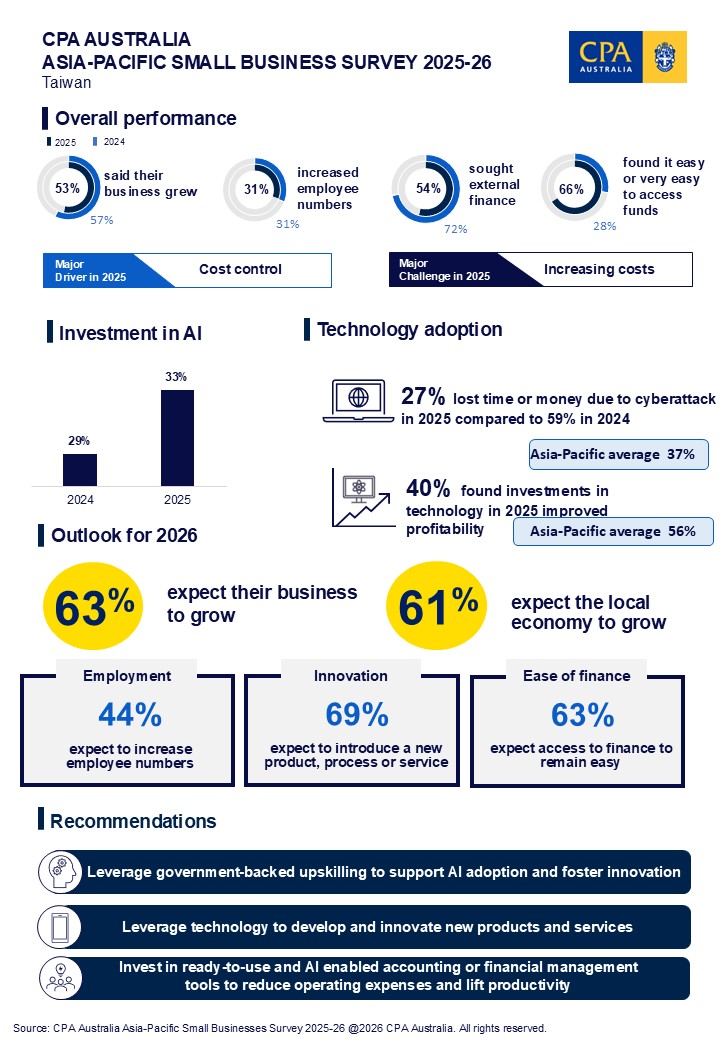
The survey found that 53 per cent of Taiwanese small businesses grew in 2025, slightly below the 57 per cent recorded in the previous survey. Looking ahead, business sentiment strengthened notably. In 2026, 63 per cent of respondents expect their business to grow, while confidence in the local economy also improved, with 61 per cent anticipating economic growth, the highest level recorded since Taiwan was first included in the survey in 2018.
Taiwan’s small and medium‑sized enterprises (SMEs) continue to play a vital role in creating new jobs. In 2025, 31 per cent of SMEs increasing staff numbers, while 44 per cent plan to hire additional employees in 2026.
With rising costs identified as the biggest challenge facing Taiwan’s SME in 2025, many businesses identified cost control as the most positive contributor to business performance last year.
Mr Elic Lam FCPA (Aust.), Honorary Taiwan Advisor at CPA Australia, said Taiwan’s economic fundamentals continue to support small business resilience, “Rising global demand for semiconductors and AI related chips continues to create opportunities for exporters and suppliers across Taiwan’s value chain,” Mr Lam said. “While geopolitical tensions and intensifying competition are adding uncertainty, government support measures for SMEs, including targeted subsidies and tax incentives, together with Taiwan’s resilient domestic demand, are helping to lift business confidence.”
Technology adoption, particularly artificial intelligence (AI), is becoming increasingly widespread among Taiwanese small businesses. The survey found that 33 per cent of small businesses identified AI as the technology they invested in most heavily invested in 2025, up from 29 per cent in the previous year.
Cyber risk among Taiwanese small businesses fell markedly. The share of small businesses reporting losses of time or money due to cyber incidents declined sharply from 59 per cent in 2024 to 27 per cent in 2025, reflecting stronger awareness and the uptake of basic protective measures across the sector.
However, the survey also indicates there is room to strengthen the returns from digital investment. Only 40 per cent of respondents reported that their technology investment in 2025 improved profitability, compared with the survey average of 56 per cent.
Mr Lam noted that Taiwan’s SME sector is undergoing a generational transition that is influencing technology adoption patterns, “Many SMEs in Taiwan are moving from first generation ownership to second or third generation leadership, and technology adoption remains cautious and practical,” he said. “The increase in AI investment reflects both external drivers, such as changing customer expectations and government policy support for digital transformation, as well as internal factors, including younger owners’ familiarity with AI tools and rising operating and staffing costs.”
“To improve profitability, SMEs should focus on applying digital solutions in areas with the greatest impact. For example, as rising costs were identified as the most negative factor affecting performance in 2025, investing in ready-to-use and AI enabled accounting or financial management tools can help reduce operating expenses and lift productivity.”
Access to finance is another notable finding. Financing conditions in Taiwan improved significantly in 2025, even as borrowing softened. Two-thirds of businesses (66 per cent) I said it was easy to access external finance, placing Taiwan among the top three surveyed markets and representing a sharp increase from 28 per cent in 2024. Looking ahead, financing conditions are expected to remain supportive, with 63 per cent anticipating easy access to finance in 2026.
Despite the marked improvement in financing conditions, demand for finance was more subdued. In 2025, 54 per cent of SMEs sought external finance, down from 72 per cent in 2024.
“The Taiwan government has expanded inclusive and guaranteed financing mechanisms to support SMEs, including higher guarantee ratios under the SME Credit Guarantee Fund and preferential loans offered through state affiliated banks,” Mr Lam said. “These measures have made bank financing more accessible for small businesses.”
“Even so, many SMEs remain cautious about taking on new debt. In a stable domestic environment, businesses can maintain steady growth, but external uncertainties drive them to take a prudent approach to borrowing. This aligns well with the government’s policy focus on gradual and resilient SME transformation rather than rapid, high risk expansion.”
Lam concluded, “To navigate international uncertainty and intensifying market competition, Taiwan’s small businesses should make better use of government policy support to upskill their workforce through AI adoption, foster innovation, and diversify export markets by strengthening online sales channels.”
The Asia Pacific Small Business Survey 2025–26 gathered views from 4,166 small businesses across 11 markets in the region, including Singapore, Chinese Mainland and Australia. The Taiwan survey sample comprised 311 small businesses.
Hashtag: #CPAAustralia
The issuer is solely responsible for the content of this announcement.
About CPA Australia
CPA Australia is Australia’s leading professional accounting body and one of the largest in the world. We have more than 176,000 members in over 100 countries and regions, including more than 22,500 members in Greater China. Our core services include education, training, technical support and advocacy. CPA Australia provides thought leadership on local, national and international issues affecting the accounting profession and public interest. We engage with governments, regulators and industries to advocate policies that stimulate sustainable economic growth and have positive business and public outcomes. A CPA is a Certified Practising Accountant. More at
cpaaustralia.com.au
Media OutReach
48% of Singaporean Divers Unaware of Taiwan’s Dive Offerings: TTA at ADEX 2026
Just over four hours from Changi Airport. Visa-free entry. And almost entirely unexplored by Singapore’s diving community.
To close that gap, the Taiwan Pavilion returned for its second consecutive year, transforming the Suntec Convention Centre into a gateway to Taiwan’s four major aquatic frontiers. This year’s headline act: Green Island (Lyudao)—a volcanic gem rising from the Pacific that’s still well under the radar for most Southeast Asian travellers.
Green Island: Taiwan’s Most Underrated Dive Destination
Green Island is not just another dive site. Swept by the warm Kuroshio Current, the island delivers visibility that regularly exceeds 30 metres—a “liquid glass” effect that few dive sites in Southeast Asia can match.
- The Ancient Guardian: Divers can encounter the “Big Mushroom,” a living coral structure believed to be over 1,000 years old—a humbling reminder of what the ocean can sustain when left in peace.
- The World’s Deepest Postbox: At the Shilang Diving Area, you can mail waterproof postcards from the world’s deepest underwater mailbox (11 metres down). It’s the kind of quirky detail that makes travel worth talking about.
- Dive by Day, Soak by Night: Green Island is home to the Zhaori Saltwater Hot Springs—one of the rare seawater hot springs globally. Trading your wetsuit for a poolside soak at sunset is the kind of contrast that turns a trip into a story.
Xiaoliuqiu: Taiwan’s Best Island Escape Off the Clock
Floating off the coast of Pingtung, this compact coral island is one of the few places on Earth where wild sea turtles are so at home, they’ve practically become locals—surfacing beside snorkelers with an ancient calm.
- The Locals Who Never Leave: Xiaoliuqiu hosts one of Taiwan’s densest populations of green sea turtles. With a professional dive guide leading you beneath the surface, an underwater encounter with a creature that has outlived the dinosaurs becomes less a lucky sighting and more a near-certainty.
- Dive by Day, Own the Night: When the sun drops, Xiaoliuqiu doesn’t go quiet—it shifts gear entirely. Night ecology tours reveal a different cast of creatures, and the evening ends not at a hotel bar but around a fire with fresh BBQ seafood under a sky with almost zero light pollution. That’s the kind of night that still feels real a week later.
Penghu: The Basalt Archipelago With a Coral Heart
Anchored in the Taiwan Strait and shaped by seasonal winds that have carved its basalt coastline for millennia, Penghu delivers a version of Taiwan that feels genuinely off-script—ancient, oceanic, and spectacular on its own terms.
- The Bridge That Crosses the Sea: At nearly 2.5 kilometres, the Penghu Cross-Sea Bridge is the kind of infrastructure that earns its own mythology. Drive it at golden hour, with open water stretching in every direction, and a standard itinerary starts to feel like an expedition.
- Taiwan’s Best-Kept Secret Island: Huching Islet—once named one of the world’s top ten secret islands—greets visitors with towering basalt columns, cats that outnumber people, and a pace of life that has no interest in catching up with the mainland. It’s 20 minutes by boat from Magong, and a different world entirely.
- The Double Heart in the Sea: At the southern tip of the archipelago, Qimei Island’s twin stone fish traps curve into two interlocking hearts—built centuries ago by fishermen, now one of Taiwan’s most iconic images. The rare landmark that earns its reputation without trying.
- The Coral That Grows Back: Penghu’s coral restoration programme lets travellers do something rarer than sightseeing—actively participate in reef recovery, planting coral fragments on underwater nurseries alongside marine biologists. The most meaningful souvenir you can’t bring home.
Sustainability: More Than a Trend
With 45.8% of surveyed divers aged 25–34 expressing strong interest in eco-conscious travel, the Pavilion put sustainable diving front and centre. World-renowned underwater photographer Yorko Summer appeared alongside conservationists Peggy (TurtleSpot Taiwan) and NT (Penghu Reef Restoration) to demonstrate how Taiwan is going beyond tourism rhetoric into genuine marine stewardship—3D-printed eco-substrates, sea turtle nesting patrols, and active reef monitoring. Singaporean divers aren’t just being invited to visit—they’re being invited to contribute.
World-Class Gear, Made in Taiwan
The Pavilion also shone a light on Taiwan’s homegrown dive industry. Brands including ATMOS, 123 Underwater Lab, and DIVEVERYDAY demonstrated that the “Made-in-Taiwan” (MIT) spirit extends well beyond electronics and manufacturing—into world-class dive technology ready for Singapore’s most discerning enthusiasts.
— Taiwan Tourism Administration, Singapore Office
As ADEX 2026 makes clear, Taiwan’s dive scene represents one of the most significant untapped opportunities in the Singaporean travel market. For divers looking for somewhere extraordinary—somewhere most of their friends haven’t been yet, just a short flight away—the Pacific has been keeping a secret.
It’s time to dive in.
Hashtag: #ADEX2026
The issuer is solely responsible for the content of this announcement.
Media OutReach
BleeqUp Launches World’s First 4-in-1 Sports Camera Glasses in Singapore
The BleeqUp Ranger debuts locally, featuring Sony 16MP imaging, open-ear audio, and optional ZEISS optics for the ultimate outdoor experience.
SINGAPORE – Media OutReach Newswire – 20 April 2026 – BleeqUp, the innovator in AI-powered sports technology, today announced the official launch of the BleeqUp Ranger in Singapore. Following its global debut at IFA Berlin, the Ranger arrives as the world’s first 4-in-1 sports camera glasses to enter mass production, offering a streamlined solution for cyclists, runners, and outdoor enthusiasts.
Weighing less than 50g, the BleeqUp Ranger replaces the need for bulky action cameras, separate headphones, and communication gear. It integrates high-fidelity imaging, long-endurance battery life, and open-ear audio into a single, aerodynamic frame.
Key Highlights :
- Available in ZEISS Lenses: Precision-engineered for sharper visuals, reduced distortion, and enhanced contrast in varying light conditions.
- Sony’s 16MP Camera: Capture POV footage exactly as you see it. With 4K photos and specialized EIS stabilization, the Ranger now supports 3K at 60FPS* video recording.
- One-Tap AI Editing: Turn your footage into highlights automatically. Smart scene recognition and AI-driven editing make sharing your best moments faster and easier than ever.
- Open-Ear Audio: Stay connected to your surroundings while listening. Four speakers and wind-noise reduction keep music and calls clear, even at speeds up to 40 km/h.
- Real-Time Walkie-Talkie: Coordinate with your team on the move. Featuring instant group communication and a dedicated Bluetooth controller, the Ranger keeps you connected without taking your hands off the bars.
*Compatibility Note: Specific feature availability and performance may vary by device model. Please check our official website for the latest compatibility updates.
Availability and Exclusive Launch Offers
Starting April 20, 2026, the BleeqUp Ranger will be available nationwide at premium retailers including Best Denki, Courts, Singtel, Takashimaya, and Sprint-Cass (Changi Airport). For online convenience, customers can purchase the Ranger through the Shopee Official Store, Lazada Official Store, KrisShop and Decathlon Online. To celebrate the launch, exclusive perks such as a SGD 100 voucher (at Singtel) and 50% off accessories (at Takashimaya) will be available for a limited time.
Hashtag: #BleeqUp
The issuer is solely responsible for the content of this announcement.
About BleeqUp
Founded in 2022, BleeqUp is dedicated to redefining performance and safety for outdoor adventurers. By combining advanced AI with premium optical design, BleeqUp helps athletes ride further, move smarter, and stay safer.
Media OutReach
Monash IVF Singapore Spotlights Male Factor Infertility for National Infertility Awareness Week (NIAW)
While fertility discussions often centre on women, statistics show that male factors contribute to approximately 50% of all infertility cases. Male factor infertility can arise from a range of factors, including low sperm count, reduced sperm motility, abnormal sperm morphology, hormonal imbalances, genetic conditions, or underlying medical issues. Lifestyle factors such as smoking, alcohol consumption, stress, and environmental exposures may also affect sperm quality over time.
Despite its prevalence, male factor infertility is often less discussed in Singapore, which can lead to delays in assessment and treatment. Early evaluation, including semen analysis and medical consultation, can help identify potential concerns and guide appropriate next steps for couples.
To support greater awareness, Monash IVF is launching a series of digital educational content aimed at de-stigmatising male reproductive health and providing actionable insights for men to take charge of their fertility. These resources will cover common causes of male infertility, when to seek medical advice, and the types of assessments and treatment options available. By making this information more accessible, the clinic aims to encourage earlier evaluation and more open conversations about male factor infertility, both within relationships and in the wider community.
As Singapore’s demographic landscape evolves, Monash IVF Singapore is contributing to broader discussions on reproductive health. With the national Total Fertility Rate (TFR) reaching a record low of 0.87 in 2025, the need for comprehensive and patient-centred fertility care continues to grow.
Understanding Modern Fertility Challenges: Beyond Biological Factors
The decline in fertility is not merely a biological hurdle but a reflection of the intense pressures that Singaporeans face today. The “workplace rat race”, high-stress environments, and environmental factors have contributed to a trend of delayed parenthood. Many individuals are choosing to start families later due to career progression, financial considerations, and evolving life priorities. At the same time, age remains a key factor, as both egg and sperm quality may decline over time.
As such, these same pressures do not just delay parenthood; they also make it more difficult for individuals to pursue fertility treatments in Singapore. Managing appointments, coping with the physical and emotional demands of treatment, and balancing work responsibilities can become an added strain for many.
“Fertility is often treated as a private struggle, but it is a societal challenge,” says June Jonet, Marketing and Business Development Head of Monash IVF Singapore. “We are calling for greater understanding and support within the workplace. Employees undergoing fertility treatments or preservation need an environment that recognises the physical and emotional toll of this journey, rather than one that penalises them for it.”
Monash IVF’s Approach to Assisted Reproductive Care
Monash IVF Singapore’s clinical and laboratory team is led by Chief Embryologist Ng Pei Hui, supported by a team of senior embryologists and Fertility Specialists, including Dr Kelly Loi, Dr Suresh Nair, and Dr Yap Lip Kee.
The clinic applies a range of established assisted reproductive techniques to enhance success rates, tailored to individual clinical needs. These include:
- Piezo-ICSI: A fertilisation method that uses a blunt needle with high-speed vibration to gently penetrate eggs and assist sperm injection. It may be considered in cases involving fragile oocytes or advanced maternal age.
- IMSI: A technique that uses high-magnification imaging to support sperm selection, enabling embryologists to identify and avoid sperm with morphological abnormalities, such as vacuoles.
- PICSI: A method of biological sperm selection using hyaluronic acid to help identify mature sperm with a lower likelihood of DNA damage.
- Embryoscope+: A time-lapse imaging system that continuously monitors embryo development without disrupting stable culture conditions, supporting the selection of embryos with strong developmental potential for transfer.
The Power of Planning: Fertility Preservation
Alongside treatment, Monash IVF Singapore highlights the importance of proactive planning. As more women and couples choose to delay parenthood, elective egg freezing (a form of fertility preservation) has become a vital tool. At the same time, early assessment of male factor infertility, including semen analysis, can identify potential concerns and help couples prepare more confidently.
“Even with the range of treatments available today, timing still matters,” says Chief Embryologist Ng Pei Hui. “Early consultation allows patients to better understand their options and make informed decisions.”
With infertility affecting approximately 1 in 6 individuals, it is now recognised as a relatively common medical condition rather than a rare exception. This is why at Monash IVF Singapore, fertility care is not only about addressing challenges as they arise but also about supporting early planning for both men and women. With options such as elective egg freezing, male fertility assessment, and fertility health checks, the clinic aims to help Singaporeans better understand their reproductive health and make informed decisions at different stages of their journey.
For more information about Monash IVF Singapore and what they do, visit their website.
Hashtag: #MonashIVF #malefertility #mensfertility #reproductivehealth #fertilityawareness #menswellness
The issuer is solely responsible for the content of this announcement.
About Monash IVF Singapore
Monash IVF Singapore is part of the global Monash IVF Group, a pioneer in reproductive medicine since achieving the world’s first IVF pregnancy in 1973. We provide a full suite of fertility services, combining compassionate patient care with the latest scientific breakthroughs.
-
Feature/OPED6 years agoDavos was Different this year
-
Travel/Tourism10 years ago
Lagos Seals Western Lodge Hotel In Ikorodu
-
Showbiz3 years agoEstranged Lover Releases Videos of Empress Njamah Bathing
-
Banking8 years agoSort Codes of GTBank Branches in Nigeria
-
Economy3 years agoSubsidy Removal: CNG at N130 Per Litre Cheaper Than Petrol—IPMAN
-
Banking3 years agoSort Codes of UBA Branches in Nigeria
-
Banking3 years agoFirst Bank Announces Planned Downtime
-
Sports3 years agoHighest Paid Nigerian Footballer – How Much Do Nigerian Footballers Earn