

Media OutReach
DFI Retail Group Holdings Limited 2024 Preliminary Announcement of Results

The following announcement was issued today to a Regulatory Information Service approved by the Financial Conduct Authority in the United Kingdom.
Highlights
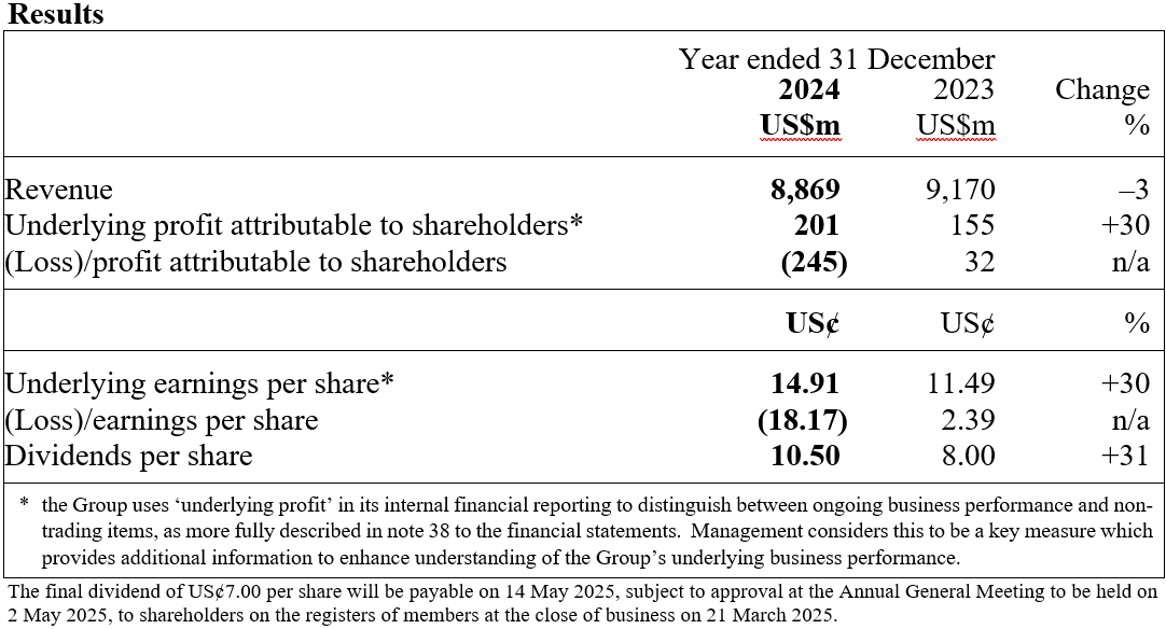
- 30% growth in underlying profit to US$201 million
- Health and Beauty delivered a stable performance
- Convenience saw strong profit growth due to favourable product mix
- Food profit improved, driven by significant Singapore Food earnings recovery
- Portfolio simplification progressed further with Yonghui and Hero Supermarket divestments
- Net cash position achieved in February 2025 with completion of Yonghui sale
- Final dividend of US¢7.00 per share
“Effective strategy execution led to strong underlying profit growth in 2024, despite a challenging retail environment. We aim to remain relevant to consumers and to increase market share further, by evolving our offering through leveraging data and expanding our omnichannel presence. We are well-positioned for sustainable growth and increased shareholder returns over the mid-term.”
John Witt
Chairman
PRELIMINARY ANNOUNCEMENT OF RESULTS
FOR THE YEAR ENDED 31 DECEMBER 2024
PERFORMANCE
I am pleased to report that DFI Retail Group (‘DFI’ or the Group) delivered a significantly improved underlying performance and a good partial recovery in results in 2024, despite a challenging retail environment. For the full year, underlying profit attributable to shareholders reached US$201 million, a 30% increase from the previous year.
Our diverse portfolio and effective operational execution enabled us to gain market share across key businesses, even as we faced shifts in consumer behaviour and macroeconomic headwinds. Profit growth was driven by improved profit in Food and Convenience, supported by growth in digital channels.
We are confident that the Group’s new strategy will drive further profit growth in the coming years, and are particularly optimistic about the growth prospects for our Health and Beauty business, which represents 55% of the Group’s total operating profit. We also see strong growth opportunities in our Convenience business. Our other businesses continue to face challenges, but we are confident in the ability of DFI’s senior leadership team to navigate short-term uncertainties, evolve the portfolio and invest in strengthening our core businesses to drive long-term growth in shareholder value.
The Board recommends a final dividend for 2024 of US¢7.00 per share (2023 final dividend: US¢5.00).
STRATEGIC HIGHLIGHTS
Under the capable leadership of our Group Chief Executive, Scott Price, we have made significant strides in implementing our strategic framework, which centres around three core pillars:
Customer First
Across our business, we have an ongoing commitment to putting our customers first, and we have made significant progress to better serve them over the past year. The yuu Rewards loyalty programme continues to strengthen, with a substantial increase in members and the addition of a number of further partners. We have also begun harnessing our proprietary customer data to refine our product assortment and revamp our Own Brand and digital strategies. We are driving a more transparent and collaborative approach to our negotiations with suppliers, leading to a better outcome for customers. As well as better serving our customers, these efforts aim to bolster market share growth and enhance margins across our businesses.
People Led
We have refined our organisation structure over the past year. Our new senior leadership team, with its deep industry expertise, shares a vision for strategic growth and operational excellence. Key appointments across the business have strengthened our capability to drive these initiatives forward, and we have reduced spans and layers within the organisation to streamline operations and expedite decision-making. Diversity across our business has also improved significantly.
Shareholder Driven
In alignment with our strategic and capital allocation priorities, we continued to simplify the Group’s portfolio and divested our Hero Supermarket business and investment in Yonghui Superstores.
Following the disposal of Hero Supermarket, the Guardian and IKEA businesses will be our focus in Indonesia and we are confident in the long-term prospects for these two businesses to increase market share as the Indonesian market grows. These disposals allow us to reinvest in our subsidiaries’ growth, deleverage our balance sheet and grow total shareholder returns.
Sustainability remains at the top of our agenda, and we are collaborating closely with our stakeholders and setting ambitious targets across the business. There was strong progress in 2024 against the Group’s sustainability strategy in areas including emissions reduction and waste diversion. Our efforts were recognised in improvements in our ESG ratings, including a significant improvement in the Group’s S&P Global Corporate Sustainability Assessment. We will continue to promote and drive sustainable business practices in our end-to-end value chain.
GOVERNANCE AND PEOPLE
The Board and its Committees, and senior leadership team, together play a key role in delivering against our priorities. The effective execution of our strategy depends on high quality debate around the boardroom table, with strong contributions from all Directors.
There have been a number of significant Board and executive leadership changes since the start of 2024:
– In July, I succeeded Ben Keswick as Chairman. On behalf of the Board, I would like to express our gratitude to Ben for his 11 years of service as Chairman.
– I also wish to thank Adam Keswick for his contribution to the Board and Nominations Committee as he steps down.
– We welcomed Elaine Chang to the Board as an Independent Non-Executive Director and Graham Baker as a Non-Executive Director. Elaine has 30 years of leadership experience across industries such as semiconductors, digital content, e-commerce, cloud computing and artificial intelligence, and her expertise in leveraging technology to drive growth will greatly benefit the Group.
– Christian Nothhaft was appointed as a member of the Remuneration and Nominations Committees.
– Tom van der Lee took over as Group Chief Financial Officer from Clem Constantine. We thank Clem for his significant contribution, especially during the pandemic and in strengthening the Group’s financial position. Tom, who joined DFI in 2016, brings a wealth of experience from his various senior financial roles within the organisation.
– Sean Ward succeeded Jonathan Lloyd as our Company Secretary in December 2024. I want to thank Jonathan for his years of valued service.
PROSPECTS
We are pleased by the Group’s strong underlying profit growth in 2024, despite a challenging retail backdrop, providing encouraging early support for our new strategy. We aim to consolidate our position in markets such as Hong Kong where we have strong businesses, while at the same time aiming to achieve long-term growth as we expand key businesses such as Health and Beauty and Convenience.
By evolving our offerings through data-driven insights and expanding our omnichannel presence, we will remain relevant to consumers and continue capturing market share. Our deleveraged balance sheet and strategic initiatives position us well for sustainable growth and increased shareholder returns in the years to come.
I should like to express my appreciation to our shareholders, our valued partners and to the wider community for your continued support. Most of all, thanks must go to our team members, who are key to our success, for their exceptional work and unwavering commitment throughout the past year, despite challenging market conditions.
John Witt
Chairman
GROUP CHIEF EXECUTIVE’S REVIEW
INTRODUCTION
As I reflect on my first full year as DFI’s Group Chief Executive, I am incredibly proud of the significant progress we have made executing in alignment to our strategic framework: Customer First, People Led, Shareholder Driven.
Despite the challenging macroeconomic backdrop, we demonstrated resilience in our business performance, reporting underlying profit attributable to shareholders of US$201 million in 2024, up 30% year-on-year. During the year, we announced the divestment of our minority stake in Yonghui, a transaction that aligns with our strategic and capital allocation framework and enables us to reinvest in the future growth of our subsidiary businesses. While our reported results were impacted by one-off items, including fair value loss, impairment of equity interest and goodwill, we have continued to significantly deleverage our balance sheet with a net cash position following the completion of the Yonghui transaction in February 2025.
As we head into the new financial year, we remain laser focused on executing our strategic priorities to drive revenue growth and enhance profitability. Our 2025 financial guidance of US$230 million to US$270 million underlying profit attributable to shareholders, reflects our confidence in further building on our momentum and delivering greater value for our stakeholders.
STRATEGIC FRAMEWORK – KEY PROGRESS
We developed our strategic framework of Customer First, People Led, Shareholder Driven in the second half of 2023 to guide the Group’s capital allocation priorities and growth plans over the coming years. I am both pleased and proud of the progress made by the team over the past 12 months in executing on this framework.
Customer First
I continue to see value unlock across our uniquely diverse businesses across Asia. We are proud to serve millions of customers in various formats and banners with nearly 11,000 outlets across 13 markets in Asia. What stands out is our ongoing commitment to putting our customers first and serving with passion and care. Our purpose has always been part of who we are. During the year, we launched our DFI purpose to articulate it in a way that unites our organisation, which is to Sustainably Serve Asia for Generations with Everyday Moments. This statement underscores our commitment to meeting the everyday needs of our customers across Asia, while emphasising their interests in sustainable solutions.
Aligned with our purpose, we have made significant progress in a number of areas to better serve our customers over the past year.
yuu Rewards
Our yuu Rewards coalition loyalty programme continues to strengthen. In our home market of Hong Kong, total members have reached 5.3 million with over 3 million monthly active members. The active use of purchases across all our formats, restaurants and partners creates substantial volume of unique data insights. In 2024, the yuu Rewards programme in Hong Kong added a number of additional partners including Starbucks and FWD Insurance. Our members have engaged across a variety of redemption offers that incorporate new travel, entertainment and dining options, driving enhanced customer engagement.
In Singapore, the yuu Rewards programme has grown to over 1.8 million members. A number of new partners joined the programme during the year including Suntec City and Singapore Airlines.
Improving assortment
We are now leveraging our broad yuu Rewards customer data to improve assortment in our stores. At Wellcome, we have leveraged our proprietary data and cutting-edge data analytics capabilities to execute a reset of 14 categories in stores. The improved assortment has seen very encouraging initial results with uplifts in both sales and gross profits. We are now also leveraging the learnings from Wellcome to support assortment optimisation for our Health and Beauty and Convenience businesses across Hong Kong and Singapore.
Improving supplier collaboration
We are beginning to better leverage our data to support enhanced supplier collaboration. By creating a more transparent and collaborative approach to negotiations with suppliers, we are working together to drive market growth and a better outcome for customers.
Own Brand
We have reset our Own Brand strategy to better align with customer needs while delivering stronger margins for our business. By optimising our product range, redesigning packaging for greater customer appeal and maximising cross-selling opportunities across our formats, we have made meaningful improvements in margin and sales productivity, which includes a more than 300bps increase in our Food Own Brand margin and close to a 40% increase in sales productivity compared to 2023. Following the success of our reset of the Own Brand portfolio across our Food business, we have integrated the Health and Beauty Own Brand assortment into this center of excellence to replicate the same success in Health and Beauty as we reset its private label strategy.
Digital
Following our digital strategy reset in September 2023, customers are now able to access our retail portfolio through a wider range of digital assets including apps, websites and third-party platforms. Our expanded omnichannel presence includes Wellcome’s quick-commerce partnership with foodpanda, a new 7-Eleven app with approximately 137,000 monthly active users and 30,000 daily active users in Hong Kong as of December 2024. Including a new Mannings Hong Kong app and Guardian Singapore app, we have launched more than 20 new channels in 2024 across apps, websites and third-party platforms. Our strengthened digital proposition was underpinned by a 31% growth in e-commerce order volume with strong profitability turnaround.
Retail Media
DFI launched our own Retail Media network in the first quarter of 2024. Initial performance has been encouraging, with more than 100 targeted marketing campaigns sold in less than a year since the launch, supported by strong sales acceleration in the second half. We have partnered with leading suppliers such as Procter & Gamble, Unilever, Coca-Cola, Nestlé and Reckitt. Importantly, the integrated online and offline advertising proposition for Retail Media has supported the improved Return on Ad Spend for our supplier partners. We are in the early days of a potentially significant source of profit to invest in the business.
People Led
In alignment with our strategic framework, we refined our organisation structure in the second half of 2023 by moving accountability to a format structure, thereby improving agility while reducing overhead costs. Throughout 2024, we have been focused on deeply embedding our values, underpinned by our purpose statement across the Group. We have reduced spans and layers within the organisation to streamline operations and expedite decision making. Diversity representation across formats has been significantly improved to ensure local relevancy of decision-making to customers. We have strengthened our leadership succession planning and development with a meaningfully improved team member engagement score, supported by a new incentive structure for senior management that aligns with shareholder interests, based on total shareholder return and business performance targets.
Shareholder Driven
Our strategic framework has been developed with the primary aim of improving shareholder returns. We have approached capital allocation in a disciplined manner, both from a capex and working capital management perspective. Over the course of the year, we executed the divestment of a number of company-owned properties, which has supported a US$150 million reduction in net debt at the end of 2024.
Concurrently, the Group continues to execute M&A transactions in a manner that is accretive to return on capital and total shareholder return based on a strategic review of our businesses in 2024. In June 2024, the Group completed the divestment of the Hero Supermarket business in Indonesia. Post-completion, DFI’s operations in Indonesia has fully pivoted to the Guardian and IKEA businesses. In September 2024, the Group announced the divestment of its entire stake in Yonghui Superstores Co., Ltd. This transaction was subsequently completed in February 2025. The Group is in a net cash position following the completion of the Yonghui transaction.
2024 PERFORMANCE
The Group reported total revenue from subsidiaries in 2024 of US$8.9 billion, down 3% year-on-year. However, excluding the impact of a significant tobacco tax increase in Hong Kong, the divestment of our Malaysia Food business in 2023 and Hero Supermarket operation in Indonesia, operating revenue was largely stable. This broadly represents market share gains in all formats except IKEA.
Total revenue for the Group, including 100% of associates and joint ventures, was US$24.9 billion, down 6% compared to 2023, largely due to lower sales at Yonghui. Total underlying profit attributable to shareholders was US$201 million for the year, up 30% year-on-year.
The Group reported subsidiaries underlying profit attributable to shareholders of US$158 million for the full year, 42% higher than the prior year. This was driven by significant earnings recovery in Singapore Food and favourable product mix shift towards non-cigarette categories in our Convenience business, partially offset by lower contribution from Home Furnishings as a result of weak property market activity and intensifying competition.
The Group’s share of underlying profit from associates was US$43 million, down 2% year-on-year. Lower contribution from Maxim’s due to weaker mooncake sales and restaurant performance in the Chinese mainland was partially offset by reduced losses from Yonghui and a 15% profit growth at Robinsons Retail.
The Group’s reported results for the year were impacted by non-trading losses attributable to shareholders of US$445 million. This was predominantly due to loss of US$114 million associated with the divestment of Yonghui, a US$231 million impairment of interest in Robinsons Retail and US$133 million goodwill impairment of Macau and Cambodia Food businesses. These losses were partially offset by gains from divestment of Singapore property assets and the Group’s share of one-off gains from the Bank of the Philippine Islands (BPI)-Robinsons Bank merger. Despite the large non-trading losses reported, the Group is now in a net cash position following the completion of Yonghui transaction in February 2025.
The Group reported operating cash flow after lease payments of US$331 million, 21% lower than the prior year, mainly due to unfavourable movement in working capital year-end timing difference, partially offset by underlying operating profit growth. Operating cash flow after lease payments and normal capital expenditure was US$158 million, down 29% year-on-year.
ENVIRONMENTAL, SOCIAL, GOVERNANCE (ESG)
As a leading Asian retailer, we recognise our unique opportunity to promote and drive sustainable business practices in response to the preference of our customers. By positioning our ESG commitment as a core pillar of our Group Strategy, we have made meaningful progress in various initiatives, including emissions reduction and waste diversion. Our efforts are reflected in a significant improvement in the S&P Global Corporate Sustainability Assessment, with our score improving to 49 as at 8 January 2025, placing DFI in the 84th percentile within the Food and Staples Retailing industry, up from the 47th percentile in 2023.
Our strong commitment to ESG is underscored by our target to halve Scope 1 & 2 greenhouse gas (GHG) emissions by 2030 and achieve net-zero by 2050. Throughout 2024, we have made significant investments in upgrading and converting our existing refrigeration systems to more environmentally friendly options. We successfully completed trials of natural gas and ultra-low global warming potential gases as refrigerant alternatives for our food stores. Following a comprehensive analysis of our Scope 3 emissions, we have identified key product categories and realistic decarbonisation opportunities within our supply chain. For example, our Low Carbon Rice Project, launching in Thailand this year, aims to drive decarbonisation by promoting low-carbon farming practices among local farmers, implementing field monitoring and tracking to measure carbon emission reductions. We have made notable progress in improving our waste diversion and are constantly exploring innovative ways to foster a transition towards a local circular economy. Wellcome has partnered with a Hong Kong-based recycling facility to convert trimmed fats into biodiesel for powering essential generators.
While we are still early in the journey, these initiatives collectively demonstrate our efforts and commitment to serving communities sustainable and affordable products, sustaining the planet and sourcing responsibly while meeting the return objectives of our shareholders.
BUSINESS REVIEW
HEALTH AND BEAUTY
Sales for the Health and Beauty division came in slightly higher than the prior year at US$2.5 billion, with like-for-like (LFL) sales remaining broadly stable. Underlying operating profit was US$211 million for the year, slightly below 2023.
Hong Kong reported strong LFL sales performance in the first quarter, which then decelerated in the second and third quarters due to a strong comparable period in 2023 when consumption vouchers were disbursed in April and July 2023. Sales momentum improved in the fourth quarter with Mannings continuing to gain market share. Profit for the year increased 6%, attributable to gross margin improvement and disciplined cost control, despite a 2% decline in full-year LFL sales. Guided by a customer-first proposition, the Pharmacare programme reached a significant milestone since its launch in 2023. In partnership with Bupa, one of Hong Kong’s major medical insurers, the Mannings team further expanded Pharmacare into its network of more than 150,000 members. Leveraging Mannings’ position as the largest pharmacist network, the programme offers free consultations and medication for a range of common illness. The Mannings team continued to enhance in-store experience with the launch of the Health Pod at our International Finance Centre flagship store in Hong Kong. This innovative service offers an AI wellness assessment that measures over 20 metrics, followed by personalised consultations and product recommendations. Initial results have been promising, with customers using the service showing a basket size three times higher than average. In addition, the team also launched a new Mannings app in December to grow its digital footprint. LFL sales of Mannings China declined as the business pivots away from offline stores to online channels which involves the closure of the majority of its offline network.
Guardian in South East Asia reported US$857 million in sales, reflecting a 5% year-on-year increase, driven by growth in basket size across all key markets. Indonesia, in particular, saw a 17% LFL sales growth supported by increased mall traffic and strong execution of promotional campaigns. Strong profit growth was reported across most key markets, underpinned by gross margin expansion and operating leverage. In Singapore, strong commercial execution and a favourable product mix contributed to gross margin expansion, with healthcare products accounting for more than 60% of sales.
CONVENIENCE
Total Convenience sales were US$2.4 billion, representing a decline of 3% year-on-year. LFL sales were 5% behind the prior year, impacted by a decline in lower-margin cigarette volumes following tax increases in Hong Kong at the end of February 2024. Excluding cigarette sales, overall Convenience LFL sales were up 2%, with continued market share gain across markets. Convenience underlying operating profit was US$102 million for the year, an increase of 17% compared to 2023. Hong Kong operating profit has grown 10% year-on-year, driven by a favourable mix shift towards higher-margin categories, with ready-to-eat (RTE) accounting for 16% of total sales for the full year. The newly launched 7-Eleven app offers discounted RTE bundles, pre-order functions, and digital stamps for IP collectibles to drive purchase frequency and customer loyalty.
7-Eleven South China and Singapore reported largely stable LFL sales supported by robust growth in RTE, which accounted for 40% and 23% of sales, respectively. Favourable margin impact from product mix shift and ongoing cost control contributed to meaningful profit growth in both markets. 7-Eleven continued to grow its store network in the South China region with 103 net openings during the year. The Group aims to drive further network expansion primarily through a capex-light franchise model.
FOOD
Reported sales for the Food division in 2024 were US$3.1 billion, down 5% year-on-year. Excluding the impact of the divestment of the Malaysia Food business in 2023 and Hero Supermarket operation in Indonesia, revenue for the division was 2% lower than the prior year. Underlying operating profit for the division was US$58 million for the year, up from US$45 million in 2023.
While increased outbound travel of Hong Kong residents to the Chinese mainland has affected food consumption for the majority of 2024, the situation has begun to normalise with total retail sales of supermarkets in Hong Kong returning to growth in the fourth quarter of 2024. Wellcome saw improving sales momentum in the fourth quarter with full-year LFL sales marginally below those of the prior year despite challenging trading conditions. Strong in-store execution and effective promotional campaigns have supported consistent market share gain over the course of the year. The Wellcome team has strengthened its omnichannel presence through the wellcome.com.hk website, its app and a quick-commerce partnership with foodpanda, contributing to a more than 20% sales growth in overall Food e-commerce with significantly improved profitability.
South East Asia Food sales performance was adversely affected by intense competition and soft consumer sentiment due to cost-of-living pressures. Improved sales mix, effective cost control and optimisation of the store portfolio led to a meaningful earnings recovery, with Singapore Food turning profitable in the fourth quarter of 2024. The Group continues to serve the Singapore market with different propositions through its various brands.
In June 2024, the Group completed the divestment of its Hero Supermarket business in Indonesia. Post-completion, DFI’s operations in Indonesia have fully pivoted to the Guardian and IKEA businesses.
HOME FURNISHINGS
IKEA reported sales of US$701 million, representing a 12% drop compared to the prior year. Overall, LFL sales reduced by 11% in 2024. Operating profit was US$16 million, down 13% year-on-year.
IKEA’s business performance has been hampered by reduced customer traffic due to weak property market activity across regions. While IKEA Taiwan demonstrated relative resilience, sales in Hong Kong and Indonesia were affected by intensified competition and basket mix change as customers reduced purchases of big-ticket items.
In response to the challenging sales environment, the IKEA team continues to implement strong cost control measures across our markets. The IKEA Hong Kong business is pivoting towards a more value-driven omnichannel proposition to compete with Chinese mainland digital platforms. E-commerce penetration has now surpassed 10% across all markets. The IKEA Indonesia team remains focused on driving sales through enhancing store commerciality, increasing local sourcing, and adopting a more effective marketing strategy to improve local relevancy. Implementation of cost-saving measures contributed to narrowing losses compared to the prior year.
RESTAURANTS
The Group’s share of Maxim’s underlying profits was US$66 million in 2024, down from US$79 million in the prior year, largely due to lower mooncake sales and weaker restaurant performance on the Chinese mainland. Maxim’s continued to expand its presence in South East Asia, adding 76 net new stores during the year, mainly in Thailand and Vietnam. Benefiting from a diversified portfolio, restaurant sales performance in Hong Kong remained resilient despite an increase in outbound travel on weekends and public holidays.
OTHER ASSOCIATES
The Group’s share of Yonghui’s underlying losses was US$33 million for the year, compared to a US$36 million share of underlying losses in the prior year. Continued macro headwinds and intense competition led to lower LFL sales. The reduction in losses was underpinned by ongoing cost optimisation, partially offset by a decline in gross margin. The divestment of the Group’s minority stake in Yonghui was completed in February 2025.
Robinsons Retail’s underlying profit contribution was US$17 million, up 15% year-on-year. Robinsons Retail reported low single-digit growth in LFL and robust growth in operating profit driven by the Food and Drugstore segments. Reported profit contribution grew close to 90% year-on-year, supported by one-off gains following the BPI-Robinsons Bank merger in early 2024.
OUTLOOK
We have navigated 2024 with resilient business performance and continued market share gains for our key business units by proactively adapting to changing market conditions through a stronger value proposition, expanded omnichannel presence and disciplined cost control. While challenges remain, we are cautiously optimistic about the outlook for 2025. The Group expects underlying profit attributable to shareholders to be between US$230 million and US$270 million in 2025, supported by an organic revenue growth of approximately 2%.
The Group will continue to execute against its strategic framework. By enhancing the local relevancy of our product offerings, deepening monetisation of our digital assets, and executing value-enhancing M&A transactions, we have put in place solid foundations in 2024, and we remain confident in driving sustained, profitable growth and shareholder returns in the years ahead.
Scott Price
Group Chief Executive
Hashtag: #DFIRetailGroup #Mannings #Guardian #7-Eleven #Wellcome #MarketPlace #ColdStorage #Giant #IKEA #yuuRewards #Maxim’s #RobinsonsRetail
 https://www.dfiretailgroup.com/
The issuer is solely responsible for the content of this announcement.
DFI Retail Group
DFI Retail Group is a leading Asian retailer. At 31 December 2024, the Group, its associates and joint ventures operated over 10,700 outlets, of which more than 5,000 stores were operated by subsidiaries. The Group, together with associates and joint ventures, employed over 190,000 people, with over 45,000 people employed by its subsidiaries. The Group had total annual revenue in 2024 of US$24.9 billion and reported revenue of US$8.9 billion.
DFI Retail Group is dedicated to delivering quality, value and exceptional service to Asian consumers through a compelling retail experience, supported by an extensive store network and highly efficient supply chains.
The Group (including associates and joint ventures) operates a portfolio of well-known brands across six key divisions. The principal brands are:
Health and Beauty
- Mannings on the Chinese mainland, Hong Kong and Macau S.A.R.; Guardian in Brunei, Indonesia, Malaysia, Singapore and Vietnam.
Convenience
- 7-Eleven in Hong Kong and Macau S.A.R., Singapore and Southern China.
Food
- Wellcome and Market Place in Hong Kong S.A.R.; Cold Storage and Giant in Singapore; Lucky in Cambodia; and Robinsons in the Philippines.
Home Furnishings
- IKEA in Hong Kong and Macau S.A.R., Indonesia and Taiwan.
Restaurants
- Hong Kong Maxim’s group on the Chinese mainland, Hong Kong and Macau S.A.R., Cambodia, Laos, Malaysia, Singapore, Thailand and Vietnam.
Other Retailing
- Robinsons in the Philippines operating department stores, specialty and DIY stores.
At the heart of its business, DFI Retail Group is driven by its purpose to ‘Sustainably Serve Asia for Generations with Everyday Moments’.
The Group’s parent company, DFI Retail Group Holdings Limited, is incorporated in Bermuda and has a primary listing in the equity shares (transition) category of the London Stock Exchange, with secondary listings in Bermuda and Singapore. The Group’s businesses are managed from Hong Kong. DFI Retail Group is a member of the Jardine Matheson Group.
Investors
Christine Chung



