Media OutReach
DHL Group’s GoHelp program conducts Disaster Response Team training in Sri Lanka to bolster regional preparedness
- DHL’s GoHelp program equips local employees with critical disaster response skills to enhance resilience 20 years after the 2004 Indian Ocean tsunami devastated Sri Lanka
COLOMBO, SRI LANKA – Media OutReach Newswire – 6 December 2024 – DHL Group has expanded its GoHelp Disaster Response Team (DRT) training to Sri Lanka, strengthening resilience and preparedness against disasters in the Asia Pacific region.
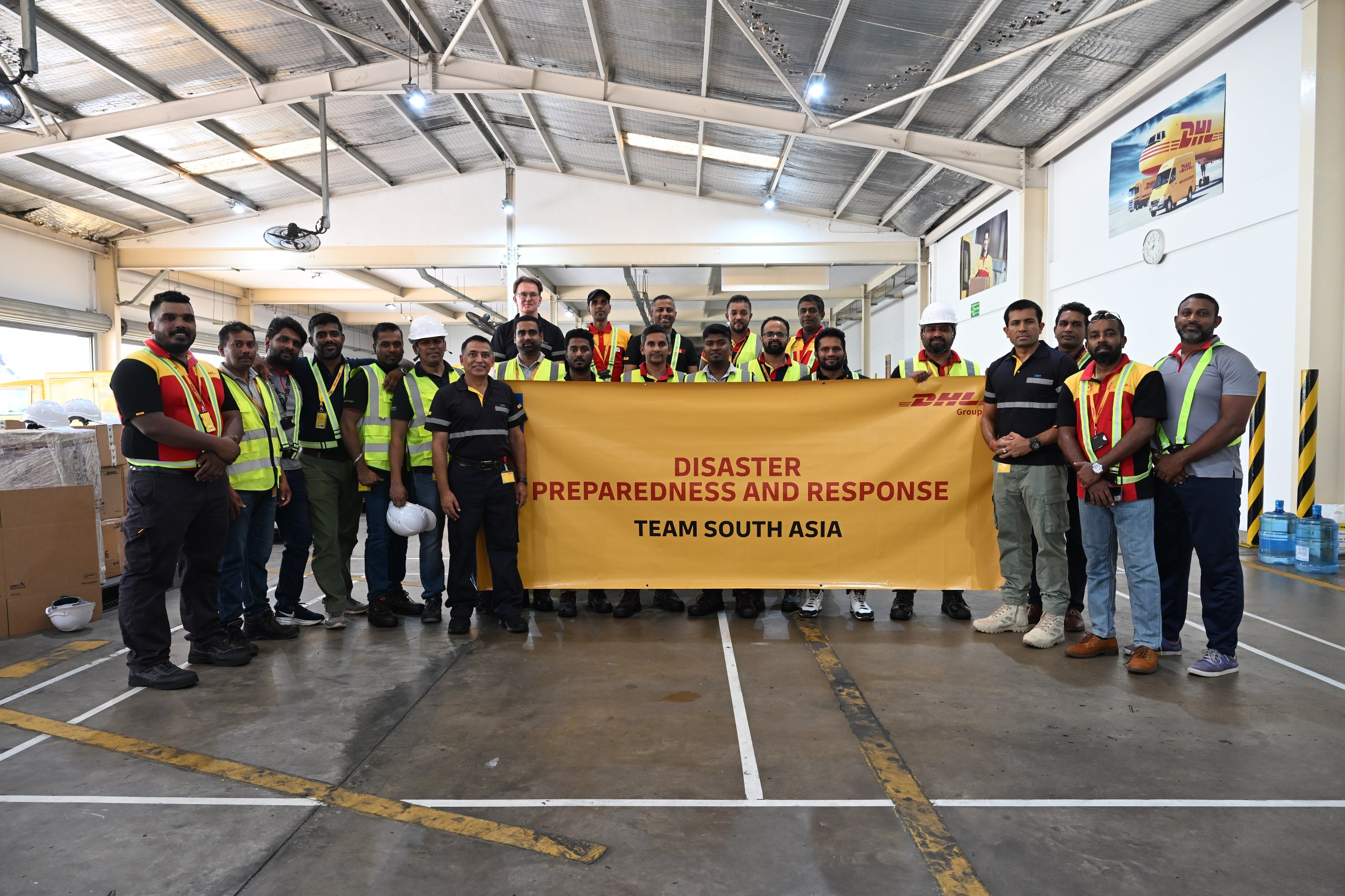
The first DRT training in Sri Lanka was held from November 23-24 at the DHL Express Service Center in Colombo. Twenty employees from both DHL Express and DHL Global Forwarding attended the training. Employees were equipped with specialized skills to manage relief cargo efficiently and ensure that aid reaches those in need safely during times of crisis.
Participants first attended a workshop on safety and stakeholder management, including how to work with NGOs, military, government organizations, and the media, before going through practical skills training, including a disaster simulation, where they were coached on relief cargo management during a crisis and forklift driving.
Since 2005, DHL Group has volunteered its logistics expertise and global network in partnership with the United Nations to help provide global relief efforts in disaster areas via their GoHelp program. In times of disaster, the DRTs are deployed to landside or airside facilities in need of assistance when called upon by the United Nations Office for the Coordination of Humanitarian Affairs, to better manage incoming relief goods.
“As we mark 20 years since the 2004 Indian Ocean tsunami profoundly impacted Sri Lanka, the humanitarian landscape has evolved significantly. Today, the focus is shifting from reactive disaster response to proactive preparedness. In line with this trend, we have adapted our Disaster Response Team (DRT) training beyond airport logistics to include warehouse management during crises. This ensures our employees are equipped to manage relief cargo effectively and provide critical aid across multiple touchpoints during emergencies,” noted Carl Schelfaut, Head of the GoHelp program, Asia Pacific, DHL Group.
The Indian Ocean earthquake and tsunami, the deadliest tsunami in recorded history, devastated communities along the surrounding coasts of the Indian Ocean in December 2004, killing an estimated 228,000 people in 14 countries, including Sri Lanka.
“Sri Lanka’s geographical position makes it particularly vulnerable to natural disasters such as tropical cyclones and storm surges. The devastation caused by the 2004 tsunami remains a stark reminder of the importance of being well-prepared for emergencies,” noted Dimithri Perera, Country Manager, DHL Express Sri Lanka. “Twenty years on, it remains essential for businesses to actively contribute to disaster preparedness, and at DHL Express, we are committed to equipping our teams to play a pivotal role in humanitarian efforts.”
Global warming has also led to intensifying monsoon variability, leading to more frequent and severe weather events such as heavy rainfall, droughts, and rising sea levels, which exacerbate flooding and coastal erosion. In October 2024, Sri Lanka experienced severe flooding due to heavy monsoon rains that resulted in landslide warnings issued across multiple districts, including Colombo.
These recent events highlighted the Sri Lanka’s vulnerability to climate-related disasters, emphasizing the need for robust disaster preparedness measures.
“Disaster preparedness is a shared responsibility. We believe in using our logistics expertise to make a tangible difference in crisis situations. Programs like GoHelp train our teams to act swiftly and effectively, empowering them to bring aid where it’s needed most. I am heartened by all our employees who volunteered to be DRT trained, and I hope that our employees can make a meaningful difference during times of crisis, both here in Sri Lanka and around the world,” said Sudeep Raina, Managing Director, DHL Global Forwarding Sri Lanka.
“As the impacts of climate change intensify, the need for swift, efficient, and effective disaster response has never been greater, and well-trained individuals are the backbone of any successful humanitarian effort. The recent DRT training in Colombo is a testament to our commitment to continue equipping our employees with the knowledge, tools, and confidence needed to make a tangible difference when disasters strike. By continuously evolving our training programs to include broader aspects of crisis management, such as warehouse operations and media coordination, we hope to build more resilient communities and contribute to a stronger, faster global humanitarian response,” said Schelfaut.
Hashtag: #DHL
The issuer is solely responsible for the content of this announcement.
DHL – The logistics company for the world
DHL is the leading global brand in the logistics industry. Our DHL divisions offer an unrivalled portfolio of logistics services ranging from national and international parcel delivery, e-commerce shipping and fulfillment solutions, international express, road, air and ocean transport to industrial supply chain management. With about 395,000 employees in more than 220 countries and territories worldwide, DHL connects people and businesses securely and reliably, enabling global sustainable trade flows. With specialized solutions for growth markets and industries including technology, life sciences and healthcare, engineering, manufacturing & energy, auto-mobility and retail, DHL is decisively positioned as “The logistics company for the world”.
DHL is part of DHL Group. The Group generated revenues of more than 81.8 billion euros in 2023. With sustainable business practices and a commitment to society and the environment, the Group makes a positive contribution to the world. DHL Group aims to achieve net-zero emissions logistics by 2050.
Media OutReach
Global Governance Report Highlights Future Shock Risks as Democratic Accountability Slips and State Capacity Plateaus
The BGI, presented Wednesday by an international group of governance scholars, analyses measurable benchmarks of democratic accountability across 145 countries.
On a 100-point scale, the global score for democratic accountability slipped slightly from 65 in 2000 to 64 in 2023, the most recent data used in the project. The wave of democratisation observed in the closing decades of the last century has stalled in the last 15 years. Democratic accountability fell in 54 countries while it improved in 48 countries.
Yet the BGI — a collaborative project of the Luskin School of Public Affairs at the University of California, Los Angeles (UCLA), Berlin’s Hertie School and the Berggruen Institute, a think tank headquartered in Los Angeles — captures remarkably widespread growth in provision of public goods.
Encompassing healthcare, education, infrastructure, environmental sustainability and conditions to foster employment and rising prosperity, public goods improved in 135 of the countries studied, while declining slightly in just four. The global average jumped from 58 to 69 points from 2000 to 2023.
The third component of what the BGI authors refer to as the “governance triangle” is state capacity, defined as the ability to tax, borrow and spend, control territory, operate scrupulous, competent bureaucracies and administer predictable rule of law. The index finds the global average ticking up from 48 to 49 points; 56 countries had increased state capacity while 57 declined.
“What does it tell us about the world ahead?” Prof. Helmut K. Anheier, a Luskin School sociologist and BGI principal investigator, asked during the public release of the 2026 BGI on the UCLA campus.
“Countries are not really improving in their governance performance in significant ways. … We’re not really having forward-looking investment in governance capacity. There is considerable inertia.”
The largest improvements across all three BGI components occurred in Gambia, which the report groups with “low-capacity developing states.” These states score low across the board, particularly in the provision of public goods. This cluster constitutes the poorest countries with the least developed economies, which face the most serious challenges.
“They have the greatest exposure to likely future crises, whether it’s global warming, whether it’s a new pandemic, whether it’s another financial crisis, whether it’s the impact of AI,” Anheier said. “And they have the least capacity to respond to it.”
Bhutan, Georgia, Iraq and Tunisia — which make up the remaining top five countries with the largest improvements in the BGI — are classified as “capacity-constrained states.” They tend to be middle-income with struggling democracies. These countries score higher across the board than the low-capacity developing states, but their state capacity tends to lag compared to public goods and democratic accountability.
The capacity-constrained states risk falling into “a cycle that erodes the institutions they have built,” Anheier said.
“Consolidated democratic states”, a cluster of most of the world’s richest countries, which score highly in all three BGI components, have to confront domestic complacency. Further, in the United States and some others, “political dysfunction” is leaving mounting problems unaddressed and risking erosion of state capacity, Anheier said.
At the other end of the spectrum, the country with the farthest fall on the BGI since 2000 is Nicaragua. Second from last is Venezuela, followed by Hong Kong, Hungary and Turkey. The rest of the bottom 10 are Russia, Iran, Poland, El Salvador and Belarus.
Since 2023, which is the last year of data available for the study, Poland and Hungary have both seen government changes via election, despite serious democratic backsliding. Both had fallen out of the group of “consolidated democratic states” by 2023 and moved into the capacity constrained cluster.
The other eight countries at the bottom of the list are all places that once had some semblance of competitive elections, but by now have little or no remaining pretense of democracy. They are grouped by the authors among the “authoritarian and hybrid states”, which have by far the lowest democratic accountability but outperform even some struggling democracies in delivering public goods.
These regimes have tended toward faster economic growth in the period observed. But that seeming prosperity, typically fueled by extractive industries or overreliance on exports, masks “serious institutional weaknesses in these countries, including divided elites,” Anheier said.
Relatively few countries — 21 of the 145 — changed enough for better or worse to be classified in a new group by the end of the 23-year study period.
“Movement between them is rare, but this is largely what we should expect,” said Stella Ghervas, a UCLA historian on a panel of experts who discussed the BGI findings Wednesday. “Government systems are not created in a moment. They evolve over long periods of time.”
Local conditions shaping governance in each country can rarely be quickly reset through political will or even external shocks, Joseph C. Saraceno, a Luskin School data scientist and BGI co-author, said Wednesday.
“Despite all the talk of major transformations happening in global affairs, the underlying configuration of governance simply doesn’t appear to change very much,” Saraceno said. “We use the term inertia to describe this reoccurring pattern. In other words, the structures of global governance are resistant to movement as the conditions beneath them are quite sticky: political economies, demographics, resource endowments. These are deeply layered, and they push each country toward the world that it already inhabits.”
But the challenges lurking around the world may not wait for the slow and difficult processes of political change and development to catch up.
“With the few exceptions of those countries in the consolidated democratic world,” Anheier said, “the great majority of the countries in the world is ill-prepared for the future.”
The full report, ‘ 2026 Berggruen Governance Index – The Four Worlds of Governance‘, can be viewed and downloaded from the website of the UCLA’s Luskin School.
Frank Fuhrig, DNA
—————————————————-
This text and the accompanying material (photos and graphics) are an offer from the Democracy News Alliance, a close co-operation between Agence France-Presse (AFP, France), Agenzia Nazionale Stampa Associata (ANSA, Italy), The Canadian Press (CP, Canada), Deutsche Presse-Agentur (dpa, Germany) and PA Media (PA, UK). All recipients can use this material without the need for a separate subscription agreement with one or more of the participating agencies. This includes the recipient’s right to publish the material in own products.
The DNA content is an independent journalistic service that operates separately from the other services of the participating agencies. It is produced by editorial units that are not involved in the production of the agencies’ main news services. Nevertheless, the editorial standards of the agencies and their assurance of completely independent, impartial and unbiased reporting also apply here.
The issuer is solely responsible for the content of this announcement.
Media OutReach
Grobrix Launches “Silver Harvest Initiative”, Turning Schools into Micro-Farms Powered by Students and Retirees
The pilot transforms existing spaces such as corridors and rooftops into small-scale growing sites using compact, soil-less farming systems. By using existing infrastructure instead of new farmland or large facilities, the model enables food production across multiple community locations, making it easier to implement in schools and shared environments.
Students take part in planting, transplanting and harvesting as part of their daily school environment, while crops such as leafy greens can be harvested in cycles of approximately three weeks. This demonstrates how consistent production can be achieved even within limited spaces.
Retirees, known as “Silver Farmers”, manage the farms and oversee daily operations. Students support planting, harvesting and basic monitoring, creating a working environment where food production becomes part of everyday school life. The setup also gives students direct exposure to how food is grown and managed, turning the school into a hands-on learning environment aligned with sustainability and applied learning goals.
“Singapore does not have the luxury of large farming spaces. But we have schools, and we have retirees who want to contribute. This pilot shows that food production can be practical and repeatable by using spaces we already have,” said Mathew Howe, Founder of Grobrix.
The initiative comes amid growing adoption of micro-farming across Singapore, with schools, companies and community spaces increasingly integrating small-scale food production into existing environments. Demand for such systems has risen in recent months, reflecting broader interest in community-based approaches to food resilience.
The Bukit View Primary School pilot will run over 12 months, focusing on improving yields and integrating produce into school consumption. Grobrix will track how much of the school’s leafy green needs can be met through these growing spaces, with the aim of developing a model that can be adopted across other schools.
Grobrix has installed more than 100 edible growing systems across Singapore and is expanding its footprint regionally and internationally. The company plans to scale the Silver Harvest Initiative to more schools while training additional retiree participants, building a network of community-based growing sites over time.
As Singapore continues to strengthen its food security strategy, including updated targets to increase local production of vegetables and protein by 2035, the initiative offers a practical example of how food production can be integrated into everyday environments beyond traditional farming spaces. It also aims to build greater awareness of food sources and encourage more active participation in local food systems.
Hashtag: #Grobrix #growingtogether #sustainability #urbanfarming
https://grobrix.com/
Grobrix is a Singapore based agritech company that integrates farming into the built environment through its patented “Farming as a Service” model. By combining modular vertical farming technology with a cloud based management system, the company enables corporate and residential spaces to produce high quality local crops. Beyond hardware, Grobrix fosters community engagement and food resilience through its unique intergenerational and corporate wellness programs. Currently operating across Singapore, Malaysia, and the United States, the brand is redefining how urban populations interact with their food sources. Its mission is to transform urban infrastructure into a productive, sentient, and sustainable ecosystem for all.
Media OutReach
CUHK Claims Top Positions in Hong Kong and Asia in the Latest QS World University Rankings by Subject
CUHK’s Academic Excellence and Global Research Impact
Ranked among the world’s top 50 universities, CUHK ascended to 32nd place globally in the QS World University Rankings 2026, marking a four-place rise that reinforces its role as a hub for rigorous inquiry, and a dynamic environment where students are empowered to pursue meaningful research and knowledge exchange. This trajectory is supported by 17 CUHK researchers recognised on the Highly Cited Researchers 2025 list by Clarivate Analytics, and 431 academics listed among the world’s top 2% scientists by Stanford University. Among them, 47 scholars were ranked within the global top 100 in their respective fields. Notably, three scholars, including Vice-Chancellor and President Professor Dennis Lo Yuk-ming, have earned positions within the global top 10, a distinction that highlights the remarkable depth and excellence of CUHK’s research community.
CUHK’s The Nethersole School of Nursing: Nurturing Research Innovation and Global Talent in Nursing
Among CUHK’s strongest performers in this year’s rankings, the Nethersole School of Nursing has been ranked #1 in Hong Kong and Asia, and #6 worldwide. Reflecting on the academic environment, Pham Nhat Vi DO, a Vietnamese PhD student in Nursing, shared: “My PhD journey at CUHK has transformed my research abilities, critical thinking, and leadership skills. Through CUHK’s outstanding faculty support, I have accessed diverse academic resources and gained invaluable hands-on experience, building a strong foundation for my future career.”
Vi’s research focuses on colorectal cancer survivorship using cutting-edge technology. As the first Vietnamese researcher adopting this approach, her work reflects CUHK’s strength in empowering students to break new ground.
CUHK’s Geography and Resource Management: Advancing Student Research on Pressing Climate Challenges
CUHK’s Department of Geography and Resource Management has also earned notable recognition in this year’s ranking, placing #4 in Asia and #21 worldwide. Arati POUDEL, a Nepali PhD student, highlighted the University’s research ecosystem as a key defining aspect of her experience. “CUHK exceeds expectations through outstanding research facilities, supportive faculty, and comprehensive professional development opportunities. The prestigious Belt and Road Scholarship has also enriched my research journey in this beautiful campus environment.”
Supported by CUHK, Arati’s research investigates how adaptation to climate extremes—particularly water scarcity and excess—are being addressed, and the pivotal role played by communities and civil society in leading these responses.
Through the QS World University Rankings by Subject 2026, CUHK continues to demonstrate the impact of its research and scholarship. These achievements underscore the University’s growing influence on the global academic stage and its steadfast commitment to addressing complex global challenges through innovation, insight, and collaboration.
Hashtag: #CUHK
The issuer is solely responsible for the content of this announcement.
About CUHK
The Chinese University of Hong Kong (CUHK) is a leading higher education institution dedicated to nurturing and empowering students to become responsible and compassionate global citizens. With a rich heritage and a forward-looking vision, CUHK strives to blend tradition with innovation, fostering academic excellence, research breakthroughs, and meaningful societal impact.
-
Feature/OPED6 years agoDavos was Different this year
-
Travel/Tourism10 years ago
Lagos Seals Western Lodge Hotel In Ikorodu
-
Showbiz3 years agoEstranged Lover Releases Videos of Empress Njamah Bathing
-
Banking8 years agoSort Codes of GTBank Branches in Nigeria
-
Economy3 years agoSubsidy Removal: CNG at N130 Per Litre Cheaper Than Petrol—IPMAN
-
Banking3 years agoSort Codes of UBA Branches in Nigeria
-
Banking3 years agoFirst Bank Announces Planned Downtime
-
Sports3 years agoHighest Paid Nigerian Footballer – How Much Do Nigerian Footballers Earn