Connect with us

Media OutReach

Gold market: May 2025 overview and June 2025 outlook. A monthly digest by the global broker Octa

Published

on

KUALA LUMPUR, MALAYSIA – Media OutReach Newswire – 5 June 2025 – May proved to be a rather challenging month for gold traders. XAUUSD, the primary financial instrument for trading gold, fluctuated in a relatively broad range between $3,120 and $3,435 per ounce (oz), but finished the month virtually unchanged, narrowly recording a fifth consecutive monthly gain. Although trading started on a bearish note, XAUUSD found support in the $3,200 area and even rebounded slightly. However, the failure to confidently break above the critical $3,430 mark led to a short-term bearish trend, with prices falling by nearly 9% by mid-May. Subsequently, technical dip-buying and robust safe-haven demand spurred a recovery in XAUUSD, which remained comfortably above its 50-, 100-, and 200-day moving averages (MAs). Nevertheless, May marked the first month since November 2024 when gold did not reach a new all-time high. Notably, the monthly chart for May has formed a strong doji candlestick, potentially signalling traders’ indecision and a possible mid-term reversal.

Overall, the past month presented a rather bumpy ride for traders as it was fueled by a series of notable market-moving events (outlined below). Gold investors contended with persistent trade-related news, shifting geopolitical dynamics in the Middle East and Eastern Europe, rapidly changing monetary policy expectations and U.S. recession probabilities as well as escalating concerns regarding global debt and weakening U.S. dollar. Demonstrating its traditional role, gold once again highlighted its inherent value as a safe-haven asset, potentially indicating continued positive performance in the near future.

Major market-moving events:
  • 5-6 May. XAUUSD rallied by more than 6% in just two days as buying from China increased after its markets reopened following a long Labour Day holiday, which ran from 1 May to 5 May. In addition, President Trump’s announcement of a 100% tariff on foreign films renewed trade war fears, weakened the U.S. dollar, and made gold more appealing to holders of other currencies.
  • 7-8 May and 12 May. Gold started to pull back from the $3,430 level as the market began to price in the potential easing of trade tensions ahead of the scheduled meeting between the U.S. Treasury Secretary Scott Bessent and Vice Premier of China He Lifeng in Geneva, Switzerland. Furthermore, the U.S. announced a ‘breakthrough’ trade agreement with Britain, which had an additional bullish impact on the greenback (and a bearish impact on the bullion). Improving risk sentiment and rising hopes for the normalisation of global trade relations culminated on 12 May when the U.S. and China announced that they managed to reach a temporary trade deal. As a result, gold prices plunged by as much as 3% on 12 May and continued to fall for another three trading sessions.
  • 15 May. Gold began to erase earlier losses after touching critical support in the 3,150 area, which triggered a flow of pending buy-limit orders, helping pull XAUUSD up by almost 2%. In addition, soft U.S. Producer Price Index (PPI) data prompted investors to expect more rate cuts by the Federal Reserve (Fed), further supporting gold prices.
  • 20 May. As investors were still digesting the long-term implications of Moody’s downgrade of the U.S. debt, U.S. President Donald Trump was attempting to convince his fellow Republicans in the U.S. Congress to unite behind a sweeping tax-cut bill, which is widely expected to worsen the federal budget deficit outlook. As a result, the U.S. dollar continued to fall, while gold’s price rose towards $3,300 per oz.
  • 23 May. Gold prices rose by almost 2%, achieving their best week in six. This was largely due to investors seeking a safe haven as U.S. President Donald Trump renewed tariff threats, recommending a 50% tariff on European Union (EU) imports from 1 June and stating that Apple would face a 25% tariff on iPhones made outside the U.S.
  • 29 May. After declining for the previous three trading sessions, XAUUSD rose again after a U.S. appeals court reinstated President Donald Trump’s sweeping tariffs, just a day after most of the tariffs were blocked by a trade court.

May was a wild ride for the gold market thanks to America’s erratic trade policies,‘ says Kar Yong Ang, a financial market analyst at Octa broker. ‘Ever since Trump announced his reciprocal tariffs in April, they have been repeatedly delayed, adjusted, challenged, blocked and reinstated, sowing chaos, breeding uncertainty and leaving traders with no clear direction‘.

Indeed, as mentioned previously, the XAUUSD monthly chart shows a significant doji candlestick for May, indicating trader indecision and a potential mid-term reversal. In fact, the short-term trend from 22 April can generally be described as ‘sideways’, as traders are unsure about the bullion’s next big move..However, the broader, long-term trend is still decidedly bullish, as gold’s price remains comfortably above key trendlines and MAs. Overall, chaotic U.S. trade policy, rising fears about the sustainability of the U.S. twin deficits (fiscal and trade), endless geopolitical tensions and political instability, and solid structural demand on the part of central banks helped keep the bullion’s price near all-time highs. In addition, the big technical picture has been positive, resulting in trend buying by investors.

Physical demand for bullion has been a key driver behind the rising price of gold in recent months. Just recently, a Hong Kong Census and Statistics Department (C&SD) report showed that China’s total gold imports via Hong Kong nearly tripled in April, hitting their highest level in more than a year. A total of 58.61 metric tons (mt) of gold was imported via Hong Kong in April, up 178.17% from 21.07 tons in March. And these figures may not even provide a complete picture of Chinese purchases, as gold is also imported via Shanghai and Beijing. Indeed, the People’s Bank of China (PBoC) has been actively adding gold to its reserves for six straight months. According to the World Gold Council, PBoC added 2.2 mt to its gold holdings in April, which now stand at 2,295 mt, 6.8% of total reserve assets. Other countries, notably India and Russia, also continued to stockpile gold. Overall, according to global broker Octa’s estimates, global central banks have added more than 240 tons of gold to their reserves in Q1 2025.

Interestingly, U.S. trade policy also affected physical flows among Western nations. According to Swiss customs data, gold imports to Switzerland from the U.S. jumped to the highest monthly level since at least April 2012 after excluding precious metals from U.S. import tariffs. Reuters reported that Switzerland, the world’s biggest bullion refining and transit hub, and Britain, home to the world’s largest over-the-counter gold trading hub, registered massive outflows to the U.S. over December-March as traders sought to hedge against the possibility of broad U.S. tariffs hitting bullion imports.

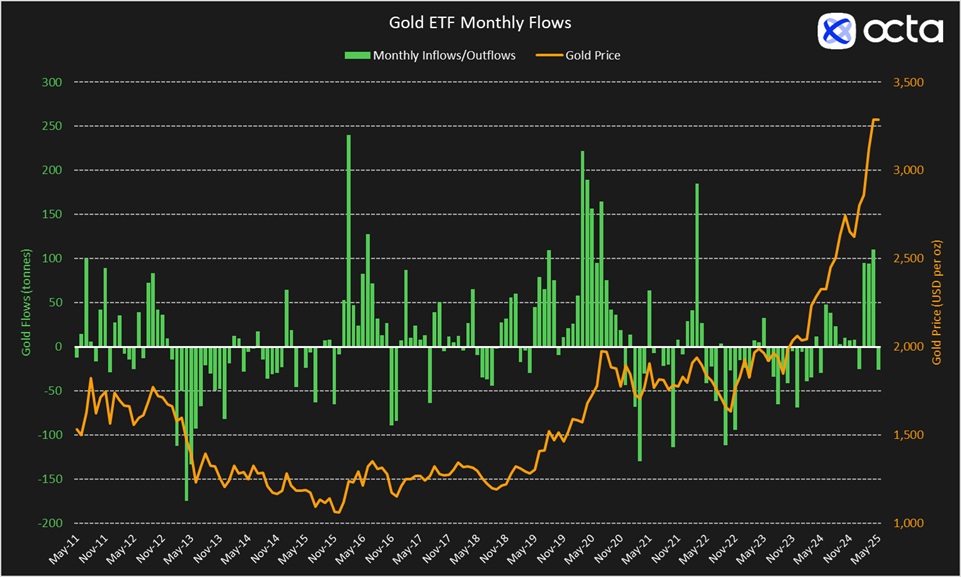
Apart from central banks, global investors have also remained quite bullish on gold. According to the Commodity Futures Trading Commission (CFTC), large speculators (leveraged funds and money managers) were still net-long COMEX gold futures and options as of 27 May, 2025. Long positions totalled 152,034 contracts vs only 34,797 short contracts. Meanwhile, according to LSEG, a financial firm, flows into physically-backed gold exchange-traded funds (ETFs) reached almost 50 mt year-to-date. Most recently, however, speculative bullish interest in gold and ETFs flows have been subsiding.

Although large speculators remain net-long, the size of their exposure is substantially smaller compared to what it was back in September 2024, when the uncertainty around the U.S. Presidential elections fuelled bullish bets‘, says Kar Yong Ang, adding that ETFs actually recorded a minor outflow in the first half of May.
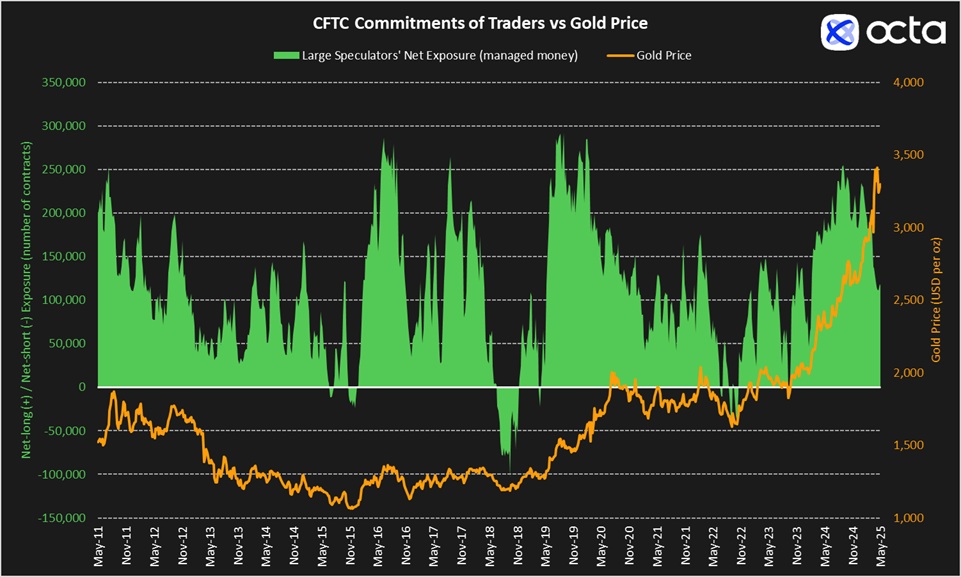
CFTC Commitments of Traders vs Gold Price

Source: CFTC, LSEG, global broker Octa's calculations
Source: CFTC, LSEG, global broker Octa’s calculations

Gold ETF Monthly Flows

Source: LSEG
Source: LSEG

Outlook
Fundamentally, the outlook for gold looks bright, but there are important caveats. We have singled out three important factors that will continue to play out in June and the rest of 2025.

Geopolitical uncertainty
Lingering global economic and geopolitical risks continue to play out, with the ongoing trade negotiations between the United States and the rest of the world, particularly China, being the most critical factor affecting the gold market and the global financial system.

The conflicts in the Middle East, such as the Israel-Hamas hostilities, a brief spat between India and Pakistan, and the ongoing conflict between Russia and Ukraine, have destabilised world politics and raised many fears ranging from oil and food supply disruptions to the prospect of a worldwide conflict. Gold, considered a ‘safe-haven’ asset, typically sees increased demand during political uncertainty and instability. While it is extremely difficult to project the resolution of geopolitical conflicts, let alone to forecast the emergence of new ones, peace negotiations in the hottest regions have already commenced. ‘Conflicting parties seem to have at least started to talk. A cease-fire in the Middle East and Eastern Europe is now more likely than it was only a month ago, but a lasting peace may take years to achieve. Either way, any progress in negotiations or even a temporary cessation of hostilities will improve risk sentiment and have a bearish impact on gold,‘ says Kar Yong Ang, global broker Octa analyst.

The looming 8 July tariff deadline imposed by U.S. President Trump further complicates the global political landscape, adding another reason for gold prices to remain elevated. As of today, the United Kingdom is the only country that has signed a new trade deal with the U.S., while trade talks with dozens of other countries have progressed too slowly. Negotiations remain unwieldy, while China and the U.S., the world’s two largest economies, continue to accuse one another of breaching the Geneva trade deal. As long as trade tensions persist, investors will be reluctant to sell gold.

Global monetary policy
Gold is priced in U.S. dollars and is therefore highly sensitive to changes in U.S. interest rates, inflation, and the greenback’s value. As already mentioned, the market is positioned for a dovish Fed. In fact, the latest interest rates swap market data implies roughly 75 basis points (bps) worth of rate cuts by the Fed by the end of December 2025. It is widely expected that other central banks will not fall far behind. For example, after the latest Eurozone inflation figures came out lower than expected, investors now expect the European Central Bank (ECB) to deliver two quarter-point rate cuts by the end of December 2025. Likewise, the Bank of England (BoE) is anticipated to announce at least two rate cuts of 25 bps each before the end of the year. Fundamentally, a less tight (or looser) monetary policy worldwide is a major bullish factor for gold. Because gold has no passive income and does not pay any interest, the opportunity cost of holding it becomes lower when central banks reduce their policy rates. The main risk, of course, is inflation. Should it remain above central banks’ targets or, even worse, start to increase, the Fed and its counterparts will be forced to hold the rates higher for longer.

Inflation is a major concern. Tariff-related price increases are yet to be felt, and although U.S. consumer 1-year and 5-year inflation expectations have eased, they remain very high by historical standards. I think some central banks, and maybe even the Fed, will prefer to wait until trade tensions are resolved before committing fully to rate cuts,‘ says Kar Yong Ang.

Physical demand
Physical demand for gold may continue to increase primarily because China, a significant gold consumer, remains an active buyer, but also because global central banks in general are increasingly turning to gold to diversify their reserves away from the U.S. dollar. Specifically, China has seen its national currency, the renminbi (RMB), appreciate more than 2% over the past month. This is not a welcoming development for a country whose economy heavily depends on exports. Thus, Chinese authorities may relax gold import quotas to stop the yuan from appreciating too much. As a result, the physical and investment demand for gold in China may rise in the months ahead. As for India, the demand for gold may temporarily slow due to seasonal factors, but is unlikely to reverse. Indian jewellers may delay making new stock acquisitions as monsoon rains are arriving, while the wedding season is concluding, but that will only have a temporary impact.

Technical picture
Kar Yong Ang, global broker Octa analyst, said: ‘From a technical perspective, XAUUSD looks bullish no matter how you look at it. 3,397, 3,438, and 3,463-3,471 levels are still real targets for bulls. Only a drop below 3,125 will invalidate the underlying bullish trend, and even then XAUUSD is more likely to trend sideways than to go deep down.’

Conclusion
Overall, we continue to see a generally bullish picture for gold, but it may be changing soon. Fundamentally, gold is still a ‘buy’ but no longer a ‘screaming buy’, as we labelled it in our August 2024 Digest. Wall Street analysts predict higher prices. Goldman Sachs recently hiked its 2025 gold forecast to $3,700 per oz, particularly due to strong central bank demand, implying a 10% upside potential from the current levels. At the same time, large speculators have already started to reduce their net-long exposure, while the outlook for the global monetary policy remains uncertain due to tariffs. Investors, in general, may be a bit too optimistic when it comes to rate cuts.

As things currently stand, it is still very hard to draw a bearish case for gold, but I do think that the bullish trend is showing first signs of exhaustion and some consolidation is likely to follow‘, said Kar Yong Ang, global broker Octa analyst. Next month will be critical for the gold market as it features seven key rate decisions and will likely be packed with news related to trade negotiations. Traders should be cautious as June news may essentially determine the XAUUSD trend for the next six months.

Key Macro Events in June (scheduled)
4 June Bank of Canada meeting
5 June European Central Bank meeting
6 June U.S. Nonfarm Payroll
11 June U.S. Consumer Price Index
15-16 June Group-7 Summit
17 June Bank of Japan meeting
18 June Federal Reserve meeting
19 June Swiss National Bank meeting
19 June Bank of England meeting
20 June People’s Bank of China meeting
23 June S&P Global Purchasing Managers Indices
24-25 June North Atlantic Treaty Organization Summit
26-27 June European Council Summit
27 June U.S. Personal Consumption Expenditure Price Index
30 June German Consumer Price Index

___

Disclaimer: This content is for general informational purposes only and does not constitute investment advice, a recommendation, or an offer to engage in any investment activity. It does not take into account your investment objectives, financial situation, or individual needs. Any action you take based on this content is at your sole discretion and risk. Octa and its affiliates accept no liability for any losses or consequences resulting from reliance on this material.
Trading involves risks and may not be suitable for all investors. Use your expertise wisely and evaluate all associated risks before making an investment decision. Past performance is not a reliable indicator of future results.
Availability of products and services may vary by jurisdiction. Please ensure compliance with your local laws before accessing them.

Hashtag: #Octa

The issuer is solely responsible for the content of this announcement.

Octa

is an international CFD broker that has been providing online trading services worldwide since 2011. It offers commission-free access to financial markets and various services used by clients from 180 countries who have opened more than 52 million trading accounts. To help its clients reach their investment goals, Octa offers free educational webinars, articles, and analytical tools.

The company is involved in a comprehensive network of charitable and humanitarian initiatives, including improving educational infrastructure and funding short-notice relief projects to support local communities.

In Southeast Asia, Octa received the ‘Best Trading Platform Malaysia 2024’ and the ‘Most Reliable Broker Asia 2023’ awards from Brands and Business Magazine and International Global Forex Awards, respectively.

Media OutReach

Midea Hiconics Teams Up with MIA Group to Bring New Solar Tech to Pakistan

Published

on

LAHORE, PAKISTAN – Media OutReach Newswire – 24 April 2026 – Midea Hiconics is making a major push into the Pakistani market this week at Solar Pakistan 2026. From Booth A-3-8, the energy division of Midea Group is showing off its latest hardware and has just signed a key distribution deal to get its products into more homes and businesses across the country.

Hardware Built for Local Conditions

The company isn’t just showing off standard gear; they’ve brought systems specifically designed to handle the challenges of the local energy landscape.

  • PowerX1 Hybrid Inverters: Intelligent energy management, seamlessly switching between solar, battery, and grid for stable, uninterrupted power. Supports multi-source integration and rapid power transition.
  • Powerinfi All-in-one ESS: ISO 13849 PL-d and IEC 62443 certified for functional safety and cybersecurity. Features a multi-layer battery safety system within a compact design.
  • Advanced Solar & System Protection: Incorporates N-type HOT3.0 solar cell technology for enhanced low-light performance. The system boasts an IP66 rating for superior dust and water resistance.

A New Partnership with MIA Group

The big news from the show floor is the new Annual Channel Distribution Strategic Partnership with MIA Group. MIA Group is already a household name in Pakistan for HVAC and energy, and this deal means they’ll be the main bridge for Midea Hiconics’ tech to reach the local market.

“We’re excited to get to work with MIA Group,” a Midea Hiconics spokesperson said. “They have the reach and the local knowledge we need. By putting our hardware in their hands, we’re making it much easier for people here to switch to reliable, clean energy without the usual headaches.”

Media Contact:
Midea Hiconics Press Office
Website: https://www.hiconics-global.com/
Location: Solar Pakistan 2026, Booth A-3-8
Hashtag: #MideaHiconics

The issuer is solely responsible for the content of this announcement.

About Midea Hiconics

Midea Hiconics (SHE: 300048) has been around since 2003 and joined the Midea Group in 2020. They focus on green energy, home storage, and industrial tech, building smart tools that help people take control of their own power.

Check out https://www.hiconics-global.com/ for more info.

Continue Reading

Media OutReach

Green SM And Umoney Partner To Build An Integrated Mobility And Digital Finance Ecosystem In Laos

Published

on

VIENTIANE, LAOS – Media OutReach Newswire – 24 April 2026 – Green SM Laos and Star Fintech Sole Co., Ltd (Umoney) have announced the signing of a Payment System Integration Agreement to incorporate Umoney into the Green SM application, alongside a Strategic Cooperation Agreement to develop a comprehensive digital finance and smart mobility ecosystem in Laos.

Ms. Tran Hanh An – Director of Mobility Services Sales, GSM Vietnam & Laos (left), and Mr. Ha Chien Thang – Director of Star Fintech Sole Co., Ltd, at the partnership signing ceremony.

Under the agreement, Umoney will be integrated as a direct payment method within the Green SM app. The two parties will also implement an embedded integration model enabling Umoney users to seamlessly access Green SM’s mobility services directly within the Umoney platform.

For the first time in Laos, customers will experience a fully seamless ride-hailing journey with fares processed instantly via the Umoney e-wallet upon trip completion, replacing the previously common manual bank transfer method. Users simply link their Umoney wallet to the Green SM app for fast, convenient, and fully cashless transactions. Additionally, customers using partner banking applications can pay drivers through Umoney’s QR system, delivering a flexible, fast, and secure payment experience that enhances user convenience and broadens customer reach across both platforms.

As part of the collaboration, Green SM Laos will provide comprehensive mobility solutions for Umoney’s enterprise partners and individual customers, including Green SM Car electric ride-hailing, Green SM Limo, Green SM Airport transfer services, as well as corporate travel packages and flexible, customized mobility plans. Umoney, in turn, will collaborate with Green SM to develop digital financial and payment solutions tailored for drivers within the Green SM ecosystem, encompassing e-wallet services, direct income disbursement, operational expense payments, and cash flow management tools. This synergy is designed to optimize operational efficiency while enhancing the experience for businesses, drivers, and end-users alike.

Beyond mobility and payment solutions, both parties plan to expand their shared digital services ecosystem by integrating Umoney and Unitel’s telecommunications and digital utilities into the Green SM platform, including SIM card registration, mobile top-ups, data package purchases, and other digital services, thereby enhancing the value proposition for users across both platforms.

The two companies will also jointly roll out customer benefit programs targeting Umoney users in Laos, with a particular focus on airports, transaction points, and key high-traffic locations. Through integrated service offerings and incentives promoting electric mobility, Green SM and Umoney aim to foster environmentally responsible travel habits while delivering greater value to customers within their shared ecosystem.

Mr. Ha Chien Thang, Director of Star Fintech Sole Co., Ltd, shared:”Our partnership with Green SM marks a significant milestone in Umoney’s strategy to develop a comprehensive digital finance ecosystem in Laos. The integration of payment capabilities and digital services not only enhances user convenience but also contributes to the advancement of cashless payments and the broader digital transformation of the economy.

Ms. Tran Hanh An, Director of Mobility Services Sales at Green SM Vietnam & Laos, stated: “The partnership between Umoney and Green SM reflects a shared commitment to connecting the essential infrastructures of modern urban life, from digital finance and telecommunications to a green mobility ecosystem. Through this collaboration, we aim to expand benefits for our customers and driver community while driving meaningful green transformation that is firmly grounded in everyday mobility and consumption needs.

Furthermore, Green SM and Umoney will collaborate on multi-channel communications initiatives to strengthen brand awareness and expand their combined customer base. Planned activities include co-branded campaigns, promotional programs for new users, digital platform communications, and on-ground experiential activations in key markets.

The partnership between Green SM and Umoney marks a significant convergence of two leading ecosystems in green mobility and digital finance in Laos, united in their pursuit of integrated service solutions that meet the increasingly diverse demands of modern urban life. This collaboration also represents a pivotal step toward fostering innovation, elevating the user experience, and contributing to the sustainable growth of the digital economy in Laos.

Hashtag: #GreenSM

The issuer is solely responsible for the content of this announcement.

Continue Reading

Media OutReach

HKUST and Times Higher Education Co-Host Asia Universities Summit 2026

Published

on

Global Leaders Converge to Shape the Future of Higher Education in Asia

HONG KONG SAR – Media OutReach Newswire – 24 April 2026 – The Hong Kong University of Science and Technology (HKUST) and Times Higher Education (THE) co-hosted the Asia Universities Summit 2026 from April 22 to 24. Under the theme “Igniting Global Transformation: Asia’s Leadership,” the three-day premier event explores Asia’s pivotal role in reshaping global innovation and addressing pressing societal challenges through higher education.

The Summit holds particular significance as it coincides with HKUST’s 35th anniversary and marks a decade of partnership between the University and THE since the inaugural summit. This year’s event has attracted over 600 university presidents, policymakers, and industry titans from 25 countries and regions, underscoring a collective commitment to advancing the academic landscape across the continent.

The Summit officially commenced on April 22 at HKUST’s Shaw Auditorium, with the opening ceremony officiated by Dr. SZE Chun-Fai, Jeff, Acting Secretary for Education of the Hong Kong Special Administrative Region (HKSAR) Government; Prof. Nancy IP, President of HKUST; Phil BATY, Chief Global Affairs Officer, and Mei Mei LIM, President, Asia Pacific, from THE.

In her opening remarks, President Ip underscored the need for cross-border collaboration and the evolving role of universities in a rapidly changing world. She said, “As HKUST celebrates its anniversary and a decade of partnership with Times Higher Education, we gather at a defining moment for our region. Asia is increasingly shaping the direction of global innovation, talent development, and societal transformation. In this era of rapid technological advancement and constant change—from artificial intelligence to climate resilience—the challenge of progress lies in anticipating needs and shaping solutions, which calls for a fundamental rethinking of how universities lead. At HKUST, we firmly believe that no single institution can address these global challenges alone; progress will come through openness, partnership, and shared responsibility.

Hong Kong is unique in being the only city in the world with five universities ranked among the global top 100, underscoring its role as a leading international hub for exchange and innovation. Building on this strength, HKUST has initiated dialogues with the world’s leading universities and invited them to Hong Kong to explore opportunities for a university town. This Summit reflects our long‑standing commitment to bringing institutions together to exchange ideas, build meaningful collaborations, and take collective action. By convening leaders from across Asia and beyond, we aim to turn thoughtful dialogue into real impact for our communities and for society at large.”

Dr. SZE Chun-Fai, Jeff, highlighted Hong Kong’s unique position as an international education hub, stating, “Universities today are not only centers of knowledge creation but also powerful drivers of innovation, resilience, and societal impact. In an era of rapid technological advancement, higher education must translate cutting-edge research into real-world solutions that address global challenges. HKUST exemplifies this excellence and achieves remarkable rankings, with its entrepreneurial story equally unmatched, demonstrating the worldwide impact of its research discoveries. Hong Kong has long served as the world’s super-connector and super-value adder, bridging East and West. Our highly internationalized and diversified post-secondary education system positions us ideally to facilitate this convergence between global academic networks and the opportunities of the Chinese Mainland and the wider region. Education, technology, and talent form a foundational triad for success. By fostering talent attraction, interdisciplinary education, industry-academic partnerships, and research collaborations with our counterparts elsewhere, we are building a vibrant ecosystem that strengthens Hong Kong’s innovation edge, contributing to Asia as well as national development.”

Phil Baty reaffirmed THE’s enduring partnership of trust with HKUST and celebrated Asia’s rising global influence, stating, “A decade ago, right here on this stunning campus, THE launched its first-ever Asia Universities Summit. Today, we are witnessing a tilt in the balance of power in global higher education and research from the West to the East. This extraordinary trajectory is driven by Asia’s booming research productivity and global ambitions. Hong Kong, with five universities now ranked among the world’s top 100, stands at the heart of this transformation—a city which we believe will remain the flagship atop the rising tide across Asia, cementing its position as a world-leading powerhouse. New knowledge creation is not a zero-sum game, as we all gain from the leapfrogging Asian university sector. This Summit is a celebration of your excellence and the glorious diversity of our academic community.”

Following the opening ceremony, President Ip joined Prof. Martin O. BERGÖ, Vice-President of Karolinska Institutet, in a keynote fireside chat on longevity science. The discussion explored how advances in biomedicine, neuroscience, and translational research can extend both lifespan and healthspan, while contributing to resilient and equitable societies. President Ip shared insights from her pioneering neuroscience research, including the University’s efforts to decode the biological basis of healthy aging. She said, “Healthy aging is not just about adding years to life, but adding life to our years. We need a paradigm shift from reactive to proactive care. At HKUST, we are focused on monitoring risks for any diseases early and implementing preventive measures. Longevity science is about extending the ‘healthspan’ and as a university, we have much to offer through our research and collaborations. We are uniquely positioned to contribute to this field.”

A spotlight on the first day was a fireside chat between Prof. Harry SHUM, Chairman of the HKUST Council, and Judson ALTHOFF, CEO of Microsoft’s Commercial Business. The dialogue delved into the transformative power of AI across both industry and academia, discussing how universities can collaborate with global technology leaders to prepare students for an AI‑pervasive world. Emphasis was placed not only on technological capability, but also on trust, critical thinking and mindset change within institutions.

Prof. Shum underscored the importance of embracing AI across disciplines, “For our university, at this time, the number one priority is really a mindset change—to focus on AI for science, engineering, business, humanities, and medicine. AI is already here. We do not have to be afraid of this technology. It is a powerful new tool for us and a wonderful thing that we must learn and master to drive growth and innovation.”

Throughout the Summit, President Ip participated in two leadership meetings with over 15 university presidents and senior leaders from institutions across Asia, engaging in candid, strategy‑focused exchanges on shared regional challenges. One session examined how Asia’s emerging innovation corridors—from the Greater Bay Area to other fast‑growing technology belts—can redefine global technology leadership, with discussions centered on governance models and cross‑border collaboration. Another session focused on shaping next‑generation cities, exploring how universities can align research, talent development and policy engagement to support sustainable urban transformation amid rapid technological and societal change. These high-level dialogues emphasized the need for strategic alignment between academic research and regional development, reinforcing the Summit’s mission to leverage Asian leadership for global transformation through collaborative institutional design and shared expertise.

Across a series of high‑level sessions, HKUST senior leadership played an active role in shaping discussions on inclusive leadership, trusted AI in higher education, research commercialization, climate resilience, and global research collaboration. The sessions examined how universities can strengthen governance frameworks to ensure the responsible and ethical use of AI, while cultivating innovation ecosystems that translate research outcomes into socio-economic impact.

The dialogue also addressed strategies for nurturing entrepreneurship, climate‑proofing rapidly growing cities through interdisciplinary engineering approaches, and sustaining borderless research collaboration amid rising geopolitical and regulatory pressures. Collectively, these contributions highlighted HKUST’s commitment to advancing responsible innovation, international partnership, and university leadership attuned to Asia’s evolving challenges and global responsibilities.

The three-day event concluded with a closing ceremony, cementing new strategic partnerships and a shared vision for the future of higher education in the region.

Download photos here: https://hkust.edu.hk/news/hkust-and-times-higher-education-co-host-asia-universities-summit-2026
Hashtag: #HKUST

The issuer is solely responsible for the content of this announcement.

Continue Reading

Trending