
Media OutReach
Huawei Named a Leader in the Gartner® Magic Quadrant for Container Management

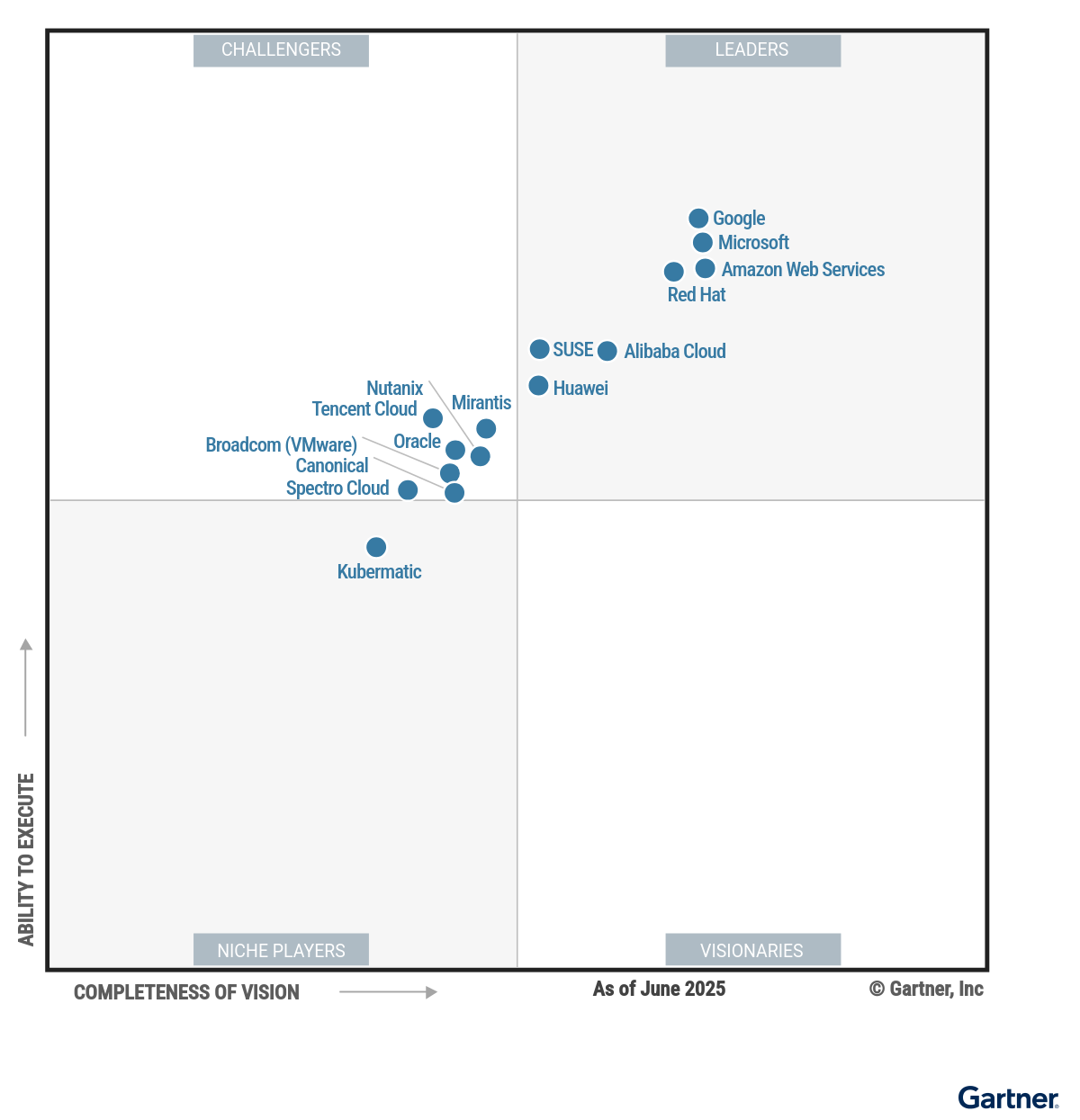
Huawei Cloud is competitive in all studied use cases, including new cloud-native applications, containerization of existing applications, AI containers, edge applications, and hybrid cloud applications, especially in the AI container domain.
Huawei Cloud is an active open-source contributor and a leader in the cloud-native technology ecosystem. As a long-standing contributor to the Cloud Native Computing Foundation (CNCF), Huawei Cloud has participated in 82 CNCF projects, holds over 20 project maintainer seats, and is the only Chinese cloud provider holding a vice-chair position on the CNCF Technical Oversight Committee (TOC). Huawei Cloud has donated several projects to CNCF, including KubeEdge, Karmada, Volcano, and Kuasar, and contributed benchmark projects such as Kmesh, openGemini, and Sermant in 2024.
Huawei Cloud offers the most comprehensive container product matrix in the industry, covering public cloud, distributed cloud, hybrid cloud, and edge scenarios. It has been extensively adopted in sectors like Internet, finance, manufacturing, transportation, electricity, and automotive, delivering pervasive cloud-native value. Furthermore, Huawei Cloud container services are actively deployed worldwide. The rapid growth of cloud-native compute power is widely acknowledged by global users and continually supports customers in achieving business success.
Starzplay, an OTT platform in the Middle East and Central Asia, leveraged Huawei Cloud CCI to transition to a serverless architecture. This move enabled the platform to handle millions of access requests during the 2024 Cricket World Cup, while also reducing resource costs by 20%.
Ninja Van, a leading logistics and express service provider in Singapore, has fully containerized its services using Huawei Cloud CCE. This cloud-native AI service architecture is both agile and efficient, ensuring zero service interruptions during peak hours and improving order processing efficiency by 40%.
Chilquinta Energía, one of the three major power companies in Chile, has upgraded its big data platform to a cloud-native architecture using Huawei Cloud CCE Turbo. The new platform boasts a 90% improvement in average performance, propelling Chilquinta toward more intelligent and automated operations.
Konga, Nigeria’s leading comprehensive e-commerce platform, has fully transitioned to a cloud-native architecture based on CCE Turbo. This agile and flexible approach effectively ensured a smooth shopping experience for its millions of monthly active users.
Meitu, a leading visual creation platform in China, leverages CCE and Ascend cloud services to efficiently manage AI computing resources. This supports the deployment and inference of various models and algorithms, ensuring rapid iteration of large-scale training and enabling 200 million monthly active users to share their life moments in real time.
In the age of AI, Cloud Native 2.0 has been fully upgraded to incorporate intelligence. Huawei Cloud is building a next-generation AI-native cloud infrastructure powered by advanced AI technologies.
1) In Cloud for AI, CCE AI clusters form the cloud-native infrastructure for CloudMatrix384 supernodes. These clusters offer large-scale supernode topology-aware scheduling, PD separation scaling, AI workload characteristic-aware auto-scaling, and ultra-fast container startups. These features significantly accelerate AI training and inference, enhancing the overall efficiency of AI tasks.
2) AI is also revolutionizing the cloud service experience. Huawei Cloud is committed to integrating AI into its cloud offerings and has introduced CCE Doer. CCE Doer integrates AI agents throughout the container usage process, providing intelligent Q&A, recommendations, and diagnostics. It can diagnose over 200 critical exception scenarios with a root cause accuracy rate exceeding 80%, enabling automated and intelligent container cluster management.
3) Cloud native is rapidly evolving toward serverless. Huawei Cloud offers two serverless container products: serverless Kubernetes cluster CCE Autopilot and serverless container instance CCI, which enable users to focus on application development and accelerate service innovation. The recently launched general-computing-lite and Kunpeng general-computing serverless containers enhance computing cost-effectiveness by up to 40%, making them the ideal scaling solution for businesses dealing with tenfold increases in traffic.
Huawei Cloud will continue to partner with global operators to advance cloud-native technology innovations and share its successes. This collaboration will drive unprecedented industry transformation, opening up new opportunities for a more inclusive, accessible, and resilient digital society.
——————————————————————————————-
Source: Gartner, Magic Quadrant for Container Management 2025, 6 August 2025
Disclaimer: Gartner does not endorse any vendor, product or service depicted in its research publications, and does not advise technology users to select only those vendors with the highest ratings or other designation. Gartner research publications contain the opinions of Gartner research and advisory organizations, and should not be construed as statements of fact. Gartner disclaims all warranties, expressed or implied, with respect to this research, including any warranties of merchantability or fitness for a particular purpose.
GARTNER, MAGIC QUADRANT, and PEER INSIGHTS are registered trademarks of Gartner, Inc. and/or its affiliates in the U.S. and internationally, and are used herein with permission. All rights reserved.
Hashtag: #Huawei
The issuer is solely responsible for the content of this announcement.



Media OutReach
Zuellig Pharma Acquires Cialis® (Tadalafil) from Lilly in three additional markets in Asia

Following the acquisition, Zuellig Pharma will now own the trademarks, marketing authorizations and license manufacturing know-how for Cialis®, a treatment for erectile dysfunction (ED) and benign prostatic hyperplasia (BPH), in 11 markets in Asia, with the expansion of its ownership into three additional markets beyond the original eight. Zuellig Pharma will also continue to promote and distribute the brand in these markets.
The expanded ownership of Cialis® will widen accessibility of the drug to a significant population of men in Asia who are affected by ED and BPH. The acquisition also aligns with Zuellig Pharma’s strategic priority of building a strong portfolio of owned prescription healthcare products as an integrated healthcare solutions company.
“Our acquisition of Cialis® in three additional markets builds on the strong foundation we established two years ago and highlights our proven success in scaling trusted brands effectively through our commercial capabilities and deep expertise. As we broaden our footprint, we remain focused on delivering sustainable growth and advancing our purpose of making in-demand healthcare solutions more accessible to communities in Asia,” said John Graham, CEO of Zuellig Pharma.
Hashtag: #ZuelligPharma #EliLillyandCompany #Cialis #MensHealth #Healthcare #Pharmaceuticals
https://www.zuelligpharma.com/ https://www.linkedin.com/company/zuellig-pharma
The issuer is solely responsible for the content of this announcement.
About Zuellig Pharma
Zuellig Pharma is a leading healthcare solutions company in Asia, and our purpose is to make healthcare more accessible to the communities we serve. We provide world-class distribution, commercialization, and clinical trial support services, underpinned by a strong culture of innovation to support the growing healthcare needs in this region. The company was founded a hundred years ago and has grown to become a multibillion-dollar business covering 18 markets with over 12,000 employees. Our people serve more than 200,000 medical facilities and work with over 450 clients, including the top 20 pharmaceutical companies in the world.

Media OutReach
Ingdan Powers Embodied AI with Humanoid-Style Brain-Cerebellum Chipset to Boost Robotics Ecosystem
2026 is widely regarded as a milestone year for humanoid robotics, in which humanoid robots transition from laboratory prototypes and demonstration performances to large‑scale mass production. At CES in January, NVIDIA announced the commercial launch of its physical‑AI core platform Jetson Thor. Tesla is scheduled to officially release the mass‑production engineering version of its Optimus (V3) humanoid robot by the end of March, with plans to initiate million‑unit‑level production lines by the end of 2026—an inflection point widely regarded as the “Model 3 moment” of the humanoid robotics industry. At the same time, Chinese robotics companies such as AGIBOT, Unitree, and Fourier Intelligence have already deployed products at scale in warehousing and logistics scenarios.
Against this backdrop, the upstream hardware focus of the humanoid robotics industry is increasingly converging on “Brain-Cerebellum” collaboration and low‑latency, multi‑joint real‑time control, which are essential to achieving coordinated, smooth, and human‑like robotic motion. During the CMG Spring Festival Gala, robots from multiple companies demonstrated complex coordinated movements and dexterous hand operations, further highlighting the value of this technical direction.
D‑Robotics, originating from the AIoT and robotics division of Horizon Robotics, focuses on edge‑side embodied intelligence solutions characterized by high computing power, integrated computation and control, and low latency. Leveraging its parent company’s long‑term experience in intelligent driving, D‑Robotics has established a precise position in humanoid robot “Brain-Cerebellum” coordination and real‑time joint control.
In November 2025, D‑Robotics unveiled its flagship robotics computing platform S600, with an official release planned for the end of the first quarter of 2026. The S600 platform features a highly integrated humanoid‑style “Brain-Cerebellum” chipset architecture. Its “Brain” configuration combines an 18‑core A78AE CPU with a proprietary Nash‑architecture BPU, delivering 560 TOPS (INT8) edge computing power and supporting efficient deployment of VLA, VLM, LLM, and locomotion models. Its “Cerebellum” configuration integrates a 6‑core R52+ MCU, providing high‑reliability, real‑time motion control.
By integrating CPU, BPU, and real‑time MCU capabilities into a single SoC, S600 enables a closed‑loop architecture encompassing perception, decision‑making, and real‑time action control. This design addresses a key industry challenge in which many edge AI processors lack embedded real‑time MCUs and rely on external controllers, resulting in excessive latency. The integrated MCU supports high‑frequency, high‑precision PWM signal generation based on FOC algorithms, enabling precise motor control and contributing to stable rhythm and natural gait.
The S600 platform has been adopted by multiple robotics companies such as Fourier Intelligence, Booster Robotics, X Square Robot, and ROBOTERA, supporting applications that require stable multi‑joint coordination and smooth motion performance.
Ingdan, Inc. (00400.HK) is a core supplier in the AI computing power supply chain and an application technology solutions provider covering both AI infrastructure and AI intelligent terminals. The Company represents a broad portfolio of international semiconductor manufacturers, including NVIDIA, Xilinx, Intel, AMD, and SanDisk, as well as numerous domestic chip vendors. It serves hundreds of robotics manufacturers and Tier‑1 customers and has formed a comprehensive embodied intelligence ecosystem.
D‑Robotics is a core product line Ingdan distributes . Building on D‑Robotics’ products and combined with its own technical services—such as multi‑sensor fusion development, real‑time closed‑loop tuning, Quantization‑Aware Training (QAT) support, simulation testing, and modular SOM customization—the Group has supported sophisticated customers including Galbot and ROBOTERA, continuously enriching the robotics industry ecosystem.
Looking ahead, Ingdan will continue to focus on the humanoid robotics sector. Leveraging an IC product matrix centered on NVIDIA Jetson and D‑Robotics platforms, the Company aims to further strengthen its AI intelligent terminal capabilities and continue supporting the iterative development of embodied intelligence products.
For investor and media enquiries
Please email to **@****an.com
Hashtag: #Ingdan #Chips #humanoid #D‑Robotics #NVIDIA #Tech
The issuer is solely responsible for the content of this announcement.
Ingdan, Inc.
Ingdan, Inc. (00400.HK) is a core supplier in the AI computing power supply chain and an application technology solutions provider covering both AI infrastructure and AI intelligent terminals. The Company represents a broad portfolio of international semiconductor manufacturers, including NVIDIA, Xilinx, Intel, AMD, and SanDisk, as well as numerous domestic chip vendors. It serves hundreds of robotics manufacturers and Tier‑1 customers and has formed a comprehensive embodied intelligence ecosystem.
Media OutReach
Snow, Ice, and Performance: 2026 Changan Global Testing Season Arrives in Europe with Back-to-Back Winter Events
- European dealers and journalists experienced the CHANGAN DEEPAL S05 AWD at 2026 Changan Global Testing Season this February.
- With intelligent AWD and advanced ADAS, the CHANGAN DEEPAL S05 AWD offered uncompromising safety and control on winter roads.
Saalfelden, Austria – Media OutReach Newswire – 12 March 2026 – Following extreme cold tests in Yakeshi, China, the 2026 Changan Global Testing Season made its European debut this February with the Changan Winter Experience in Courmayeur and the Winter Test Drives in Saalfelden. The all-electric CHANGAN DEEPAL S05 AWD was tested on snow and ice—familiar conditions for European drivers—offering dealers and journalists an immersive introduction to Changan’s electric mobility vision through dynamic drives.
Three-time Olympic gold medalist and Milano Cortina 2026 Ambassador Deborah Compagnoni joined the event in Courmayeur, testing the CHANGAN DEEPAL S05 AWD. Her career—defined by determination, control, and reliability—reflects Changan’s core values. “I felt that the principles of trajectory and speed in skiing apply to driving. With this model, you gain confidence on challenging terrain,” she said.
Snow-Validated Performance: The CHANGAN DEEPAL S05 AWD
Tested in Europe, the CHANGAN DEEPAL S05 AWD demonstrated controllable dynamics, reliable traction, and enhanced safety—highlighting its cutting-edge AWD and ADAS. The system adapts seamlessly: ECO/COMFORT modes prioritize RWD efficiency, while AWD will engage automatically when sensors detect slip, high torque demand, or extreme cold below -25°C. SPORT mode delivers permanent 50:50 torque for sharper response. SNOW mode maintains balanced torque with optimized slip control for confident driving on low-grip surfaces.
The intelligent AWD system delivers up to 320 kW power, 502 Nm torque, and 0–100 km/h acceleration in 5.5 seconds. It also improves hill climbing with a 40% gradient capability, ensures stability by actively balancing power to prevent skidding, and enables safer cornering at higher speeds through optimized grip and vehicle dynamics.
Changan Standard: Proven in the Alps, Bound for the World
Changan Standard is defined by a principle: forged in extremes, built for every day. From Yakeshi to the Alps, the test environments are selected to verify specific performance attributes—safety technologies, chassis response, all-wheel-drive calibration, and ADAS in low-grip scenarios. The objective of 2026 Global Testing Season is not to demonstrate extremes, but to confirm consistency: that the same level of safety, control, and stability demonstrated will be replicated in Mexico, Thailand, and Saudi Arabia.
Hashtag: #Changan
The issuer is solely responsible for the content of this announcement.










-
 Feature/OPED6 years ago
Davos was Different this year
-
Travel/Tourism10 years ago
Lagos Seals Western Lodge Hotel In Ikorodu
-

 Showbiz3 years ago
Estranged Lover Releases Videos of Empress Njamah Bathing
-
 Banking8 years ago
Sort Codes of GTBank Branches in Nigeria
-

 Economy3 years ago
Subsidy Removal: CNG at N130 Per Litre Cheaper Than Petrol—IPMAN
-

 Banking3 years ago
Sort Codes of UBA Branches in Nigeria
-

 Banking3 years ago
First Bank Announces Planned Downtime
-

 Sports3 years ago
Highest Paid Nigerian Footballer – How Much Do Nigerian Footballers Earn