

Media OutReach
Keeper Security surpasses $225M in ARR with transformative growth and is emerging as the market standard for AI-native identity security
Compelling path to $1billion ARR and public offering, fueled by product market fit in the agentic AI age, explosion of identities and related threats, and accelerating growth
SINGAPORE – Media OutReach Newswire – 9 July 2026 – Keeper Security (“Keeper” or “we”), the identity security platform for humans, machines and AI agents, today announced a major milestone in its journey to become the market standard for AI-native identity security, having reached $225 million in Annual Recurring Revenue (ARR). Since 2021, Keeper’s ARR has grown over 3x.
Keeper protects over 95,000 organizations, which includes many Fortune 500 enterprises and public sector agencies. The company is quickly emerging as the market standard for AI-native identity security for enterprises globally with its leading zero-trust and zero-knowledge identity security platform. In 2025, leading analyst firm Gartner recognized Keeper as the second-fastest-growing security software competitor globally, second only to Google.* This recognition underscores Keeper’s rapid market expansion in addressing identity security challenges created by cloud transformation and artificial intelligence adoption across enterprise infrastructure and endpoints.
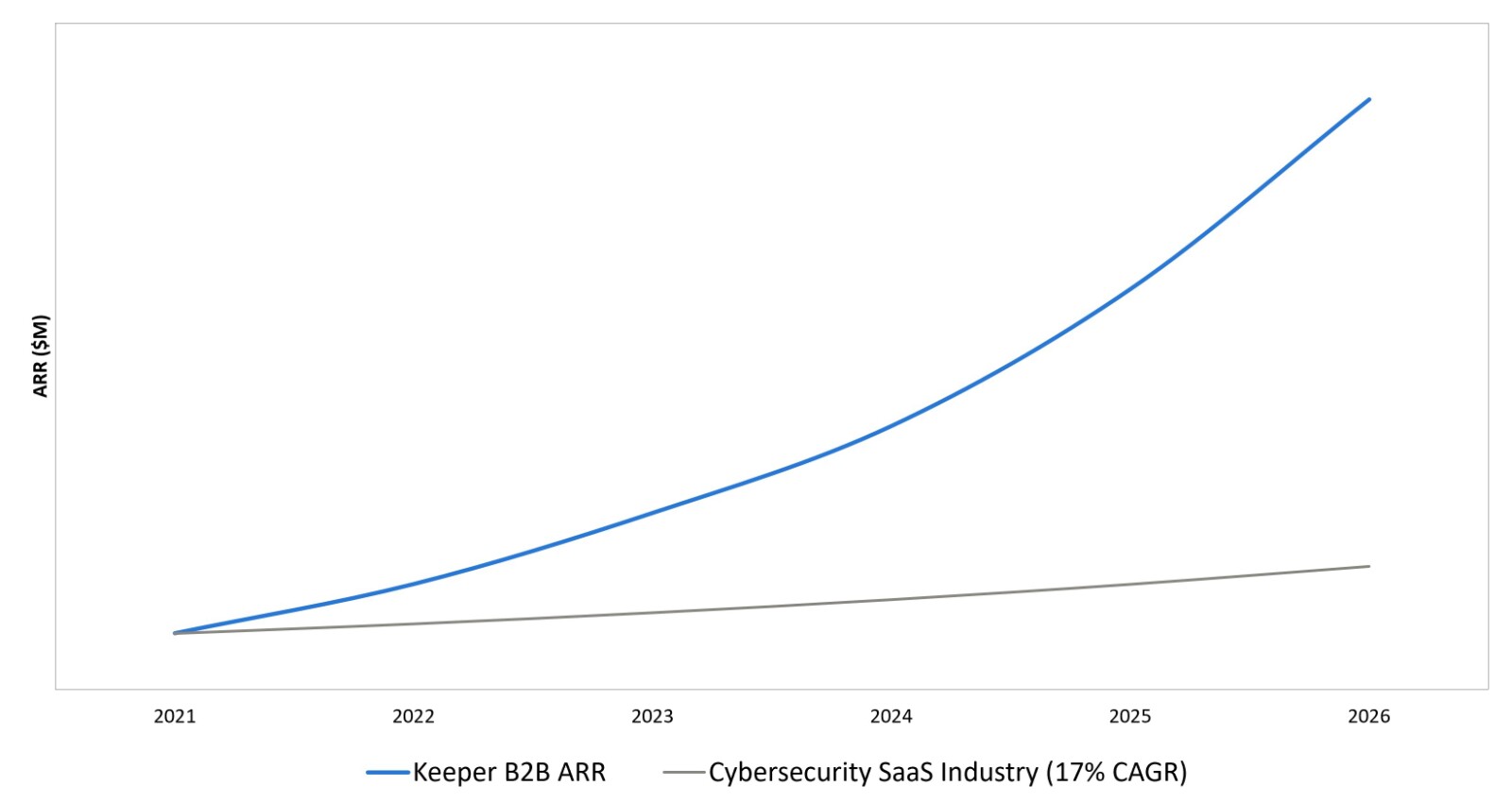
Keeper is now growing at over 4x the industry average.
This market-leading growth is driven by the explosion of identities in the agentic AI age and relentless focus on innovation to protect customers, as evidenced by the release of its unified privileged access management and identity security platform, KeeperPAM®, which protects both human and Non-Human Identities (NHIs), including service accounts, machine identities, databases, AI agents and agentic workloads. Since the launch of KeeperPAM in February 2025, KeeperPAM revenue has exhibited 10x year-over-year growth and Keeper has seen industry-leading new customer growth, adding an average of 850 new organizations every month. In the last fifteen months, Keeper added over 400 innovative features and products to KeeperPAM.
“Identity is the new security perimeter,” said Darren Guccione, CEO and Co-founder of Keeper Security. “As enterprises increasingly deploy AI agents and autonomous systems, the number of privileged identities and machine credentials is growing exponentially. Organizations need a modern, unified platform that secures every identity – human and non-human – and governs every privileged interaction. Our growth reflects the market’s demand for a platform purpose-built to address these challenges.”
Keeper’s cloud-native cybersecurity platform delivers a comprehensive approach to identity security and privileged access management by unifying enterprise password management, secrets management, privileged session management, database management and endpoint privilege management in a single platform. Keeper’s AI-native identity security strategy seamlessly extends these capabilities to non-human identities and agentic AI environments, enabling organizations to discover, manage and secure machine credentials and autonomous workloads with the same rigor applied to human users.
As enterprises adopt AI technologies at scale, the proliferation of non-human identities is rapidly outpacing that of human identities by 150:1, according to reports, thereby creating new attack surfaces and operational complexity. Keeper’s platform helps organizations establish identity-first security strategies that provide security, visibility, governance and least-privilege controls across their entire identity ecosystem.
“Autonomous agents, frontier LLMs and machine-to-machine workflows are operating inside enterprise environments right now – without adequate governance, secrets management or access controls,” said Craig Lurey, CTO and Co-founder of Keeper Security. “Keeper is purpose-built to solve this problem at scale.”
The company’s continued growth and market recognition reinforce its position as one of the cybersecurity industry’s most innovative and fastest-growing providers of AI-native identity security and privileged access management solutions. Keeper’s financial profile combines best-in-class growth, profitability and a debt-free capital structure and is an asset positioned to efficiently lead identity security in the agentic AI age.
“Surpassing $225 million in ARR confirms what we’ve heard in every enterprise conversation – that securing non-human identities is the defining security challenge of the AI era,” said Darren Guccione, CEO of Keeper Security. “We have established an accelerated path to $1 billion in ARR which, coupled with our technology roadmap, will provide optionality for a public offering.”
Source Citation:
Gartner, Market Share Analysis: Security Software, Worldwide, 2025, Rahul Yadav, Deepali, 11 May 2026
Gartner is a trademark of Gartner, Inc. and/or its affiliates.
Gartner does not endorse any vendor, product or service depicted in its research publications and does not advise technology users to select only those vendors with the highest ratings or other designation. Gartner research publications consist of the opinions of Gartner’s Business and Technology Insights Organization and should not be construed as statements of fact. Gartner disclaims all warranties, expressed or implied, with respect to this research, including any warranties of merchantability or fitness for a particular purpose.
Hashtag: #KeeperSecurity
The issuer is solely responsible for the content of this announcement.
About Keeper Security
Keeper Security is the leading zero-trust and zero-knowledge identity security solution, trusted by millions of people and thousands of organizations globally. KeeperPAM® is Keeper’s privileged access management platform that unifies password and passkey management, secrets management, privileged session management and endpoint privilege management in a single cloud-native platform, protected with quantum-resistant encryption. KeeperAI delivers real-time, AI-native threat detection across every privileged session. As AI agents proliferate and identity becomes the defining attack surface, Keeper governs access for humans, machines, non-human identities and AI agents, serving as the unified control plane for access, compliance and visibility across the enterprise. For more information, visit
KeeperSecurity.com.
Media OutReach
BRICS Competition Authorities Establish Task Force to Study Global Grain Trade
The decision was announced during the discussion “Competition Development in Global Grain Trade: Joint Efforts of BRICS Countries”, organized by the BRICS Competition Law and Policy Centre on the sidelines of the 23rd Session of the UNCTAD Intergovernmental Group of Experts on Competition Law and Policy in Geneva.
The event included a closed meeting of BRICS competition authorities and a public panel featuring researchers, academics and representatives of international organizations.
Discussions focused on competition in global grain markets, the growing influence of financialization and digitalization across agricultural value chains, and policy tools to improve market transparency. Participants also reviewed the findings of a joint report prepared by the BRICS Competition Centre and UNCTAD (link: https://www.bricscompetition.org/ru/grainreport) , first presented at the 9th BRICS International Competition Conference in Cape Town in 2025.
A coordinated market study
The central outcome of the meeting was the establishment of a BRICS task force that will coordinate a joint sector inquiry into global grain trade within the framework of the BRICS Working Group on Food Markets.
The task force will be co-chaired by Diogo Thomson, President of Brazil’s Administrative Council for Economic Defense (CADE), and Mahmoud Momtaz, Chairperson of the Egyptian Competition Authority (ECA).
Thomson welcomed the initiative and proposed making competition in global grain trade a key topic at the next BRICS International Competition Conference, scheduled to take place in Brazil in 2027.
“Brazil is the only jurisdiction that has launched an investigation into digital grain trading platforms such as Covantis. I therefore strongly welcome this sector inquiry, which will help us better understand the impact of digitalization across grain supply chains and the risks it may create for competition. I also support using the BRICS Competition Centre as the coordination platform for this work,” he said.
Momtaz said one of the main conclusions of the BRICS-UNCTAD report was the significant role speculative activity plays in global grain markets.
“One of the key findings of the report presented by the BRICS Competition Centre is the extent to which speculative factors influence global grain trade. The most effective response is greater market transparency. We should not accept a situation where farmers receive only a small share of the value they create while consumers in Egypt pay excessively high prices for bread. Where does this margin accumulate, and who ultimately benefits from it? These are the questions our sector inquiry should answer,” he said.
He also proposed that the task force develop a common AI-powered price monitoring tool covering BRICS grain markets.
“Such a tool would provide the information needed for market analysis and become an important complement to the joint sector inquiry,” Momtaz added.
From analysis to policy recommendations
Hardin Ratshisusu, Deputy Commissioner of the Competition Commission of South Africa, said the study should contribute to the implementation of the BRICS Grain Exchange initiative endorsed by BRICS leaders in the Kazan Declaration (2024) and the Rio de Janeiro Declaration (2025).
“The proposal to establish a BRICS Grain Exchange should become one of the key recommendations of the sector inquiry as an innovative mechanism for restoring competition in global grain trade. Our objective is not merely to identify market problems but to develop practical recommendations that can ultimately be submitted to the leaders of our countries,” he said.
Alexey Ivanov, Director of the BRICS Competition Law and Policy Centre, said competition authorities should play a central role in designing the institutional framework of the future exchange.
“The BRICS Grain Exchange should not become another formal institution. It must serve as a practical mechanism for improving competition and market transparency. Competition authorities are uniquely positioned to identify the institutional features that will allow the exchange to achieve these objectives,” he said.
Growing international role
Frédéric Jenny, Chairmanof the OECD Competition Committee, said the initiative demonstrated the growing international role of BRICS competition authorities.
“This project illustrates how BRICS competition authorities are becoming drivers of the global competition agenda. In the past, they largely followed the lead of developed jurisdictions. That is no longer the case. There are very few examples worldwide of such close cooperation between competition authorities. This applies not only to joint market studies, but also to enforcement cooperation and competition advocacy. Rather than acting individually, you have found both the mechanisms and the political will to work together,” Jenny said.
The task force will now begin developing the methodology and work plan for the joint inquiry. Its findings are expected to provide policy recommendations aimed at strengthening competition, improving transparency in global grain trade, and supporting future BRICS initiatives in agricultural markets.
Hashtag: #BRICSCompetition
The issuer is solely responsible for the content of this announcement.
Media OutReach
VinFast VF 8: Blending Business and Family Leisure in an Electric SUV
Today’s premium SUVs are expected to do more than ever before. For EVs, that expectation increasingly extends beyond the drive itself to the ownership experience that comes with it.
DUBAI, UNITED ARAB EMIRATES – Media OutReach Newswire – 17 July 2026 – There’s a reason premium SUVs remain the vehicle of choice across much of the Middle East. People here spend a lot of time in their cars, commuting between cities, shuttling between meetings, while thinking nothing of driving hundreds of kilometers over a long weekend.
A vehicle is where conference calls are taken between appointments, where children fall asleep in the back seat on the drive home, and where many of the ordinary moments of daily life quietly unfold. That is also why buyers in the region tend to value both performance and convenience, rather than simply paying for horsepower or a premium badge.
Electric vehicles have made those decisions even more nuanced. Not long ago, conversations about EVs were largely centered on battery size, driving range and charging times. Those questions still matter, but increasingly, buyers also demand a clear picture of their post-delivery ownership experience, specifically requiring convenient charging, straightforward servicing, and long-term support.
Viewed through that lens, perhaps the most interesting thing about the VinFast VF 8 isn’t any single specification. Rather, it is the way the company has approached the ownership experience around it.
Designed by the legendary Italian design house Pininfarina, the all-electric D-segment SUV combines premium styling with everyday practicality. With up to 493 km of NEDC driving range and up to 402 horsepower through its dual-motor AWD system, the VF 8 is equally at home navigating city traffic or tackling longer journeys across the region. Its spacious cabin, Level 2 driver assistance technologies and 15.6-inch infotainment display are designed with comfort in mind, whether the journey lasts twenty minutes or two hours.
In the UAE, buyers also benefit from a 10-year vehicle warranty, a 10-year unlimited-mileage battery warranty, 24/7 roadside assistance and five years of free maintenance up to 100,000 km. These benefits strike at the heart of the EV ownership experience, especially for first-time buyers. Running low on charge before an important meeting or worrying about finding support on a long drive are precisely the kinds of concerns that can make consumers hesitate about making the switch.
Globally, VinFast has been investing heavily in the ecosystem surrounding its vehicles. Earlier this year, the company signed agreements with 29 international aftersales partners as part of its plan to expand its global service network to more than 1,100 workshops across North America, Europe, the Middle East and Asia during 2026. The initiative includes globally standardized technician training alongside software updates, battery inspections and technical support throughout the ownership journey.
In the UAE, VinFast works with Al Tayer Motors to provide local aftersales support while continuing to strengthen its regional service network through experienced local partners. Earlier this year, the company also signed an MoU with PlusX Electric, a DEWA-approved charging provider, to complement its charging ecosystem with portable charging pods, on-demand mobile charging and emergency roadside charging services.
In many ways, the Middle East’s EV market is still writing its next chapter. Buyers have more choices than ever before, but expectations are rising just as quickly. Developing a competitive electric SUV addresses only part of the equation; ensuring a seamless ownership experience may ultimately prove equally decisive.
Hashtag: #VinFast
The issuer is solely responsible for the content of this announcement.
Media OutReach
Alpro Launches Subsidised RM1 Ferritin Checks to Help Women Understand, Prepare and Live Well Through the Transition to Menopause
Before Menopause, Many Women Are Already Struggling in Silence
While menopause is becoming more widely discussed, the years leading up to it often receive far less attention. During perimenopause, women may experience changes in their menstrual cycle, energy levels, concentration, sleep, mood and overall well-being. These changes may begin several years before menopause and can gradually affect a woman’s daily life, work and family responsibilities.
The fatigue women are expected to live with
Women in their late thirties, forties, and early fifties often carry multiple responsibilities at home, at work, and within their communities. Persistent exhaustion or difficulty concentrating may therefore be dismissed as stress, lack of sleep, ageing or simply part of having a busy life.
Representing the Faculty of Pharmacy, UiTM, Associate Professor Dr Mahmathi Karuppannan said:
Hashtag: #Alpro
The issuer is solely responsible for the content of this announcement.
About Alpro Group
Founded in 2002, Alpro Group’s ecosystem has grown to include Alpro Pharmacy, Apotek Alpro, Alpro スギ (Sugi) Pharmacy, Alpro Physio, Alpro Clinic, Alpro Baby, Alpro OptiSaver, Alpro Audiology, Alpro Health, and Alpro Foundation. Supported by a team of more than 1,000 healthcare professionals, including doctors, pharmacists, nutritionists, dietitians, physiotherapists, optometrist and many others, Alpro serves over 5 million families in Malaysia and Indonesia through its extensive network of 500 physical outlets.
Alpro Pharmacy is the first and only community pharmacy in the region to offer product liability insurance of MYR 1 million in Malaysia and IDR 3 billion in Indonesia, ensuring the supply of genuine medications and enhancing consumer trust.
With the vision of a healthy and vibrant world, Alpro Group aims to become the No. 1 prescription pharmacy chain in Southeast Asia.



