

Connect with us

Media OutReach

Key Findings from the “Hong Kong Vitiligo Patients and Caregivers Survey” Released for “World Vitiligo Day”

Published

on

Patients Demonstrate Significant Knowledge Gaps in Treatment Options, Leading to Lost Hope and Treatment Discontinuation

Over 70% of Vitiligo Patients Desire Skin Repigmentation; New Topical Therapy Introduced in Hong Kong Shows Encouraging Results

HONG KONG SAR – Media OutReach Newswire – 22 June 2025 – In observance of World Vitiligo Day (June 25), Hong Kong Vitiligo Support Group has released findings from its latest “Hong Kong Vitiligo Patients and Caregivers Survey.” The study reveals critical gaps in treatment knowledge, with over 80% of respondents demonstrating limited understanding of available therapies and their efficacy. More than 70% of patients hoped therapy could partially or fully restore their original skin pigmentation, yet many reported disappointing outcomes with existing treatments, leading to loss of confidence and treatment discontinuation.

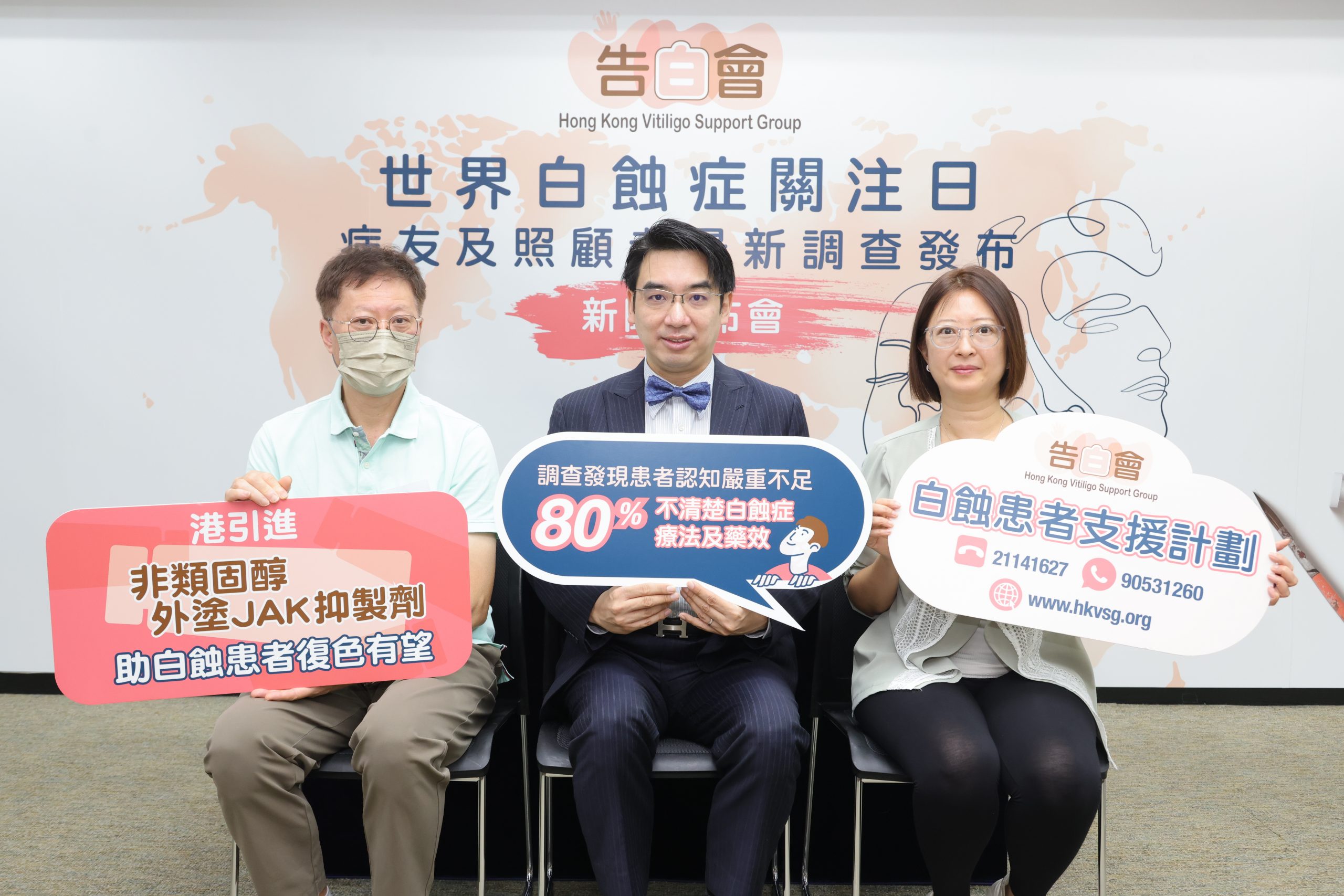
(From left) Mr. Chan (pseudonym), a patient with vitiligo; Dr. Chan Yung, a specialist in dermatology; and Ms. Amy Wong, a registered social worker from the Hong Kong Vitiligo Support Group, urge individuals with vitiligo to seek professional medical consultation for personalized treatment plan promptly and to avoid unproven remedies

Dr. Chan Yung, a specialist in dermatology, noted that with advancing insights into vitiligo pathogenesis, novel therapy has recently been introduced in Hong Kong. Clinical studies confirm its repigmentation potential, encouraging patients to consult specialists for personalized treatment plans.

In Hong Kong, vitiligo affects approximately 1% of the population, with an estimated 70,000 individuals living with the condition. In May 2025, Hong Kong Vitiligo Support Group successfully surveyed 61 patients or their primary caregivers to identify key challenges in disease management. Key findings as follows:

1. Critical Knowledge Deficits in Treatment Understanding

  • 80% lack understanding of treatment options
  • 78% unfamiliar with medication efficacy
  • 84% uncertain about which specialist to consult

2. Disparity Between Treatment Expectations and Outcomes

  • 74% of respondents expressed a desire for full or partial skin repigmentation, yet among the 48 treated patients, none achieved complete repigmentation, and only 8% reported partial improvement
  • 67% perceived treatments as completely ineffective

3. Treatment Discontinuation Due to Lost Confidence

  • 43% are not receiving any active treatment at present
  • Barriers included: high private healthcare costs and long public-sector wait times (95%), and perceived futility of therapy (75%)

Vitiligo is classified as segmental (SV) or non-segmental (NSV), with 90% of cases being NSV—a subtype with higher progression risk and greater therapeutic difficulty. Traditional options (e.g., topical corticosteroids, topical calcineurin inhibitors, phototherapy) often yield variable results, with limitations such as:

  • Corticosteroids: Risk of skin atrophy, telangiectasia; unsuitable for long-term use
  • Phototherapy: Requires 3–6 months (or longer) of 2–3 weekly sessions, with potential sunburn and skin cancer risks
  • Non-steroidal topicals: Often only slow progression rather than induce repigmentation


Over 70% of Vitiligo Patients Seek Skin Repigmentation – New Topical Treatment Introduced in Hong Kong Offers Hope

Dr. Chan Yung stated that targeted therapies like topical JAK inhibitors represent a breakthrough in vitiligo treatment. “Topical JAK inhibitors are non-steroidal medications with demonstrated efficacy and safety profiles, making them a viable long-term treatment option for patients,” he explained.

While the exact etiology of vitiligo remains unclear, current evidence suggests autoimmune-mediated attack on melanocytes plays a key pathogenic role, resulting in depigmented lesions. Non-steroidal Topical JAK inhibitors work by modulating the aberrant immune signaling responsible for melanocyte attack, enabling gradual repigmentation of affected areas.

Ruxolitinib cream, the first FDA-approved non-steroidal topical JAK inhibitor for localized treatment of non-segmental vitiligo in patients aged 12 years and above, has recently become available in Hong Kong. Clinical trials show:

  • Approximately 30% of patients achieved ≥75% improvement in Facial Vitiligo Area Scoring Index (F-VASI) after 24 weeks of treatment;
  • 50% of patients showed ≥50% improvement;
  • Extension to 52 weeks of treatment resulted in >50% of patients attaining ≥75% improvement7


Ms. Amy Wong,
a Registered Social Worker at Hong Kong Vitiligo Support Group noted that many vitiligo patients and caregivers seeking assistance express confusion about treatment options and medication efficacy. “Many patients spend over a year just obtaining a definitive diagnosis,” she explained. “In their search for solutions, patients often invest substantial resources in various cosmetic packages and alternative therapies, only to experience significant discrepancies between desired and actual outcomes. This frequently leads to disillusionment, loss of hope for effective treatment, and even emotional distress.”

“However,” Ms. Wong emphasized, “with medical advancements, vitiligo is no longer considered untreatable. Repigmentation is now achievable, and we strongly encourage patients to seek professional medical consultation at the earliest opportunity.”

Conclusion and Recommendations

The survey reveals significant gaps in patients’ understanding of vitiligo treatments and their mechanisms, leaving many uncertain about where to begin treatment. Over 80% of respondents expressed desire for patient support in medication access and resource referrals. Accordingly, Dr. Chan Yung and Ms. Amy Wong, propose the following recommendations:

1. Public Education Seminars
Conduct lectures and workshops to help patients and caregivers understand that vitiligo requires long-term management, with visible results often taking extended periods to manifest. These initiatives should also educate participants about various treatment modalities, particularly newly available options like non-steroidal topical JAK inhibitors, enabling informed discussions with healthcare providers about appropriate treatment plans.

2. Medication Support and Resource Referral Services
Given that vitiligo necessitates prolonged treatment, and considering that many patients find private care cost-prohibitive while public service wait times are excessively long, we recommend establishing medication support and resource referral services to facilitate timely access to proper treatment. Hong Kong Vitiligo Support Group is currently implementing a “Vitiligo Patient Support Program,” offering free psychological counseling, medication assistance, and resource referral services. Interested individuals may contact Hong Kong Vitiligo Support Group for details.

Case Study

Mr. Chan (pseudonym), 58, first developed symptoms thirty years ago with a small depigmented spot on his neck that subsequently spread to his neck, waist, wrists, and thighs. At diagnosis, his physician prescribed topical corticosteroids but stated vitiligo was essentially “incurable.” Mr. Chan subsequently pursued numerous alternative treatments including UV light therapy, traditional Chinese medicine, electroacupuncture, topical shampoo applications, and cosmetic packages – exhausting savings and liquidating his stocks – all without achieving satisfactory repigmentation.

After years of unsuccessful treatment attempts, he discontinued treatment until being referred to the Hong Kong Vitiligo Support Group. Through their seminars and “Vitiligo Patient Support Program”, he learned about modern treatment advances and, with medication assistance, has begun new therapy with renewed hope for repigmentation.

“My greatest wish is to wear crew-neck shirts again,” Mr. Chan shared. “Since developing vitiligo, I’ve only worn high-collared shirts to conceal neck patches and haven’t gone swimming in thirty years.” He looks forward to regaining sartorial freedom following successful repigmentation.
Hashtag: #Vitiligo #WorldVitiligoDay #TopicalJAKinhibitors #Non-steroidalTopicalJAKinhibitors #Ruxolitinibcream #SkinRepigmentation #Dr.ChanYung #Dermatology #Skincare#HongKongVitiligoSupportGroup

The issuer is solely responsible for the content of this announcement.

About Hong Kong Vitiligo Support Group

Initiated by social enterprise Hong Kong Health Care Alliance, Hong Kong Vitiligo Support Group is a non-profit patient organization dedicated to individuals affected by vitiligo and their caregivers. Our mission is to enhance societal understanding of vitiligo through comprehensive disease education and support services, empowering patients to better understand and confront their condition while fostering public awareness. We strive to ensure no patient faces this journey alone.

Media OutReach

“Happiness from Europe” Returns to Hong Kong with PizzaExpress Partnership

Published

on

HONG KONG SAR – Media OutReach Newswire – 22 June 2026 – The “Happiness from Europe” campaign is back in Hong Kong this summer through a partnership with PizzaExpress. From 23 June to 7 September 2026, 19 PizzaExpress branches will feature a special Grana Padano PDO menu in honor of Restaurant Weeks.

The three-year campaign is co-funded by the European Union and centered on Grana Padano PDO, a hard cheese from the Pianura Padana (Po River Valley) in Northern Italy, known for its fine, granular texture and 900-year production history. In 2026 the campaign returns to PizzaExpress with a dedicated three-dish Grana Padano PDO menu running across 19 branches for the length of the promotion. The partnership puts the cheese in front of diners through one of Hong Kong’s most familiar restaurant brands.

Each of the three dishes uses Grana Padano PDO in a different way, from the sauce of a pizza to the finishing of a pasta. The menu is designed to show how the cheese works across familiar dishes diners already order.

The Menu

The starter is a Cheesy Crab Dip with Grana Padano PDO. Grana Padano PDO is stirred through the dip to balance the sweetness of the crab, and the dip is served with a Grana Padano PDO cheese flatbread for tearing and dipping. It is built to be shared and finished before the rest of the meal arrives.

The Grana Padano PDO Pizza is built on a béchamel base rather than tomato sauce, with Grana Padano PDO worked into the sauce and shaved generously over the top. It is layered with fresh porcini, mortadella, mozzarella, and sliced peach. The combination of sweet peach, cured mortadella, and earthy porcini gives the pizza its character, and the cheese running through both the base and the finish brings the flavors together.

The Spaghetti Seafood Bianco with Grana Padano PDO brings together prawns, clams, and mussels in a garlic and white wine sauce with chili flakes and Grana Padano PDO. The cheese is stirred through the sauce, giving the dish more body than a typical white-wine seafood pasta.

About Grana Padano PDO

Grana Padano is one of the oldest cheeses still in continuous production. It was first made in 1135 at the Abbey of Chiaravalle near Milan, where Cistercians monks developed it as a way to preserve surplus milk. The name comes from its texture: “grana” means “grainy”, a reference to the fine, granular structure the cheese develops as it ages.

Each wheel is handcrafted from fresh milk produced in the Po River Valley of Northern Italy. The cheese is naturally lactose-free thanks to the production process. Maturation takes at least nine months, with some wheels aged for over two years. Younger wheels are milky and slightly sweet; longer-aged ones become richer, nuttier, and faintly crystalline. Grana Padano is the world’s most consumed PDO cheese in Europe.

The Consorzio Tutela Grana Padano is a non-profit making organization charged with protecting, promoting and enhancing the product, providing consumer information and generally taking care of the interests regarding its P.D.O. status.

The absence of lactose is a natural consequence of the traditional Grana Padano production process. It contains less than 10 mg/100 g of galactose.

Ciao! Buon appetito everyone!

For campaign updates and participating branches, visit www.happinessfromeu.com or follow the campaign on Instagram and Facebook.

FOOTER EN

Funded by the European Union. Views and opinions expressed are however those of the author(s) only and do not necessarily reflect those of the European Union or of the granting authority. Neither the European Union nor the granting authority can be held responsible for them.

Hashtag: #HappinessfromEurope

The issuer is solely responsible for the content of this announcement.

Continue Reading

Media OutReach

Hong Kong’s AI Adoption Outpaces Organizational Change, Microsoft Work Trend Index 2026 Finds

Published

on

  • 18% of Hong Kong workers using AI are the most advanced group known as Frontier Professionals, higher than the global average at 16%
  • Just 19% Hong Kong AI users say leadership is clearly and consistently aligned on AI, and only 10% say they’re rewarded for reinvention even when results aren’t immediate
  • Organizational factors such as culture, manager support, and talent practices drive 2x more AI impact than individual factors alone
  • Microsoft is also announcing the launch of Copilot Cowork, bringing multi-model capabilities to help organizations close the gap between AI adoption and how work is designed by enabling end-to-end, multi-step workflows

HONG KONG SAR – Media OutReach Newswire – 22 June 2026 – Hong Kong employees are moving faster than their organizations when it comes to using AI, creating a growing gap between AI adoption and how work is actually designed, according to Microsoft’s 2026 Work Trend Index. The research warns of a “Transformation Paradox”: while AI use is accelerating across the workforce—with more Frontier Professionals using agents for multi-step workflows and building multi-agent systems, leadership alignment, culture, and operating models are not evolving at the same pace, limiting impact and increasing pressure on employees.

The 2026 Work Trend Index draws on analysis of trillions of anonymized Microsoft 365 productivity signals, combined with survey insights from AI users and perspectives from experts in AI, work, and organizational psychology. The conclusion is consistent: the constraint is no longer what people can do, but how work is structured around them.

  • AI is lifting output but not yet transforming organizations. The data shows that AI is already raising the ceiling on individual performance in Hong Kong. A privacy-preserving analysis of more than 100,000 chats in Microsoft 365 Copilot shows that 49% of all conversations support cognitive work—helping workers analyze information, solve problems, evaluate and think creatively. This shift is visible in outcomes: 57% of AI users in Hong Kong say they are producing work they could not have a year ago, rising to 73% among Frontier Professionals, the most advanced AI users in the research.
  • The Transformation Paradox reflects the need for systemic change, with the gap more pronounced in Hong Kong than globally. 75% of Hong Kong AI users fear falling behind if they do not adapt quickly, yet 57% say it feels safer to focus on current goals than to redesign work with AI. [i] At the same time, only 19% say their leadership is clearly and consistently aligned on AI, and just 10% say they are rewarded for reinventing work with AI even when results are not immediate, revealing a widening gap between individual adoption and organizational change. [ii]
  • As AI and agents take on more execution, human value is shifting rather than diminishing. When asked which skills matter most as AI becomes more embedded in work, Hong Kong AI users ranked quality control of AI output (48%) and critical thinking (42%) at the top, underscoring that AI is redesigning work, not replacing people.

From Using AI to Being Frontier Professionals Who Refuse to Outsource Thinking
The Work Trend Index identifies the rise of Frontier Firms—organizations that deliberately rebuild their operating models around human‑agent collaboration, rather than layering AI onto existing ways of working.

Realizing this shift requires transformation at both the individual and organizational level. The research outlines four modes of human-AI collaboration to help employees take the first step toward becoming Frontier Professionals, before progressing to designing agentic workflows:

  • Delegate execution—Employees hand off routine or repeatable tasks to AI to gain speed and scale, while retaining responsibility for the outcome.
  • Ask for information—Employees turn to AI for context, clarification, or insight when they need to quickly get up to speed.
  • Collaborate on reasoning—People work alongside AI to analyze information, test ideas, and solve problems, using AI as a thought partner rather than a shortcut.
  • Explore new possibilities—AI is used to explore open‑ended questions, reframe problems, and surface options when the path forward is not yet clear.

These patterns matter because Frontier Firms do not aim to maximize AI use everywhere. Instead, they intentionally match the right level of human involvement to the outcome, enabling speed without sacrificing quality or accountability.

Leadership and Culture Are the Real Multipliers
The research makes clear that technology alone is not the differentiator, but by how organizations lead, operate, and evolve. Organizational factors, including culture, manager support, and talent practices, account for more than twice the AI impact of individual mindset and behavior. In Hong Kong, Frontier Professionals are significantly more likely to say their managers set clear quality standards for AI work[iii], create space for experimentation[iv], and encourage more ambitious redesign of work[v].

“This is the Transformation Paradox facing Hong Kong today,” said Leo Liu, General Manager of Microsoft Hong Kong and Macau. “AI adoption is moving fast on the ground, but many organizations are still trying to fit it into old operating models. To unlock real value, leaders must move beyond pilots and productivity gains, and intentionally redesign how work gets done—how teams collaborate, how managers lead, and how success is measured.”

Microsoft is also announcing the launch of Copilot Cowork, designed to support this shift toward workflow redesign. Built on Microsoft’s multi-model approach, this agentic system enables long-running tasks across multiple tools, with usage-based pricing, cost management, and governance capabilities to balance quality, performance, and cost, and helps organizations run complex workflows more efficiently at scale.

Microsoft brings this perspective as Customer Zero, applying the same principles internally to redesign workflows, build human‑agent teams, and embed continuous learning into everyday work. Using Copilot Studio and Microsoft Foundry, Microsoft transformed its “Ask Microsoft” web agent from a standalone chatbot into a multi‑agent system that routes conversations more effectively and supports more dynamic, context‑aware interactions. This shift improves how customer intent is understood and addressed, while steering queries to the right resources or teams and allowing sales to focus on higher‑value, high‑intent engagement.

The solution delivered measurable business impact across customer engagement and operational efficiency, achieving up to 61% lower response latency and 70% fewer human escalations. Users who engaged with the agent were 10 times more likely to sign up for services and drove a 16% increase in product trial initiations.

“Inside Microsoft, we’ve learned that AI transformation is not a tooling exercise. It’s an operating model shift,” said Lorraine Bardeen, Corporate Vice President, MCAPS AI Transformation, Microsoft. “When leaders clarify how humans and agents work together, set standards for quality and judgment, and create room to experiment, organizations move faster and learn faster. That’s what separates Frontier Firms from everyone else.”

“We are entering a new era of work, where the traditional value formula is being rewritten,” said Nancy Wang, Head of LinkedIn Greater China. “We call it the ‘new math of work’—a concept introduced in LinkedIn’s new book, Open to Work. The people and organizations that emerge strongest will be those who use the time freed up by AI to build work around what’s actually harder to automate—the specific, contextual, human judgment that no tool can fully replicate, because no tool has lived what you’ve lived or knows what you know.”

The message of the 2026 Work Trend Index is clear: access to AI will soon be table stakes. How work is designed around it will define the next generation of competitive advantage for Hong Kong organizations. For more insights, read the 2026 Work Trend Index Report.


[i] A higher share of AI users in Hong Kong are Frontier Professionals (18% vs. 16% globally), reflecting talent readiness. However, despite greater pressure to adapt to AI (75% vs. 65% globally), day-to-day demands often take precedence, with more in Hong Kong choosing to prioritize current goals over redesigning work with AI (57% vs. 45% globally).

[ii] This pattern is closely linked to limited organizational support. Only 19% of Hong Kong AI users say their leadership is clearly and consistently aligned on AI (vs. 26% globally), and just 10% say they are rewarded for reinventing work with AI even without immediate results (vs. 13% globally). Without stronger top-down direction, support, and recognition, employees naturally default to the safer path.

[iii] 79% Frontier Professionals say their manager sets quality standards for AI work, compared with 59% of Non-Frontier Professionals.

[iv] 80% Frontier Professionals say their manager creates space for experimentation, compared with 61% of Non-Frontier Professionals.

[v] 81% Frontier Professionals say their manager encourages more ambitious work redesign, compared with 63% of Non-Frontier Professionals.

Hashtag: #Microsoft

The issuer is solely responsible for the content of this announcement.

About Microsoft

Microsoft (Nasdaq “MSFT” @microsoft) creates platforms and tools powered by AI to deliver innovative solutions that meet the evolving needs of our customers. The technology company is committed to making AI available broadly and doing so responsibly, with a mission to empower every person and every organization on the planet to achieve more.

Continue Reading

Media OutReach

SIM Highlights the Importance of Strong Personal Statements in University Applications

Published

on

SINGAPORE – Media OutReach Newswire – 22 June 2026 – In today’s competitive education landscape, students are increasingly expected to do more than simply meet academic admission requirements. Education advisors say that writing a strong personal statement for university applications is becoming similar to crafting a compelling CV for a job application. While qualifications and grades may help applicants meet eligibility criteria, a personal statement allows prospective students to communicate their motivations, experiences, and aspirations beyond academic results.

Preparing Students Beyond Admissions
Over at the Singapore Institute of Management, most programmes primarily assess applicants based on academic qualifications and programme specific eligibility requirements. However, selected postgraduate programmes, such as the University of Birmingham Master of Business Administration offered at SIM, may require applicants to submit a Statement of Purpose as part of the admissions process. Even for programmes where a personal statement is not mandatory, education experts suggest that submitting one can still strengthen an application by providing additional context about the applicant’s interests, goals, and readiness for higher education.

Tips for Writing a Strong Personal Statement
According to guidance from the University of Birmingham, a strong personal statement should clearly communicate an applicant’s motivation, interests, and suitability for the programme. Admissions tutors note that the opening section is particularly important, as it creates the first impression and helps establish the applicant’s enthusiasm and direction.

Education experts also recommend that applicants explain how their academic background, professional experiences, and personal achievements have shaped their interest in the chosen field of study. Relevant experiences such as internships, leadership roles, volunteer work, and professional accomplishments can help demonstrate initiative, growth, and readiness for higher education. Rather than simply listing activities, applicants should reflect on what they learned from these experiences and how they contributed to their personal development.

The University of Birmingham further advises students to avoid overly generic statements and instead tailor their applications to the specific programme they are applying for. Demonstrating an understanding of the programme structure, learning outcomes, and career relevance can help strengthen the application, particularly for postgraduate programmes such as the MBA.

Authenticity is another important factor highlighted by university admissions advisors. Applicants are encouraged to present a genuine reflection of their interests, ambitions, and experiences rather than relying on exaggerated language or generic phrases. In terms of structure, admissions guidance generally recommends presenting information in a clear and organised manner. A strong personal statement typically includes an introduction outlining academic or professional interests, relevant experiences and achievements, career aspirations, and reasons for choosing the programme. Applicants should also proofread carefully to ensure clarity, grammatical accuracy, and consistency throughout the document.

Reference:

  1. SIM Application Process – https://www.sim.edu.sg/degrees-diplomas/admissions/application-process
  2. What makes a great personal statement – https://www.birmingham.ac.uk/accessibility/transcripts/personal-statement
  3. How to write a statement for MBA – https://www.inspirafutures.com/blog/how-to-write-a-statement-of-purpose-for-mba-admission
  4. MBA Statement of Purpose Examples – https://bemoacademicconsulting.com/blog/mba-statement-of-purpose-example

Hashtag: #SIMGlobalEducation #SIMGE #GlobalEducation #InternationalDegree #CareerReady #FutureSkills

The issuer is solely responsible for the content of this announcement.

About SIM Global Education

SIM Global Education (SIM GE) is a leading private education institution in Singapore and the region. We offer more than 140 academic programmes ranging from diplomas and graduate diploma programmes to bachelor’s and master’s degree programmes with some of the world’s most reputable universities from Australia, Canada, Europe, United Kingdom, and the United States. SIM GE’s cohort is made up of 17,000 full- and part-time students and adult learners, of which approximately 41% are international students hailing from over 50 countries.

SIM GE’s holistic learning approach and culturally diverse learning environment aim to equip students with knowledge, industry skills and employability competencies, as well as a global perspective to succeed as future leaders in a fast-changing, technologically driven world.

For more information on SIM Global Education, visit

Continue Reading

Trending

