
Media OutReach
New Opportunities in Southeast Asia’s Digital Shift: Thailand Emerges as the New ASEAN’s AI Hub

The expansion of AI and data centers (DCs) in Thailand is driving several transformative trends:
- Changing data traffic patterns. As DCs multiply in Bangkok, Chonburi, and beyond, Thailand is evolving from a traditional data “transit point” into a regional “convergence hub.” East-west digital traffic is accelerating, with Thai DC clusters increasingly meeting the computing demands of Southeast Asia and the broader Asia-Pacific.
- Optimized data routing. Data flows that once relied on submarine cables via Hong Kong and Singapore are gradually shifting to land-based digital corridors linking China, Laos, and Thailand. This route reduces data transmission latency from southwestern China to Southeast Asia.
- Elevated business expectations. Demand is shifting beyond “sufficient bandwidth” toward “high-quality experience.” Thailand sits in a “latency sweet spot” for key Asia-Pacific markets, with latencies to Singapore, Vietnam, and Malaysia falling within an optimal range—a crucial advantage for latency-sensitive sectors like autonomous driving, telemedicine, and fintech.
New opportunities inevitably bring new challenges, and Thailand also addresses the following three challenges:
1. Massive traffic impacting existing networks: Compared with mature hubs like Singapore, Thailand has insufficient international submarine cables. A large volume of cross-border data still needs to be transmitted through detours. Meanwhile, as DC investments continue to accelerate, traffic will keep rising. Analysis shows that by 2029, Thailand’s DC capacity may reach 2000 MW, with cross-region traffic surging to 630 Tbps. The current network architecture is no longer capable of supporting such heavy traffic.
2. Latency advantages not fully realized: Despite its geographic advantages, Thailand’s network latency performance has yet to reach its full potential. Routes to key markets, like China, still require third-party transit. What’s more, traditional network scheduling lacks intelligent route selection capabilities, making it difficult to provide deterministic assurance for latency-sensitive services like financial transactions and real-time AI interactions.
3. Potential risks in network reliability: Thailand’s network reliability faces structural challenges. Single points of failure have previously caused hours-long interruptions to critical services, directly undermining enterprise users’ confidence.
To overcome these challenges, Thailand can take a systematic approach to upgrading its digital infrastructure, aiming to build next-generation AI-ready networks.
1. Building ultra-high-bandwidth “sea-land” connectivity. By actively introducing new submarine cables, Thailand can significantly enhance its connectivity with the Asia-Pacific region and the world. Meanwhile, accelerating the construction and expansion of key terrestrial cable routes—such as China-Laos-Thailand and Thailand-Malaysia-Singapore—will transform Thailand’s geographic advantage into a tangible connectivity advantage.
2. Optimizing network routes to create a regional low-latency core. Strengthening the Kunming-Laos-Thailand terrestrial cable route will continuously reduce transmission latency between China and Thailand, meeting the needs of real-time applications. In addition, the introduction of autonomous networks will enable automatic selection of the optimal, shortest route, shifting from “best effort” to “deterministic low latency.”
3. Designing a “never-interrupted” high-resilience architecture. Deploying active-active DC networks with millisecond-level switchover capabilities ensures the continuity of core services. Meanwhile, AI-driven intelligent O&M can reduce fault detection and diagnosis from hours to minutes.
Thailand’s booming AI and DC industries are driving rapid growth in regional and cross-border business demand. In this trend, network infrastructure construction centered on DCs is the core engine that drives AI transformation, propelling Thailand toward its vision of becoming the new AI hub for ASEAN.
Hashtag: #huawei
The issuer is solely responsible for the content of this announcement.


Media OutReach
CUKTECH Officially Launches Its Online Store in Indonesia, Expanding Charging Technology Presence in Southeast Asia
CUKTECH focuses on the development of power and charging solutions, with a product portfolio that includes power banks, charging cables, wall chargers, and car chargers. Product development emphasizes charging efficiency, safety standards, and long-term reliability, addressing everyday usage scenarios involving smartphones, tablets, laptops, and other connected devices. The brand’s solutions are designed to support increasingly common multi-device lifestyles, including mobile work and frequent travel.
Prior to the launch of the official online store, CUKTECH operated in Indonesia mainly through third-party distribution channels, resulting in limited product availability. With the establishment of an official channel, the company is gradually introducing a more complete product lineup to the Indonesian market, aligning local availability with that of other Southeast Asian markets such as Vietnam, Malaysia, and the Philippines.
According to the company, the official online store serves as a centralized platform for presenting product specifications, technical features, and launch updates in a consistent manner. This approach is intended to improve transparency and accessibility for consumers while supporting a more structured, long-term market strategy in Indonesia.
Looking ahead, CUKTECH plans to continue expanding its product portfolio in Indonesia, introducing additional products to address evolving local usage needs. Future launches will focus on scenarios such as multi-device charging, mobile productivity, and daily commuting, reflecting changing consumer behavior.
This market-oriented approach aligns with CUKTECH’s brand philosophy, “In somewhere, For somewhere,” which emphasizes adapting products and solutions to the specific needs of each market rather than applying a uniform global model.
Updates on product launches, brand developments, and the official online store can be found through CUKTECH’s official social media channels on Instagram and TikTok:cuktech_id
https://www.tokopedia.com/cuktech-official-store
https://shopee.co.id/shop/1748675224
Hashtag: #CUKTECH
The issuer is solely responsible for the content of this announcement.
Under the partnership structure, Green SM provides the technology platform, all-electric vehicle fleet, operational standards, and driver development system, while Taksi Komotra contributes its established local expertise and network across Bali. The collaboration integrates electric mobility technology with on-the-ground operational capabilities to deliver a scalable, governance-driven transportation model.
Operations in Bali are implemented under Green SM’s “5 Green Promises” service commitment framework. Established as a foundational operating standard since the company’s inception, the framework ensures that each ride delivers an excellent customer experience, professional drivers, high-quality and safe vehicles, fair and transparent pricing, and a meaningful contribution to environmental sustainability.
The service operates an all-electric fleet that produces no exhaust emissions or fuel combustion. All vehicles are maintained under strict technical and safety protocols to ensure consistent service performance while contributing to cleaner air and quieter urban environments.
A central pillar of the launch is the Green SM Driver ecosystem. Drivers are positioned as professional green mobility ambassadors guided by five core values: Respect, Professionalism, Dedication, Discipline, and Competitive Income with Stable Career Pathways. Structured training, transparent earnings mechanisms, and disciplined service governance aim to elevate driving into a respected profession while maintaining safety and reliability as foundational standards. This framework aligns income stability with environmental responsibility, reinforcing the role of drivers in supporting Bali’s sustainable tourism trajectory.
The launch comes amid rising mobility demand driven by tourism growth and daily transportation needs across the island. The Indonesia Tourism Outlook 2025 report notes a sustained shift toward environmentally responsible travel, underscoring the relevance of electric mobility in long-term development planning. According to projections from Indonesia’s National Development Planning Agency (Bappenas), green employment nationwide is expected to reach 4.8-5.3 million by 2029, reflecting the broader economic potential of sustainable industries.

Mr. Deny Tjia, Managing Director of Green SM Indonesia, said: “The partnership with Taksi Komotra reflects our long-term commitment to building a high-quality, well-governed mobility ecosystem in Indonesia. By combining electric vehicles with professional driver development and clear operational standards, we aim to support Bali’s sustainable tourism ambitions while delivering safe, reliable, and comfortable rides for the community.”
H. Hasbi, Chairman of Koperasi Komotra, said: “We are proud to partner with Green SM to introduce electric taxis in Bali. Electric mobility will become part of the new standard for tourism and daily transportation on the island, and this collaboration helps us better serve local residents and visitors while preparing for the future of sustainable transport.”
The Bali launch marks another strategic milestone in Green SM’s expansion in Indonesia, following earlier operations in key markets including Jakarta, Makassar, Bekasi, and Surabaya. In these cities, the service has been positively received by local residents and international visitors alike, who value its clean electric fleet, professional drivers, and structured safety standards that enhance travel confidence.
With its growing presence across the country, Green SM continues to build a scalable electric mobility ecosystem that balances environmental responsibility, service excellence, and inclusive economic growth.
Hashtag: #GreenSM
The issuer is solely responsible for the content of this announcement.
About GSM and Green SM
GSM (Green Smart Mobility) is the world’s first company to operate a fully electric ride-hailing service across multiple platforms. As a pioneer in sustainable transportation, GSM has laid the foundation for a cleaner, smarter, and more responsible mobility model powered entirely by VinFast electric vehicles. Founded by Vingroup Chairman Pham Nhat Vuong, GSM is committed to building a future-ready mobility ecosystem while promoting more environmentally conscious lifestyles in markets that are rapidly embracing sustainability.
Green SM is GSM’s official global brand, representing the company’s vision and values in every market it serves. In Southeast Asia, the brand operates as Green SM in Indonesia, Xanh SM in Vietnam and Laos, and Green GSM in the Philippines. Across all markets, the service consistently delivers a modern travel experience through VinFast electric vehicles, professional drivers, and a service culture that prioritizes safety and passenger comfort.
Green SM symbolizes progress toward a future where technology, people, and the environment move forward in harmony. Beyond providing zero-emission transportation, the brand is also committed to fostering environmentally aware communities in every market where it operates.
About Taxi Komotra
Taksi Komotra Bali is part of the Koperasi Mobil Transport Bali, which was established in 1993 under its original name, KOMITRA Bali. In 1996, the cooperative officially changed its name to KOMOTRA Bali and has continued to grow as one of Bali’s local transportation operators.
Today, Taksi Komotra Bali manages two core transportation services: rural bus services and taxi operations. For more than three decades, Komotra Bali has remained committed to providing safe and reliable transportation while supporting local mobility and the tourism sector across the Island of the Gods.


Launched on February 14, the “Chinese Folk Music Odyssey” featured seven major concerts alongside a series of academic and grassroots cultural exchanges. The tour served as a high-level dialogue between the traditional heritage of China’s Jiangnan region and the classical musical heartlands of Europe.
The tour opened at the Centre for Fine Arts in Brussels, where a capacity crowd of 2,000 experienced the vibrant Spring Festival Overture. The ensemble presented a “Chinese Music Feast,” using traditional instruments to paint an auditory “Jiangnan Scroll” of southern Chinese life. In a poignant finale, Chinese fiddles joined forces with local keyed violins to perform the classic Horse Racing. The fusion of Eastern and Western strings brought tears to the eyes of the Chinese diaspora and earned standing ovations from local attendees.
“The melodies possess both natural charm and profound cultural heritage,” noted Belgian music critic Philippe, following six curtain calls. “It is a truly borderless musical exchange.”
Beyond the concert halls, the group engaged with European pop culture in the heart of Brussels’ Comic Strip district. A “flash mob” titled Tintin’s Encounter with Jiangnan Music saw musicians performing alongside iconic murals of Tintin, engaging local youth and residents through social media-friendly cultural interaction.
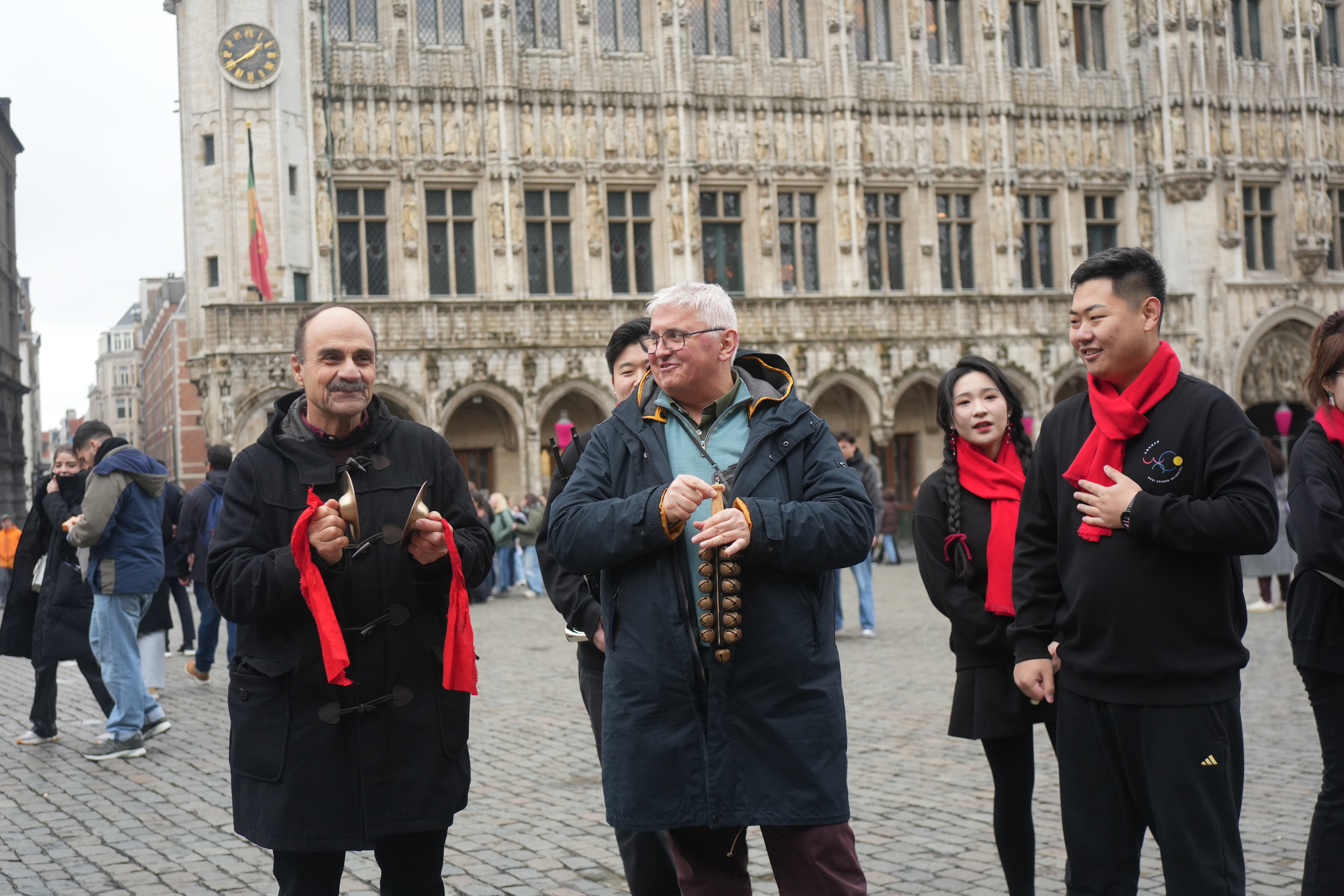
The journey continued through Germany’s elite venues, including Hamburg’s Elbphilharmonie and the Tonhalle Düsseldorf, showcasing the technical precision of Chinese folk orchestration. In the Austrian Tyrol, the tour took an improvisational turn as Wuxi musicians performed alongside local artists against the backdrop of the Alps, a live demonstration of the “beauty without borders”.
The tour concluded on February 26 in Vienna, where the ensemble hosted the “Dreamy Jiangnan” cultural salon at the Wiener Konzerthaus. The event paired musical performances with an interactive exhibition of Wuxi’s intangible cultural heritage, featuring traditional embroidery and clay figurines. The delegation also visited the University of Music and Performing Arts Vienna for the “Jiangnan Charm, Harmonious Resonance” China-Austria Music Exchange event. Through a series of academic dialogues with faculty and students, both sides engaged in a meaningful cultural encounter. These interactions went beyond simple performances, significantly deepening mutual understanding and strengthening the musical ties between East and West.
By integrating the “Voice of China” into the “World Symphony,” the Wuxi Cultural Exchange Group has opened a new chapter in Wuxi’s enduring musical engagement with the world.
Hashtag: #WuxiInformationOffice
The issuer is solely responsible for the content of this announcement.











-
 Feature/OPED6 years ago
Davos was Different this year
-
Travel/Tourism10 years ago
Lagos Seals Western Lodge Hotel In Ikorodu
-

 Showbiz3 years ago
Estranged Lover Releases Videos of Empress Njamah Bathing
-
 Banking8 years ago
Sort Codes of GTBank Branches in Nigeria
-

 Economy3 years ago
Subsidy Removal: CNG at N130 Per Litre Cheaper Than Petrol—IPMAN
-

 Banking3 years ago
Sort Codes of UBA Branches in Nigeria
-

 Banking3 years ago
First Bank Announces Planned Downtime
-

 Sports3 years ago
Highest Paid Nigerian Footballer – How Much Do Nigerian Footballers Earn