Media OutReach
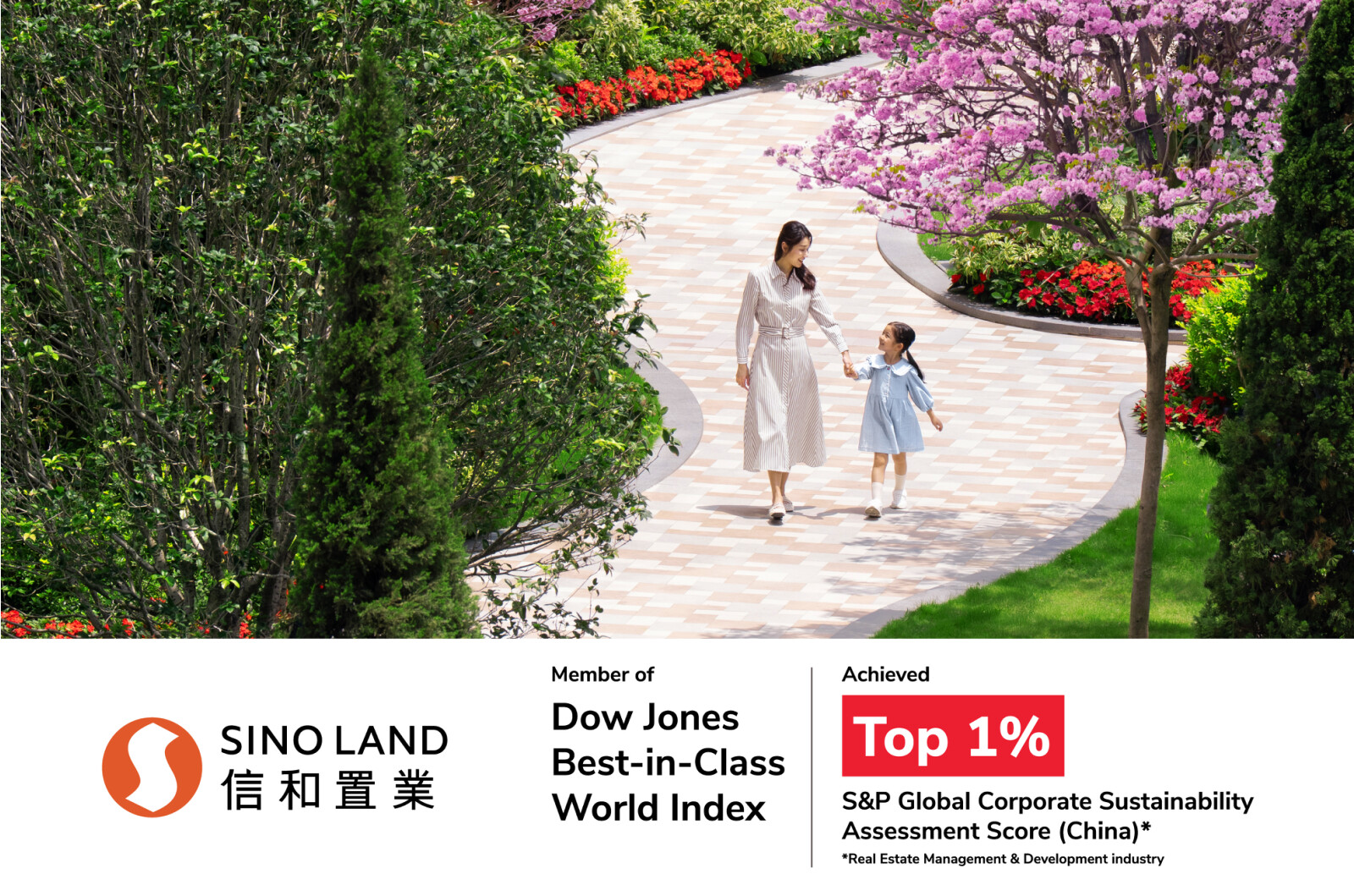
Sino Land Recognised Among Top 1% in China Real Estate Development Sector for ESG Performance
Second Consecutive Year of Inclusion in the Dow Jones Best in Class World Index
HONG KONG SAR – Media OutReach Newswire – 7 May 2026 – Sino Group (‘the Group’) is pleased to announce that Sino Land Company Limited (‘Sino Land’) (Stock Code: 0083.HK) has been recognised as a ‘Top 1% S&P Global Corporate Sustainability Assessment (CSA) Score (China)’ company in the S&P Global Sustainability Yearbook 2026 (China Edition), and is the only company in the Real Estate Management & Development industry to receive this distinction. Sino Land has also been included as a constituent of the Dow Jones Best‑in‑Class (DJ BIC) World Index for the second consecutive year, underscoring international recognition of the Group’s efforts and leadership in sustainability.
The S&P Global Sustainability Yearbook 2026 (China Edition) acknowledges Chinese companies that demonstrate sustainability excellence in their respective industries. This year’s assessment covers nearly 1,800 companies, of which around 190 were selected for inclusion in the Yearbook. Sino Land is the only company in the Real Estate Management & Development industry to be rated among the top 1%, building on its earlier recognition in the S&P Global Sustainability Yearbook 2026 as a ‘Top 5% S&P Global CSA Score’ company. The Dow Jones Best-in-Class World Index is also one of the market’s leading sustainability indices. Based on long‑term economic, environmental and social criteria, the index comprises the top 10% of sustainability performers among the largest 2,500 companies in the S&P Global Broad Market Index (BMI). These recognitions reflect the Group’s ongoing efforts to integrate sustainability principles into its business strategy and daily operations, as well as its continued and measurable progress across key sustainability areas.
Mr Daryl Ng, Chairman of Sino Group and Chairman of the Group’s ESG Steering Committee, said, ‘We are grateful for this recognition under S&P Global’s rigorous assessment framework, particularly as one of the top 1% companies in the Chinese mainland’s Real Estate Management & Development industry. It encourages us to continue strengthening our sustainability efforts in line with international standards. We recognise that our progress has been made possible by the dedication of our colleagues and the support of our business partners and communities, enabling us to implement the Group’s sustainability strategy. In response to the country’s emphasis on accelerating the comprehensive green transformation of the economy and society, as highlighted in the 15th Five-Year Plan, we also hope to learn from it and explore how we can better align our business accordingly, promoting the integration of international experience with local practices and working together to build communities that are lower in carbon and more liveable. Looking ahead, we will continue to learn with humility and work collaboratively with our stakeholders to uphold our corporate culture and core values as we make steady progress on our sustainability journey.’
Beyond advancing a more sustainable environment through climate action, building planning and design, and innovative solutions, the Group also remains committed to a people‑centric approach by promoting sustainability through employee engagement. For the second consecutive year, Sino Group organised ‘Sino Sustainability Month’ in collaboration with close to 15 partners, including environmental social enterprises, green-technology start-ups, academic institutions and professional bodies, to organise visits, workshops and hands-on experiential activities for our employees. Such initiatives encourage colleagues and their families to embrace sustainable practices in the context of work and home life, while gradually extending awareness of sustainable living practices to families and business partners. This year, the programme extended from Hong Kong to Singapore and Sydney, attracting nearly 300 employees and delivering over 650 training hours through the ‘Sino Sustainability Academy’, bringing teams from the three locations together to support sustainability initiatives.
Hashtag: #SinoLand
The issuer is solely responsible for the content of this announcement.
About Sino Group
Established in 1971, Sino Group comprises three listed companies – Sino Land Company Limited (HKSE: 0083), Tsim Sha Tsui Properties Limited (HKSE: 0247), Sino Hotels (Holdings) Limited (HKSE: 1221) – and private companies held by the Ng Family.
As one of Hong Kong’s leading property developers with core businesses in property development and investment, Sino Group has grown with the communities it serves. The Group’s business interests comprise a diversified portfolio of residential, office, industrial, retail and hospitality properties across Hong Kong, mainland China, Singapore and Australia, and has developed over 250 projects spanning more than 130 million square feet. Core business assets are further complemented by property management services, hotel investment and management, including The Fullerton Hotels & Resorts and other affiliate brands.
With over 11,000 committed staff members, the Group strives to fulfil its vision of Creating Better Lifescapes with a focus on three interconnected pillars – Green Living, Community Spirit and Innovative Design – shaping the cities we call home where people live, work and play. Sustainability is central to what we do as we seek to create value for stakeholders and make the business a driver of sustainability for a better future.
Media OutReach
Skills Become the New Currency: Salary Polarisation Deepens as AI and Semiconductor Talent Command Up to 30% Pay Increases in Taiwan
Robert Walters Taiwan’s 15th anniversary report Reveals Structural Shift in the Local Talent Market
- Taiwan’s talent market has officially shifted from an employer-driven to a candidate-driven market, with critical skills increasingly replacing tenure and job titles as the core measure of talent value.
- AI adoption and global supply chain restructuring are accelerating salary polarisation. Professionals in semiconductors and high-tech industries are seeing salary increases of 15–20% when changing jobs, while those with AI, HPC and cross-border supply chain expertise can command increases of up to 30%.
- Career priorities are evolving beyond compensation. 54% of professionals cite learning and development opportunities as a key reason for staying with their current employer.
- By 2030, Gen Z is expected to account for 30–33% of Taiwan’s workforce, making flexibility, work-life balance and transparent workplace culture critical factors in talent attraction and retention.
TAIPEI, TAIWAN – Media OutReach Newswire – 29 May 2026 – Taiwan’s talent market has gradually shifted from an employer-driven to a candidate-driven market through globalisation, digital transformation and pandemic-driven disruption. Meanwhile, the rapid advancement of technology and AI is not only accelerating demand for critical skills, but also reshaping industry structures and redefining the rules of talent competition.
Robert Walters, the world’s most trusted talent solutions business, said in its latest 15th anniversary report, Taiwan’s Talent Market: The New Rules of Competition, that “critical skills” are increasingly replacing tenure and job titles as the primary indicators of talent value and compensation. Particularly as Taiwan’s semiconductor industry strengthens its strategic position within the global technology supply chain, professionals with in-demand capabilities are seeing salary growth significantly outpace the broader market, making salary polarisation an increasingly structural feature of Taiwan’s labour market.
As competition for high-skilled talent intensifies, candidates are placing greater emphasis not only on compensation, but also on Career Value Proposition (CVP), including career development, workplace flexibility and management culture. The report also highlights the rise of a candidate-driven market, where professionals are becoming increasingly selective about what they expect from employers.
In today’s market, growing uncertainty and increasing business complexity are shifting competition away from workforce scale towards the ability to secure critical capabilities and high-value talent. John Winter, Country Manager of Robert Walters Taiwan, noted: “Since entering the Taiwan market in 2011, we have seen talent strategy evolve into a core business strategy. Organisations that can identify critical capabilities early, integrate talent effectively and continuously strengthen organisational resilience will be best positioned for long-term success.”
Global Supply Chain Restructuring Accelerates the Shift Towards a Skills-Based Talent Market and Salary Polarisation
Amid geopolitical uncertainty and ongoing global supply chain restructuring, organisations are increasingly reshaping their structures and global workforce strategies to strengthen resilience and competitiveness. As a result, hiring priorities are shifting away from narrow technical expertise towards cross-functional integration, strategic thinking and problem-solving capabilities. At the same time, talent assessment is moving beyond tenure and job titles, with greater emphasis placed on practical capability, skill scarcity and immediate business impact.
Rapid AI adoption is further accelerating demand for critical skills, driving increasingly concentrated salary growth across the market.
In semiconductor and high-tech industries, professionals changing jobs may see salary increases of 15–20%, while talent with expertise in AI, High-Performance Computing (HPC), Edge Computing and cross-border supply chain management may achieve salary growth of up to 30% reinforcing the growing shift towards a labour market increasingly defined by “skills value”. In contrast, salary growth among execution-focused roles has remained relatively moderate. According to Taiwan’s Directorate-General of Budget, Accounting and Statistics (DGBAS), nearly 70% of employees in 2025 earned below the average salary level — the highest proportion on record — highlighting widening salary polarisation across the labour market.
Candidate-Driven Market Takes Shape:
Career Value Proposition Emerges Alongside Salary as a Key Driver of Employer Attractiveness
The rise of in-demand skills is accelerating Taiwan’s shift towards a candidate-driven labour market, with professionals becoming increasingly selective about what they expect from employers. According to Robert Walters Taiwan’s 15th Anniversary Report, candidates are moving beyond a compensation-led mindset and placing greater emphasis on Career Value Proposition (CVP), including career growth, workplace flexibility and management culture.
As AI adoption and industry transformation continue to reshape the workforce, professionals are placing greater importance on long-term career development and employability. Robert Walters Taiwan’s research found that 54% of professionals view continuous learning and development opportunities as a key reason for staying with their current employer.
Expectations around workplace culture and working models are also evolving. The report shows that beyond salary and benefits (75%), professionals increasingly prioritise flexible working arrangements (36%) and an open, effective management culture (32%) when evaluating employers. Meanwhile, Taiwan’s National Development Council projects that Gen Z will account for approximately 30–33% of the labour force by 2030. As the influence of this generation continues to grow, priorities such as work-life balance, workplace flexibility and transparent organisational culture are becoming defining factors in employer attractiveness.
Reflecting on the findings, John Winter noted: “The rise of a candidate-driven market reflects a broader shift in how professionals evaluate employers. Beyond compensation, talent is increasingly prioritising long-term growth, flexibility and organisational culture. Companies that can provide meaningful career development and adaptability will be better positioned to attract and retain top talent.”
Five Strategies Reshaping Talent Competition:
Building Organisational Resilience Through Critical Capabilities and Skills Value
As geopolitical uncertainty, global supply chain restructuring and rapid AI adoption continue to reshape business environments, organisations are increasingly competing on critical capabilities and organisational resilience rather than scale alone. In this context, talent strategy is no longer a back-office HR function, but a core driver of transformation, competitiveness and long-term business sustainability.
Robert Walters Taiwan’s report identifies five key strategies organisations should focus on to remain competitive in a rapidly evolving market:
1. Shift from workforce expansion to critical capability planning
Hiring success will increasingly depend on the ability to identify and secure high-value talent with in-demand, business-critical skills.
2. Build compensation strategies around skills value
As skills replace tenure as the key measure of talent value, organisations must redesign salary structures and talent evaluation frameworks to remain competitive.
3. Strengthen long-term learning and capability development
AI-driven transformation will require organisations to proactively build reskilling and upskilling cultures to reduce future capability gaps.
4. Redesign workplaces around flexibility and employee experience
Beyond compensation, organisations must strengthen career development, flexibility and workplace culture to attract and retain high-performing talent.
5. Elevate talent strategy to a core business priority
Future talent competition will increasingly shape organisational agility, transformation capability and long-term competitiveness.
Reflecting on the evolving talent landscape, John Winter said: “In the past, talent strategies were largely designed to address immediate hiring needs. Today, the nature of talent strategy has fundamentally changed. Organisations must shift from asking ‘Who do we need now?’ to ‘What capabilities will we need in the future?’ The businesses that can continuously build adaptable talent and resilient organisations will be the ones best positioned for long-term success.”
-END-
About Taiwan’s Talent Market: The New Rules of Competition
Published as Robert Walters Taiwan’s 15th anniversary report, Taiwan’s Talent Market: The New Rules of Competition explores how globalisation, digital transformation, the pandemic, AI adoption and geopolitical uncertainty have structurally reshaped Taiwan’s labour market over the past 15 years.
The report combines Robert Walters Taiwan’s long-term market observations, talent insights and findings from the Salary Survey 2026, covering key sectors including semiconductors, high technology, manufacturing, digital transformation and cross-border operations. It also examines the major workforce trends redefining talent competition, salary structures and employer attractiveness in Taiwan’s evolving labour market.
To access the full report, please visit: https://reurl.cc/9W97bn
Hashtag: #RobertWalters
The issuer is solely responsible for the content of this announcement.
About Robert Walters
Robert Walters is the world’s most trusted talent solutions business. Across the globe, we deliver recruitment, recruitment process outsourcing and advisory services for businesses of all shapes and sizes, opening doors for people with diverse skills, ambitions, and backgrounds. We help organisations find the skills and solutions to reach their goals and assist talented professionals to power their unique potential.
The Taipei office specialises in placing candidates in the following specialities: accounting & finance, electronics & industrial, healthcare, human resources, IT & digital transformation, marketing, manufacturing, sales, semiconductors, software, supply chain, logistics & procurement.
Media OutReach
Vietnam’s Bridge to the Global Experience Economy
The rapid growth of the Experience Economy is reshaping competition across the global MICE industry, spanning meetings, incentives, conferences, and exhibitions. Against this backdrop, Vietnam is increasingly positioning itself as a new regional hub. At the center of this shift is the Vietnam Exposition Center (VEC), whose record-breaking scale and all-in-one ecosystem are redefining event infrastructure standards while creating new opportunities to bring Vietnamese culture onto the global stage.
The Rise of the Experience Economy
No longer viewed simply as entertainment, the event industry has become a major economic growth driver, a trend increasingly reflected in Vietnam’s market performance.
Speaking at the High-Level Conference connecting the Vietnam Exhibition, Event & Advertising Industry 2026 held at VEC on May 8, Jason Yan, Partner at M Square Capital, the investment fund behind the global EDM festival brand Ultra Worldwide, said Vietnam’s live entertainment market has surpassed USD 50 million in revenue. More than 700 large-scale events are now held annually, generating over USD 1 billion in economic impact from international visitors.
In 2025 alone, Vietnam hosted more than 800 music events of varying scales, while music copyright revenues grew by 200%. According to Yan, these figures indicate that Vietnam is entering a period of accelerated growth within the Experience Economy.
The momentum extends beyond live entertainment. Dr. Cấn Văn Lực, Chief Economist at BIDV, noted that Vietnam’s MICE market has reached approximately USD 6 billion, while the advertising industry has grown to USD 3.5 billion. With annual growth projected at around 12%, Vietnam is increasingly viewed as entering a “golden period” for experiential industries.
At the same time, the market itself is evolving. Consumers are no longer simply purchasing tickets to events, but seeking immersive and integrated experiences. Global brands, meanwhile, are looking beyond venues alone, prioritizing platforms capable of delivering meaningful “Return on Experience.”
VEC’s emerging role as a “strategic connector”
Capturing investment flows from the Experience Economy requires more than consumer demand alone. Large-scale infrastructure remains essential, and for many years, this was one of the limitations preventing Vietnam from hosting major international events. The emergence of VEC is increasingly changing that equation.
Located in Cổ Loa, Hanoi, VEC is a landmark development spanning 900,000 square meters, making it one of Southeast Asia’s largest exposition complexes. At the heart of the venue is the Kim Quy Exhibition Hall, a 13-hectare centerpiece designed with flexible operational capabilities capable of accommodating exhibitions and events welcoming millions of visitors.
The complex is complemented by the VinPalace conference and banquet system, parking facilities for up to 10,000 vehicles integrated with VinFast charging stations, and transportation links providing rapid access to central Hanoi. Together, these elements create a seamless experience ecosystem aligned with international standards.
Vingroup’s world-class organization and operational excellence have already been proven through legendary mega-events, most notably bringing G-Dragon’s “Übermensch” World Tour to Vietnam under the 8Wonder brand. Leveraging this proven expertise, VEC is designed to seamlessly execute the next generation of large-scale activations. Looking ahead, this operational blueprint will further expand across the Vingroup ecosystem, notably with the upcoming VEC Can Gio project in Ho Chi Minh City, the Blue Wave Theater—a 60,000-capacity venue set to become the largest in Southeast Asia.

Building a nationwide all-in-one event ecosystem
Much of VEC’s all-in-one capability is tied directly to its integration within the broader Vingroup ecosystem. Events hosted at VEC can simultaneously leverage platforms including Vincom, Vinpearl, VinWonders, Vinhomes, and the green mobility network Green SM, which now operates across 34 provinces and four countries.
As a result, VEC is evolving beyond a standalone venue into a broader platform connecting commerce, tourism, entertainment, and culture within a unified experience ecosystem.
The broader infrastructure ecosystem also includes the 135,000-seat Hùng Vương Stadium and the 60,000-seat PVF Stadium, equipped with a retractable roof system capable of opening or closing within minutes.
While many traditional Asian venues, including Singapore National Stadium and Thailand’s Rajamangala Stadium, are increasingly facing constraints related to capacity and aging infrastructure, Vingroup’s next-generation venue network is positioning Vietnam as a more competitive player in the regional event market.
The growing presence of global MICE leaders in Vietnam is increasingly viewed as a reflection of both the market’s potential and VEC’s operational readiness.
Jason Yan described Vietnam as “a convergence point of limitless energy for the future of cultural industries,”emphasizing that realizing such potential requires operators capable of managing venues at massive scale. According to him, the ecosystem developed by Vingroup and VEC provides the operational confidence needed for Ultra Worldwide to expand major festival productions into Vietnam.
Geoff Dickinson, CEO of dmg events, shared a similar perspective, noting that decisions by global corporations and political leaders to choose a destination “are never accidental,” but rather the result of “deliberate” long-term strategies.
According to Dickinson, the emergence of VEC, combined with Vietnam’s broader development vision, is creating what he described as a “perfect storm” for international businesses seeking long-term opportunities in the market.
From that viewpoint, the launch ceremony for Vietnam’s Exhibition, Event and Advertising Ecosystem at VEC on May 8 marked more than a new partnership milestone between VEC and international partners. It also signaled a broader new phase for Vietnam’s cultural industries.
Supported by large-scale infrastructure, growing operational capabilities, and Vingroup’s integrated ecosystem, VEC is increasingly positioning itself as a strategic platform connecting Vietnam with the global Experience Economy while advancing its vision of “Bring Vietnam to the world and bring the world to Vietnam.”
Hashtag: #VEC
The issuer is solely responsible for the content of this announcement.
About the Vietnam Exposition Center (VEC)
The Vietnam Exposition Center (VEC) is Southeast Asia’s largest exhibition complex, covering more than 90 hectares. As a destination for major national and international events, VEC pursues the mission of “Bring Vietnam to the world and bring the world to Vietnam,” serving as a gateway where global excellence converges and Vietnamese identity reaches audiences worldwide, while contributing to the growth of key economic sectors and strengthening Vietnam’s position on the global stage.
Website:
https://vec.global/en
Email:
[email protected]
Media OutReach
Hong Kong rises to world No.1 cross-boundary wealth hub
Hong Kong’s cross-boundary wealth rose 10.7% in 2025 to US$2.9 trillion, driven by Chinese Mainland flows and a vigorous stock market that delivered significant IPO (initial public offering) activity and strong gains in benchmark-heavy internet platforms, according to the report. It also projected that, from 2025 to 2030 the cross-boundary wealth managed by Hong Kong will grow by 9% on average annually and maintain first place globally, fully affirming Hong Kong’s position as a world-leading cross-boundary wealth management centre.
Paul Chan, Financial Secretary of the Hong Kong Special Administrative Region Government (HKSARG), highlighted that China’s National 15th Five-Year Plan clearly supports Hong Kong in strengthening its functions as an international asset and wealth management centre, which is also a key component of Hong Kong’s ‘Finance +’ development strategy.
“Over the past few years, the Government has worked closely with the financial sector to continuously improve the financial infrastructure and ecosystem, expand the range of investment products and risk management tools, and deepen the connectivity with capital markets around the world.
“Leveraging the advantages of ‘one country, two systems’, complemented by free, open, transparent, and predictable economic policies as well as a stable and secure investment environment, and cross-market connectivity, Hong Kong is attracting more and more ultra-high-net-worth individuals and family offices to establish a presence and invest in the city,” Mr Chan said.
Christopher Hui, Secretary for Financial Services and the Treasury of the HKSARG, noted that the Government had issued the Policy Statement on Developing Family Office Businesses in Hong Kong in March 2023 and has since implemented various measures to encourage family offices to operate in Hong Kong. Such initiatives, he said, include providing profits tax concession to family-owned investment holding vehicles managed by eligible single family offices and introducing the New Capital Investment Entrant Scheme.
“The Government will introduce legislative proposals into the Legislative Council next month (June 2026) to further enhance the preferential tax regimes for funds, single family offices and carried interest, so as to further enhance the competitiveness of the tax regimes, and attract more funds and family offices to set up and operate in Hong Kong,” Mr Hui said.
According to a study commissioned by Invest Hong Kong and published in February 2026, there were over 3,380 single family offices operating in Hong Kong as of end-2025, representing an increase of more than 25%, over the past two years.
Hashtag: #HongKong #BrandHongKong #Global #Wealth #Management #Top
https://www.brandhk.gov.hk/
https://www.linkedin.com/company/brand-hong-kong/
https://x.com/Brand_HK/
https://www.facebook.com/brandhk.isd
https://www.instagram.com/brandhongkong
The issuer is solely responsible for the content of this announcement.
-
Feature/OPED6 years agoDavos was Different this year
-
Travel/Tourism10 years ago
Lagos Seals Western Lodge Hotel In Ikorodu
-
Showbiz3 years agoEstranged Lover Releases Videos of Empress Njamah Bathing
-
Banking8 years agoSort Codes of GTBank Branches in Nigeria
-
Economy3 years agoSubsidy Removal: CNG at N130 Per Litre Cheaper Than Petrol—IPMAN
-
Banking3 years agoSort Codes of UBA Branches in Nigeria
-
Banking3 years agoFirst Bank Announces Planned Downtime
-
Sports3 years agoHighest Paid Nigerian Footballer – How Much Do Nigerian Footballers Earn