Connect with us

Media OutReach

Year of Extremes: 2024 Market Review by Global Broker Octa

Published

on

KUALA LUMPUR, MALAYSIA – Media OutReach Newswire – 18 December 2024 – 2024 has been a year of contradictory events, significant economic changes, and major political shifts. On a positive note, it was the year when global central banks finally managed to tackle inflation, partly induced by the negative and far-reaching effects of the COVID pandemic and partly by the more recent geopolitical events.

After holding borrowing costs near record highs for most of 2023, almost all major central banks started to cut rates in 2024. However, the pace of interest rate reductions varied, leading to a divergence in monetary policy expectations between different economies, which, in turn, resulted in notable exchange rate fluctuations among major currencies.

On a negative note, however, 2024 has been a year of lingering political uncertainty and geopolitical instability. Although investors learned to coexist with the simmering conflicts in Eastern Europe and the Middle East, a sense of underlying unease persisted. Adding to this sense of anxiety is the changing political landscape.

Indeed, numerous elections took place in tens of countries around the world in 2024. Investors were particularly concerned about the parliamentary elections in France, the general elections in the United Kingdom, and the presidential and congressional elections in the United States. The market still feels the effect of these elections, with traders and investors anticipating major changes in economic policies and trying to front-run their impact on global assets.

The U.S. Dollar (USD) has been the best-performing currency in 2024 among the 20 global currencies that Octa Broker tracks. From 29 December 2023 to 13 December 2024, the U.S. dollar index (DXY), which measures the value of the greenback against the basket of six foreign currencies (the euro, Japanese yen, British pound, Canadian dollar, Swedish krona, and Swiss franc) rose by almost 6%. However, the index has undergone substantial fluctuations over the course of the year. Kar Yong Ang, a financial market analyst at Octa Broker, explains: ‘The dollar index has been on a rollercoaster ride in 2024, soaring to new multi-month heights and plummeting to fresh multi-month lows. Although the greenback looks like the best-performing currency in 2024 so far, the lion’s share of its appreciation occurred during the latter part of the year and has been mostly driven by expectations for a major shift in U.S. trade policy.’
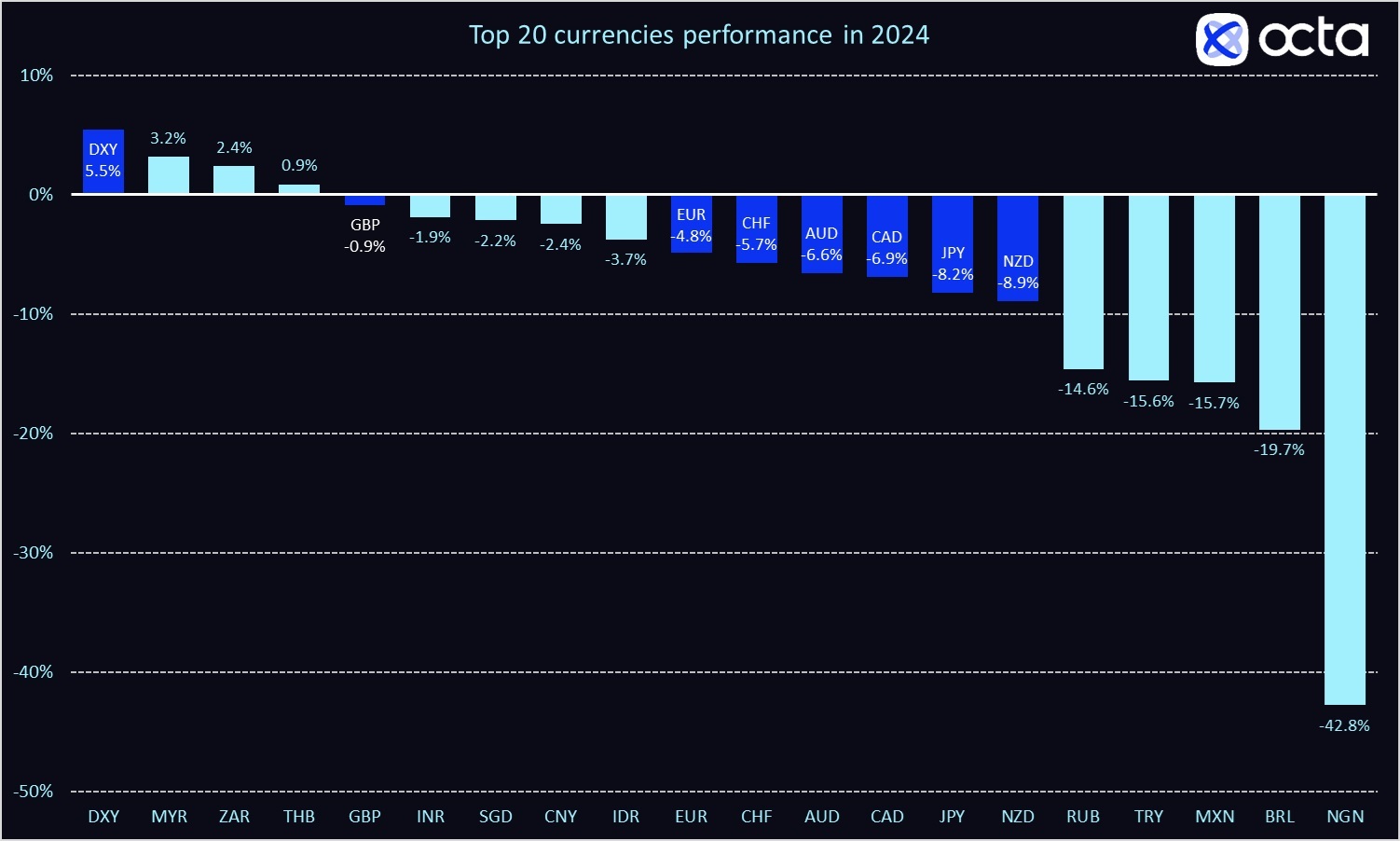
Top 20 currencies performance in 2024

Source: Octa Broker calculations


Indeed, the market is concerned that Donald Trump’s proposed immigration and trade policies could have inflationary consequences, prompting the Federal Reserve (Fed) to adopt a less dovish monetary policy. As a result, the divergence in investors’ monetary policy expectations between the Fed and other major central banks has widened, leading to higher capital inflows into the U.S. dollar. Furthermore, the U.S. economy has been outperforming other advanced economies in 2024 and is expected to continue to do better than the rest in 2025 as well. According to the International Monetary Fund (IMF), real gross domestic product (GDP) growth of advanced economies in 2024 will average just 1.8%, whereas the U.S. GDP is projected to expand by 2.8%.

Because the dollar advanced higher, most major currencies are poised to conclude the year with negative performance. The only exception is the British pound, which is anticipated to finish the year virtually unchanged compared to 2023. ‘The relative strength of the U.S. dollar is only one of many reasons why most other major currencies underperformed in 2024. Other factors, however, are specific to individual countries and a major bearish factor this year specifically has been the lack of political certainty, which currencies do not like,’ says Kar Yong Ang, a financial market analyst at Octa Broker. Indeed, EURUSD, the most liquid and widely traded foreign exchange (Forex) pair in the world, has been weakened by political uncertainty in the eurozone’s largest economies—France and Germany—where political stalemate led to high-profile resignations and early elections. Likewise, when the U.K. Prime Minister Rishi Sunak called a snap parliamentary election, GBPUSD experienced one of the biggest one-day declines of 2024. Moreover, the sluggish growth in the eurozone and the U.K. has prompted investors to anticipate additional rate cuts from both the European Central Bank (ECB) and the Bank of England (BoE). In contrast, the Fed is expected to slow down its easing cycle, further widening the interest rate differential between the U.S. dollar on the one hand and the euro and sterling on the other.

Despite its safe-haven status, the Japanese yen (JPY) was the most volatile currency among the majors. Three-month implied options volatility for the yen, a measure of trader hedging demand, averaged around 9.73% in 2024, whereas the total average across seven major currencies was 7.46%. ‘USDJPY traders have had a wild ride in 2024. It has been a total rollercoaster, to be honest. I think fortunes were made and lost here very quickly. This outgoing year has been truly historical for the JPY,’ says Kar Yong Ang, a financial market analyst at Octa Broker. Indeed, during the year’s first half, the bullish dollar momentum has propelled the pair to a multi-decade high. Then, as rumours of potential intervention by Japanese authorities to bolster the yen began to spread, the USDJPY pair started to decline. A massive sell-off accelerated in late July after the Bank of Japan (BoJ) raised interest rates to 15-year highs and announced details on how it will reduce its huge bond buying. Kar Yong Ang explains: ‘At that time, it looked like BoJ was taking a surprisingly hawkish stance. Its decision really shook the markets and caused investors to reassess popular JPY carry-trades.’

The commodities’ performance varied greatly, and each deserves a separate story to tell, but coffee, lithium, gold, and silver have certainly been the biggest stories in 2024.

Just recently, the prompt-month futures contract of arabica coffee traded on Intercontinental Exchange (ICE) hit an all-time high. It is up some 70% year-over-year (y-o-y), which makes it the best-performing commodity in 2024 among 20 other commodities that Octa Broker tracks. ‘Like many other soft commodities, both arabica and robusta coffee futures are almost entirely driven by the whims of the weather. This year, Brazil, [the world’s largest coffee producer], experienced its worst drought in 70 years, whereas Vietnam, [another key producer] was faced with both drought and heavy rainfall,’ says Kar Yong Ang, a financial market analyst at Octa Broker. Indeed, according to official customs data, Vietnam’s coffee exports in the first half of this year were 893,820 metric tons, down 11.4% from a year earlier. Traders are very much concerned about the 2025 global crop outlook, and prices have reflected these worries.

In contrast, lithium has been the worst-performing commodity in 2024 as the sale of electric vehicles (EV) started to level off while capital investments from previous years boosted production capacity and led to oversupply. According to Refinitiv, the price of Lithium Hydroxide futures contracts traded on the Commodity Exchange (COMEX) was down 42.3% y-o-y as of December 13, 2024.

As for precious metals, 2024 has been a record-setting year, especially for gold. The price for the yellow metal has been setting a new all-time high essentially every month in 2024. Kar Yong Ang, a financial market analyst at Octa Broker, outlines three main factors that have contributed to such a meteoric rise in gold prices. ‘It all boils down to three sources of demand: safe-haven demand due to intensifying geopolitical tensions, investor demand due to less tight monetary policy globally, and structural demand from global central banks as part of de-dollarization and diversification efforts.’ As many times before, gold has once again proved its underlying value as a protective asset during times of uncertainty and may continue to shine in the months ahead. Although the price of silver did not set any new records, its y-o-y performance was even more impressive than that of gold: +28.6% (as of December 13).

‘Perhaps surprisingly, but despite growing geopolitical tensions, crude oil prices went down annually. This is mostly because non-OPEC members—notably, the U.S.—have managed to increase production but also because investors were worrying about the health of the Chinese economy, the main importer of crude oil,’ says Kar Yong Ang, a financial market analyst at Octa Broker.
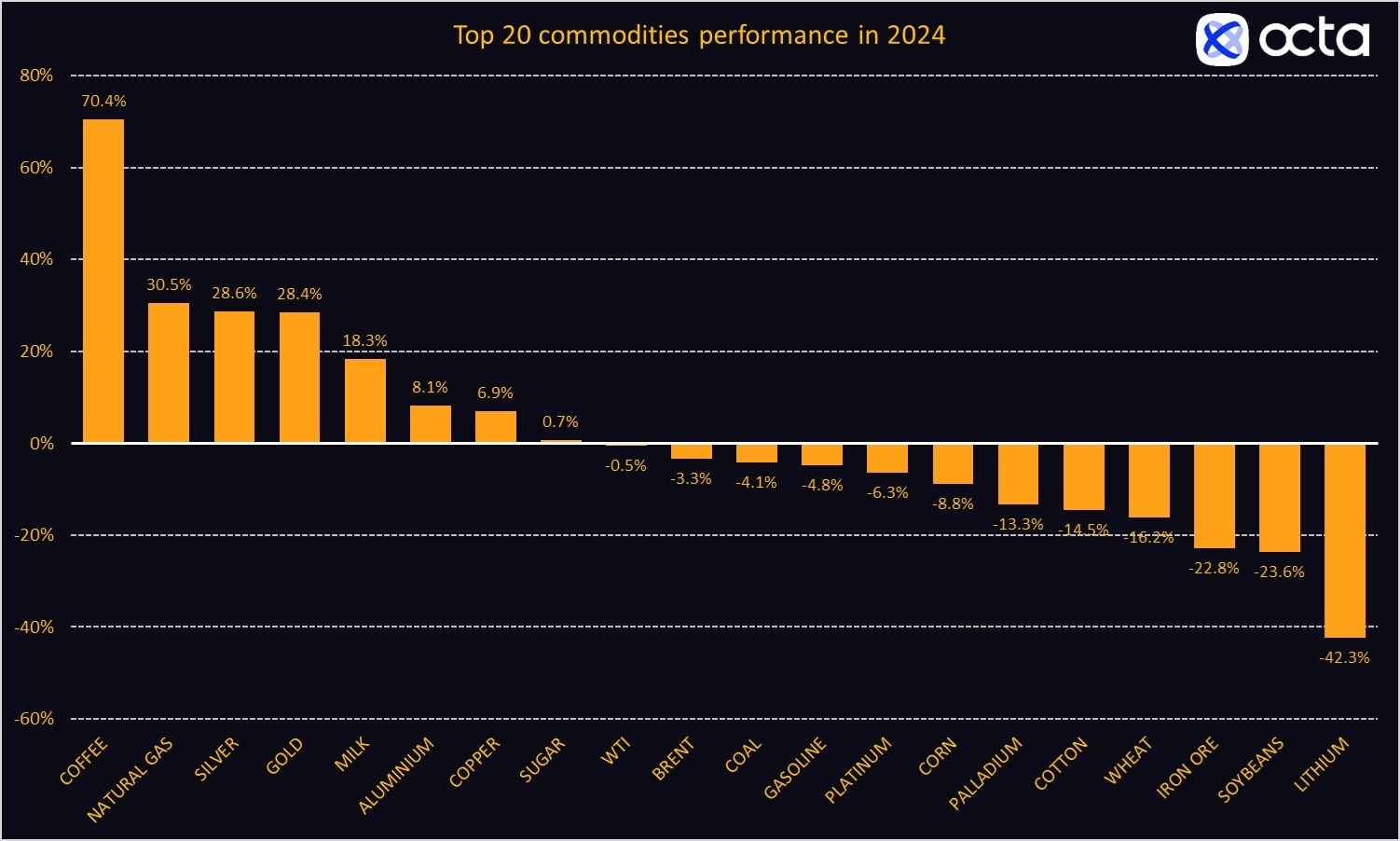
Top 20 commodities performance in 2024

Source: Octa Broker calculations

2024 also witnessed significant developments in the cryptocurrency market, particularly for Bitcoin. On March 8, its price set a new all-time high of $70,000. On 5 December, it finally managed to achieve another key milestone of $100,000 per coin. However, Bitcoin was not the best-performing digital coin of 2024. The price of Doge has increased four-fold. Most of the gains in the crypto sphere were in response to Donald Trump’s victory in the U.S. presidential elections. Such a favourable market reaction to Trump’s victory stems from investors’ belief that his Administration, coupled with a friendly Congress, will effectively deregulate the crypto industry, facilitate its expansion, and implement a coherent regulatory framework that will serve investors and consumers for years to come. ‘It should be said, argues Kar Yong Ang, that this belief is not without foundation. Trump has managed to lure many crypto fans to his side with his bold moves, clear views, and a strong focus on deregulation.’
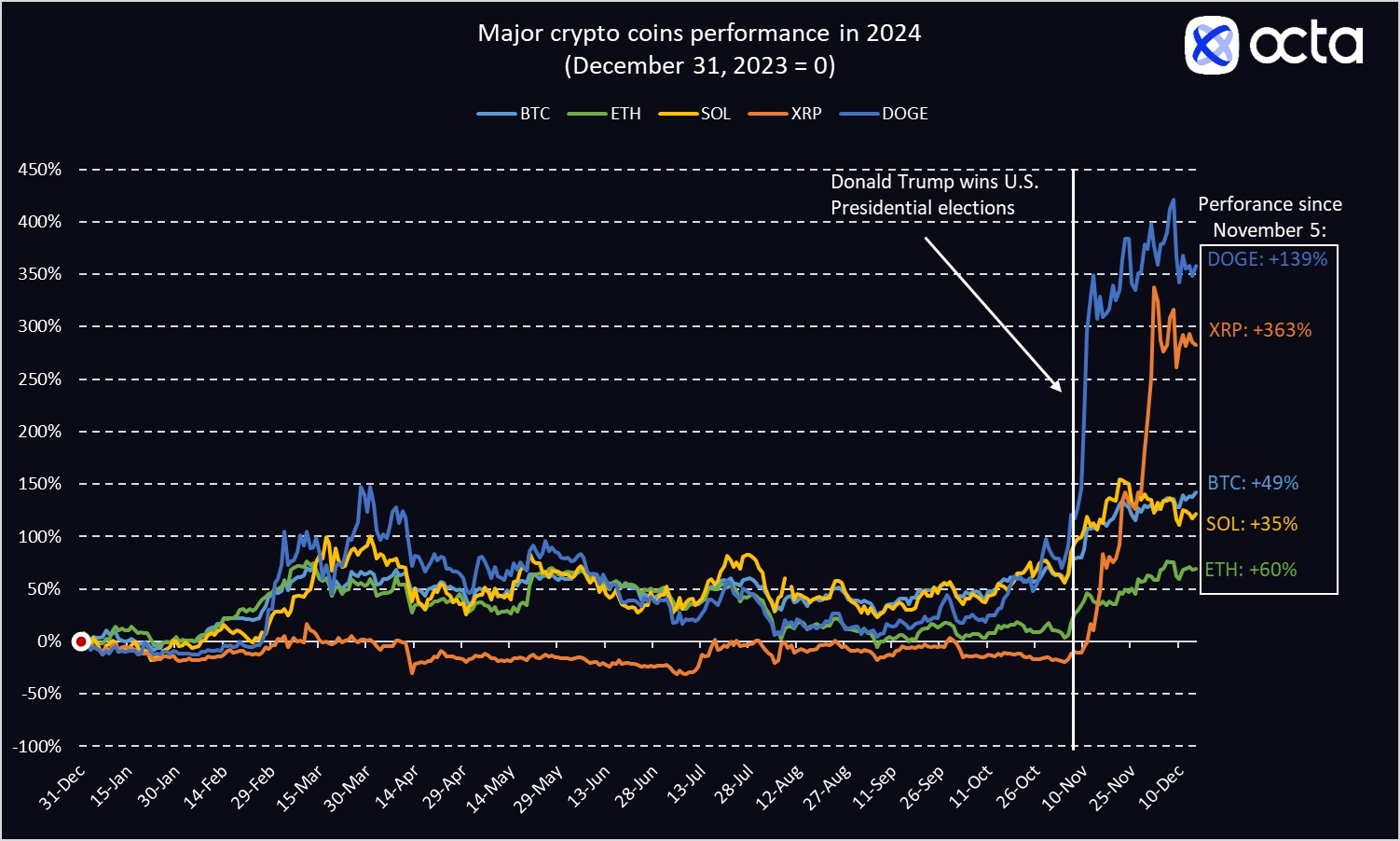
Top 5 crypto coins performance in 2024
Source: Octa Broker calculations

Overall, 2024 has been a year of uneven economic growth and significant political shifts. While central banks successfully addressed inflationary pressures globally, diverging monetary policies led to notable currency fluctuations. At the same time, geopolitical tensions have been on the rise, while political uncertainty persisted.

The U.S. dollar emerged as the strongest currency, driven by a strong U.S. economy, a tightening monetary policy stance, and expectations of potential policy shifts. Other major currencies, such as the euro and the British pound, faced headwinds from economic sluggishness and political instability.

In the commodity markets, 2024 was a year of extremes. While arabica coffee prices soared to record highs due to supply shortages, lithium prices plummeted as oversupply concerns mounted. Precious metals, particularly gold, experienced a remarkable surge, driven by safe-haven demand, easing monetary conditions, and central bank buying.

Meanwhile, the main crypto coins broke new records and seem to be poised for major transformations in 2025.
Hashtag: #Octa

The issuer is solely responsible for the content of this announcement.

Octa

is an international broker that has been providing online trading services worldwide since 2011. It offers commission-free access to financial markets and various services used by clients from 180 countries who have opened more than 52 million trading accounts. To help its clients reach their investment goals, Octa offers free educational webinars, articles, and analytical tools.

The company is involved in a comprehensive network of charitable and humanitarian initiatives, including the improvement of educational infrastructure and short-notice relief projects supporting local communities.

In the APAC region, Octa received the ‘Best Trading Platform Malaysia 2024’ and the ‘Most Reliable Broker Asia 2023’ awards from Brands and Business Magazine and International Global Forex Awards, respectively.

Media OutReach

Global Governance Report Highlights Future Shock Risks as Democratic Accountability Slips and State Capacity Plateaus

Published

on

LOS ANGELES, US – Newsaktuell – 7 May 2026 – The newly released 2026 Berggruen Governance Index (BGI) paints a mixed picture of global governance heading into a future of mounting shocks, finding widespread gains in public-goods provision from 2000 to 2023 even as democratic accountability edged down and state capacity showed little overall improvement.

Presentation of the 2026 Berggruen Governance Index: On 6 May in Los Angeles, the following individuals discussed the findings of the study (from left): Vinay Lai (Professor of History, UCLA), Michael Storper (Distinguished Professor of Urban Planning, UCLA), Stella Ghervas (Professor of History, UCLA) and the two authors of the study, Joseph Saraceno and Prof. Helmut Anheier (both from UCLA’s Luskin School of Public Affairs). Democracy News Alliance / Jordan Strauss/AP for DNA

The BGI, presented Wednesday by an international group of governance scholars, analyses measurable benchmarks of democratic accountability across 145 countries.

On a 100-point scale, the global score for democratic accountability slipped slightly from 65 in 2000 to 64 in 2023, the most recent data used in the project. The wave of democratisation observed in the closing decades of the last century has stalled in the last 15 years. Democratic accountability fell in 54 countries while it improved in 48 countries.

Yet the BGI — a collaborative project of the Luskin School of Public Affairs at the University of California, Los Angeles (UCLA), Berlin’s Hertie School and the Berggruen Institute, a think tank headquartered in Los Angeles — captures remarkably widespread growth in provision of public goods.

Encompassing healthcare, education, infrastructure, environmental sustainability and conditions to foster employment and rising prosperity, public goods improved in 135 of the countries studied, while declining slightly in just four. The global average jumped from 58 to 69 points from 2000 to 2023.

The third component of what the BGI authors refer to as the “governance triangle” is state capacity, defined as the ability to tax, borrow and spend, control territory, operate scrupulous, competent bureaucracies and administer predictable rule of law. The index finds the global average ticking up from 48 to 49 points; 56 countries had increased state capacity while 57 declined.

“What does it tell us about the world ahead?” Prof. Helmut K. Anheier, a Luskin School sociologist and BGI principal investigator, asked during the public release of the 2026 BGI on the UCLA campus.

“Countries are not really improving in their governance performance in significant ways. … We’re not really having forward-looking investment in governance capacity. There is considerable inertia.”

The largest improvements across all three BGI components occurred in Gambia, which the report groups with “low-capacity developing states.” These states score low across the board, particularly in the provision of public goods. This cluster constitutes the poorest countries with the least developed economies, which face the most serious challenges.

“They have the greatest exposure to likely future crises, whether it’s global warming, whether it’s a new pandemic, whether it’s another financial crisis, whether it’s the impact of AI,” Anheier said. “And they have the least capacity to respond to it.”

Bhutan, Georgia, Iraq and Tunisia — which make up the remaining top five countries with the largest improvements in the BGI — are classified as “capacity-constrained states.” They tend to be middle-income with struggling democracies. These countries score higher across the board than the low-capacity developing states, but their state capacity tends to lag compared to public goods and democratic accountability.

The capacity-constrained states risk falling into “a cycle that erodes the institutions they have built,” Anheier said.

“Consolidated democratic states”, a cluster of most of the world’s richest countries, which score highly in all three BGI components, have to confront domestic complacency. Further, in the United States and some others, “political dysfunction” is leaving mounting problems unaddressed and risking erosion of state capacity, Anheier said.

At the other end of the spectrum, the country with the farthest fall on the BGI since 2000 is Nicaragua. Second from last is Venezuela, followed by Hong Kong, Hungary and Turkey. The rest of the bottom 10 are Russia, Iran, Poland, El Salvador and Belarus.

Since 2023, which is the last year of data available for the study, Poland and Hungary have both seen government changes via election, despite serious democratic backsliding. Both had fallen out of the group of “consolidated democratic states” by 2023 and moved into the capacity constrained cluster.

The other eight countries at the bottom of the list are all places that once had some semblance of competitive elections, but by now have little or no remaining pretense of democracy. They are grouped by the authors among the “authoritarian and hybrid states”, which have by far the lowest democratic accountability but outperform even some struggling democracies in delivering public goods.

These regimes have tended toward faster economic growth in the period observed. But that seeming prosperity, typically fueled by extractive industries or overreliance on exports, masks “serious institutional weaknesses in these countries, including divided elites,” Anheier said.

Relatively few countries — 21 of the 145 — changed enough for better or worse to be classified in a new group by the end of the 23-year study period.

“Movement between them is rare, but this is largely what we should expect,” said Stella Ghervas, a UCLA historian on a panel of experts who discussed the BGI findings Wednesday. “Government systems are not created in a moment. They evolve over long periods of time.”

Local conditions shaping governance in each country can rarely be quickly reset through political will or even external shocks, Joseph C. Saraceno, a Luskin School data scientist and BGI co-author, said Wednesday.

“Despite all the talk of major transformations happening in global affairs, the underlying configuration of governance simply doesn’t appear to change very much,” Saraceno said. “We use the term inertia to describe this reoccurring pattern. In other words, the structures of global governance are resistant to movement as the conditions beneath them are quite sticky: political economies, demographics, resource endowments. These are deeply layered, and they push each country toward the world that it already inhabits.”

But the challenges lurking around the world may not wait for the slow and difficult processes of political change and development to catch up.

“With the few exceptions of those countries in the consolidated democratic world,” Anheier said, “the great majority of the countries in the world is ill-prepared for the future.”

The full report, ‘ 2026 Berggruen Governance Index – The Four Worlds of Governance‘, can be viewed and downloaded from the website of the UCLA’s Luskin School.

Frank Fuhrig, DNA

—————————————————-

This text and the accompanying material (photos and graphics) are an offer from the Democracy News Alliance, a close co-operation between Agence France-Presse (AFP, France), Agenzia Nazionale Stampa Associata (ANSA, Italy), The Canadian Press (CP, Canada), Deutsche Presse-Agentur (dpa, Germany) and PA Media (PA, UK). All recipients can use this material without the need for a separate subscription agreement with one or more of the participating agencies. This includes the recipient’s right to publish the material in own products.

The DNA content is an independent journalistic service that operates separately from the other services of the participating agencies. It is produced by editorial units that are not involved in the production of the agencies’ main news services. Nevertheless, the editorial standards of the agencies and their assurance of completely independent, impartial and unbiased reporting also apply here.

The issuer is solely responsible for the content of this announcement.

Continue Reading

Media OutReach

Grobrix Launches “Silver Harvest Initiative”, Turning Schools into Micro-Farms Powered by Students and Retirees

Published

on

SINGAPORE – Media OutReach Newswire – 7 May 2026 – More than 200 students and retirees have come together at Bukit View Primary School to grow fresh produce within school corridors, as part of Grobrix’s newly launched Silver Harvest Initiative. With local vegetable production at just 8% against a national target of 20%, the pilot demonstrates how everyday spaces can be transformed into productive micro-farms, offering a scalable approach to local food production in land-scarce Singapore.

The pilot transforms existing spaces such as corridors and rooftops into small-scale growing sites using compact, soil-less farming systems. By using existing infrastructure instead of new farmland or large facilities, the model enables food production across multiple community locations, making it easier to implement in schools and shared environments.

Students take part in planting, transplanting and harvesting as part of their daily school environment, while crops such as leafy greens can be harvested in cycles of approximately three weeks. This demonstrates how consistent production can be achieved even within limited spaces.

Retirees, known as “Silver Farmers”, manage the farms and oversee daily operations. Students support planting, harvesting and basic monitoring, creating a working environment where food production becomes part of everyday school life. The setup also gives students direct exposure to how food is grown and managed, turning the school into a hands-on learning environment aligned with sustainability and applied learning goals.

“Singapore does not have the luxury of large farming spaces. But we have schools, and we have retirees who want to contribute. This pilot shows that food production can be practical and repeatable by using spaces we already have,” said Mathew Howe, Founder of Grobrix.

The initiative comes amid growing adoption of micro-farming across Singapore, with schools, companies and community spaces increasingly integrating small-scale food production into existing environments. Demand for such systems has risen in recent months, reflecting broader interest in community-based approaches to food resilience.

The Bukit View Primary School pilot will run over 12 months, focusing on improving yields and integrating produce into school consumption. Grobrix will track how much of the school’s leafy green needs can be met through these growing spaces, with the aim of developing a model that can be adopted across other schools.

Grobrix has installed more than 100 edible growing systems across Singapore and is expanding its footprint regionally and internationally. The company plans to scale the Silver Harvest Initiative to more schools while training additional retiree participants, building a network of community-based growing sites over time.

As Singapore continues to strengthen its food security strategy, including updated targets to increase local production of vegetables and protein by 2035, the initiative offers a practical example of how food production can be integrated into everyday environments beyond traditional farming spaces. It also aims to build greater awareness of food sources and encourage more active participation in local food systems.
Hashtag: #Grobrix #growingtogether #sustainability #urbanfarming


is a Singapore based agritech company that integrates farming into the built environment through its patented “Farming as a Service” model. By combining modular vertical farming technology with a cloud based management system, the company enables corporate and residential spaces to produce high quality local crops. Beyond hardware, Grobrix fosters community engagement and food resilience through its unique intergenerational and corporate wellness programs. Currently operating across Singapore, Malaysia, and the United States, the brand is redefining how urban populations interact with their food sources. Its mission is to transform urban infrastructure into a productive, sentient, and sustainable ecosystem for all.

Continue Reading

Media OutReach

CUHK Claims Top Positions in Hong Kong and Asia in the Latest QS World University Rankings by Subject

Published

on

HONG KONG SAR – Media OutReach Newswire – 7 May 2026 – The Chinese University of Hong Kong (CUHK) has achieved outstanding results in the QS World University Rankings by Subject 2026, released on 25 March, further cementing its position as a global leader in research and academic excellence. Ten CUHK subjects have secured the top position in Hong Kong, and 21 subjects rank among the top 50 worldwide. These outstanding results reflect CUHK’s sustained commitment to research impact and the calibre of its scholars, whose work continues to advance the collective understanding of the world’s most pressing challenges.

CUHK’s Academic Excellence and Global Research Impact

Ranked among the world’s top 50 universities, CUHK ascended to 32nd place globally in the QS World University Rankings 2026, marking a four-place rise that reinforces its role as a hub for rigorous inquiry, and a dynamic environment where students are empowered to pursue meaningful research and knowledge exchange. This trajectory is supported by 17 CUHK researchers recognised on the Highly Cited Researchers 2025 list by Clarivate Analytics, and 431 academics listed among the world’s top 2% scientists by Stanford University. Among them, 47 scholars were ranked within the global top 100 in their respective fields. Notably, three scholars, including Vice-Chancellor and President Professor Dennis Lo Yuk-ming, have earned positions within the global top 10, a distinction that highlights the remarkable depth and excellence of CUHK’s research community.

CUHK’s The Nethersole School of Nursing: Nurturing Research Innovation and Global Talent in Nursing

Among CUHK’s strongest performers in this year’s rankings, the Nethersole School of Nursing has been ranked #1 in Hong Kong and Asia, and #6 worldwide. Reflecting on the academic environment, Pham Nhat Vi DO, a Vietnamese PhD student in Nursing, shared: “My PhD journey at CUHK has transformed my research abilities, critical thinking, and leadership skills. Through CUHK’s outstanding faculty support, I have accessed diverse academic resources and gained invaluable hands-on experience, building a strong foundation for my future career.”

Vi’s research focuses on colorectal cancer survivorship using cutting-edge technology. As the first Vietnamese researcher adopting this approach, her work reflects CUHK’s strength in empowering students to break new ground.

CUHK’s Geography and Resource Management: Advancing Student Research on Pressing Climate Challenges

CUHK’s Department of Geography and Resource Management has also earned notable recognition in this year’s ranking, placing #4 in Asia and #21 worldwide. Arati POUDEL, a Nepali PhD student, highlighted the University’s research ecosystem as a key defining aspect of her experience. “CUHK exceeds expectations through outstanding research facilities, supportive faculty, and comprehensive professional development opportunities. The prestigious Belt and Road Scholarship has also enriched my research journey in this beautiful campus environment.”

Supported by CUHK, Arati’s research investigates how adaptation to climate extremes—particularly water scarcity and excess—are being addressed, and the pivotal role played by communities and civil society in leading these responses.

Through the QS World University Rankings by Subject 2026, CUHK continues to demonstrate the impact of its research and scholarship. These achievements underscore the University’s growing influence on the global academic stage and its steadfast commitment to addressing complex global challenges through innovation, insight, and collaboration.
Hashtag: #CUHK

The issuer is solely responsible for the content of this announcement.

About CUHK

The Chinese University of Hong Kong (CUHK) is a leading higher education institution dedicated to nurturing and empowering students to become responsible and compassionate global citizens. With a rich heritage and a forward-looking vision, CUHK strives to blend tradition with innovation, fostering academic excellence, research breakthroughs, and meaningful societal impact.

Continue Reading

Trending