
Technology
Meta Launches AI Support Assistant on Facebook, Instagram

By Aduragbemi Omiyale
New Artificial Intelligence (AI) tools designed to provide support for users of its applications have been launched by Meta.
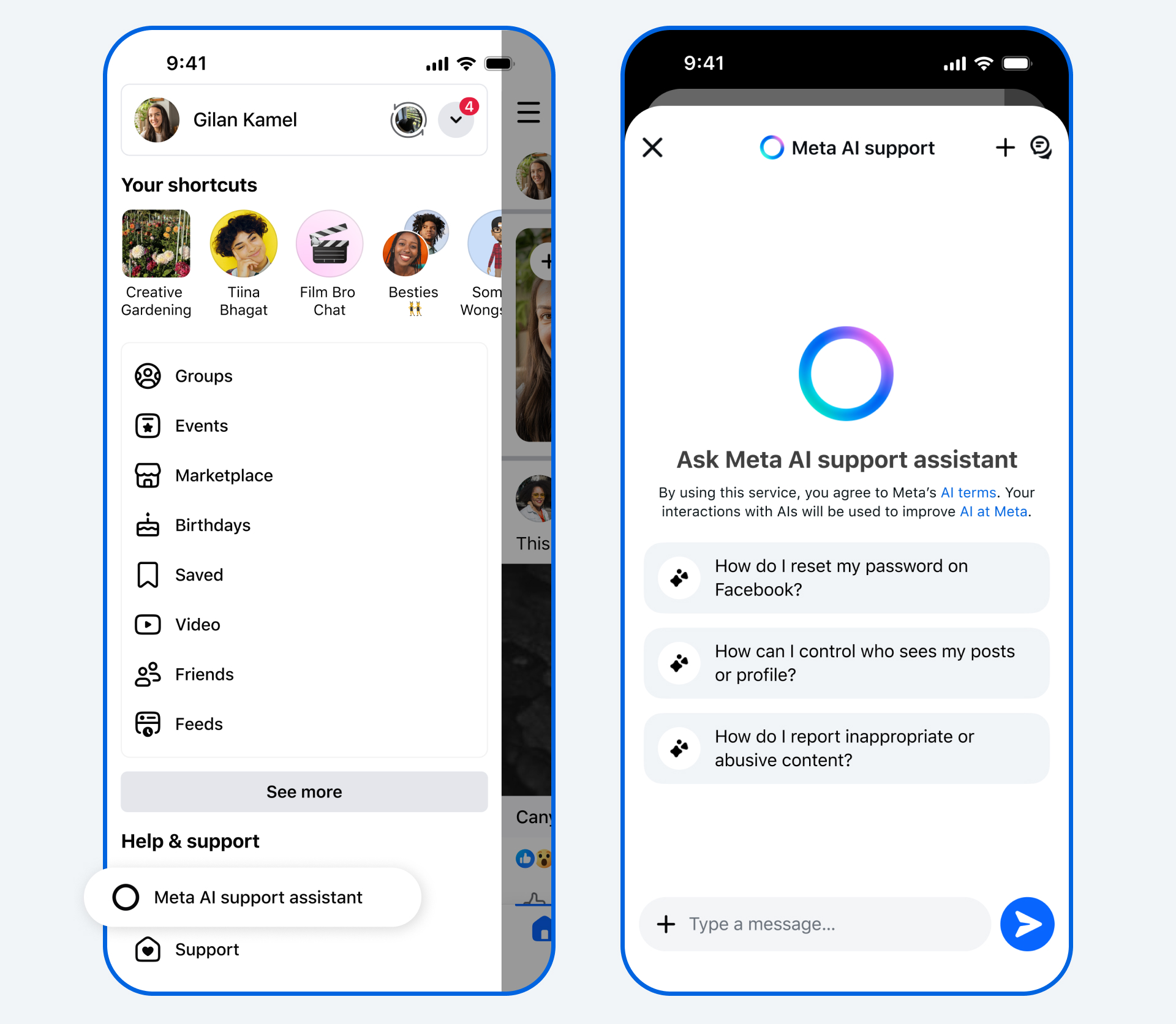
The AI Support Assistant will work on the Facebook and Instagram apps, the company said in a statement.
The tools will help users to receive reliable and action-oriented assistance when needed.
In December, the Meta AI support assistant, a tool designed to provide reliable, 24/7 support for nearly any support issue at any time, was previewed.
Now, Meta is rolling it out globally on the Facebook and Instagram apps for iOS and Android, and within Help Centre on Facebook and Instagram on desktop, with even more capabilities and ways to help.
The new Meta AI support assistant is designed to help resolve account problems from start to finish. It offers answers for any question, like notification settings or new features, and can also take action for users on a growing set of requests directly within Facebook and, in the future, on Instagram.
The feature can report scams, impersonation accounts, or problematic content, make it easier to see why content was taken down, provide appeal options, track what happens next, manage privacy settings, reset passwords, and update profile settings.
The Meta AI support assistant can respond to requests typically in under five seconds, dramatically reducing wait times compared to traditional help centre searches or seeking answers on external websites.
“The Meta AI support assistant is a major step in our work to deliver stronger support on our apps. In fact, among people who have provided feedback, the majority report a positive experience with the Meta AI support assistant. It’s rolling out now in all languages supported by Facebook and Instagram for support topics.
“We’re continuing to invest in AI- powered tools to make support more accessible, reliable, and effective — and we’ll keep evolving the Meta AI support assistant as more people use it and as the technology advances, so it continues to improve over time,” the organisation disclosed.
Meta has also deployed AI to improve content enforcement to help users reduce the chance that scammers trick people into giving away their login details, ultimately finding and mitigating 5,000 scam attempts per day that no existing review team had caught before.
Meta said over the next few years, it would be deploying these more advanced AI systems across its apps once they consistently perform better than its current methods of content enforcement, transforming its approach.
“As we do this, we’ll reduce our reliance on third-party vendors for content enforcement and focus on strengthening our internal systems and workforce.
“While we’ll still have people who review content, these systems will be able to take on work that’s better-suited to technology, like repetitive reviews of graphic content or areas where adversarial actors are constantly changing their tactics, such as with illicit drug sales or scams,” it stated.




By Adedapo Adesanya
South African-founded Refiant AI has raised $5 million to slash the energy footprint of artificial intelligence (AI) in a seed round led by VoLo Earth Ventures, a top climate technology fund.
The startup uses nature-inspired algorithms to radically compress AI models, slashing the hardware and energy required to run them. The new fund will be used to scale Refiant’s team – which already includes a former Google Cloud architect, a Cambridge PhD researcher, and an engineer with NASA experience – to build out a platform and to accelerate enterprise partnerships.
According to a statement shared with Business Post, the company is in active conversations with several multinational technology firms exploring how Refiant’s approach could reduce their AI compute costs while maintaining data and energy sovereignty.
“AI’s growing energy footprint is one of the most urgent and underappreciated challenges in the climate space,” said Mr Sid Gutta, the company’s co-founder. “The industry’s default answer is to build more data centres and consume more power. Ours is to make the AI itself dramatically more efficient.”
The company said it has already successfully demonstrated it can compress a 120 billion parameter AI model to run on a standard laptop, reducing energy requirements by over 80 per cent while preserving near-identical quality. It achieved this to run on a MacBook Pro with just 12GB of RAM. The same model would normally require hardware with at least 80GB of memory. The model retained 95-99 per cent of its fidelity, ran alongside a second AI model on the same machine, and the entire process took four hours with no cloud computing required.
For Refiant, its approach will help businesses reduce their carbon footprint and adopt AI to stay competitive. The energy required to process a single AI prompt on standard infrastructure could power roughly 100 equivalent prompts using Refiant’s approach.
The current breakthrough results were attained at the end of last year, and since then, the team have been gearing up to demonstrate successfully exceeding these results with further compression, longer context windows and model traceability.
“The AI industry is spending hundreds of billions scaling infrastructure when the real breakthrough is the ability to do more with radically less,” said Mr Viroshan Naicker, co-Founder and a mathematician with published research in networks and quantum systems. “Nature doesn’t build by brute force. Evolution optimises. We’ve applied that principle to AI – and the results speak for themselves.”
“AI’s biggest constraint isn’t demand – it’s energy,” added Mr Joseph Goodman, Managing Partner, VoLo Earth. “What’s been missing is a fundamentally more efficient way to compute. Refiant’s architecture replaces brute-force scaling with a far more efficient, nature-inspired approach that lowers energy use while increasing capability. That’s the kind of breakthrough needed to make AI sustainable on a global scale.”

By Adedapo Adesanya
Google and UpSkill Universe, Sub-Saharan Africa’s leading AI and business skills training partner, have announced a major redesign of the Google Hustle Academy programme. For the first time, the free training initiative is open to everyone, not just business owners.
The new curriculum is focused on equipping individuals and entrepreneurs with practical AI skills and comes at a time when small businesses have become the engine of Africa’s economy, creating over 80 per cent of jobs on the continent. To help them grow, the Hustle Academy was launched in 2022, providing bootcamp-style training on business strategy, digital skills, AI, and leadership. The program has since trained over 18,000 SMEs, with many reporting increased revenue and job creation.
Now, as AI reshapes the job market, the program is evolving. The 2026 edition is built for anyone in Sub-Saharan Africa, including employees, students, and job seekers, who want to use AI to advance their careers. To meet the needs of a diverse audience, the new format includes short, 60-minute webinars and more immersive, high-impact bootcamps. These sessions are laser-focused on putting AI to work immediately in areas like digital commerce, marketing, and growth strategy.
Speaking about the academy, Mr Gori Yahaya, Founder & CEO of UpSkill Universe, said, “The 2026 Hustle Academy is designed to close the AI Skills gap with hands-on training that is short, focused, and immediately useful. AI is reshaping how businesses win and how careers are built, right across this continent. We’re excited to renew our partnership, now in its fifth year with Google, combining their global AI leadership with our deep regional AI expertise. The next wave of AI leaders will come from this continent. We are making sure they are ready.”
The Hustle Academy initiative has strengthened digital competitiveness across emerging African economies by enabling SMEs to move beyond AI awareness to practical implementation, positioning them for sustained growth in an increasingly AI-driven business environment.
“We believe that the future of Africa’s digital economy lies in the hands of individuals and entrepreneurs alike. Our new strategy focuses on scaling reach by training individuals in the latest AI-centred tools and techniques,” said a Google representative.
Applications for the 2026 cohort are now open. Interested participants can apply at: https://rsvp.withgoogle.com/events/hustle-academy


By Modupe Gbadeyanka
To develop the country’s internet ecosystem and build a dedicated connectivity community, the London Internet Exchange (LINX) has launched a 12-month no-charge promotion for all services at its new Ghana Internet Exchange Point, LINX Accra.
LINX Accra went live at the end of 2025, providing a regional interconnection point and a platform for networks to meet and exchange traffic, available from PAIX, Onix and the new Digital Realty data centre launched at the end of last year.
As part of its growth drive, LINX Accra aims to attract major global internet carriers and content delivery networks to keep more traffic local to Ghana, building relationships between local networks and encouraging early adoptions through promotion.
A key aspect is growing the local networking and peering community to reduce Ghana’s reliance on international routing, improve latency, and cut costs for networks and end users across the country.
“Ghana’s connectivity ecosystem is growing fast, and our goal, through the promotion, is to remove early barriers and encourage local ISPs to join and exchange traffic from the start.
“We’ve seen in other African markets that once the local community grows, global networks follow, so this is an important step for building community engagement and driving the localisation of internet traffic in Ghana and West Africa,” the Head of Existing Business for LINX, Inga Turner, said.
Ghana is one of West Africa’s fastest-growing digital markets, with over 70 per cent of the country’s 25 million people accessing the internet, and Accra is connected to six submarine cables to provide international connectivity to the country.
The market is also attracting significant data centre investment with new facilities opening every few months.
LINX has had a successful growth in Kenya, building on a similar promotion for LINX Mombasa and LINX Nairobi, which helped establish and expand the connectivity ecosystem, attracting major global networks and content providers to keep traffic local.
-
 Feature/OPED6 years ago
Davos was Different this year
-
Travel/Tourism10 years ago
Lagos Seals Western Lodge Hotel In Ikorodu
-

 Showbiz3 years ago
Estranged Lover Releases Videos of Empress Njamah Bathing
-
 Banking8 years ago
Sort Codes of GTBank Branches in Nigeria
-

 Economy3 years ago
Subsidy Removal: CNG at N130 Per Litre Cheaper Than Petrol—IPMAN
-

 Banking3 years ago
Sort Codes of UBA Branches in Nigeria
-

 Banking3 years ago
First Bank Announces Planned Downtime
-

 Sports3 years ago
Highest Paid Nigerian Footballer – How Much Do Nigerian Footballers Earn