
Technology
Telco Subscribers Threaten to Sue Over 50% Tariff Hike


By Adedapo Adesanya
An association representing the interest of telecommunication subscribers in Nigeria has rejected the 50 per cent tariff increase announced by the Nigerian Communications Commission (NCC) and has threatened legal action.
On Monday, the NCC approved a 50 per cent tariff increase for telecom operators in the country, the first since 2013.
The 50 per cent call was lower than the 100 per cent recommended by the other stakeholders, including the Association of Licensed Telecommunications Operators of Nigeria (ALTON) and the Association of Telecommunications Companies of Nigeria (ATCON), which has members like MTN and Airtel.
Now in response, the National Association of Telecoms Subscribers (NATCOMS) has faulted the move, saying the 50 per cent was too high and called for another review.
The association’s president, Mr Deolu Ogunbanjo, said on Channels Television’s Lunchtime Politics, monitored by Business Post on Tuesday, that the body would approach the courts if there’s no reversal.
He noted that Nigerians are already bearing the brunt of a cost of living crisis, adding that the 50 per cent hike which was supposed to reprieve from the initial 100 per cent recommendation, was still not acceptable.
“It is not it at all. It is so much for subscribers to bear. Already, we are grappling with a lot of things that are surrounding the business climate here… fuel cost, electricity cost, and all that… you are now looking at telcos asking for 100 per cent and NCC now is granting them 50 per cent It is a no-no,” he said.
“We are definitely not going to accept this,” he declared.
The NCC, announcing the hike on Monday, said the increase was pursuant to its power under Section 108 of the Nigerian Communications Act, 2003 (NCA) to regulate and approve tariff rates and charges by telecommunications operators.
“…Over 100 per cent requested by some network operators was arrived at taking into account ongoing industry reforms that will positively influence sustainability.
“These adjustments will remain within the tariff bands stipulated in the 2013 NCC Cost Study, and requests will be reviewed on a case-by-case basis as is the Commission’s standard practice for tariff reviews. It will be implemented in strict adherence to the recently issued NCC Guidance on Tariff Simplification, 2024,” the announcement statement noted.



By Adedapo Adesanya
South African-founded Refiant AI has raised $5 million to slash the energy footprint of artificial intelligence (AI) in a seed round led by VoLo Earth Ventures, a top climate technology fund.
The startup uses nature-inspired algorithms to radically compress AI models, slashing the hardware and energy required to run them. The new fund will be used to scale Refiant’s team – which already includes a former Google Cloud architect, a Cambridge PhD researcher, and an engineer with NASA experience – to build out a platform and to accelerate enterprise partnerships.
According to a statement shared with Business Post, the company is in active conversations with several multinational technology firms exploring how Refiant’s approach could reduce their AI compute costs while maintaining data and energy sovereignty.
“AI’s growing energy footprint is one of the most urgent and underappreciated challenges in the climate space,” said Mr Sid Gutta, the company’s co-founder. “The industry’s default answer is to build more data centres and consume more power. Ours is to make the AI itself dramatically more efficient.”
The company said it has already successfully demonstrated it can compress a 120 billion parameter AI model to run on a standard laptop, reducing energy requirements by over 80 per cent while preserving near-identical quality. It achieved this to run on a MacBook Pro with just 12GB of RAM. The same model would normally require hardware with at least 80GB of memory. The model retained 95-99 per cent of its fidelity, ran alongside a second AI model on the same machine, and the entire process took four hours with no cloud computing required.
For Refiant, its approach will help businesses reduce their carbon footprint and adopt AI to stay competitive. The energy required to process a single AI prompt on standard infrastructure could power roughly 100 equivalent prompts using Refiant’s approach.
The current breakthrough results were attained at the end of last year, and since then, the team have been gearing up to demonstrate successfully exceeding these results with further compression, longer context windows and model traceability.
“The AI industry is spending hundreds of billions scaling infrastructure when the real breakthrough is the ability to do more with radically less,” said Mr Viroshan Naicker, co-Founder and a mathematician with published research in networks and quantum systems. “Nature doesn’t build by brute force. Evolution optimises. We’ve applied that principle to AI – and the results speak for themselves.”
“AI’s biggest constraint isn’t demand – it’s energy,” added Mr Joseph Goodman, Managing Partner, VoLo Earth. “What’s been missing is a fundamentally more efficient way to compute. Refiant’s architecture replaces brute-force scaling with a far more efficient, nature-inspired approach that lowers energy use while increasing capability. That’s the kind of breakthrough needed to make AI sustainable on a global scale.”

By Adedapo Adesanya
Google and UpSkill Universe, Sub-Saharan Africa’s leading AI and business skills training partner, have announced a major redesign of the Google Hustle Academy programme. For the first time, the free training initiative is open to everyone, not just business owners.
The new curriculum is focused on equipping individuals and entrepreneurs with practical AI skills and comes at a time when small businesses have become the engine of Africa’s economy, creating over 80 per cent of jobs on the continent. To help them grow, the Hustle Academy was launched in 2022, providing bootcamp-style training on business strategy, digital skills, AI, and leadership. The program has since trained over 18,000 SMEs, with many reporting increased revenue and job creation.
Now, as AI reshapes the job market, the program is evolving. The 2026 edition is built for anyone in Sub-Saharan Africa, including employees, students, and job seekers, who want to use AI to advance their careers. To meet the needs of a diverse audience, the new format includes short, 60-minute webinars and more immersive, high-impact bootcamps. These sessions are laser-focused on putting AI to work immediately in areas like digital commerce, marketing, and growth strategy.
Speaking about the academy, Mr Gori Yahaya, Founder & CEO of UpSkill Universe, said, “The 2026 Hustle Academy is designed to close the AI Skills gap with hands-on training that is short, focused, and immediately useful. AI is reshaping how businesses win and how careers are built, right across this continent. We’re excited to renew our partnership, now in its fifth year with Google, combining their global AI leadership with our deep regional AI expertise. The next wave of AI leaders will come from this continent. We are making sure they are ready.”
The Hustle Academy initiative has strengthened digital competitiveness across emerging African economies by enabling SMEs to move beyond AI awareness to practical implementation, positioning them for sustained growth in an increasingly AI-driven business environment.
“We believe that the future of Africa’s digital economy lies in the hands of individuals and entrepreneurs alike. Our new strategy focuses on scaling reach by training individuals in the latest AI-centred tools and techniques,” said a Google representative.
Applications for the 2026 cohort are now open. Interested participants can apply at: https://rsvp.withgoogle.com/events/hustle-academy

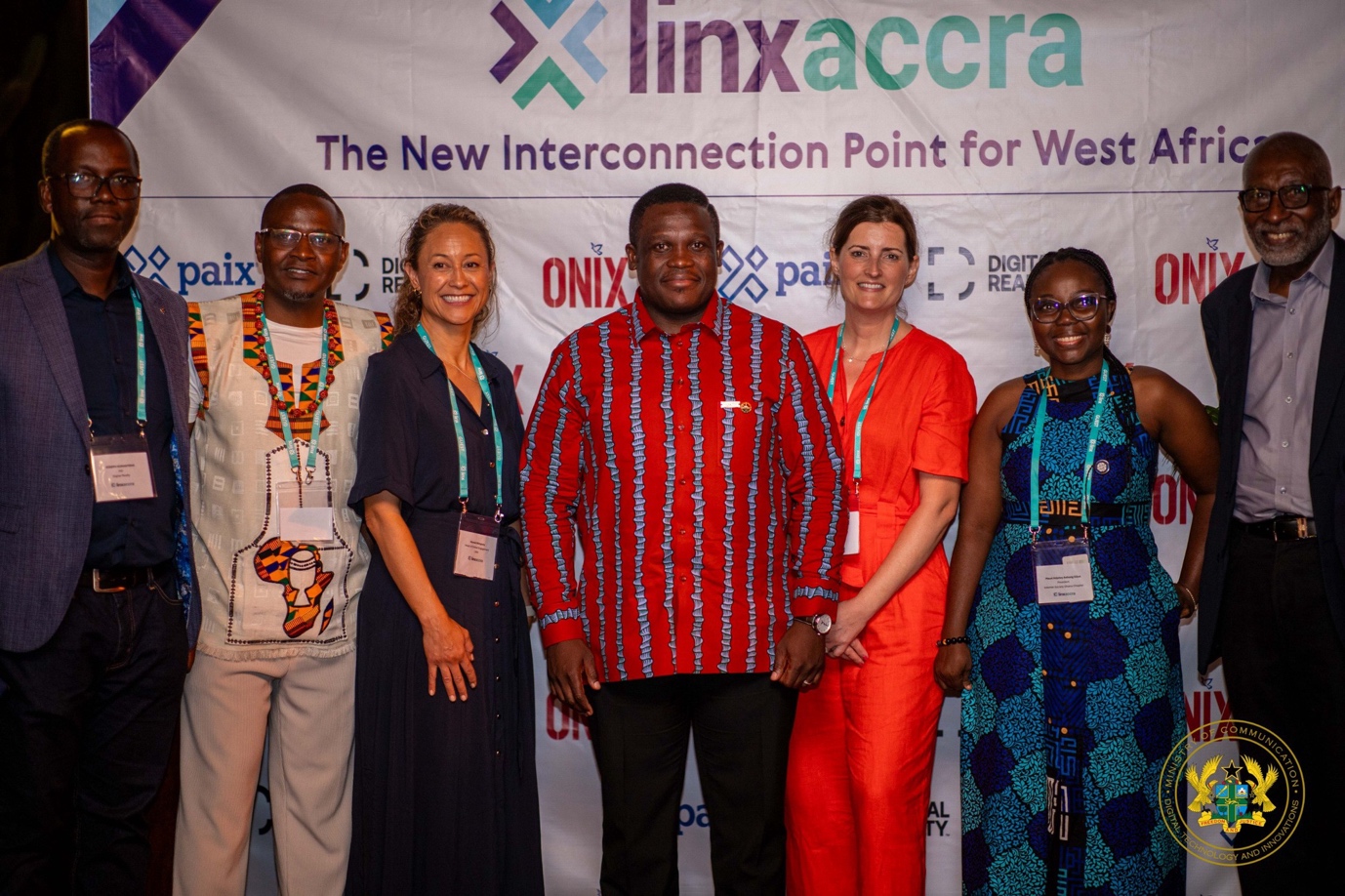
By Modupe Gbadeyanka
To develop the country’s internet ecosystem and build a dedicated connectivity community, the London Internet Exchange (LINX) has launched a 12-month no-charge promotion for all services at its new Ghana Internet Exchange Point, LINX Accra.
LINX Accra went live at the end of 2025, providing a regional interconnection point and a platform for networks to meet and exchange traffic, available from PAIX, Onix and the new Digital Realty data centre launched at the end of last year.
As part of its growth drive, LINX Accra aims to attract major global internet carriers and content delivery networks to keep more traffic local to Ghana, building relationships between local networks and encouraging early adoptions through promotion.
A key aspect is growing the local networking and peering community to reduce Ghana’s reliance on international routing, improve latency, and cut costs for networks and end users across the country.
“Ghana’s connectivity ecosystem is growing fast, and our goal, through the promotion, is to remove early barriers and encourage local ISPs to join and exchange traffic from the start.
“We’ve seen in other African markets that once the local community grows, global networks follow, so this is an important step for building community engagement and driving the localisation of internet traffic in Ghana and West Africa,” the Head of Existing Business for LINX, Inga Turner, said.
Ghana is one of West Africa’s fastest-growing digital markets, with over 70 per cent of the country’s 25 million people accessing the internet, and Accra is connected to six submarine cables to provide international connectivity to the country.
The market is also attracting significant data centre investment with new facilities opening every few months.
LINX has had a successful growth in Kenya, building on a similar promotion for LINX Mombasa and LINX Nairobi, which helped establish and expand the connectivity ecosystem, attracting major global networks and content providers to keep traffic local.
-
 Feature/OPED6 years ago
Davos was Different this year
-
Travel/Tourism10 years ago
Lagos Seals Western Lodge Hotel In Ikorodu
-

 Showbiz3 years ago
Estranged Lover Releases Videos of Empress Njamah Bathing
-
 Banking8 years ago
Sort Codes of GTBank Branches in Nigeria
-

 Economy3 years ago
Subsidy Removal: CNG at N130 Per Litre Cheaper Than Petrol—IPMAN
-

 Banking3 years ago
Sort Codes of UBA Branches in Nigeria
-

 Banking3 years ago
First Bank Announces Planned Downtime
-

 Sports3 years ago
Highest Paid Nigerian Footballer – How Much Do Nigerian Footballers Earn