Economy
Experts Urge Nigerians to Embrace Islamic Estate Planning
By Dipo Olowookere
Nigerians have been enjoined to consider subscribing to the Islamic Estate Planning irrespective of their religion, tribe or views because of the numerous benefits the system has.
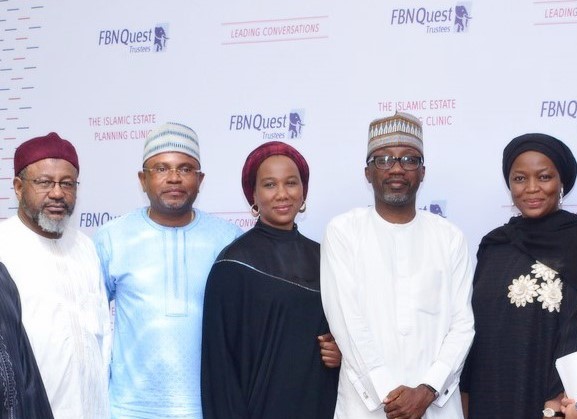
At the Islamic Estate Clinic held on April 28, 2019 in Abuja, different speakers highlighted how Nigerians, both Muslims and non-Muslims can benefit from the system.
The event was put together by FBNQuest Trustees, a subsidiary of FBN Holdings, with Managing Director, Mr Adekunle Awojobi, hosting it. The clinic featured sessions facilitated by Dr. Bashir Umar, a renowned Islamic Financial Scholar.
The sessions covered Islamic Trust (Waqaf), Islamic Will (Wasiyyah), Zakat (Charitable Trust), Hibah and Takaful, among other asset preservation and wealth transfer principles. These enabled attendees understand the guidelines for distributing one-third of their assets (which Islam grants them control over), how to plan for non-heirs in line with Faraid laws and generally the importance of Sharia-compliant Estate Plans to Muslims, as highlighted in the Qur’an (and its interpretations in the Sunnah and Hadith).
Organisers explained that the event was hosted so as to share deep insights on the importance of estate planning and the provisions for this within Islam. The event was premised on the understanding that with increasing wealth comes complex estates, which require robust estate planning for asset protection and wealth transfer across generations.
The Islamic estate planning session brought together high net worth individuals, top industry players, investors, seasoned professionals and sector experts who together tackled the robust conversation on how the affairs of one’s assets should be administered and expert guidelines that come to bear in ensuring plans are made in keeping with the prescriptions of the Qur’an.
During the programme, FBNQuest Trustees used the occasion to educate the public on the relevance of distributing assets and generational wealth transfer in accordance with Islamic tenets.
Managing Director of FBNQuest Trustees, Mr Adekunle Awojobi, encouraged individuals to embrace estate planning to ensure that their assets are well preserved and transferred according to their wishes and that the legacies they are working hard to build can be preserved for generations to come.
He emphasised that Islamic estate planning ensures that individuals can plan for the future of their loved ones and favoured charities while fulfilling in entirety, the guidelines of the Qur’an where assets transfer is concerned.
“Estate planning is for everyone, regardless of religion, however, as the first and one of the leading providers of trust services in Nigeria, FBNQuest Trustees is particularly positioned to support Muslim Clients in their desire to leave a legacy that aligns with their beliefs,” Mr Awojobi said.
“Over the last 40 years, we have gained experience and developed expertise in Islamic Inheritance planning, among other types of Estate Planning solutions. We help guide individuals and families on wealth creation, preservation and transfer processes in line with their desires and beliefs,” he added.
FBNQuest Trustees said it remains committed to pioneering critical conversations such as this and helping Nigerians make sense of assets accrued in the course of their lives, without compromising their faith or values.
Economy
CPPE Warns Against Rising Push for Petrol Importation
By Adedapo Adesanya
The Centre for the Promotion of Private Enterprise (CPPE) has warned that Nigeria must not forgo its commitment to boosting domestic refining capacity amid growing advocacy for the importation of petroleum products.
In a statement, the centre explained that Nigeria must, therefore, avoid drifting into a policy regime that undermines domestic production in the name of competition or liberalisation.
The Chief Executive Officer (CEO) of the think tank, Mr Muda Yusuf, in a press release, warned that Nigeria is signalling to investors what happens if a multi-billion-dollar Dangote refinery investment of continental significance is confronted with regulatory uncertainty and policy headwinds.
The development comes as the management of the refinery has approached the court to battle against regulators, including the Nigerian National Petroleum Company (NNPC) and the Nigerian Midstream and Downstream Petroleum Regulatory Authority (NMDPRA), over their decision to allow importation.
The dispute stems from a lawsuit filed by Dangote Refinery against the Attorney-General of the Federation, Mr Lateef Fagbemi, over fuel import licences granted to six marketers and the state oil company. The case has since widened the debate around local refining, market competition and the future direction of Nigeria’s downstream petroleum industry.
According to the centre, the increased call speaks to the very architecture of Nigeria’s economic philosophy, the future of industrialisation, the resilience of the macroeconomy and, ultimately, the preservation of the country’s economic sovereignty.
“No nation has ever imported its way to industrial greatness. Prosperous economies are built on production, refining, manufacturing, value addition and the strengthening of domestic productive capacity.
“Countries that become excessively dependent on imports inevitably export jobs, weaken domestic industries, erode local investments and mortgage their economic sovereignty.
“Nigeria must therefore avoid drifting into a policy regime that undermines domestic production in the name of competition or liberalisation,“ Mr Yusuf noted.
Economy
Airtel Africa Moves to Return Cash to Shareholders With $110m Buyback
By Adedapo Adesanya
Airtel Africa has launched a share buyback programme worth up to $110 million, signalling confidence in its strong balance sheet and financial flexibility as the telco seeks to return value to shareholders.
The company disclosed in a notice filed on the portal of the Nigerian Exchange (NGX) Limited that the programme would involve the repurchase of up to 1 per cent of its issued share capital as part of its capital allocation policy.
The telco further stated that all shares repurchased under the programme would be cancelled as the sole purpose of the exercise is to reduce the company’s capital base.
“The sole purpose of the buyback programme is to reduce the capital of the company. As such, all shares purchased under the buyback programme will be cancelled,” the notice stated.
According to the organisation, the initiative reflects the board’s confidence in the group’s financial position and its ability to continue investing across its African operations while rewarding shareholders.
“The board’s decision reflects the continued strength of the Group’s balance sheet and its ability to preserve financial flexibility while supporting ongoing investment to capitalise on the compelling growth outlook across the Group’s footprint,” the notice stated.
Airtel Africa said it had entered into an agreement with Barclays Capital Securities Limited to execute the programme through on-market purchases of its ordinary shares, which would subsequently be acquired by the company. The agreement, according to the notice, consists of two parallel elements.
Under the non-discretionary arrangement, Barclays will independently purchase between $50 million and $60 million worth of ordinary shares without influence from the company.
The second component is a discretionary arrangement under which Airtel Africa may instruct Barclays to purchase up to an additional $50 million worth of shares, subject to the provisions of the Market Abuse Regulation.
The programme commenced on May 22, 2026, and is expected to run until no later than November 27, 2026, unless terminated earlier in line with the terms of the agreement.
Airtel Africa said further tranches of the programme could be announced later to enable it fulfil its objective of repurchasing up to one per cent of its issued share capital as at the date of the announcement.
The telecommunications company also explained that the purchases would be carried out in line with shareholder approvals, UK listing regulations and market abuse rules. It noted that shareholders had earlier granted the company authority at its annual general meeting held on July 9, 2025, to repurchase a maximum of 366.07 million ordinary shares.
Following the completion of an earlier buyback programme, Airtel Africa said the remaining authority available for repurchases currently stands at 357.04 million ordinary shares.
The company further disclosed that Barclays may continue executing the discretionary portion of the buyback autonomously during closed periods under irrevocable and non-discretionary instructions permitted by regulation.
The new buyback announcement comes weeks after Airtel Africa reported strong financial and operational performance for the year ended March 31, 2026 (Q1), supported by growth in data usage, mobile money services and improved profitability across its markets.
According to its audited financial statement, the group recorded a 29.5 per cent increase in revenue to $6.42 billion from $4.96 billion in the previous year, while profit after tax (PAT) rose by 147.4 per cent to $813 million from $328 million.
Economy
Court Battle: Tension Brews as NNPC Accuses Dangote of Monopoly
By Adedapo Adesanya
* NNPC rejects Dangote’s argument, cites risks
* NMDPRA joins suit
The Nigerian National Petroleum Company (NNPC) has accused Dangote Petroleum Refinery of seeking to restrict competition and expose the country’s fuel market to monopoly control.
This came after the management of the 650,00/ barrels per day refinery challenged import licences issued to rival marketers in court by suing the federal government.
In a proposed defence filed at the Federal High Court in Lagos, NNPC said granting Dangote’s request to void or restrict import permits would expose Africa’s largest oil producer to supply disruptions, price instability and risks to national energy security.
The regulator, the Nigerian Midstream and Downstream Petroleum Regulatory Authority (NMDPRA), has applied to join the case, widening a legal battle over import policy and Dangote refinery’s market position.
Dangote said in the filing that the licences issued to marketers, including NIPCO, AA Rano, Matrix, Shafa, Pinnacle, and Bono, undermined its operations and contravene the provisions of Nigeria’s Petroleum Industry Act, which it argues allows imports only when domestic supply falls short.
Named in the suit against the country is the Attorney General and Minister of Justice, Mr Lateef Fagbemi. The federal government can only be sued via his office.
The state-owned oil company rejected the argument, saying the law allows import licences to companies with local refining licences or proven records in international crude and petroleum-product trading.
It said regulators had discretion to manage imports under Nigeria’s backwards-integration policy and that there was no mandatory ban on imports except in cases of domestic shortfall.
NNPC also said Dangote had not provided “credible, independent or verifiable evidence” that the refinery could meet Nigeria’s total fuel demand or guarantee uninterrupted nationwide supply, the court documents show.
The company denied allegations that it had sabotaged Dangote’s refinery or deliberately withheld crude, saying crude allocations depended on operational, commercial, security and logistical factors.
The court has scheduled a hearing in the coming weeks.
Fuel marketers under Depot and Petroleum Products Marketers Association of Nigeria (DAPPMAN) have also opposed Dangote’s suit, warning it could hurt competition and supply security.
The dispute comes months before Dangote’s planned September IPO of its refinery business, adding uncertainty over market rules, import competition and the revenue outlook investors may assign to the 650,000-barrel-per-day plant.
-
Feature/OPED6 years agoDavos was Different this year
-
Travel/Tourism10 years ago
Lagos Seals Western Lodge Hotel In Ikorodu
-
Showbiz3 years agoEstranged Lover Releases Videos of Empress Njamah Bathing
-
Banking8 years agoSort Codes of GTBank Branches in Nigeria
-
Economy3 years agoSubsidy Removal: CNG at N130 Per Litre Cheaper Than Petrol—IPMAN
-
Banking3 years agoSort Codes of UBA Branches in Nigeria
-
Banking3 years agoFirst Bank Announces Planned Downtime
-
Sports3 years agoHighest Paid Nigerian Footballer – How Much Do Nigerian Footballers Earn