

Economy
These are Nigeria’s 10 Biggest Stockbroking Companies

By Dipo Olowookere
Business Post has got list of the biggest stockbroking companies operating in the country. These firms in the local capital market help investors execute transactions in the space.
The list was obtained from their year-to-date performance as compiled by the Nigerian Stock Exchange (NSE).
The list comprises the performances of the brokerage firms by volume and value of transactions they executed from January 2019 to May 2019 as earlier indicated.
During the first five months of this year, the nation’s 10 biggest stockbroking firms contributed 55.31 percent to the total volume of transactions recorded in the period under review, which stood at 39.092 billion.
By the volume of shares traded through the top 10 firms, Greenwich Trust Limited took the first position, contributing 9.83 percent to the 55.31 percent the top 10 brokers contributed to the total volume of transactions recorded in the period under review. A total of 6.947 billion shares were bought and sold through the company.
On the second position is Stanbic IBTC Stockbrokers Limited, which traded 6.772 billion units of stock, accounting for 9.58 percent, while Cardinalstone Securities Limited occupied the third spot with 4.195 billion shares, representing 5.93 percent.
On the fourth position is Rencap Securities (Nig) Limited, which transacted 4.077 billion shares (5.77 percent) in the period under consideration, while the fifth place was held by CSL Stockbrokers Limited, which traded 4.056 billion (5.74 percent).
The sixth biggest brokerage firm in Nigeria by volume is Chapel Hill Denham Securities Limited, which traded 3.440 billion stocks (4.87 percent), the seventh is Morgan Capital Securities Limited with 3.150 billion (4.46 percent), while the eighth is FBN Quest Securities Limited a turnover of 2.265 billion shares (3.20 percent).
On the ninth position is Meristem Stockbrokers Limited with a turnover of 2.156 billion shares (3.05 percent), while the tenth is EFG Hermes Nigeria Limited with a turnover of 2.035 billion equities (2.88 percent).
But by value, the 10 underlisted companies contributed N537.966 billion or 68.60 percent of the total trades from the beginning of 2019 till May 31, 2019.
On the top spot is Stanbic IBTC Stockbrokers, which added 17.21 percent or N135 billion to the total value of transactions on the NSE.
Rencap Securities is the second on the list with N95.543 billion or 12.18 percent, while the CSL Stockbrokers is third with N59.081 billion or 7.53 percent.
Coronation Securities claimed the fourth spot with N52.838 billion or 6.74 percent, while EFCP Limited is fifth with N52.700 billion or 6.72 percent.
Chapel Hill Denham Securities took the sixth spot with N34.784 billion or 4.44 percent, seventh is EFG Hermes with N33.956 billion or 4.33 percent, the eighth is FBN Quest Securities with 30.438 billion or 3.88 percent, the ninth is Cardinalstone Securities with N28.564 billion or 1.92 percent, while the tenth position was filled by Meristem Stockbrokers with N15.063 billion or 1.92 percent.



By Adedapo Adesanya
Nigeria’s crude oil production increased in May and June, according to data published by the Organisation of the Petroleum Exporting Countries (OPEC).
The country’s output increased by 42,000 barrels per day to 1,530 million barrels in May, from 1,489 million barrels in April.
According to Reuters, Nigeria, whose shipments were not affected by the Iran war, also pumped more in June, based on flow data from financial group LSEG, information from other companies that track flows, such as Kpler, and data provided by sources at oil companies, OPEC, and consultants.
Output from the OPEC rose by 2.34 million barrels a day to 18.75 million a day, with the gains driven by Kuwait, Saudi Arabia and Iran, the survey showed. The rebound still leaves production considerably below prewar levels.
Kuwait posted the biggest increase among OPEC’s 11 members last month, boosting output by 870,000 barrels a day to 1.36 million a day followed by Saudi Arabia, which raised output by 550,000 barrels a day to an average of 7.2 million a day. That was followed by Iran, which hiked by 510,000 a day to pump 2.85 million a day, and has accumulated a hoard of supply on tankers at sea as it struggles to find buyers.
In the wider alliance, Russia has bolstered crude exports to record levels following Ukrainian strikes on its refineries, potentially diverting volumes that can’t be processed at home.
Even before the peace deal, Persian Gulf producers had found ways to sneak cargoes out through the strait, which was largely shuttered in the early stages of the conflict.
The uptick in supply is creating a surplus in parts of the market, erasing crude’s wartime rally and raising the question of whether OPEC nations will need to compete for customers.
The group’s June production was still 7.3 million barrels a day, or 28 per cent, below February levels, when adjusted for exit by the United Arab Emirates (UAE).
The UAE quit OPEC in May, giving it the freedom to pump at will once the strait fully stabilises. Iraq also briefly threatened it could exit unless eventually given a higher output quota by the organisation.
On Sunday, a subgroup of seven OPEC+ nations announced a 188,000 barrels a day boost in August continuing the series of small and symbolic production hikes during the war to continue a process of restoring output halted a few years ago.
By Adedapo Adesanya
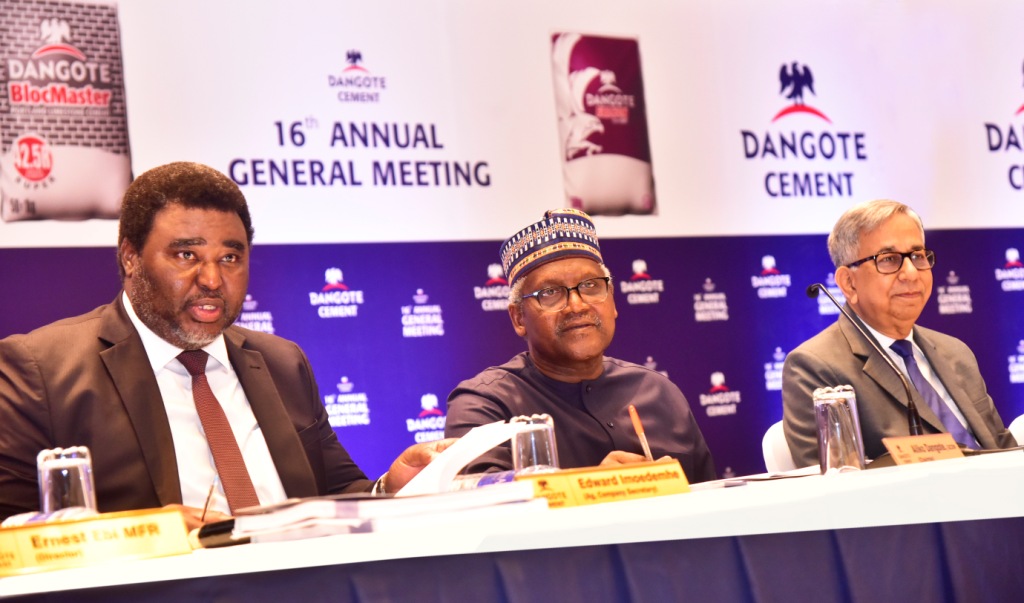
Shareholders of Dangote Cement Plc have approved plans that could pave the way for the company’s secondary listing on the London Stock Exchange (LSE) while also endorsing a final dividend of N45.00 per ordinary share for the 2025 financial year.
The resolutions were passed at the company’s 17th Annual General Meeting (AGM) held on Thursday at Eko Hotels & Suites in Lagos, where shareholders also approved the audited financial statements for the year ended December 31, 2025.
The approval for an international secondary listing marks a significant step in Dangote Cement’s plans to broaden its access to global capital markets and enhance its international investor base.
In May, the company’s founder Mr Aliko Dangote said the cement subsidiary was planning a London listing to sell 10 per cent stake, sixteen years after debuting on the Nigerian Exchange (NGX) Limited. This would provide the company with the much-needed boost to compete in the United Kingdom market.
Shareholders also ratified the payment of a final dividend of N45.00 per ordinary share from the company’s retained earnings as of December 31, 2025. The dividend was paid on Thursday, July 2, 2026.
At the meeting, shareholders approved the appointment of Ms Mariya Aliko-Dangote to the company’s board of directors. In recent months, the eldest daughter of the billionaire as well as her sisters Halima and Fatima, have been strategically positioned across their father’s empire in what has been touted as succession plans.
They also re-elected four directors retiring by rotation: Mr Emmanuel Ikazoboh, an Independent Non-Executive Director; Mr Olakunle Alake, a Non-Executive Director; Ms Berlina Moroole, a Non-Executive Director; and Mr Alvaro Poncioni Merian, an Independent Non-Executive Director.
In addition, shareholders authorised the board to determine the remuneration of the company’s external auditors for the 2026 financial year.
The AGM also noted the disclosure of managers’ remuneration in compliance with the provisions of the Companies and Allied Matters Act (CAMA) 2020.
Shareholders further approved the election of Mr Robert Ade-Odiachi, Mr Sheriff Yussuf Mojirola and Mr Nicholas Nyamali as shareholders’ representatives on the Statutory Audit Committee. They will serve alongside the company’s representatives, Mr Ernest Ebi and Mr Olakunle Alake, until the next AGM.
They also approved annual remuneration of N20 million for the chairman and N15 million each for the non-executive directors for the financial year ending December 31, 2026.
By Dipo Olowookere
The activity level on the Nigerian Exchange (NGX) Limited improved last week after market participants traded 3.821 billion stocks worth N154.393 billion in 258,567 deals compared with the 2.324 billion stocks valued at N134.486 billion transacted in 249,328 deals in the preceding week.
Analysis showed that financial equities dominated with 2.330 billion units sold for N54.606 billion in 108,978 deals, accounting for 60.99 per cent and 35.37 per cent of the total trading volume and value, respectively.
Services stocks recorded a turnover of 509.473 million units worth N16.353 billion in 16,527 deals, and consumer goods shares recorded 216.344 million units valued at N8.057 billion in 25,963 deals.
Sterling Holdings, Access Holdings, and Ikeja Hotel were the busiest stocks, accounting for 1.405 billion units worth N28.370 billion in 12,898 deals, contributing 36.78 per cent and 18.37 per cent to the total trading volume and value, respectively.
The best-performing equity for the week was Airtel Africa, which gained 21.00 per cent to sell for N5,274.00. Regency Assurance grew by 20.25 per cent to 95 Kobo, UPDC expanded by 12.31 per cent to N3.65, DAAR Communications rose by 7.84 per cent to N1.65, and SUNU Assurances increased by 7.50 per cent to N3.87.
The worst-performing equity was International Energy Insurance, which fell by 18.83 per cent to N4.70, McNichols slumped by 18.60 per cent to N7.00, University Press crashed by 17.54 per cent to N4.70, RT Briscoe dipped by 13.98 per cent to N10.15, and UPDC REIT moderated by 13.00 per cent to N8.70.
Business Post reports that 22 shares appreciated during the week, the same as the previous week, and 57 equities depreciated, the same as a week earlier, while 67 stocks remained unchanged, the same as the preceding week.
The All-Share Index (ASI) and the market capitalisation closed lower by 1.21 per cent in the five-day trading week to 229,240.34 points and N147.103 trillion, respectively.
Similarly, all other indices finished lower apart from the main board, which chalked up 2.27 per cent.

-
 Feature/OPED6 years ago
Davos was Different this year
-
Travel/Tourism10 years ago
Lagos Seals Western Lodge Hotel In Ikorodu
-

 Showbiz4 years ago
Estranged Lover Releases Videos of Empress Njamah Bathing
-
 Banking8 years ago
Sort Codes of GTBank Branches in Nigeria
-

 Economy3 years ago
Subsidy Removal: CNG at N130 Per Litre Cheaper Than Petrol—IPMAN
-

 Banking3 years ago
Sort Codes of UBA Branches in Nigeria
-

 Banking3 years ago
First Bank Announces Planned Downtime
-

 Sports3 years ago
Highest Paid Nigerian Footballer – How Much Do Nigerian Footballers Earn