

Economy
Stockbroker Blames Buhari for Recent Decline in Stock Market

By Adedapo Adesanya
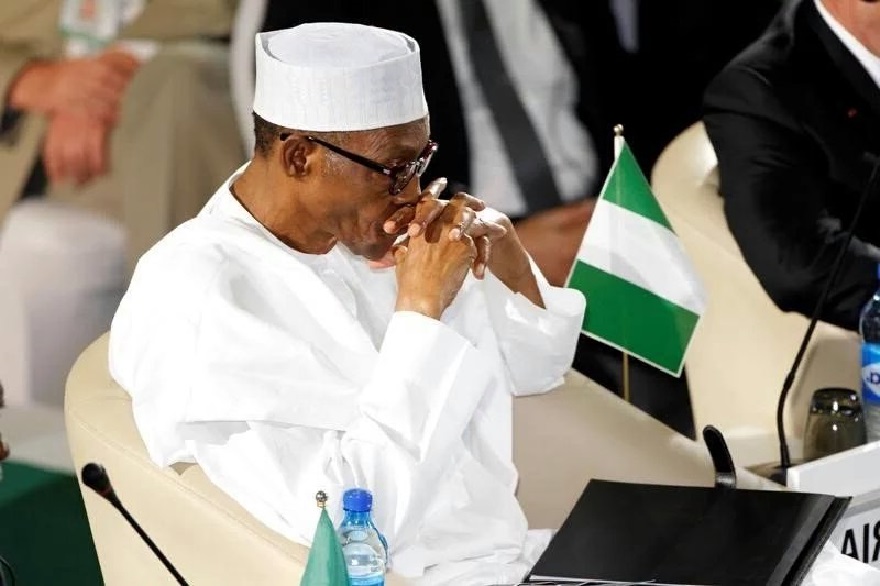
Things are not looking well for investors at the Nigerian Stock Exchange (NSE) due to the bearish trend that has plagued it and an expert in the field has blamed the President Muhammadu Buhari-led administration for being the cause.
Chairman of the Association of Securities Dealing Houses of Nigeria (ASHON), Mr Patrick Ezeagu, in a chat last month, said market began to fall when the President kept investors in the dark by not announcing members of his cabinet almost four months after he was sworn in for a second term in office.
According to Mr Ezeagu, this singular act by Mr Buhari sent the wrong signal to investors, who felt the present government was not serious for governance.
“The bearish trend has to do with the fact that the government is yet to settle down after the elections,” the stockbroker said, adding that “core investors are awaiting a couple of things, including announcement of ministers of the federal republic and the economic team to show the clear direction of the government.”
Even with the screening of ministers by the Senate earlier in the month, market sentiment remained weak so far in August, with the All Share Index down by 286 basis points month-to-date, amid unimpressive macro and global conditions.
The NSE said a total turnover of 726.607 million shares worth N10.459 billion in 12,915 deals were traded last week by investors on the floor of the exchange, in contrast to a total of 1.081 billion shares valued at N12.014 billion that exchanged hands the previous week in 16,246 deals.
Despite the addition of N1.4 trillion into the market as a result of the listing of Airtel Africa Plc shares on July 1, 2019 on the stock exchange, total market recapitalisation has seen lost N645 billion since President Buhari was sworn in on Wednesday, May 29, 2019.
Total market capitalisation stood at N13.766 trillion a day after the President’s second term inauguration, however, as at last Friday, the market capitalisation finished at N13.121 trillion.
Business Post reports that after the Sallah holiday last week, stock investors in the nation’s equity market lost a total of N186 billion.
But despite the situation of things at the equity market, Mr Ezeagu said, “Astute and professionally guided investors should take position now that most stocks are trading lower than their net realisable asset value and expect handsome returns when the market shall eventually rally.”


By Adedapo Adesanya
Nigerian domestic oil producer Renaissance Energy has recorded its first major oil discovery since taking over Oil Mining Lease (OML) 74 last year, following the successful drilling of an exploration well offshore Nigeria in a development that could support the country’s efforts to boost crude oil production and replenish reserves.
Preliminary results showed about 1,000 feet (305 metres) of crude oil-bearing reservoirs across seven zones, with data and fluid tests confirming light oil in high-quality reservoirs, Renaissance said in a statement, without providing further details.
OML 74 is a large shallow-water block in the eastern Niger Delta off Nigeria’s coast and holds at least eight previously undeveloped discoveries.
Renaissance, which now owns Shell’s former onshore and shallow-water assets, operates Nigeria’s largest upstream joint venture with 18 oil leases, two export terminals and a FPSO vessel in the oil-rich delta.
Commenting on Tuesday, Mr Tony Attah, the managing director/chief executive of Renaissance, said the discovery reflects the company’s renewed focus on exploration and its commitment to boosting Nigeria’s long-term oil production.
“The success of JK-004, just over one year after assuming operatorship of these assets, demonstrates the strength of our exploration programme,” he said.
He lauded the Nigeria Upstream Petroleum Regulatory Commission (NUPRC), adding that the exploration performance reflected the collaboration with the company’s joint venture partners comprising the Nigerian National Petroleum Company Limited (NNPC), TotalEnergies Limited and Agip Energy and Natural Resources.
He added that the NNPC Group Chief Executive Officer, Mr Bayo Ojulari, and the Executive Vice President, Upstream, Mr Udobong Ntia, provided the needed strategic guidance with commitment for value delivery across the joint venture assets.
On his part, the Vice President of Exploration and Chief Explorer at Renaissance, Mr Johnbosco Uche, said the exploration success was due to the company’s subsurface excellence, technical rigour, and disciplined approach to reserve replacement.
“The JK-004 well provides a strong foundation for accelerated maturation with clear pathways to early development and value realisation,” the Chief Explorer said, adding that the strategic location of JK-004 near an existing field would enable rapid commercialisation.
The chief executive of the Nigerian Upstream Petroleum Regulatory Commission (NUPRC), Mrs Oritsemeyiwa Eyesan, described the feat as a perfect alignment with the commission’s vision of growing the nation’s reserves “to future-proof sustainable national growth,” and pledged to continue building the enabling regulatory environment required to support the Nigerian oil and gas industry.


By Aduragbemi Omiyale
The mandatory takeover bid of about 1.63 per cent shares held by minority shareholders of Premier Paints Plc by Xenergi has been launched.
Business Post learned that the exercise will open at 8 am on Monday, July 13, 2026, and close on Friday, August 7, 2026, and it concerns shareholders of Premier Paint, excluding Xenergi Plc, whose names appear in the register of members of Premier Paint on the qualification date, which was Monday, July 6, 2026.
Xenergi is looking to acquire a total of 2 million shares of Premier Paints at N38 per unit, amounting to N76 million.
The reason for this offer is to enable Xenergi comply with Section 142(4) of the ISA Act 2025 and Rules 445 – 448 of the SEC New Rules and Amendment dated August 30, 2021, following its acquisition of a 49.60 per cent majority equity stake in Premier Paint.
On June 8, 2026, Xenergi Plc acquired 61,003,350 ordinary shares in Premier Paint, representing a 49.60 per cent equity stake.
Xenergi Plc and Premier Paint Plc executed a Share Sale and Purchase Agreement detailing the terms and conditions of the acquisition. The acquisition was concluded following receipt of the required regulatory approvals from the Federal Competition & Consumer Protection Commission (FCCPC), the Securities and Exchange Commission (SEC) and the Nigerian Exchange (NGX) Limited.
In accordance with Section 142(4) of the ISA Act 2025, Xenergi is required to make a takeover bid to all the other shareholders of Premier Paint.
Consequently, on May 25, 2026, the board of Xenergi granted approval for a Takeover to be made to all qualifying shareholders, for the acquisition of the offer shares.
By Adedapo Adesanya
Nigeria generated N21.6 trillion in tax revenue in the first half of 2026, representing a 49 per cent year-on-year increase from the corresponding period of 2025, as recent tax reforms and improved compliance continued to boost government collections.
According to a report by CSL Stockbrokers, the strong performance extends Nigeria’s recent revenue growth trajectory, with total tax collections increasing from N12.3 trillion in 2023 to N21 trillion in 2024 and N28.3 trillion in 2025.
The report attributed the growth to the digitalisation of tax administration through a national electronic invoicing system, the implementation of four tax reform laws that took effect in January 2026, the transition of the Federal Inland Revenue Service (FIRS) to the Nigeria Revenue Service (NRS) with an expanded revenue collection mandate, and stronger compliance across the oil and non-oil sectors.
It also noted that Executive Order 9, signed in February 2026, has strengthened revenue collection by requiring upstream oil and gas companies to remit royalties, taxes and production-sharing contract profit oil directly to the Federation Account.
The report said non-oil taxes accounted for 76 per cent of total NRS collections during the review period, reflecting a gradual broadening of the country’s tax base and reducing dependence on hydrocarbon-related revenues.
It added that the improvement helped raise Nigeria’s tax-to-GDP ratio to 13 per cent from 10.3 per cent, although the figure remains below the government’s medium-term target of 18 per cent and the average recorded by many African peers.
CSL said sustaining the current pace of revenue growth would require continued legislative backing and effective implementation of the new tax framework.
The report recommended incorporating the provisions of Executive Order 9 into permanent legislation through amendments to the Nigeria Tax Administration Act or the Petroleum Industry Act to provide greater legal certainty for upstream revenue remittances.
It also identified nationwide implementation of the new tax laws, wider adoption of electronic invoicing, improved taxpayer compliance and continued digitalisation of tax administration as key measures to support further gains in domestic revenue mobilisation.
According to the report, stronger and more predictable government revenues could improve Nigeria’s fiscal sustainability by narrowing the fiscal deficit while creating additional fiscal space for infrastructure development and social spending, provided expenditure remains disciplined.

-
 Feature/OPED6 years ago
Davos was Different this year
-
Travel/Tourism10 years ago
Lagos Seals Western Lodge Hotel In Ikorodu
-

 Showbiz4 years ago
Estranged Lover Releases Videos of Empress Njamah Bathing
-
 Banking8 years ago
Sort Codes of GTBank Branches in Nigeria
-

 Economy3 years ago
Subsidy Removal: CNG at N130 Per Litre Cheaper Than Petrol—IPMAN
-

 Banking4 years ago
Sort Codes of UBA Branches in Nigeria
-

 Banking3 years ago
First Bank Announces Planned Downtime
-

 Sports3 years ago
Highest Paid Nigerian Footballer – How Much Do Nigerian Footballers Earn