

Economy
Stocks Gain N26bn on Bulls’ Return to Customs Street

By Dipo Olowookere
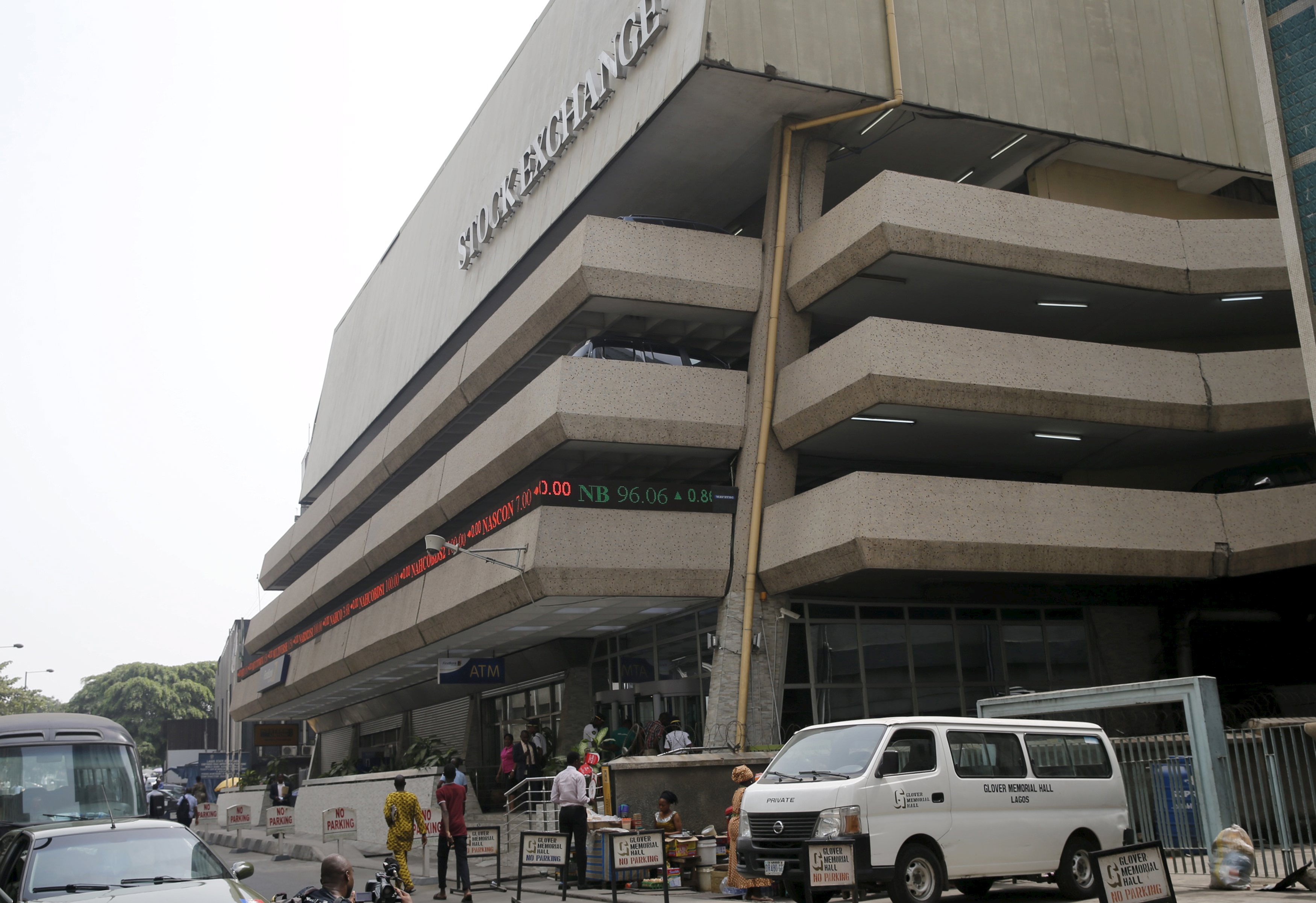
Transactions closed positive on Customs Street on Friday as a result of gains posted by Nestle Nigeria and 16 other equities, which lured the bulls back to the market to cut short the reigns of the bears.
Business Post reports that the Nigerian Stock Exchange (NSE) finished 0.19 percent higher yesterday on the impact of renewed bargain hunting by investors.
This increased the All-Share Index (ASI) by 52.54 points to settle at 27,698.69 points and fortified the market capitalisation by N25.6 billion to finish at N13.484 trillion.
Nestle Nigeria led the 17 stocks on the gainers’ chart at the trading session with a price appreciation of N10 to close at N1210.10k per share, with Stanbic IBTC trailing with a gain of N2.90k to end at N42.85k per unit.
Nigerian Breweries garnered 55 kobo to close at N52.55k per share, Dangote Sugar raked 50 kobo to trade at N11.05k per unit, while Flour Mills mopped up 30 kobo to quote at N14 per share.
On the other side, Cadbury Nigeria claimed the top spot on the 16-member losers’ table on Friday after shedding 70 kobo from its share value to close at N10.95k per unit.
Zenith Bank went down by 30 kobo to settle at N18.70k per share, while the trio of Dangote Flour, GTBank and Lafarge Africa depreciated by 25 kobo each to close at N22.15k, N29 and N15.10k respectively.
The activity level was mixed yesterday with the volume of traded shares going south by 27.65 percent and the value of the trades as well as the number of deals moving north by 253.87 percent and 0.99 percent respectively.
A total of 177.6 million shares worth N5.9 billion were traded in 3,484 deals on Friday against the 245.4 million equities worth N1.7 billion exchanged in 3,450 deals on Thursday.
Nigerian Breweries was the most active stock at the session, closing with a turnover of 28.1 million shares worth N1.5 billion, while GTBank followed with 17.7 million units traded for N512.3 million.
FBN Holdings exchanged 16 million equities valued at N89.5 million, UBA sold 15.2 million shares valued at N93.6 million, while Zenith Bank transacted 14.6 million stocks for N276 million.
At the sectoral level, the consumer goods sector and the energy industry appreciated by 0.90 percent and 0.54 percent respectively, while the banking index, insurance index and the industrial goods index went down by 1.15 percent, 0.53 percent and 0.37 percent respectively.


By Dipo Olowookere
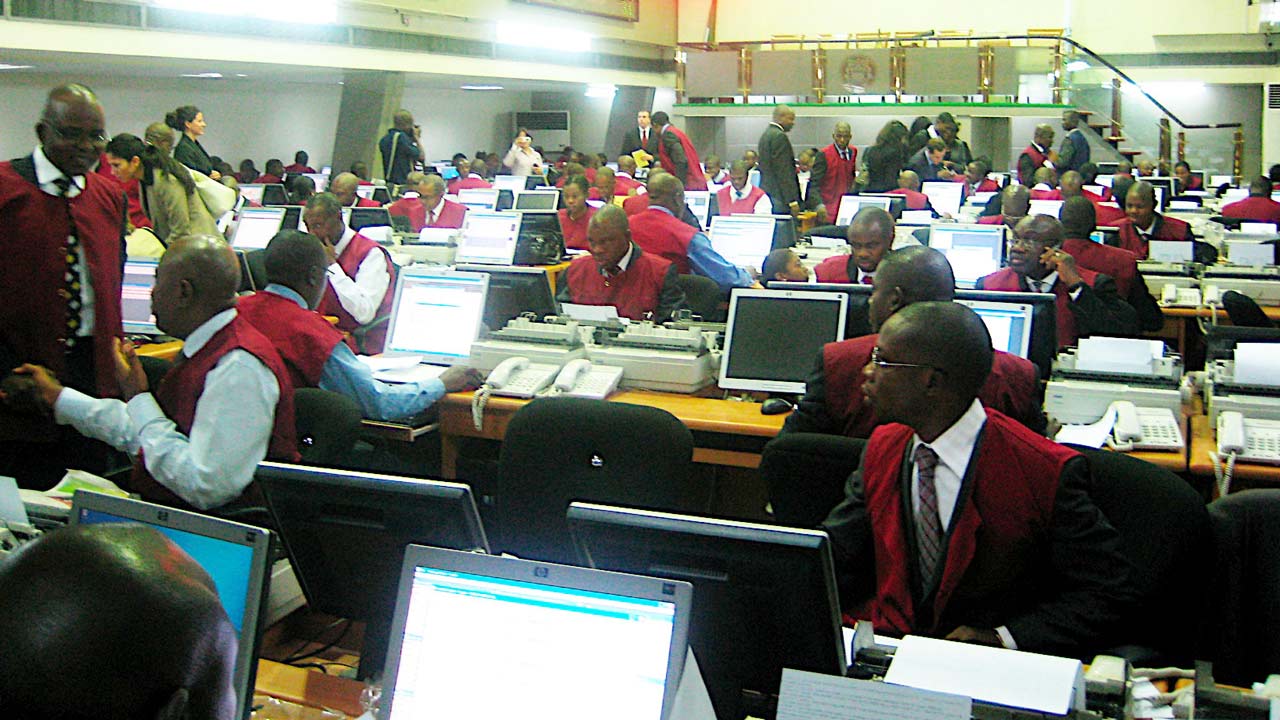
The bullish run seen lately in the Nigerian equities market continued on Wednesday after it closed the session with a 2.27 per cent growth.
This was influenced by renewed interest in domestic stocks by investors, who are locking funds in some shares with sound fundamentals like Airtel Africa, Aradel Holdings, Dangote Cement, and others.
Data showed that Airtel Africa and Trans-Nationwide Express gained 10.00 per cent to sell for N5,801.40 and N2.97, respectively. Fidelity Bank appreciated by 9.97 per cent to N19.85, Thomas Wyatt advanced by 9.89 per cent to N3.00, and UPDC REIT improved by 9.47 per cent to N10.40.
Conversely, Haldane McCall lost 9.95 per cent to trade at N3.53, McNichols declined by 8.89 per cent to N6.15, Transcorp slid by 5.65 per cent to N40.05, CWG went down by 5.24 per cent to N19.00, and VFD Group crashed by 5.19 per cent to N28.12.
The market breadth index remained positive after the Nigerian Exchange (NGX) Limited ended the day with 32 appreciating stocks and 24 depreciating stocks, indicating strong investor sentiment.
Business Post reports that the insurance sector was under pressure yesterday, resulting in a 0.20 per cent loss, which did not affect the outcome of the market.
The energy space gained 3.85 per cent, the industrial goods segment chalked up 1.89 per cent, the banking index rose by 1.07 per cent, and the consumer goods counter soared by 0.31 per cent.
As a result, the All-Share Index (ASI) added 5,378.70 points to finish at 242,459.98 points compared with the previous day’s 237,083.28 points, and the market capitalisation went up by N3.450 trillion to N155.586 trillion from N152.136 trillion.
The busiest equity during the trading session was Lasaco Assurance, with a turnover of 56.6 million units valued at N104.8 million. Fidelity Bank traded 47.5 million units worth N911.9 million, Linkage Assurance transacted 33.9 million units for N51.2 million, Zenith Bank sold 32.0 million units valued at N3.4 billion, and Sterling Holdings exchanged 30.5 million units worth N233.3 million.
At the close of transactions, 518.4 million shares worth N22.8 billion exchanged hands in 48,495 deals versus the 493.7 million shares valued at N28.0 billion traded in 49,969 deals a day earlier. This implied that the trading volume was up by 5.00 per cent, the trading value was down by 18.57 per cent, and the number of deals decreased by 2.95 per cent.

By Adedapo Adesanya
Oil prices surged over 5 per cent to a two-week high on Wednesday after US President Donald Trump declared that the interim ceasefire agreement with Iran is officially.
Brent futures rose $4.40 or 5.9 per cent to settle at $78.02 a barrel, while the US West Texas Intermediate (WTI) crude increased by $3.64 or 5.2 per cent to $73.52 per barrel.
The American President said an interim deal signed last month to end the war with Iran was “over” and that the US was likely to launch new strikes on Wednesday night following Iranian attacks on US bases in the Gulf and tankers in the Strait of Hormuz.
Asked before a NATO summit in Turkey whether the memorandum of understanding was over, President Trump said: “It’s a very interesting question. To me, I think it’s over. I don’t want to deal with them.”
He later ruled out the restart of full-fledged war with Iran, which pulled oil benchmarks lower from the session’s highest gains of as much as 9 per cent.
A fifth of global oil supplies moved through the Strait before the Iran war began on February 28 after US-Israeli airstrikes against Iran, which led to retaliation that forced Middle Eastern oil producers to cut millions of barrels of oil production.
Iran on Tuesday attacked three commercial vessels transiting the Strait of Hormuz, prompting retaliatory attacks by the US. A Saudi-flagged LNG tanker was struck on its port side, causing an engine room fire, while the supertanker suffered minor damage off the coast of Oman.
In response, US Central Command (CENTCOM) conducted massive offensive airstrikes hitting more than 80 military targets inside Iran while the Trump administration also revoked a temporary sanctions waiver that allowed Iran to sell oil and petrochemicals, cutting off a key revenue stream for the oil producer.
Freight rates for tankers operating in the Gulf have surged as shipowners demand higher risk premiums, while refiners in Asia are scrambling to secure alternative cargoes from West Africa, the US, and Latin America in case Hormuz remains closed.
The International Monetary Fund (IMF) downgraded its 2026 global economic growth forecast to 3 per cent, down from 3.5 per cent posted in 2025, with the impact of the Iran war expected to negate gains made by the ongoing AI boom.
By Adedapo Adesanya
The Independent Petroleum Producers Group (IPPG) is pushing for a harmonised tax regime for Nigeria’s oil and gas sector, citing the burden of more than 270 different taxes, fees and statutory levies imposed on operators.
The Chairman of IPPG, Mr Adegbite Falade, stated this in his keynote address at the opening of the 2026 NOG Energy Week in Abuja.
He said a situation where oil firms pay as many as 270 different types of taxes and levies discourages investment and threatens the viability of many projects.
Mr Falade said while recent government reforms have improved investor confidence, the multiplicity of charges imposed by different government agencies risks undermining those gains.
“Today, the Nigerian oil and gas industry remains the most taxed and levied in the country, and perhaps globally, with over 270 separate fees, taxes and levies,” he said.
According to him, the cumulative burden of these charges has begun to outweigh the incentives introduced under the Petroleum Industry Act (PIA), particularly for smaller indigenous operators managing mature oil assets.
He warned that the situation could force some operators to abandon projects, urging the federal government to harmonise the various charges into a transparent and globally competitive fiscal framework.
“We therefore urge the government to undertake a comprehensive harmonisation of all fees and levies across all agencies to eliminate duplication, ensure transparency in how these charges are computed and applied, and align the overall fiscal burden with the incentive-driven spirit of the PIA,” he said.
Beyond fiscal reforms, the IPPG chairman identified an emerging manpower crisis as another major threat to the industry, noting that the retirement of experienced professionals and recent international oil company divestments have created significant skills gaps that require urgent investment in workforce development.
Mr Falade also called for a comprehensive review of the PIA five years after its enactment, to address implementation challenges and incorporate presidential directives that have improved investment conditions.
He stressed that Nigeria must shift its focus from simply increasing crude oil production to creating greater value through refining, gas processing, power generation, fertiliser production and petrochemicals.
According to him, the country’s vast hydrocarbon resources should serve as a catalyst for industrialisation rather than continued exports of raw crude and gas.
While commending the administration’s reforms that have helped secure more than $8 billion in upstream final investment decisions since 2023 and boosted oil production to about 1.6 million barrels per day, Mr Falade maintained that sustainable growth would depend on creating a more competitive operating environment for investors.
