Education
IFC Sponsors Ghanaian Student Architects to GBCSA Conference
The International Finance Corporation (IFC), a member of the World Bank Group, in collaboration with Orthner Orthner & Associates, is sponsoring three architectural students from Ghana to attend the annual conference of the Green Building Council South Africa (GBCSA) in Cape Town. The project has been funded by the State Secretariat for Economic Affairs (SECO) with technical support provided by SGS and thinkstep.
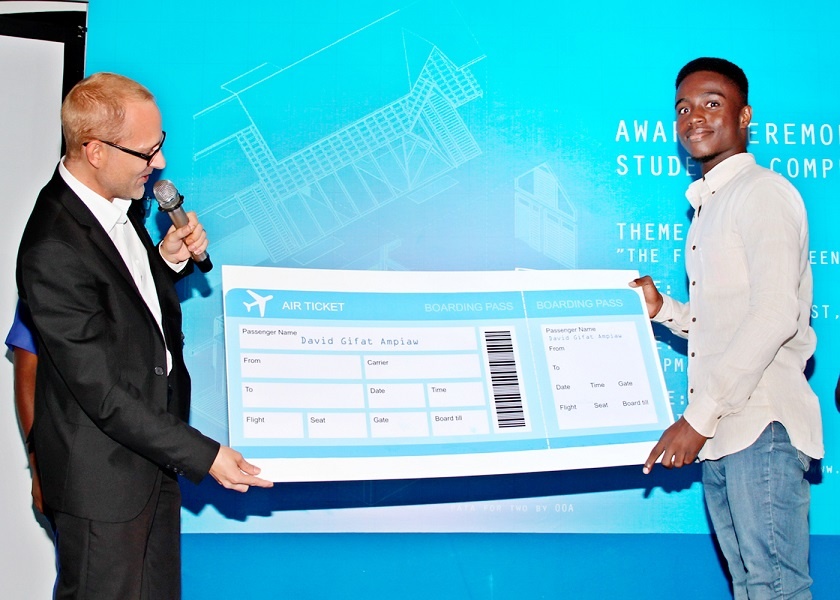
The students are the winners of a sustainable design competition using IFC’s EDGE green building software.
Participants in the competition, launched on July 18 this year, were selected from the Architecture Department of the Central University in Accra.
The competition challenged students to design a cutting-edge, single-family home intended for a young family located around the outskirts of Accra using only locally available materials. A panel of experts decided on the top three designs.
The students who emerged as winners of IFC’s Student Architectural Design Competition were awarded an all-expense paid trip to Cape Town to attend GBCSA’s 12th Green Building Convention, to be held October 2-4. They will also receive professional training on the EDGE software and engage with accredited EDGE Experts, with the intention of bringing home best practices upon their return.
David Ekow Ampiaw, aged 20, emerged the topmost winner with Olufemi Abodunrin and Cheryl Omani-Baah placing second and third respectively.
The winners were full of praise to organizers for the competition and emphasized they were eagerly awaiting the trip and their chance to contribute to the greater knowledge of EDGE and green building design in Ghana.
Ninnette Quao Fio, a lecturer at the Architecture Department of the Central University, explained to News Ghana in an exclusive interview why the competition has come at an opportune time.
She said, “The world is now going green so it is relevant that we inculcate in the education of our students how to design in a sustainable way, making use of affordable, high-quality local materials while taking care of the environment.”
The Central University Architecture Lecturer commended IFC for introducing the competition and expressed optimism it will continue in the coming years. “I hope going forward this will last because it’s an innovative idea that IFC has introduced. It’s relevant to the construction industry and students are also getting the idea of how to design buildings in a sustainable manner.”
By 2050, the built environment is expected to double due to high population growth and urbanization trends. This has serious implications for global warming, as buildings already generate 19 percent of energy-related GHG emissions and consume 40 percent of electricity worldwide.
Switzerland, through the State Secretariat for Economic Affairs, considers the need for more sustainable buildings so important that it provided seed capital for IFC’s EDGE.
EDGE is a green building certification system available in more than 150 countries with an online, free-to-use application that is tailored to emerging economies. The EDGE platform, available at www.edgebuildings.com, allows those involved with designing and developing projects to proceed to being certified when the requirements of 20 percent savings across energy, water and embodied energy in materials are met.
SECO’s support for EDGE has resulted in an upward trajectory of certified buildings in Ghana and the region, where the construction sector is booming. “Green building standards, such as the EDGE standard, can play an important role in greening the economy and in ensuring greater resource efficiency and environmental sustainability of new buildings,” said Matthias Feldmann, Deputy Head of Mission /Head of Cooperation for SECO.
He further emphasized, “With EDGE we found a way to push design practices to higher levels and foster innovation in the financial sector to accelerate green buildings.”
In Ghana, mortgage rates are more than 30 percent and annual inflation is 9 percent, so a certified green home makes a measurable difference in the lives of homebuyers struggling to make ends meet. Lower utility bills translate to a better quality of life, as families can reinvest savings into other areas such as education. It is envisaged that IFC and SECO will have a generational impact by encouraging greener building practices with EDGE.
Education
Kidnappings: FG Reopens 47 Unity Schools
By Adedapo Adesanya
The federal government has announced the reopening of the 47 unity schools earlier shut down due to security concerns on November 21.
This was disclosed in a statement by the Federal Ministry of Education on Thursday.
It said that the decision to reopen the affected colleges across the country reaffirmed its unwavering commitment to safeguarding students and ensuring the continuity of education.
On November 18, 2025, over 20 schoolgirls were kidnapped by unidentified armed men from the Government Girls Comprehensive Secondary School in Maga, Kebbi state.
Just three days later, on November 21, about 303 students and 12 teachers were kidnapped at St. Mary’s Catholic Primary and Secondary School in Papiri, Niger state.
In response, the federal government shut down 47 Federal Unity Colleges, and some states including Katsina, Taraba, and Niger also closed schools or restricted school activities, particularly boarding institutions.
Rights group including Human Rights Watch lamented that while these measures were aimed at protecting students, they disrupted learning for thousands of children, denied them access to education, and the social and psychological support schools provide.
FULL LIST OF AFFECTED UNITY COLLEGES
North-West:
FGGC Minjibir, FTC Ganduje, FGGC Zaria, FTC Kafanchan, FGGC Bakori, FTC Dayi, FGC Daura, FGGC Tambuwal, FSC Sokoto, FTC Wurno, FGC Gusau, FGC Anka, FGGC Gwandu, FGC Birnin Yauri, FTC Zuru, FGGC Kazaure, FGC Kiyawa, FTC Hadejia.
North-East:
FGGC Potiskum, FGC Buni Yadi, FTC Gashua, FTC Michika, FGC Ganye, FGC Azare, FTC Misau, FGGC Bajoga, FGC Billiri, FTC Zambuk.
North-Central:
FGGC Bida, FGC New-Bussa, FTC Kuta-Shiroro, FGA Suleja, FGC Ilorin, FGGC Omu-Aran, FTC Gwanara, FGC Ugwolawo, FGGC Kabba, FGGC Bwari, FGC Rubochi, FGGC Abaji.
South-West:
FTC Ikare Akoko, FTC Ijebu-Imusin, FTC Ushi-Ekiti, FTC Ogugu.
Education
Coursera, Udemy Announce $2.5bn Merger
By Adedapo Adesanya
Online learning platforms, Coursera and Udemy, have reached an agreement to merge in an all-stock transaction, with the combined company’s implied equity value estimated at approximately $2.5 billion.
The agreement, unanimously approved by both companies’ boards of directors, stipulates that Udemy shareholders will receive 0.8 shares of Coursera common stock for each Udemy share held.
Upon completion of the merger, Coursera shareholders are expected to own about 59 per cent and Udemy shareholders approximately 41 per cent of the new entity on a fully diluted basis.
The combined company will continue under the Coursera name, and maintain its headquarters in Mountain View, California.
Coursera, founded in 2012 by Mr Andrew Ng and Ms Daphne Koller, is an online learning platform with 191 million registered users as of September 30, 2025. It collaborates with over 375 universities and industry partners to offer courses, specialisations, professional certificates, and degrees.
The platform includes features such as generative AI (gen AI) tools (Coach, Role Play, Course Builder) and role-based solutions (Skills Tracks) to support scalable and personalised learning. Coursera is used by institutions for workforce development in fields such as gen AI, data science, technology, and business.
Udemy is a platform that provides on-demand, multi-language courses to help companies and individuals develop technical, business, and soft skills. It uses AI to offer personalised learning experiences and supports workforce development in a changing workplace.
Mr Greg Hart, currently CEO of Coursera, is set to lead the enlarged organisation as CEO after the merger.
The board will consist of nine members. Six from Coursera’s board, including chairman Mr Ng and CEO Mr Hart, and three from Udemy’s board.
“We’re at a pivotal moment in which AI is rapidly redefining the skills required for every job across every industry.
“Organisations and individuals around the world need a platform that is as agile as the new and emerging skills learners must master,” Mr Hart said.
The combination is said to create a complete ecosystem of top instructors supported by AI tools, data-driven insights, and broader distribution, enabling more engaging, personalised, and dynamic learning at scale.
Projected operational efficiencies include anticipated annual run-rate cost synergies of $115m within two years after closing.
Udemy CEO, Mr Hugo Sarrazin said: “For more than 15 years, Udemy has helped millions of people master in-demand skills at the speed of innovation.
“Through this combination with Coursera, we will create meaningful benefits for our learners, enterprise customers, and instructors, while delivering significant value to our shareholders, who will participate in the substantial upside potential of the combined company.”
The merger is anticipated to close in the second half of 2026, pending regulatory clearances, approval by both companies’ shareholders, and other customary closing conditions.
Education
Luno, AltSchool Launch Crypto Education Programme for Nigerians
By Adedapo Adesanya
Global cryptocurrency platform, Luno and AltSchool Africa, an accredited online learning platform, have announced a strategic partnership aimed at demystifiing crypto to 15,000 Nigerians.
The initiative at that scale makes it Africa’s largest crypto education programme.
According to a joint statement on Wednesday, this is a significant step in Luno’s continued efforts to strengthen trust in digital assets and support safer participation in the digital economy.
This is hinged on Africa’s fast-growing digital finance landscape where 33 per cent of the country’s population already engage with digital assets, and a rapidly growing youth population are eager to participate in the digital economy.
According to the statement, the partnership aims to bridge the knowledge gap by providing structured, practical, and safe crypto education.
This will be done by combining Luno’s experience in promoting safe crypto participation with AltSchool Africa’s capability in delivering accessible digital skills training.
“The course directly addresses the misinformation and financial risks associated with unregulated digital assets, while demonstrating real-world applications tailored to African contexts,” the joint statement added.
The initiative will be implemented in three cohorts of 5,000 learners each. Applications for Cohort 1 will be open from January to February 2026, with the course commencing in March 2026. Cohort 2 participants will gain access to the course in July 2026, while Cohort 3 participants will begin the programme in November 2026.
The programme will be led by Web3 expert Mr Abdulsamad Tiamiyu, who will provide a practical, Africa-focused introduction to cryptocurrency, showing how it can be used for saving, remittances, global trading, and entrepreneurship.
The curriculum consists of five core modules and is designed to be completed within three to four weeks.
Learners benefit from up to one year of access to all course materials, including online, self-paced video lessons, slides, quizzes, and case studies. The course combines theory with hands-on experience, where learners interact with wallets, exchanges, stablecoins, and research tools like CoinGecko and Etherscan.
According to the organisers, this approach gives learners the tools to confidently use digital currencies in everyday financial activities. Successful learners, upon passing the assessments, earn an AltSchool Africa Certificate of Completion.
Speaking on the partnership, Mr Ayotunde Alabi, CEO of Luno Nigeria, said: “This initiative is a crucial intervention in Africa’s digital ecosystem. As crypto adoption accelerates, formal literacy must grow alongside it, so individuals can benefit safely and meaningfully,”
“Our partnership with AltSchool Africa is a deliberate step toward that goal and a foundational investment in the integrity of the industry. By delivering structured, high-quality education, Luno is helping ensure that Africans can participate confidently, securely, and sustainably – turning what is often seen as risk into real economic opportunity,” he added.
Adding his input, Mr Adewale Yusuf, Co-founder and CEO of AltSchool Africa, said “This partnership between AltSchool and Luno is a major step toward financial education that truly serves Africans and helps people gain the knowledge and tools they need to understand crypto with confidence and use it in practical, life-changing ways.”
The programme is open to Nigerian residents aged 18 and above who are able to commit to completing it within four weeks. Applicants must have a Luno account or create one before enrolling.
Starting January, Interested participants are encouraged to submit application through the AltSchool Africa portal, with scholarship decisions communicated within one week.
-
Feature/OPED6 years agoDavos was Different this year
-
Travel/Tourism9 years ago
Lagos Seals Western Lodge Hotel In Ikorodu
-
Showbiz3 years agoEstranged Lover Releases Videos of Empress Njamah Bathing
-
Banking7 years agoSort Codes of GTBank Branches in Nigeria
-
Economy3 years agoSubsidy Removal: CNG at N130 Per Litre Cheaper Than Petrol—IPMAN
-
Banking3 years agoFirst Bank Announces Planned Downtime
-
Banking3 years agoSort Codes of UBA Branches in Nigeria
-
Sports3 years agoHighest Paid Nigerian Footballer – How Much Do Nigerian Footballers Earn