Connect with us

Education

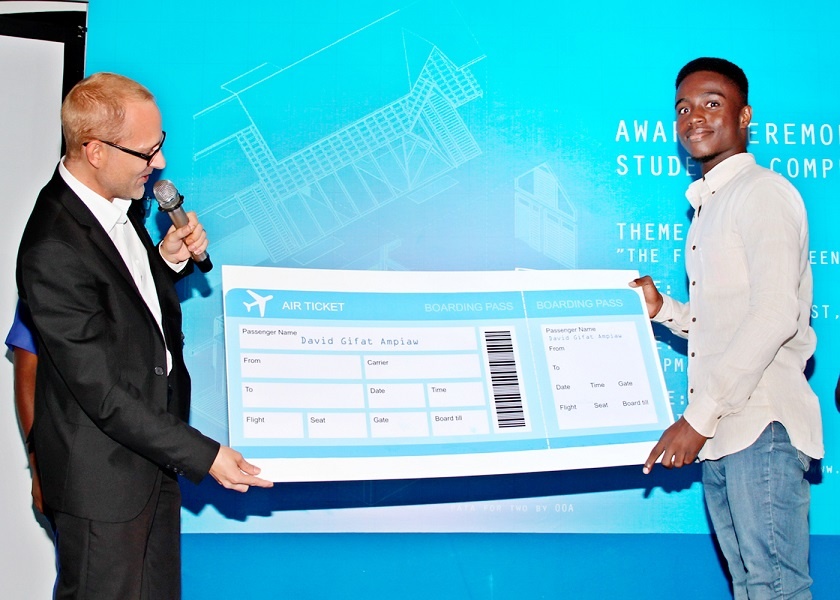
IFC Sponsors Ghanaian Student Architects to GBCSA Conference

Published

on

The International Finance Corporation (IFC), a member of the World Bank Group, in collaboration with Orthner Orthner & Associates, is sponsoring three architectural students from Ghana to attend the annual conference of the Green Building Council South Africa (GBCSA) in Cape Town. The project has been funded by the State Secretariat for Economic Affairs (SECO) with technical support provided by SGS and thinkstep.

The students are the winners of a sustainable design competition using IFC’s EDGE green building software.

Participants in the competition, launched on July 18 this year, were selected from the Architecture Department of the Central University in Accra.

The competition challenged students to design a cutting-edge, single-family home intended for a young family located around the outskirts of Accra using only locally available materials. A panel of experts decided on the top three designs.

The students who emerged as winners of IFC’s Student Architectural Design Competition were awarded an all-expense paid trip to Cape Town to attend GBCSA’s 12th Green Building Convention, to be held October 2-4. They will also receive professional training on the EDGE software and engage with accredited EDGE Experts, with the intention of bringing home best practices upon their return.

David Ekow Ampiaw, aged 20, emerged the topmost winner with Olufemi Abodunrin and Cheryl Omani-Baah placing second and third respectively.

The winners were full of praise to organizers for the competition and emphasized they were eagerly awaiting the trip and their chance to contribute to the greater knowledge of EDGE and green building design in Ghana.

Ninnette Quao Fio, a lecturer at the Architecture Department of the Central University, explained to News Ghana in an exclusive interview why the competition has come at an opportune time.

She said, “The world is now going green so it is relevant that we inculcate in the education of our students how to design in a sustainable way, making use of affordable, high-quality local materials while taking care of the environment.”

The Central University Architecture Lecturer commended IFC for introducing the competition and expressed optimism it will continue in the coming years. “I hope going forward this will last because it’s an innovative idea that IFC has introduced. It’s relevant to the construction industry and students are also getting the idea of how to design buildings in a sustainable manner.”

By 2050, the built environment is expected to double due to high population growth and urbanization trends. This has serious implications for global warming, as buildings already generate 19 percent of energy-related GHG emissions and consume 40 percent of electricity worldwide.

Switzerland, through the State Secretariat for Economic Affairs, considers the need for more sustainable buildings so important that it provided seed capital for IFC’s EDGE.

EDGE is a green building certification system available in more than 150 countries with an online, free-to-use application that is tailored to emerging economies. The EDGE platform, available at www.edgebuildings.com, allows those involved with designing and developing projects to proceed to being certified when the requirements of 20 percent savings across energy, water and embodied energy in materials are met.

SECO’s support for EDGE has resulted in an upward trajectory of certified buildings in Ghana and the region, where the construction sector is booming. “Green building standards, such as the EDGE standard, can play an important role in greening the economy and in ensuring greater resource efficiency and environmental sustainability of new buildings,” said Matthias Feldmann, Deputy Head of Mission /Head of Cooperation for SECO.

He further emphasized, “With EDGE we found a way to push design practices to higher levels and foster innovation in the financial sector to accelerate green buildings.”

In Ghana, mortgage rates are more than 30 percent and annual inflation is 9 percent, so a certified green home makes a measurable difference in the lives of homebuyers struggling to make ends meet. Lower utility bills translate to a better quality of life, as families can reinvest savings into other areas such as education. It is envisaged that IFC and SECO will have a generational impact by encouraging greener building practices with EDGE.


Dipo Olowookere is a journalist based in Nigeria that has passion for reporting business news stories. At his leisure time, he watches football and supports 3SC of Ibadan. Mr Olowookere can be reached via [email protected]

Advertisement
Click to comment

Leave a Reply

Your email address will not be published. Required fields are marked *

Education

Appeal Court Orders CBN, ABU Zaria to Pay N2.5bn to 110 Illegally Sacked Workers

Published

on

abu zaria

By Adedapo Adesanya

The Court of Appeal in Abuja has dismissed the fresh bids by the Central Bank of Nigeria (CBN) and the Ahmadu Bello University (ABU) Zaria to stop the implementation of N2.5 billion judgment debt against the school and in favour of the 110 workers of the University unlawfully sacked in 1996.

In two separate unanimous judgements by a three-member panel of justices, the appellate court ordered the CBN to immediately release N2.5 billion to the former workers of the higher institution of learning without further delay.

In the lead judgments delivered by Justice Okon Abang, the appellate court threatened to impose heavy sanctions on the prime movers of CBN should the apex bank further refuse to release the money kept in its custody since 2018 by ABU, for onward payment to the aggrieved workers.

Justice Abang dismissed the CBN’s claim that the 110 workers unlawfully sacked by ABU in 1996 but ordered reinstated by the National Industrial Court in Abuja, cannot use garnishee proceedings against it to collect the money.

The claims of the apex bank that consent of the Attorney General of the Federation and Minister of Justice (AGF) must first be obtained by the workers before payments can be effected were also dismissed by the Court of Appeal.

The CBN and ABU had, in separate appeals, challenged the implementation of the judgment of the Industrial Court, which ordered ABU to pay the entitlement of the 110 workers, having found that they were unlawfully laid off by the Sole Administrator of the University, General Mamman Kontagora, in 1996.

The two appellants also faulted the use of garnishee proceedings against them by the workers to effect payments.

The two appeals were dismissed for being unmeritorious.

Justice Rakiya Haastrup of the Industrial Court had on January 27, 2022, issued a “garnishee order absolute,” directing the CBN to pay the judgment sum to the workers from ABU’s funds.

Justice Abang held that the workers were right in filing garnishee proceedings against CBN to enforce payments of their entitlement as required by law.

The Court of Appeal admonished the apex bank for wasting public funds to engage lawyers to file a suit to frustrate the payments of the entitlement to the aggrieved workers.

According to the appellate court, the conduct of the CBN in opposing payments of the money was reckless and reprehensible to the workers since the ABU had deposited the money with it for the settlement of the judgment debt.

“In this matter, it is not the duty of the CBN to play the role of the advocate but to implement the court judgment that awarded the money to the workers in the absence of any contrary court order.

“It is also unethical for the lawyer to the CBN to have supported the bank in frustrating the judgment of the Industrial Court. The unfortunate action of the CBN had prolonged the sufferings and hardships of the workers.

“The lawyer ought to have advised the CBN not to play the role of the advocate, no matter how juicy the CBN brief. The action of CBN is cowardice. It took the matter personal against the workers who have been suffering since 2013.

“There is no lawful reason for the CBN to have filed this appeal against the judgment of the Industrial Court since the workers made no claims against the bank.

“The lawyer owes a duty to the court, to the country, and to the 110 workers to see that they are not unjustly punished or denied the fruits of their court victory. He ought to have withdrawn his services if CBN went against his advice. They ended up wasting the valuable judicial time of this Court.

“How can CBN be asking that the order of the court not made against it be vacated when it has been holding the workers’ money since 2018? The situation must not continue. There must be an end to it. The workers deserve the fruit of their labour,” he said.

The Court of Appeal awarded N5 million against CBN and another N5 million against ABU to be paid to the workers as costs of litigation in addition to the N2.5 billion.

Continue Reading

Education

British High Commission Lauds 99 Chevening, Commonwealth Scholarship Beneficiaries

Published

on

Nigeria 99 Chevening

By Adedapo Adesanya

The British High Commission has celebrated 99 Nigerians who have recently completed their studies in the United Kingdom through the prestigious Chevening and Commonwealth scholarships, pursuing a wide range of master’s degree, PhD, and fellowship programmes.

In Abuja and Lagos, the commission held Welcome Home ceremonies for the 30 Chevening scholars who have completed their studies, as well as the 69 beneficiaries who make up the Commonwealth scholars and fellows.

Chevening Scholarships are the UK Government’s global scholarship programme, funded by the Foreign, Commonwealth and Development Office (FCDO), partner organisations, and partner universities, while Commonwealth Scholarships are managed by the Commonwealth Scholarship Commission (CSC) in the UK.

At both events, the scholars and fellows shared their academic journeys and experiences, and their preparedness to use the skills and knowledge developed during their studies to contribute to Nigeria’s development. Additionally, they were celebrated for their exceptional academic achievements, received their completion certificates, and were officially inducted into the Chevening and Commonwealth alumni community in Nigeria.

Speaking at the reception, the British Deputy High Commissioner, Mrs Gill Lever (OBE), said, “We take great pride in welcoming back our Commonwealth and Chevening Scholars. Congratulations to every one of them for completing their studies, many with distinctions. I’m so happy that talented Nigerians have had the opportunity to study in the UK, returning with additional knowledge and skills to make a positive difference in their home country. I encourage them to aim for excellence in their future endeavours. I know they will be great ambassadors for the UK in Nigeria and make the most of the networking and knowledge sharing that being a Commonwealth or Chevening scholar presents. Keep in touch, everyone!”

British Council was represented at the welcome event by Mr Chikodi Onyemerela, Director of Programmes, British Council Nigeria. During his remarks, Chikodi congratulated the scholars for completing their master’s and PhD programmes in the UK.

He urged the scholars to be good Ambassadors of their institutions in Nigeria and urged them to apply the knowledge, skills and network that they have acquired in the UK to address challenges facing Nigeria in various sectors while maintaining ties with their UK institutions.

A Chevening Scholar, Nankur Pontip Ramdur, who studied Terrorism, International Crime and Global Security at Coventry University, UK, said, “I understand that peace and security are at the heart of every nation’s development and success; hence, I look forward to contributing to a safer Nigeria. I plan to continue outreach to schools and communities with my team, teaching responses and safe practices regarding sexual and gender-based violence. I am also currently writing a book to broaden the impact of this initiative in Nigeria and subsequently across the globe. I have so much more to meaningfully contribute to my country, and I am glad Chevening has propelled me towards achieving my dreams!”

A Commonwealth Scholar, Chimdi Ekwueme, who studied Health Policy, Planning and Finance at the London School of Hygiene and Tropical Medicine, UK, said, “Studying in the UK has deepened my Nigerian perspective by allowing me to situate my local experience within wider international conversations and gaining practical insights I can apply at home.”

Continue Reading

Education

Edtech Platform Aahbibi Rebrands as Hallos, Unveils New Self-Paced Courses

Published

on

EdTech Platform Aahbibi Hallos

By Adedapo Adesanya

An education technology-based platform known as Aahbibi has officially rebranded as Hallos, also launching more than 5,000 self-paced courses aimed at strengthening knowledge transfer, accelerating skill acquisition, and improving literacy among everyday learners across Africa and beyond.

According to a statement on Thursday, the new identity signals a renewed commitment to building an inclusive, creator-driven learning ecosystem that equips individuals with practical, relevant skills for today’s economy.

Positioned as a creator-economy engine, Hallos brings together education, entertainment, and commerce within a single digital platform. It integrates live classes hosted by creators, social commerce and merchandising, podcast-driven learning, and quiz-based gamification. This blended approach is designed to deepen understanding, boost engagement, and promote fast, practical learning experiences for users at every level.

With creators already active on the platform from Kenya, Ghana, Côte d’Ivoire, Lagos, the United States, and Dubai, Hallos is cultivating a truly global community rooted in African creativity and innovation. Its expanding international network offers diverse perspectives, practical insights, and culturally relevant content that resonates with learners across regions.

Beyond online learning, Hallos is also emerging as a creative economy powerhouse, driving engagement through physical and hybrid experiences.

Upcoming initiatives include the Learning247 Creator Summit at the University of Nigeria, Enugu Campus (UNEC), and a major exhibition at the Enugu Technology Festival. These events are designed to connect creators, learners, and industry stakeholders, fostering collaboration, showcasing innovation, and expanding opportunities in the creative and digital sectors.

At the heart of Hallos’ mission is a four-pillar strategy focused on long-term social and economic impact. The platform is dedicated to supporting women in technology, advancing massive open connected education, and positioning Africa as a global production hub through market-ready skills development. By empowering individuals with practical knowledge, Hallos aims to strengthen the labour market and unlock new economic opportunities across the continent.

Hallos is also introducing a social impact course that encourages collective participation in Africa’s transformation. The initiative invites individuals, creators, and organisations to help reshape narratives, broaden opportunities, and drive the continent toward greater prosperity.

With its new brand identity and expanded course catalogue, Hallos says it is charting a bold future for learning — one where creators lead, communities thrive, and practical knowledge is accessible to all.

Continue Reading

Trending