Banking
Why Zenith Bank’s Shares Remain Toast of Investors—Sunny Nwosu
By Dipo Olowookere
The Chairman Emeritus of the Independent Shareholders Association of Nigeria (ISAN), Sir Sunny Nwosu, has commended the board and management of Zenith Bank Plc for the payment of dividends to shareholders.
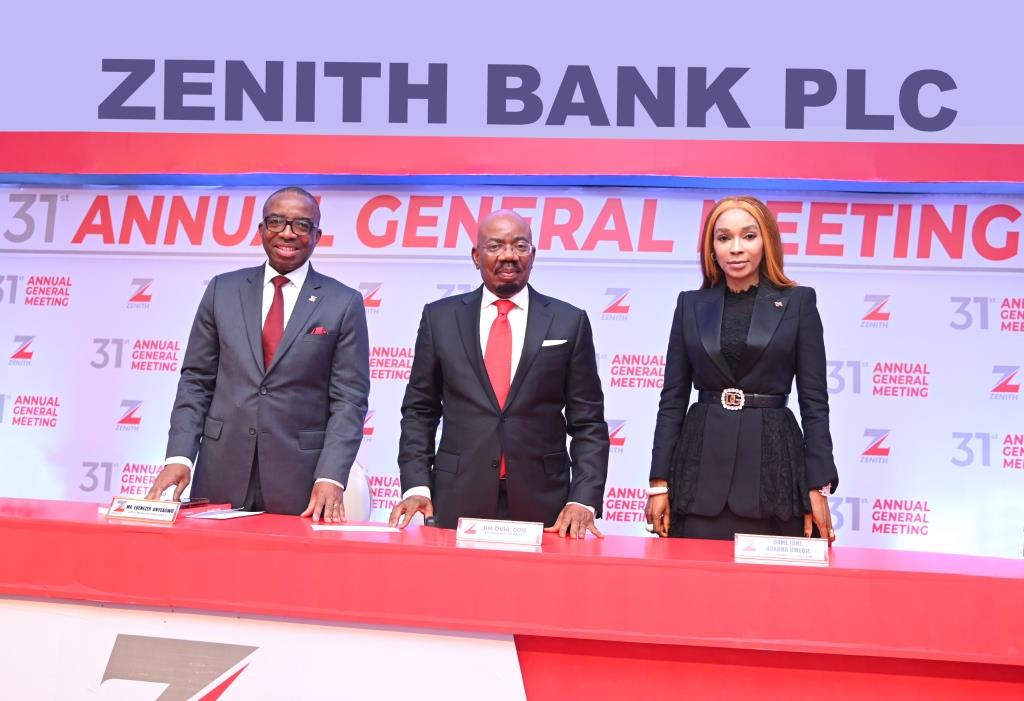
Speaking at the 31st Annual General Meeting (AGM) of the bank held on Wednesday, April 6, 2022, at the Civic Centre, Victoria Island, Lagos, he said investors love to have Zenith Bank’s shares in their portfolios because it never fails to pay dividends to shareholders.
He praised the financial institution for being consistent in the payment of dividends to shareholders, just as it did yesterday by crediting their accounts with N97.33 billion.
At the meeting on Wednesday, the final dividend payment of N2.80 per share proposed by the board was unanimously approved, bringing the total cash reward for the 2021 financial year to N3.10 per share.
Another shareholder of the company at the gathering, Mr Faruk Umar, who is the President of the Association of the Rights of Nigerian Shareholders (AARNS), also applauded the bank for rewarding loyalty.
“The bank is doing very well. All the ratios and indices have gone up. And more importantly, while we were in the meeting, I got my alert of the credit of my dividend. This is very commendable.
“The leadership of the bank has been very effective; we thank Jim Ovia for the leadership he has been giving, he has increased the dividend in spite of the economic hardship in the country, and I believe the GMD is doing very well.
“I commend the management and staff of the bank, including the board, and I am very confident that this year would also be very good for the bank,” he said.
Business Post reports that in spite of a challenging macroeconomic environment aggravated by the COVID-19 pandemic, Zenith Bank grew its gross earnings year-on-year by 10 per cent from N696.5 billion in 2020 to N765.6 billion in 2021.
This was buoyed by a 23 per cent growth in non-interest income from N251.7 billion to N309 billion and a 2 per cent rise in interest income from N420.8 billion to N427.6 billion.
In the year, profit before tax also grew by 10 per cent from N255.9 billion to N280.4 billion as a result of the growth in the top-line and very strong management of the treasury portfolio that increased efficiency, resulting in a drop in interest expense by 12 per cent from N121.1 billion in 2020 to N106.8 billion in the current year. This further led to a 7 per cent increase in net interest income of N320.8 billion in 2021 from N299.7 billion in 2020.
It was observed that last year, the lender increased its customer deposits by 21 per cent to N6.47 trillion from N5.34 trillion, with the growth from both corporate and retail customers.
A breakdown showed that retail deposits grew by N146 billion from N1.72 trillion in 2020 to N1.87 trillion in 2021 on the back of a continuous drive for retail deposits combined with the strategic rebalancing of its funding base helped to reduce the cost of funding from 2.1 per cent to 1.5 per cent in the current year.
Although operating expenses grew by 13 per cent, growth remains below the inflation rate, and the Group improved its Earnings per Share (EPS) by 6 per cent from N7.34 to N7.78.
Also, Zenith Bank expanded its total assets by 11 per cent from N8.48 trillion in 2020 to N9.45 trillion in 2021, mainly driven by growth in customer deposits.
With the steady recovery in economic activities, the Group prudently grew its gross loans by 20 per cent from N2.9 trillion to N3.5 trillion, with a non-performing loan (NPL) ratio at 4.19 per cent compared with 4.29 per cent a year earlier.
Zenith Bank also recorded impressive liquidity and capital adequacy ratios of 71.6 per cent and 21.0 per cent, which remained above regulatory thresholds of 30 per cent and 15 per cent, respectively.
While commenting on the performance of the bank at the AGM, the Group Managing Director/Chief Executive, Mr Ebenezer Onyeagwu, said: “If you look at the bank’s history over the years, Zenith Bank has always grown, and even within the pandemic, we have maintained a reasonable positive growth trajectory.
“Growth is coming from the fact that we are deploying our digital capability to grow more businesses, simplify our service processes, make our processes more efficient, and deal with customers’ complaints.
“Apart from developing new products, we are discovering new business verticals, especially within the retail segment, which have significant revenue.”
He added that: “meeting the expectation of shareholders means we have to work harder. The team is dodged, hardworking, resilient, and above all, we have a very supportive board that comes with superior guidance.”
On his part, the founder and Chairman of Zenith Bank, Mr Jim Ovia, thanked the shareholders for their unflinching loyalty, which has enabled the bank to rise to the pinnacle of the nation’s financial services industry, and assured them of the bank’s commitment to consistently deliver superior value to them.
In recognition of its track record of excellent performance, Zenith Bank was voted as Best Commercial Bank in Nigeria in the World Finance Banking Awards 2021, Best Bank in Nigeria in the Global Finance World’s Best Banks Awards 2020 and 2021, Bank of the Year (Nigeria) in The Banker’s Bank of the Year Awards 2020, and Best in Corporate Governance ‘Financial Services’ Africa 2020 and 2021 by the Ethical Boardroom.
Also, the bank emerged as the Most Valuable Banking Brand in Nigeria in the Banker Magazine Top 500 Banking Brands 2020 and 2021, Number One Bank in Nigeria by Tier-1 Capital in the “2021 Top 1000 World Banks” Ranking by The Banker Magazine and the Retail Bank of the year at the BusinessDay Banks and Other Financial Institutions (BOFI) Awards 2020 and 2021.
Similarly, Zenith Bank was honoured as Bank of the Decade (People’s Choice) at the ThisDay Awards 2020 and emerged winner in four categories at the Sustainability, Enterprise, and Responsibility (SERAS) Awards 2021, carting home the awards for “Best Company in Reporting and Transparency”, “Best Company in Infrastructure Development”, “Best Company in Gender Equality and Women Empowerment”, and the coveted “Most Responsible Organisation in Africa.

Banking
Sterling Holdco Interim FY25 Results Show Rise in Earnings, Profit
By Aduragbemi Omiyale
The 2025 full-year interim financial statements of Sterling Financial Holdings Company Plc released to the Nigerian Exchange (NGX) Limited revealed that pre-tax profit increased by 99 per cent to N90.7 billion.
The parent company of The Alternative Bank and Sterling Bank showcased an improvement in operational efficiency by cutting its cost-to-income ratio to 63 per cent from 72 per cent in 2024.
In the period under review, the gross earnings grew by 46 per cent to N476.5 billion, driven by healthy growth in both interest and non-interest income, with the former up by 43 per cent to N369.6 billion, fueled by an increase in loans and advances and improved yields on investment securities.
Also, the non-interest income expanded by 57.3 per cent, supported by higher trading income and growth in fees and commissions.
As for the balance sheet, it was robust as total assets surged by 11 per cent to nearly N4 trillion, a strong indicator of its expanded market footprint, with customer deposits rising by 18 per cent to N2.98 trillion, further reflecting the organisation’s successful efforts in enhancing customer engagement and product adoption across its platforms.
Sterling Holdco has also continued to strengthen its capital position, with shareholders’ funds increasing 39 per cent to N424.0 billion.
This bolstered capital base ensures the group’s banking subsidiaries are well-equipped to support its future growth initiatives, having met the recapitalisation requirements of the Central Bank of Nigeria (CBN) ahead of the March 2026 deadline.
This achievement was driven by a series of disciplined capital-raising initiatives, including a public offer of over N88 billion to bolster Sterling Bank’s position, and a prior capital injection that secured The Alternative Bank’s status as a national non-interest bank.
The results reflect a diversified earnings base, an emphasis on efficient capital deployment, and a strengthened operational foundation, all of which position Sterling Holdco for continued growth in the competitive financial services landscape.
Banking
Cardtonic vs Cleva Virtual Card: What Nigerians Should Know Before Choosing
The growing digital economy and the Naira card payment restriction have accelerated the rise of virtual card payments. From a single virtual card operator in 2015, Nigerians now have as many options. They can literally get a virtual card in Nigeria today from several platforms.
But among the most popular are highly reliable options like Cardtonic and Cleva. Both virtual cards deliver an excellent experience for shoppers and freelancers in Nigeria alike. They are accepted across global stores and online payment platforms.
Cardtonic is best for making subscription payments, like paying for YouTube Premium. While Cleva is for receiving foreign payments internationally. It is also one of the best ways to send money to Nigeria.
So between Cardtonic and Cleva, which virtual card would you choose? This article explains everything you need to know before choosing a particular option. Let’s get into it
Cardtonic Vs Cleva Virtual Card: Head-to-Head
Let’s compare Cardtonic and Cleva based on value proposition, card creation and other fees, funding options, global acceptance, rating and social sentiment, and extra perks.
| S/No | Factor | Cardtonic | Cleva |
| 1. | Value Proposition | Affordable. High Reliability. Flexible funding. | Receive payment from abroad. |
| 2. | Card Creation and Other Fees | $1.5 Card Creation Fee. 2% Funding Fee | $3 Card Creation Fee. 1% Funding Fee |
| 3. | Funding Options | Bank Transfer; Gift Cards | Bank Transfer; Foreign Payment |
| 4. | Global Acceptance | Wider acceptance at global locations | Wide Acceptance |
| 5. | Rating and Social Sentiment | 43.6% Positive Sentiment. | 36.7% Positive Sentiment
|
| 6. | Extra Perks | Multi-purpose app | Sleek User Interface. Speedy Customer Support. |
1. Overview and Value Proposition
Cardtonic:
Nigeria’s premium gift card brand, Cardtonic, offers virtual cards so users can navigate international payment restrictions without stress. It’s the most flexible option around, letting you fund your wallet in Naira via bank transfer or gift cards.
Furthermore, Cardtonic’s conversion fees are also very competitive, whether you are converting from Naira to USD or vice versa. You are guaranteed to get the best value for your funds.
One thing that truly stands out is that Cardtonic isn’t a one-off provider; it’s a full-scale fintech solution. Within a single app, you can access virtual dollar cards and pay utility bills, trade gift cards, shop for gadgets, and even buy eSIMs.
But how do you set up a Cardtonic virtual card? Getting started is quite straightforward. You need to download the Cardtonic app, complete KYC, and then create a virtual card in-app and fund it.
Then head to your payment page, key in your card details, just as you would use a physical card, and boom! Your payment goes through instantly.
Cleva:
Cleva is a standard solution that lets you make and receive international payments in USD. You open a Cleva USD account, and you get a virtual card linked to your account. Well, it isn’t automatic; you need to create the card and pay the card creation fee.
Cleva is particularly well-suited for freelancers and offers an alternative to major payment platforms like PayPal. You can use Cleva to receive payment from major freelance sites like Fiverr and Upwork
Unlike Cardtonic, Cleva allows you to receive and make payments. It’s not either/or; it’s both.
Once the payment arrives in your USD account, you can convert and pay out in Naira. Otherwise, you can use them to fund your virtual cards so you can shop online and pay for digital subscriptions.
2. Card Creation and Other Fees
Cardtonic charges a low card creation fee of $1.5 for a regular card and $5 for the platinum version. Unlike the regular cards, the platinum cards offer extra flexibility. You can add them to your digital wallet, like Apple/Google Pay, to make quick payments from your device without ever needing a physical card.
Additionally, Cardtonic has no monthly or maintenance fees, so you’re never charged if your card goes unused. What’s more? Cardtonic’s funding fees are capped at 2% of the Naira value. And when you indeed make a transaction, you get charged just a fraction as transaction fees.
Lastly, the Cardtonic app is one of the few platforms where you can get the best exchange rates when converting between USD and Naira. The rates often match the prevailing market price.
On the flip side, Cleva offers a low-fee structure. For example, you get charged just $1 for up to $100; that is 1% funding fees, cheaper than most payment providers. Its card creation fee isn’t over the roof either. You get charged only $3, with $1 credited to your card balance and available for use.
But similar to Cardtonic, there are no card maintenance fees whatsoever. Cleva does not charge rent; you are free to use your card at any time and you only get charged when you do so.
3. Funding Options
Cardtonic offers the most seamless card funding options: You can fund your digital wallet in Naira via bank transfer or even gift cards. Once your wallet is funded, you can convert Naira to USD and top up your virtual dollar card. You can then pay or shop at your favorite global platforms like Amazon and Macy’s.
When it comes to Cleva, it’s a little different. You can fund your Cleva virtual card via a bank transfer from within or outside Nigeria. You always have decent options, like US wire, ACH, or even stablecoins, available for you to receive payment from abroad.
Stablecoin payments are available for remote workers whose clients pay in crypto. They are typically settled in less than 5 minutes and provide an effective way to fund your Cleva USD account.
4. Global Acceptance
The Cardtonic virtual card is a popular payment option supported at global merchants, particularly at vendors that accept Visa or Mastercard. That said, you can shop at eBay or Amazon and subscribe to ChatGPT, Google Cloud, and Workspace.
You also get to enjoy contactless payment. Another extra value added. You add your platinum virtual card to Apple or Google Pay and pay simply by tapping your device on supported payment terminals. That’s speed and convenience merged into one.
Other platforms where the Cardtonic virtual cards are accepted include Grammarly, Twitter Blue, Google Ads, YouTube Premium, Canva Pro, and Adobe Creative Cloud.
Comparatively, Cleva is accepted at global locations with the Visa or Mastercard logos. Like Cardtonic, you can shop at your favorite global e-commerce stores like Amazon or eBay. Additionally, you can use your Cleva virtual card to subscribe to Netflix or run Facebook or Google ads.
5. Rating and Social Sentiments
While both products are strong options for paying internationally, ratings on Google Play showed that Cardtonic has a 4.6-star rating out of 20k reviews. Cleva, on the other hand, has received 4.7 out of 5k reviews. However, you should keep in mind that Cardtonic has way more product offerings than Cleva.
Secondly, the Virtual Card in Nigeria Report indicates that Cardtonic is hugely more popular than its counterpart. It has a stronger total number of X mentions than Cleva: 278 total tweets, ahead of Cleva’s 49.
Social sentiment also favors Cardtonic over the Cleva virtual card. Cardtonic led with a positive score of 43.6%, ahead of Cleva’s 36.7%. Overall, Cardtonic is praised for its reliability in supporting Apple and Namecheap payments, while Cleva is recognized for its sleek user interface and speedy support.
Frequently Asked Questions About Cleva and Cardtonic Virtual Card
- Which Virtual Card is Best in Nigeria?
The best virtual card in Nigeria currently is Cardtonic due to its high reliability. Since its launch in 2024, it has continually enabled Nigerians to pay across popular global destinations without stress.
Besides, the Cardtonic virtual card is cost-effective and provides the strongest security and the most flexible funding options.
- Cardtonic vs. Cleva: Which is Cheaper?
Overall, Cardtonic is cheaper: In terms of card creation fees, Cardtonic charges $1.5 compared to Cleva’s $3. And as regards card funding fees, Cardtonic charges about 1.5% on Naira deposits, with a maximum of 2,000 Naira overall. Alternatively, Cleva charges only 1% for funding in USD.
- Can Funds be Added in Naira?
Yes, Cardtonic lets you fund your digital wallet directly in Naira via bank transfer or gift card sales. Alternatively, Cleva has also launched its Naira funding feature. With this, you can transfer from any local bank app and have your Cleva NGN account credited.
- Cardtonic vs. Cleva: What Should Nigerians Consider Before Choosing?
It is important to consider your use case before choosing between the Cardtonic and Cleva virtual cards. For example, if you want to receive funds from abroad, choose Cleva. If you wish to make a payment or subscribe to popular channels, then you can choose from either Cardtonic or Cleva. However, Cardtonic offers a full fintech package.
Other factors to consider before choosing a virtual card include fees and exchange rates. If you want lower fees or the best conversion rates, the Cardtonic virtual card is your best option.
- Can Cleva Receive Money from Abroad?
Yes, Cleva has a USD account feature that allows users to receive payments via US wire or ACH from global locations. Additionally, Cleva supports stablecoins, so you can also receive USDT and USDC from abroad directly to your USD wallet.
- How Long Does it Take to Receive Payment on Cleva?
It all depends on the payment option. General ACH payment takes 1–3 business days. While wire transfer from the US takes 1 to 2 days. Meanwhile, stablecoins take less than five minutes.
Conclusion
Cardtonic vs. Cleva: Which should you choose? Well, it all depends on your needs and preferences. Choose Cardtonic if you need an all-in-one app for fintech payments and gift card trading.
Then choose Cleva if you’re a remote worker looking for an alternative means to receive payment from abroad. They may not be as popular as their counterparts, but they do work.
Cardtonic clearly outperforms Cleva, as evidenced by its user feedback and statistics. It has way more users, the most flexible funding, and the cheapest fees, and it clearly supports a wider range of platforms than Cleva.
Banking
Coronation Merchant Bank Targets Top-Tier African Status in Next Growth Phase
By Adedapo Adesanya
Coronation Merchant Bank has set its sights on attaining top-tier status among African banks, leveraging a decade of operations and Nigeria’s ongoing economic reforms to drive its next phase of growth across key sectors.
Speaking at the Chairman’s Dinner held to commemorate the bank’s 10th anniversary in Lagos, the chief executive of the lender, Mr Paul Abiagam, said the institution had successfully carved out a distinct niche in Nigeria’s highly competitive financial services market despite a decade defined by economic volatility, policy shifts and macroeconomic uncertainty.
“Over the last 10 years, we have found our own space in a very tight market and built credible footprints in the specific markets we chose to serve,” Mr Abiagam said.
Describing the bank’s journey as “valiant” amid the changing economic landscape, he said the anniversary represents both a moment of gratitude to the bank’s founder, shareholders, board and partners, and a recommitment to scale new heights in the decade ahead.
Mr Abiagam attributed the bank’s resilience and steady growth to strong shareholder and board support, as well as a clear and disciplined corporate strategy.
He noted that Coronation Merchant Bank’s focus on defined target markets had enabled it to expand its footprint across key sectors of the economy while maintaining operational clarity.
Looking ahead, the CEO said ongoing reforms and the Federal Government’s ambition to build a $1 trillion economy present significant opportunities for financial institutions with the right expertise and positioning.
He identified infrastructure, construction, real estate, oil and gas, and manufacturing as priority sectors where the bank is already aligning its strategy.
“Volatility often comes with opportunity, What we see clearly is opportunity, and our strategy is to ensure we are well positioned to take advantage of it.” Mr Abiagam said.
Among the bank’s notable milestones, Mr Abiagam highlighted its international credit ratings, placing Coronation among a small group of internationally rated merchant banks in Nigeria.
He also pointed to human capital as a core strength, describing the bank’s people and talent as its greatest asset.
In his remarks, the Chairman of Coronation Merchant Bank, Mr Babatunde Folawiyo, reflected on the challenges of operating in Nigeria’s banking sector over the past decade, noting that the true measure of success lies in an institution’s ability to grow through uncertainty and emerge stronger.
“Anyone who has operated in Nigeria’s banking space over the last 10 years knows how challenging it has been,” Mr Folawiyo said, citing policy changes, macroeconomic shifts and leadership transitions. “The real test is whether you can grow through those challenges—and we have.”
Mr Folawiyo said recent reforms have introduced greater certainty into the economy, particularly in the foreign exchange market, which is critical for business planning and sustainable growth. While acknowledging that the adjustment period has been difficult, he stressed that predictability, even at higher exchange rates, is far more beneficial than extreme volatility.
“No business thrives without some level of stability. What hurts the economy most is wild and sudden swings. Predictability allows businesses to plan, adjust and grow,” he said.
On the outlook for the sector, Mr Folawiyo said Nigeria remains significantly underbanked, creating room for diverse players within the financial system. While technology and fintechs are expanding access to financial services, he emphasized the enduring role of specialized institutions such as merchant banks in serving corporate and structured finance needs.
“A corporate client structuring commercial papers or complex funding solutions needs more than a fintech app. It needs a bespoke, one-stop financial partner. That is where merchant banks like ours play a critical role,” the Chairman said.
He added that Coronation Merchant Bank’s strategy is anchored on long-term economic fundamentals rather than political cycles, noting that the current policy direction of the Central Bank and the Federal Government, though initially painful, aligns with sound economic principles.
“These are textbook reforms. There is no gain without pain, and we are already beginning to see the gains, not just in the financial sector but across the broader economy,” he added.
-
Feature/OPED6 years agoDavos was Different this year
-
Travel/Tourism9 years ago
Lagos Seals Western Lodge Hotel In Ikorodu
-
Showbiz3 years agoEstranged Lover Releases Videos of Empress Njamah Bathing
-
Banking8 years agoSort Codes of GTBank Branches in Nigeria
-
Economy3 years agoSubsidy Removal: CNG at N130 Per Litre Cheaper Than Petrol—IPMAN
-
Banking3 years agoSort Codes of UBA Branches in Nigeria
-
Banking3 years agoFirst Bank Announces Planned Downtime
-
Sports3 years agoHighest Paid Nigerian Footballer – How Much Do Nigerian Footballers Earn