Connect with us

Technology

Jubilation as WIOCC Brings Google’s Equiano Subsea Internet Cable to Nigeria

Published

on

Equiano Subsea Internet Cable

By Dipo Olowookere

Millions of internet users in Nigeria are currently in cloud nine and the reason is that internet connectivity will get better with the landing of the state-of-the-art Equiano subsea internet cable in the country.

With a design capacity roughly 20 times larger than any other cable currently in use, the Equiano subsea cable will have a direct impact on connectivity, resulting in faster internet speeds, reduced internet prices and improved user experience in Nigeria.

Named after Nigerian-born writer and abolitionist, Olaudah Equiano, the Equiano cable will help support further digital transformation in Nigeria, a country that has produced five start-up unicorns (companies now valued at more than $1 billion) in the past five years.

The new cable will save 2.8 million tonnes of CO2 emissions per annum, boost the nation’s gross domestic product (GDP) by $10.1 billion by 2025, create about 1.6 million jobs within the period as a result of an increase in internet speeds by a factor of six, increase in internet penetration by six percentage points and a cut in internet retail prices by 21 per cent.

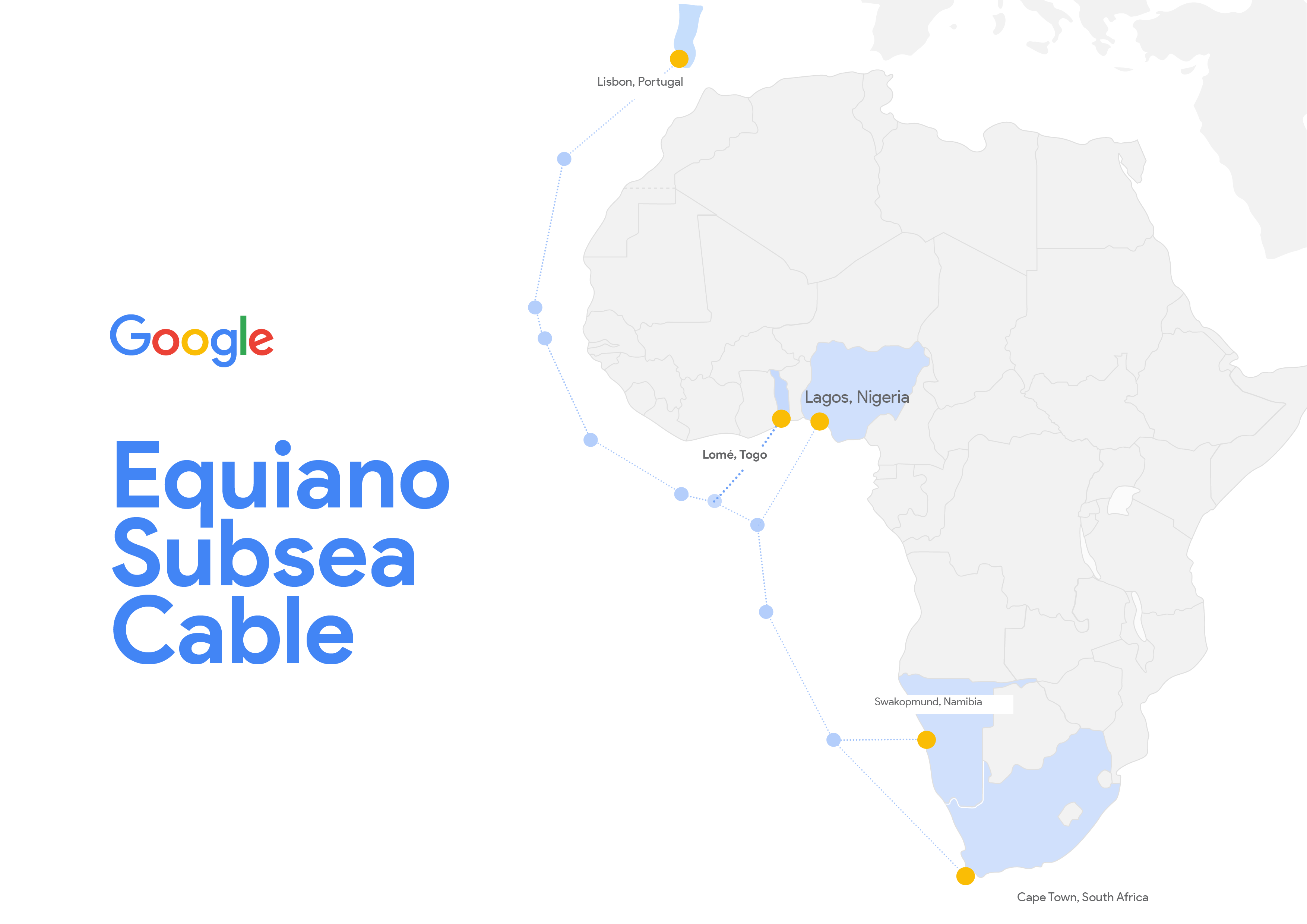
Business Post gathered that this Equiano subsea internet cable was brought to Nigeria through Lagos by Google and WIOCC, a cable landing partner, from Portugal.

It runs more than 12,000km along the West Coast of Africa and initially land in Lomé, Togo; Lagos, Nigeria; Swakopmund, Namibia; Rupert’s Bay, Saint Helena and Melkbosstrand, South Africa; establishing a valuable new high-capacity connection between the African continent and Europe.

“Google is committed to supporting Africa’s digital transformation and we are excited to see the impact of the landing of Equiano in Nigeria.

“We’ve worked with established partners and in-country experts to guarantee that Equiano has the greatest potential effect in Nigeria and throughout Africa,” the Director of West Africa at Google, Ms Juliet Ehimuan, stated.

“Equiano is set to make an enduring contribution towards the development of Nigeria’s communications infrastructure and today marks another major step in its development. We look forward to honouring our commitment to being part of Africa’s digital transformation,” Ms Ehimuan added.

On his part, the Chief Executive Officer of WIOCC, Mr Chris Wood, stated: “We are proud to have been selected by Google as the landing partner for the Equiano cable in Nigeria, landing the cable directly into the OADC Lagos data centre. From there it will be extended to other data centres across Lagos.”

“The Equiano cable will deliver improved internet quality, speeds and affordability to the people of Nigeria. However, for the benefits to be fully felt throughout Nigeria, hyper scale connectivity needs to be extended from the Lagos area to the rest of the country.

“To make this happen, WIOCC is also deploying a comprehensive, hyper scale national fibre network. The network will go live in phases, starting in June and continuing through to the end of the year. When combined with the Equiano cable this network will deliver transformational benefits across the country,” he added.

Last month, the Equiano subsea cable made its first landing in Africa in Lomé, Togo, as a confirmation of the commitment made at the Google for Africa 2021 event to help increase internet access across Africa.


Advertisement
Click to comment

Leave a Reply

Your email address will not be published. Required fields are marked *

Technology

Google Introduces Yorùbá, Hausa Language Support for AI Search Features

Published

on

google AI Search

By Modupe Gbadeyanka

The language support for its AI Search features has been expanded by Google, with the inclusion of Yoruba and Hausa in Nigeria.

This is part of a broader effort to make AI more inclusive across the continent, with support now extending to a total of 13 African languages.

Under the AI Overviews and AI Mode, speakers of both Nigerian languages can utilise AI-powered Search experiences in their mother tongue for quick summaries and conversational exploration.

This means existing AI features in Google Search are now accessible to people like the student in Kano asking a question in Hausa, and the trader in Ibadan seeking advice in Yorùbá.

By addressing language barriers, this update ensures that technology reflects the identity and culture of the people it serves. With this expansion, more people can now use AI Mode to ask complex questions in their preferred language, while exploring the web more deeply and naturally through text or voice.

The 13 languages now supported across Africa include Afrikaans, Akan, Amharic, Hausa, Kinyarwanda, Afaan Oromoo, Somali, Sesotho, Kiswahili, Setswana, Wolof, Yorùbá, and isiZulu.

These languages were chosen based on the vibrant search activity across the continent, ensuring that our AI experiences reach the communities that need them most.

Commenting on the development, the Communications and Public Affairs Manager for Google in West Africa, Taiwo Kola-Ogunlade, said, “Building a truly global Search goes far beyond translation — it requires a nuanced understanding of local information.

“With the advanced multimodal and reasoning capabilities of our custom version of Gemini in Search, we’ve made huge strides in language understanding, so our most advanced AI search capabilities are locally relevant and useful in each new language we support.

“This is about ensuring Nigerians can converse with Search in their mother tongues, making information more helpful for everyone.”

To use AI Overviews and AI Mode in the local language, users must open the Google app on an Android or iOS device, or via the Web. They are required to tap on AI Mode within the Search experience. Thereafter, they can type or speak the question in their preferred language, such as Hausa or Yorùbá, and let the AI guide the journey.

Continue Reading

Technology

Telecom Operators to Issue 14-Day Notice Before SIM Disconnection

Published

on

SIM Cards Nigeria

By Adedapo Adesanya

Telecommunications operators in Nigeria will now be required to give subscribers a minimum of 14 days’ notice before deactivating their SIM cards over inactivity or post-paid churn, following a fresh proposal by the Nigerian Communications Commission (NCC).

The proposal is contained in a consultation paper, signed by the Executive Vice Chairman and Chief Executive Officer of the NCC, Mr Aminu Maida, and titled Stakeholders Consultation Process for the Telecoms Identity Risks Management Platform, dated February 26, 2026, and published on the Commission’s website.

Under the proposed amendments to the Quality-of-Service (QoS) Business Rules, the Commission said operators must notify affected subscribers ahead of any planned churn.

“Prior to churning of a post-paid line, the Operator shall send a notification to the affected subscriber through an alternative line or an email on the pending churning of his line,” the document stated.

It added that “this notification shall be sent at least 14 days before the final date for the churn of the number.”

A similar provision was proposed for prepaid subscribers. According to the Commission, operators must equally notify prepaid customers via an alternative line or email at least 14 days before the final churn date.

Currently, under Section 2.3.1 of the QoS Business Rules, a subscriber’s line may be deactivated if it has not been used for six months for a revenue-generating event. If the inactivity persists for another six months, the subscriber risks losing the number entirely, except in cases of proven network-related faults.

The new proposal is part of a broader regulatory review tied to the rollout of the Telecoms Identity Risk Management System (TIRMS), a cross-sector platform designed to curb fraud linked to recycled, swapped and barred mobile numbers.

The NCC explained in the background section of the paper that TIRMS is a secure, regulatory-backed platform that helps prevent fraud stemming from churned, swapped, barred Mobile Station International Subscriber Directory Numbers in Nigeria.

It said this platform will provide a uniform approach for all sectors in relation to the integrity and utilisation of registered MSISDNs on the Nigerian Communications network.

In addition to the 14-day notice requirement, the Commission also proposed that operators must submit details of all churned numbers to TIRMS within seven days of completing the churn process, strengthening oversight and accountability in the system.

The consultation process, which the Commission said is in line with Section 58 of the Nigerian Communications Act 2003, will remain open for 21 days from the date of publication. Stakeholders are expected to submit their comments on or before March 20, 2026.

Continue Reading

Technology

Silverbird Honours Interswitch’s Elegbe for Nigeria’s Digital Payments Revolution

Published

on

Mitchell Elegbe Interswitch

By Modupe Gbadeyanka

The founder of Interswitch, Mr Mitchell Elegbe, has been honoured for pioneering Nigeria’s digital payments revolution.

At a ceremony in Lagos on Sunday, March 1, 2026, he was bestowed with the 2025 Silverbird Special Achievement Award for shaping Africa’s financial ecosystem.

The Silverbird Special Achievement Award recognises individuals whose innovation, vision, and sustained impact have left an indelible mark on society.

Mr Elegbe described the award as both humbling and symbolic of a broader journey, saying, “This honour represents far more than a personal milestone. It reflects the courage of a team that believed, long before it was fashionable, that Nigeria and Africa could build world-class financial infrastructure.”

“When we started Interswitch, we were driven by a simple but powerful idea that technology could democratise access, unlock opportunity, and enable commerce at scale.

“This recognition by Silverbird strengthens our resolve to continue building systems that empower businesses, support governments, and expand inclusion across the continent,” he said when he received the accolade at the Silverbird Man of the Year Awards ceremony attended by several other dignitaries, whose leadership and contributions continue to shape national development and industry transformation.

In 2002, Mr Elegbe established Interswitch after he was inspired by a bold conviction that technology could fundamentally redefine how value moves within and across economies.

Under his leadership, the company has evolved into one of Africa’s foremost integrated payments and digital commerce companies, powering financial transactions for governments, banks, businesses, and millions of consumers.

Today, much of Nigeria’s electronic payments ecosystem traces its foundational architecture to the systems and rails established under his leadership.

“Mitchell’s journey is inseparable from Nigeria’s digital payments evolution. His foresight and resilience helped establish foundational infrastructure at a time when the ecosystem was still nascent.

“This recognition affirms not only his personal legacy, but the broader impact of Interswitch in enabling commerce and strengthening financial systems across Africa,” the Executive Vice President and Group Marketing and Communications for Interswitch, Ms Cherry Eromosele, commented.

Continue Reading

Trending