Connect with us

Economy

AgroEknor Seeks to Transform Superfoods Value Chain

Published

on

AgroEknor

By Adedapo Adesanya

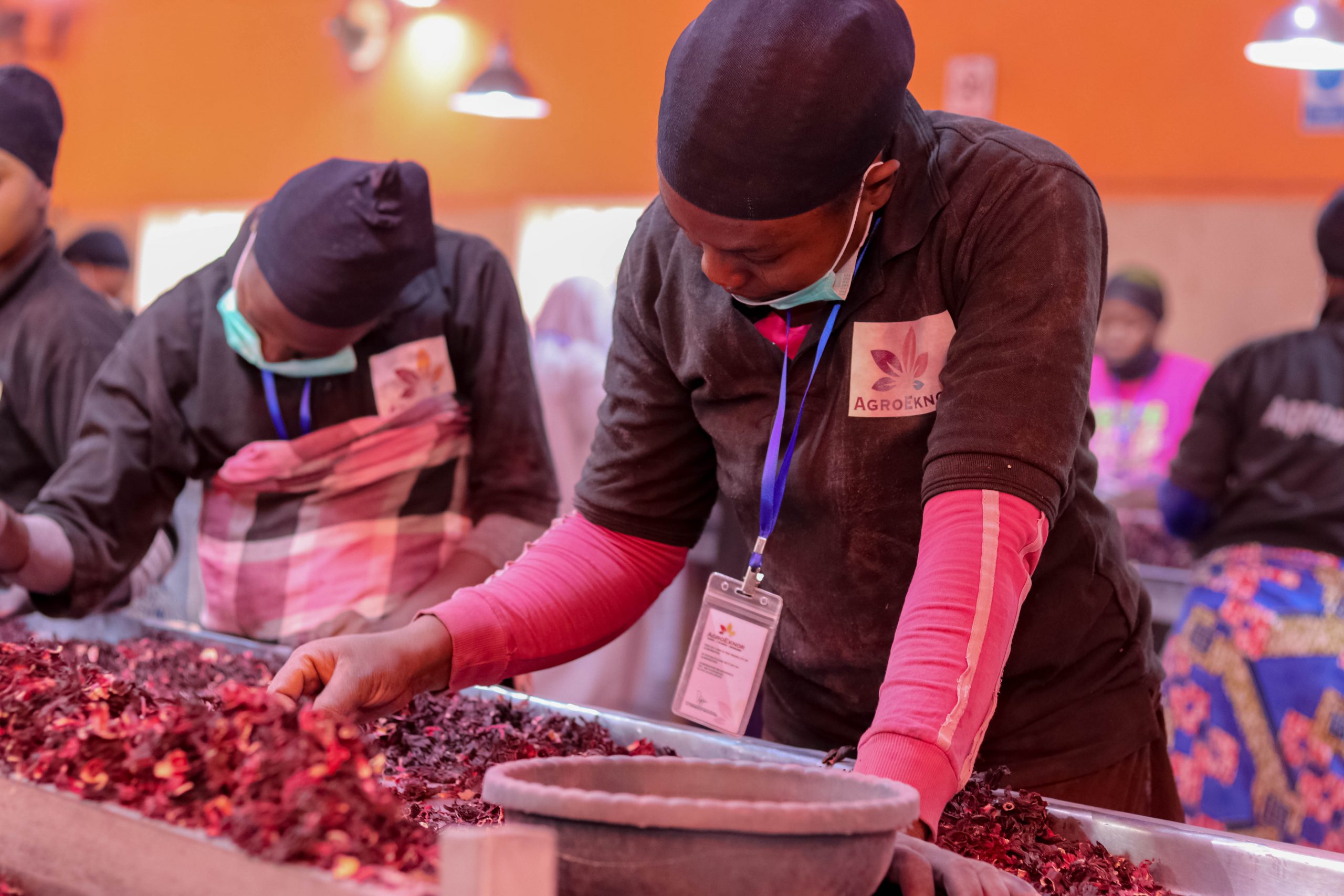
Nigerian agri-tech startup, AgroEknor, has disclosed that it was working on transforming the value chain of superfoods with scalable digital infrastructure through backward integration.

Through this value chain, investments and solutions are provided for agro products which have created higher income opportunities for smallholder farmers and also reduced wastage in the agricultural value chain.

The startup came about after the team spent around 12 months researching which products were most viable for trade.

“We were able to identify the opportunity with superfoods. We then joined a few industry groups and began to engage potential partners and stakeholders to establish our credibility and build the business,” the co-founder of the startup, Mr Timi Oke said.

“We eventually secured an order of 60 tonnes of containers of dried hibiscus from a Mexican customer. We were upfront with the customer that this was our first deal but we were able to give them enough assurances to go ahead with the transaction. Myself, Ayo and Attah [co-founders] used our own money to purchase the hibiscus from middlemen who procured it from small-scale farmers across Northern Nigeria.

“We successfully completed the order, delivering 60 tonnes of dried hibiscus to a satisfied customer, and that was the beginning of the long journey that has brought us to where we are today,” he added.

The company said there is a growing global demand for natural, nutrient-rich meals, and changing lifestyle choices, which is driving the global superfood trend, with demand expected to reach $204 billion by 2025.

“Hibiscus, for example, is predicted to be one of the biggest global food trends in 2022 and Nigeria happens to be one of the largest growers in the world. With scalable digital infrastructure and impact-driven, inclusive partnerships, AgroEknor is helping farmers and other players in Nigeria’s superfoods value chain to maximise the opportunity that is available to them by driving greater efficiency and enabling increased export earnings,” the founder said.

“The opportunity to transform Africa’s agriculture sector is attracting more attention and drawing more players to the market but our focus on superfoods is our main differentiator. As most of our customers are based outside Nigeria, our competition is typically agribusinesses from other parts of the world where some of these superfoods are also grown.”

AgroEknor secured an undisclosed investment from Aruwa Capital Management, an early-stage growth equity and gender lens fund investing in Nigeria and Ghana, in November of last year, and has also received some grants, including the export stimulation facility from the Nigeria Export-Import Bank (NEXIM).

“We are currently in the process of engaging investors to secure more funding to drive the delivery of our tech-enabled solutions,” Mr Oke said.

Regardless of funding, the company says adoption has been strong. It claims that over the last five years, it has empowered over 5,000 smallholder farmers with farm inputs to maximise crop cultivation potential and exported more than 15,000 tonnes of agricultural products to clients globally.

“Through our end-to-end value chain involvement, we are able to enhance food security, extend shelf-life of agro commodities and ultimately improve palatability and export value of agricultural commodities,” he explained.​

AgroEknor currently exports agricultural products to global clients spanning Asia, Europe, North, and South American markets.

“Over the next few years we want to scale our sourcing and processing infrastructure to three identified value chains across West Africa,” he said.

Founded in 2013 by brothers Timi and Ayo Oke alongside Attah Anzaku, AgroEknor operates by sourcing, refining and exporting superfoods such as dried hibiscus flower, ginger, sesame seeds to global clients.  It has 68 employees and counting and operates from two locations – a processing centre in Kano and a liaison office in Abuja.


Adedapo Adesanya is a journalist, polymath, and connoisseur of everything art. When he is not writing, he has his nose buried in one of the many books or articles he has bookmarked or simply listening to good music with a bottle of beer or wine. He supports the greatest club in the world, Manchester United F.C.

2 Comments

Leave a Reply

Your email address will not be published. Required fields are marked *

Economy

MRS Oil, FrieslandCampina Wamco Shrink NASD Index by 0.68%

Published

on

MRS Oil voluntary delisting

By Adedapo Adesanya

The duo of MRS Oil and FrieslandCampina Wamco Nigeria Plc weakened the NASD Over-the-Counter (OTC) Securities Exchange by 0.68 per cent on Friday, June 5.

MRS Plc lost N19.00 during the session to sell at N171.00 per share compared with Thursday’s value of N190.00 per share, and FrieslandCampina Wamco Nigeria Plc depreciated by N8.70 to finish at N181.68 per unit compared with the preceding session’s N190.38 per unit.

As a result, the market capitalisation further lost N22.59 billion to close at N2.607 trillion versus the N2.630 trillion it ended a day earlier, and the NASD Unlisted Security Index (NSI) dropped 37.76 points to settle at 4,358.32 points, in contrast to the previous day’s 4,396.08 points.

The alternative stock market closed the last trading day of this week with a price gainer, Central Securities Clearing System (CSCS) Plc, which gained 6 Kobo to quote at N78.40 per share compared with the preceding session’s N78.34 per share. However, it could not prevent the market from going down at the close of business.

Yesterday, the volume of securities bought and sold by investors went down by 50.0 per cent to 140,345 units from the preceding day’s 280,714 units, the value of stocks decreased by 16.5 per cent to N17.9 million from the previous session’s N21.5 million, and the number of deals carried out by market participants fell by 35.7 per cent to 27 deals from the 42 deals recorded on Thursday.

When trading activities closed for the day, Great Nigeria Insurance (GNI) Plc remained the most active stock by value on a year-to-date basis, with 3.4 billion units exchanged for N8.4 billion, trailed by Infrastructure Credit Guarantee (Infracredit) Plc with 2.3 billion units sold for N6.5 billion, and CSCS Plc with 64.7 million units traded for N4.4 billion.

GNI Plc also ended the session as the most traded stock by volume on a year-to-date basis, with 3.4 billion units worth N8.4 billion, followed by Infracredit Plc with 2.3 billion units transacted for N6.5 billion, and Resourcery Plc with 1.1 billion units valued at N415.7 million.

Continue Reading

Economy

NGX Index Rebounds 0.15% on Renewed Interest in Financial Stocks

Published

on

Financial Stocks

By Dipo Olowookere

Renewed interest in financial stocks and others lifted the Nigerian Exchange (NGX) Limited by 0.15 per cent on Friday.

Customs Street closed higher yesterday despite the 1.37 per cent loss recorded by the consumer goods sector as a result of profit-taking.

This was offset by gains in the other key sectors of the local bourse, as the insurance counter chalked up 1,14 per cent. The banking space appreciated by 0.90 per cent, the industrial goods segment grew by 0.46 per cent, and the energy sector expanded by 0.01 per cent.

Consequently, the All-Share Index (ASI) went up by 366.00 points to 242,593.31 points from 242,227.31 points, and the market capitalisation gained N235 billion to close at N155.594 trillion compared with the previous day’s N155.359 trillion.

The trio of International Energy Insurance, Abbey Mortgage Bank, and DAAR Communications improved by 10.00 per cent each yesterday to N7.26, N9.35, and N1.98, respectively, while Zichis advanced by 9.39 per cent to N32.38, with Sovereign Trust Insurance up by 8.70 per cent to N2.50.

On the flip side, Academy Press lost 9.84 per cent to quote at N8.25, University Press depreciated by 9.73 per cent to N5.10, Africa Prudential dipped by 2.63 per cent to N12.95, Chams crumbled by 2.44 per cent to N4.00, and International Breweries slipped by 1.59 per cent to N12.35.

Business Post reports that the market breadth index was positive during the session after recording 37 appreciating equities and 14 depreciating equities, implying strong investor sentiment.

Abbey Mortgage Bank led the activity chart with a turnover of 164.1 million units worth N1.5 billion, Ellah Lakes sold 76.7 million units for N767.2 million, Access Holdings transacted 44.8 million units valued at N1.1 billion, Linkage Assurance exchanged 23.0 million units worth N41.2 million, and The Initiates traded 20.2 million units for N562.1 million.

At the close of trades, market participants transacted 608.5 million units worth N32.0 billion in 53,826 deals versus the 588.5 million units valued at N27.9 billion executed in 57,352 deals in the previous session. This showed that the number of deals eased by 6.15 per cent, the volume of transactions rose by 3.40 per cent, and the value of transactions soared by 14.70 per cent.

Continue Reading

Economy

Naira Depreciates to N1,362/$1 at Official Market

Published

on

Naira 4 Dollar

By Adedapo Adesanya

The Naira further depreciated against the United States Dollar by N3.46 or 0.25 per cent to N1,362.21/$1 from N1,358.75/$1 in the Nigerian Autonomous Foreign Exchange Market (NAFEX) on Friday, June 5.

However, it appreciated against the Pound Sterling in the same market window during the session by N4.47 to trade at N1,823.59/£1 compared with the previous day’s N1,828.06/£1, and gained N7.00 against the Euro to sell at N1,574.58/€1, in contrast to Thursday’s closing price of N1,581.58/€1.

For another trading session, the Nigerian Naira maintained stability against the Dollar in the parallel market and the GTBank forex counter on Friday at N1,375/$1 and N1,372/$1, respectively.

The Naira is expected to remain strong in the near term, backed by a rise in external reserves, which are nearing $50 billion, enhancing analysts’ confidence about its outlook in the second half of 2026.

Heightened global uncertainty has reduced the incentive for importers and corporates to demand FX, as cautious trade weighs on import needs. Analysts estimate a $40 billion net FX position for the year, a projection anchored in oil windfall gains.

As for the cryptocurrency market, prices remained depressed following a strong US jobs report that spurred markets to price in higher-for-longer interest rates, sending Treasury yields and the dollar up while hammering stocks, especially AI-related names. Crypto markets saw heavy leverage washouts with about $1.6 billion in positions liquidated over 24 hours.

Ethereum (ETH) gave up 4.9 per cent to trade at $1,584.68, Solana (SOL) fell by 3.3 per cent to $63.22, Bitcoin (BTC) crashed by 1.9 per cent to $61,333.23, Dogecoin (DOGE) slipped by 1.8 per cent to $0.0821, and Ripple (XRP) moderated by 1.8 per cent to $1.09.

Further, TRON (TRX) dropped 1.6 per cent to sell at $0.3197, Binance Coin (BNB) slumped by 1.0 per cent to $581.18, and  Cardano (ADA) declined by 0.4 per cent to $0.1589, while the US Dollar Tether (USDT) gained 0.07 to sell at $0.9997, and US Dollar Coin (USDC) closed flat at $0.9998.

Continue Reading

Trending