

World
SADC Rejects US Law Against Russian Activities in Africa

By Kestér Kenn Klomegâh
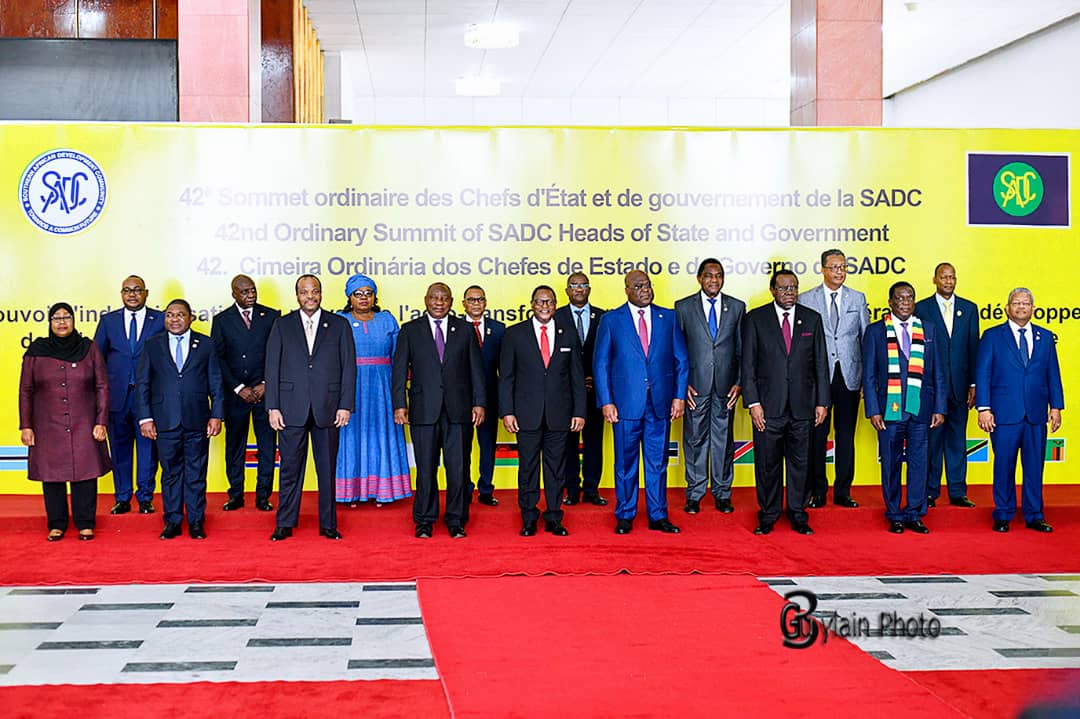
The Southern African Development Community (SADC), during its 42nd Ordinary Summit of Heads of State and Government, held on August 17 and 18, 2022, at Palais du Peuple (Parliament Building), vehemently, expressed collective opposition to a proposed United States law on countering Russian activities in Africa.
The Countering Malign Russian Activities in Africa Act adopted by the US House of Representatives directs the US Secretary of State to submit a strategy on Russia.
According to the statement posted to its website, the 16-member regional bloc complained that the United States has made the African continent “the target of unilateral and punitive measures” and its Senate’s Foreign Relations Committee pushed the bill designed to stop President Vladimir Putin from using Africa to bypass US sanctions and fund his war in Ukraine, as well as to protect African people from human rights violations by Russian mercenaries.
The SADC leaders have, therefore, reaffirmed their collective position of non-alignment towards conflicts outside the continent. The summit was held under the theme “Promoting Industrialization through Agro-processing, mineral beneficiation and regional value chains for inclusive and resilient economic growth.”
“Africa Is Not For Sale. Africa is open for business not for sale or looting. We must defend what is ours and make sure that no one takes from us what is ours,” declared Malawian President Lazarus Chakwera at the summit, pointing to the bold stance against the scramble for Africa’s resources by external powers.
“If the world wants what we have they must buy in a fair trade so that we use proceeds to build ourselves new cities, new universities, new infrastructure, industries and new programmes that lift people out of poverty and vulnerability.”
President Chakwera urged African leaders and their people to build Africa and future generations not for those bent on looting its resources. He further touched on the need for Africa to define its destiny and chart a new independent course; that the resources of Africa remain in the hands of Africans but not be stolen by some people. Let us stand up with one voice and tell the World, that Africa is open for business but not for sale.
“It takes only Africans to build the African continent. No foreigners will develop the continent. We must not always look upon them because what they give us does not build anything but simply cause tension in the continent like they did in the past.”
“In that scathing speech, he further lambasted Western and Eastern countries that they must not just be in Africa to steal but to build. There is no one outside Africa who can build it, not any European, Asian or American.”
Labelled as the Countering Malign Russian Activities in Africa Act (H.R. 7311) was passed on April 27 by the House of Representatives in a bipartisan 419-9 majority and will probably be approved by the Senate which is evenly split between the Democrats and the Republicans.
Russian military operations in Ukraine are in response to Washington and Wall Street’s efforts to expand the North Atlantic Treaty Organization (NATO) deeper into Eastern Europe as a direct threat to the interests of the Russian Federation and its allies. Two other bills have recently been passed to maintain and expand Pentagon military bases around the world along with providing an additional $40 billion to supply weapons to the Ukrainian government which is bolstered by neo-Nazi militias integrated into the armed forces.
During the early phase of the Russian special operations in Ukraine, many African states abstained from two United Nations General Assembly resolutions motivated by Washington to condemn the Russian government for its intervention in Ukraine while completely ignoring the level of fascist infiltration of Kyiv military forces and the necessity of reaching a diplomatic solution to the burgeoning conflict.
African Heads-of-State, such as President Cyril Ramaphosa of the Republic of South Africa, have consistently argued that the African National Congress (ANC) led government in Pretoria will not support the Ukraine war along with the draconian sanctions instigated by the Biden administration. Ramaphosa has demanded that the U.S. State Department and White House support negotiations between Kyiv and Moscow, which have been routinely undermined by Biden and his cabinet members.
Long before the February 24 invasion by the Russian armed forces, the U.S. has engaged in repeated threats against President Putin and the entire government based in Moscow demanding that it acquiesce to the expansion of NATO. Unprecedented sanctions with the stated aims of completely blockading Russia from the world economic system have largely failed to curtail the advances by Moscow in eastern Ukraine.
The Countering Malign Russian Activities in Africa Act adopted by the US House of Representatives is a well-designed legislative measure broadly worded enabling the State Department to monitor the foreign policy of the Russian Federation in Africa including military affairs and any effort that Washington deems as a malign influence.
The United States Congressional bill was approved by a wide margin that would target and punish African states that maintain political and economic relations with the Russian Federation.
On March 2 at the United Nations General Assembly, with all 193 UN Member States in attendance, a total of 141 countries voted in favour of the resolution, which reaffirmed Ukrainian sovereignty, independence and territorial integrity. African representatives and their votes were considered very interesting. Some 17 African countries abstained from the vote at the UN General Assembly to deplore the Russian invasion of Ukraine while some other 28 countries in the continent voted in favour.
Among those abstaining from voting were South Africa, Algeria, Uganda, Burundi, Senegal, South Sudan, Mali and Mozambique. Others were Sudan, Namibia, Angola, Zimbabwe, Equatorial Guinea, Central Africa Republic, Madagascar, Tanzania and Congo.
Eritrea was the only African country that voted against the resolution. Besides that, however, Egypt, Tunisia, Nigeria, Kenya, Chad, Ghana, Gambia, Gabon, Rwanda, Cote d’Ivoire, Libya, Liberia, Djibouti, Mauritania, Somalia, Niger, Benim, Lesotho, Botswana, Zambia, Malawi, Mauritius, Comoros, Seychelles, Cape Verde, Sao Tome and Principe, Sierra Leone and the Democratic Republic of Congo, among others, voted yes.
Burkina Faso, Cameroon, Guinea Bissau, Ethiopia, and Eswatini were not in the room. Uganda said it abstained from the vote to uphold “neutrality” as the incoming chair of the Non-Aligned Movement (NAM). NAM is a forum made up of 120 developing countries to assert their independence from the competing claims of the two superpowers.
In a tweet, Uganda’s Permanent Representative to the United Nations, Adonia Ayebare, said the country would continue to play a constructive role in the maintenance of peace and security both regionally and globally.
Shahid said the resolution reflected the international community’s grave concern about the situation in Ukraine. “I join member states in expressing concern about reports of attacks on civilian facilities such as residences, schools and hospitals, and of civilian casualties, including women, older persons, persons with disabilities, and children,” he said, citing the text. In practice, African countries hold similar views on the principles of sovereignty, independence, and territorial integrity, even including those that voted and those that abstained.
UN Secretary-General António Guterres stated he was duty bound to stand by the resolution and be guided by its call. “The message of the General Assembly is loud and clear: End hostilities in Ukraine now. Silence the guns now. Open the door to dialogue and diplomacy now,” Guterres said, adding: “Looking ahead, I will continue to do everything in my power to contribute to an immediate cessation of hostilities and urgent negotiations for peace. People in Ukraine desperately need peace. And people around the world demand it.”
The SADC collectively aims at, among others, promoting sustainable and equitable economic growth and social-economic development that will ensure poverty alleviation, and improve the living standards of the people in Southern Africa. This 16-member organization was established in 1980. The member states are Angola, Botswana, Comoros, Democratic Republic of Congo, Eswatini, Lesotho, Madagascar, Malawi, Mauritius, Mozambique, Namibia, Seychelles, South Africa, United Republic of Tanzania, Zambia and Zimbabwe.


