Economy
Rising External Borrowing Costs of Nigeria, Others Worry World Bank
By Adedapo Adesanya
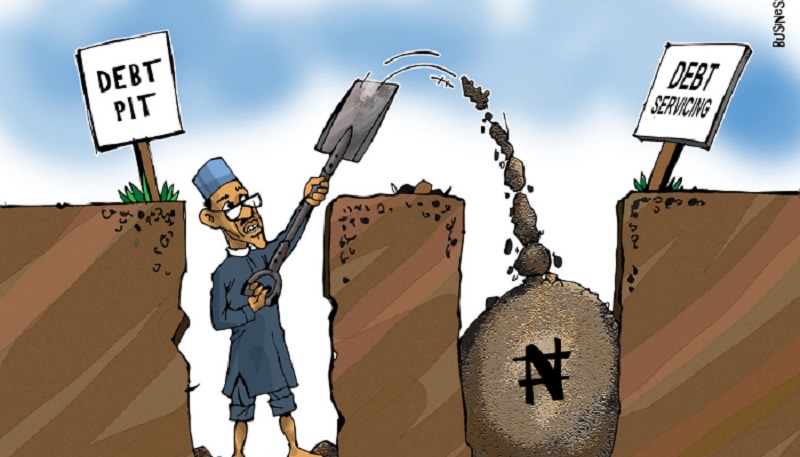
The World Bank has expressed worry over the rising external borrowing costs of Nigeria and other African countries, especially those in sub-Saharan Africa (SSA), noting that in the last 12 years, the region has used about 16.5 per cent of revenue to service debts as against 5 per cent in 2010.
In a press release titled African Governments Urgently Need to Restore Macro-Economic Stability and Protect the Poor in a Context of Slow Growth, High Inflation, the global lender said, “Debt is projected to stay elevated at 58.6 per cent of GDP in 2022 in SSA.
“African governments spent 16.5 per cent of their revenues servicing external debt in 2021, up from less than 5 per cent in 2010. Eight out of 38 IDA-eligible countries in the region are in debt distress, and 14 are at high risk of joining them.
“At the same time, high commercial borrowing costs make it difficult for countries to borrow on national and international markets while tightening global financial conditions are weakening currencies and increasing African countries’ external borrowing costs,” it stated.
According to the bank, it is crucial to increase the effectiveness of current resources and to maximize taxes in light of the current difficult situation.
The biannual analysis of the near-term regional macroeconomic outlook showed that economic growth in Sub-Saharan Africa (SSA) is set to decelerate from 4.1 per cent in 2021 to 3.3 per cent in 2022, a downward revision of 0.3 per cent.
This is mainly due to the slowdown in global growth, including flagging demand from China for commodities produced in Africa.
Due to decreased corporate investments and consumer consumption, the war in Ukraine is impacting on economic activity and aggravating already high inflation.
The report that 29 of the 33 SSA nations having information as of July 2022 had inflation rates exceeding 5 per cent, while 17 nations experienced double-digit inflation.
The bank said, “Global headwinds are slowing Africa’s economic growth as countries continue to contend with rising inflation, hindering progress on poverty reduction. The risk of stagflation comes at a time when high-interest rates and debt are forcing African governments to make difficult choices as they try to protect people’s jobs, purchasing power, and development gains.”
Due to recent economic shocks, instability, and war, and extreme weather, hunger has drastically grown throughout SSA.
The World Bank spoke about the growing debt to GDP ratio, particularly in the high inflationary environment.
Economy
FrieslandCampina, Okitipupa Trigger 0.64% Loss at NASD OTC Bourse
By Adedapo Adesanya
Five securities caused the NASD Over-the-Counter (OTC) Securities Exchange to experience a setback of 0.64 per cent on Monday, February 2.
During the first trading session of February 2026, FrieslandCampinaWamco Nigeria Plc shrank by N4.46 to end at N63.54 per unit versus the previous session’s N68.00 per unit, as Okitipupa Plc depreciated by N3.83 to close at N230.77 per share versus last Friday’s N234.60 per share.
Further, Central Securities Clearing System (CSCS) dropped 50 Kobo to sell at N40.00 per unit compared with the previous closing price of N40.50 per unit, UBN Property Plc dipped by 21 Kobo to N1.99 per share from N2.20 per share, and Acorn Petroleum Plc lost 3 Kobo to end at N1.35 per unit versus N1.38 per unit.
As a result, the market capitalisation went down by N13.98 billion to settle at N2.158 trillion, in contrast to the previous value of N2.171 trillion, and the NASD Unlisted Security Index (NSI) contracted by 23.35 points to settle at 3,606.76 points compared with last Friday’s closing value of 3,630.11 points.
Amid the loss, Geo-Fluids Plc managed to finish green after it chalked up 9 Kobo to sell at N6.84 per share versus the N5.75 per share it ended in the last trading day.
Yesterday, the volume of securities traded by investors surged by 1,238.5 per cent to 3.9 million units from 287,618 units, the value of securities increased by 1,075.2 per cent to N36.0 million from N3.1 million, and the number of deals soared by 90.5 per cent to 40 deals from 21 deals.
At the close of trades, CSCS Plc remained the most traded stock by value (year-to-date) with 15.4 million units valued at N623.9 million, followed by FrieslandCampina Wamco Nigeria Plc with 1.7 million units worth N110.2 million, and Geo-Fluids Plc with 10.6 million units sold for N69.9 million.
CSCS Plc was also the most active stock by volume (year-to-date) with 15.4 million units traded for N623.9 million, trailed by Geo-Fluids Plc with 10.6 million units worth N69.9 million, and Mass Telecom Innovation Plc with 10.1 million units transacted for N4.1 million.
Economy
Renewed FX Pressure Weakens Naira to N1,390/$1 at Official Market
By Adedapo Adesanya
The value of the Naira dropped against the United States Dollar in the the Nigerian Autonomous Foreign Exchange Market (NAFEX) on Monday, February 2 by N3.81 or 0.27 per cent to N1,390.36/$1 from the N1,386.55/$1 it traded last Friday.
This was driven by stronger demand for forex at the official market, which outweighed to what was available to meet customers’ needs. But the local currency remained within the expected trading range.
In the same market window, the domestic currency further appreciated against the Pound Sterling during the session by N6.72 to close at N1,899.51/£1 compared with the preceding session’s rate of N1,906.23/£1 and improved against the Euro by N7.70 to trade at N1,644.52/€1 versus the previous trading day’s value of N1,652.22/€1.
In the parallel market, the exchange rate of the Nigerian Naira to its American counterpart remained unchanged yesterday at N1,465/$1 and at the GTBank FX counter, it also maintained stability at N1,419/$1.
The Naira is expected to remain relatively stable in the coming days, boosted by stronger FX liquidity, enhanced price discovery, and a gradual restoration of offshore investor confidence while Nigeria’s external reserves, which provide the Central Bank of Nigeria (CBN) with the capacity to defend the Naira and stabilise the foreign exchange market, have continued to grow steadily.
Updated data showed that Nigeria’s gross external reserves printed at $46.18 billion as of January 29, 2026, reflecting an addition of $62.40 million.
As for the cryptocurrency market, it was bullish after a sharp weekend sell-off while a resurgent US Dollar index, which has logged its strongest two-day gain in nine months, threatened to keep gains in check.
Expectations that US Federal Reserve chair nominee, Mr Kevin Warsh, will be cautious on interest-rate cuts, along with upcoming US jobs data, are seen as potential drivers of further Dollar strength.
The biggest gainer for the session was Cardano (ADA), which rose by 6.2 per cent to trade at $0.2976, Ethereum (ETH) appreciated by 5.5 per cent to $2,319.80, Dogecoin (DOGE) grew by 5.3 per cent to $0.1066, Binance Coin (BNB) gained 4.8 per cent to sell for $776.00, and Solana (SOL) added 4.6 per cent to sell at $103.75.
In addition, Litecoin (LTC) improved by 4.5 per cent to trade at $59.95, Bitcoin (BTC) appreciated by 3.6 per cent to $78,445.62, and Ripple (XRP) expanded by 3.4 per cent to $1.60, while the US Dollar Tether (USDT) and the US Dollar Coin (USDC) traded flat at $1.00 each.
Economy
NGX Index Records Marginal 0.01% Rise Amid Weak Investor Sentiment
By Dipo Olowookere
The Nigerian Exchange (NGX) Limited managed to finish in the green territory on Monday after it marginally closed higher by 0.01 per cent.
The last minute escape from the bears was triggered by the gains posted by large-cap equities like Zenith Bank, Aradel Holdings and others, offsetting the losses recorded by GTCO, Oando, First Holdco and others.
According to data obtained by Business Post, only 29 stocks ended on the gainers’ chart, while 44 equities landed on the losers’ table, indicating a negative market breadth index and weak investor sentiment.
Universal Insurance rose by 10.00 per cent to sell for N1.32, Premier Paints appreciated by 10.00 per cent to N11.00, DAAR Communications improved by 9.93 per cent to N1.55, RT Briscoe increased by 9.92 per cent to N8.64, and Morison Industries advanced by 9.91 per cent to N10.98.
On the flip side, Omatek declined by 10.00 per cent to N2.70, Union Homes REIT declined by 9.96 per cent to N85.40, AXA Mansard shrank by 9.94 per cent to N14.31, Deap Capital decreased by 9.90 per cent to N8.46, and C&I Leasing moderated by 9.80 per cent to N6.90.
On the first trading session of this week, market participants bought and sold 762.8 million shares valued at N18.4 billion in 55,374 deals compared with the 687.4 million shares worth N15.0 billion traded in 41,553 deals last Friday, a spike in the trading volume, value, and number of deals by 10.97 per cent, 22.67 per cent, and 33.26 per cent, respectively.
Tantalizers ended the day as the most active stock with 88.5 million units sold for N329.4 million, Zenith Bank traded 40.2 million units worth N2.9 billion, Veritas Kapital transacted 39.2 million units valued at N92.1 million, Universal Insurance exchanged 29.3 million units for N38.1 million, and First Holdco transacted 27.6 million units worth N1.1 billion.
The sectorial performance yesterday showed that the mood of investors was in the sell region despite the slight growth recorded by Customs Street, as only the energy index closed in green, rising by 2.00 per cent.
The insurance counter was down by 1.99 per cent, the banking industry depleted by 0.64 per cent, the consumer goods shrank by 0.37 per cent, and the industrial goods retreated by 0.08 per cent.
When the first trading day of February 2026 ended on Monday, the All-Share Index (ASI) went up by 14.23 points to 165,384.63 points from 165,370.40 points, while the market capitalization chalked up N9 billion to finish at N106.162 trillion compared with the previous session’s N106.153 trillion.
-
Feature/OPED6 years agoDavos was Different this year
-
Travel/Tourism9 years ago
Lagos Seals Western Lodge Hotel In Ikorodu
-
Showbiz3 years agoEstranged Lover Releases Videos of Empress Njamah Bathing
-
Banking8 years agoSort Codes of GTBank Branches in Nigeria
-
Economy3 years agoSubsidy Removal: CNG at N130 Per Litre Cheaper Than Petrol—IPMAN
-
Banking3 years agoSort Codes of UBA Branches in Nigeria
-
Banking3 years agoFirst Bank Announces Planned Downtime
-
Sports3 years agoHighest Paid Nigerian Footballer – How Much Do Nigerian Footballers Earn