Economy
Naira Redesigning: Finance Minister Warns of Consequences
By Aduragbemi Omiyale
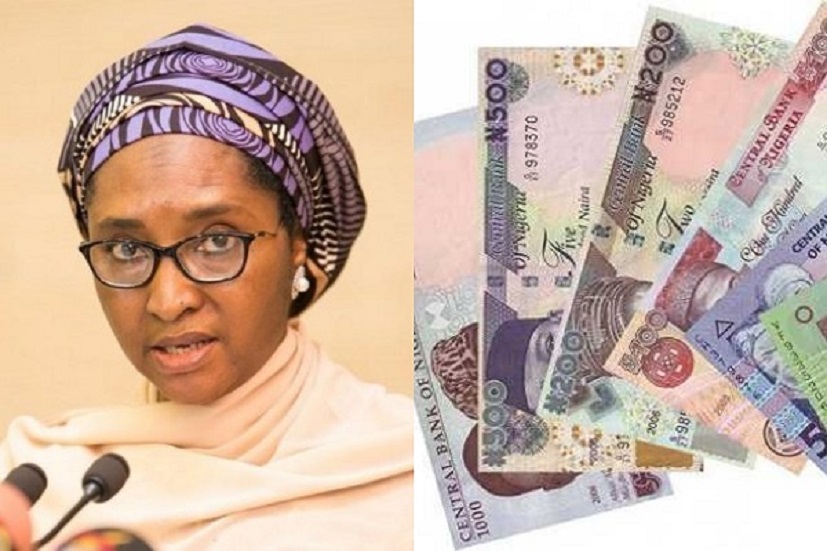
The Minister of Finance, Budget, and National Planning, Mrs Zainab Ahmad, has expressed her displeasure about redesigning the Naira notes by the Central Bank of Nigeria (CBN).
At the 2023 budget defence session with the Senate Committee on Finance, the Finance Minister said it was not the thing to do now, informing the lawmakers that her ministry was never consulted by the apex bank concerning the issue.
Mrs Ahmed said she only heard about the policy in the media, just like every other Nigeria, despite being in charge of the country’s fiscal policy team, urging the committee, headed by Mr Olamilekan Adeola, to invite the central bank to explain the benefits of the new policy.
“Distinguished senators, we were not consulted at the Ministry of Finance by the CBN on the planned Naira redesigning and cannot comment on it as regards merits or otherwise,” she said.
Speaking further, Mrs Ahmed said, “However, as a Nigerian privileged to be at the top of Nigeria’s fiscal management, the policy as rolled out at this time portends serious consequences on the value of the Naira to other foreign currencies.
“I will, however, appeal to this committee to invite the CBN governor for required explanations as regards merits of the planned policy and rightness or otherwise of its implementation now.”
At the hearing on Friday, one of the committee members, Mr Opeyemi Bamidele, raised concerns over the planned redesigning of the nation’s legal tender.
On Wednesday, the Governor of the central bank, Mr Godwin Emefiele, said a new design of the N200, N500 and N1,000 notes would be introduced on December 15, 2022, and the old banknotes removed from circulation on or before January 31, 2023.
This has put the Nigerian Naira under pressure in the foreign exchange (FX) market, especially in the black market, depleting to a low of N787/$1 yesterday.
This was corroborated by Mr Bamidele, who told the Finance Minister that barely two days after the announcement, the value of the Naira to the Dollar had further weakened at the parallel market.
“Just two days after the announcement of the policy, the value of naira to a US dollar has risen from N740/$1 to N788/$1 due to a rush in exchange of Naira notes for foreign currencies, particularly dollars,” he said.
Economy
Nipco, 11 Plc Crash OTC Securities Exchange by 4.76%
By Adedapo Adesanya
Energy stocks influenced the 4.76 per cent loss recorded by the NASD Over-the-Counter (OTC) Securities Exchange on Friday, December 5.
The culprits were the duo of 11 Plc and Nipco Plc,with the former shedding N32.17 to end at N291.83 per share compared with the previous day’s N324.00 per share, and the latter down by N21.00 to sell at N195.00 per unit versus the previous session’s N216.00 per unit.
Consequently, the NASD Unlisted Security Index (NSI) slumped by 170.16 points to 3,401.37 points from 3,571.53 points and the market capitalisation lost N101.81 billion to close at N2.035 billion from the N2.136 trillion quoted in the preceding session.
The OTC securities exchange suffered the decline yesterday despite the share prices of three companies closing green.
Central Securities Clearing System (CSCS) Plc was up by N1.80 to close at N39.80 per share compared with Thursday’s price of N38.00 per share, Air Liquide Plc appreciated by N1.09 to N11.99 per unit from N10.90 per unit, and FrieslandCampina Wamco Nigeria Plc grew by 78 Kobo to N56.57 per share from N55.79 per share.
During the session, the volume of transactions rose by 6,885.3 per cent to 18.2 million units from 4.3 million units, the value of transactions ballooned by 10,301.7 per cent to N389.7 million from N347.2 million, but the number of deals declined by 29.7 per cent to 26 deals from 37 deals.
Infrastructure Credit Guarantee Company (InfraCredit) Plc ended the day as the most traded stock by value on a year-to-date basis with 5.8 billion units worth N16.4 billion, followed by Okitipupa Plc with 170.4 million units valued at N8.0 billion, and Air Liquide Plc with 507.5 million units worth N4.2 billion.
InfraCredit Plc also finished the day as the most traded stock by volume on a year-to-date basis with 5.8 billion units transacted for N16.4 billion, followed by Industrial and General Insurance (IGI) Plc with 1.2 billion units sold for N420.2 million, and Impresit Bakolori Plc with 536.9 million units worth N524.9 million.
Economy
Naira Depreciates to N1,450/$1 at Official Forex Market
By Adedapo Adesanya
The Naira depreciated further against the US Dollar in the Nigerian Autonomous Foreign Exchange Market (NAFEX) on Friday, December 5, as FX demand pressure mounts.
The Nigerian currency lost N2.60 or 0.18 per cent against the greenback to close at N1,450.43/$1 compared with the previous day’s N1,447.83/$1.
Equally, the domestic currency declined against the Pound Sterling in the official forex market during the session by N4.48 to trade at N1,935.45/£1, in contrast to Thursday’s closing price of N1,930.97/£1 and shrank against the Euro by 43 Kobo to end at N1,689.17/€1 versus the preceding session’s rate of N1,688.74/€1.
Similarly, the local currency performed badly against the US Dollar at the GTBank FX counter by N2 to close at N1,455/$1 versus Thursday’s N1,453/$1 but traded flat at the parallel market at N14.65/$1.
As the country gets into the festive period, pressure mounted on the local currency reflecting higher foreign payments and lower FX inflows.
However, there are expectations that the Nigerian currency will be stable, supported by interventions by to the Central Bank of Nigeria (CBN) in the face of steady dollar Demand and inflows from Detty December festivities that will give the Naira a boost after it depreciated mildly last month.
Traders cited by Reuters expect that the Naira will trade within a band of N1,443-N1,450/$1 next week, buoyed by improved FX interventions by the apex bank.
As for the crypto market, it was down yesterday due to profit-taking associated with year-end trading. However, the December 1-Year Consumer Inflation Expectation by the University of Michigan fell to 4.1 per cent from 4.5 per cent previously and 4.5 per cent expected. The 5-Year Consumer Inflation Expectation fell to 3.2 per cent from 3.4 per cent previously and 3.4 per cent expected.
With the dearth of official economic data of late, these private surveys have taken on a new level of significance and the market banks of them to make decisions.
Cardano (ADA) depreciated by 5.7 per cent to $0.4142, Dogecoin (DOGE) slid by 5.1 per cent to $0.1394, Ethereum (ETH) dropped by 3.9 per cent to $3,039.75, Solana (SOL) declined by 3.8 per cent to $133.24, and Litecoin (LTC) fell by 3.7 per cent to $80.59.
Further, Bitcoin (BTC) went down by 2.6 per cent to sell at $89,683.72, Binance Coin (BNB) slumped by 2.2 per cent to $883.59, and Ripple (XRP) shrank by 2.1 per cent to $2.04, while the US Dollar Tether (USDT) and the US Dollar Coin (USDC) remained unchanged at $1.00 each.
Economy
Oil Market Climbs on Federal Reserve Rate-Cut Signals, Supply Concerns
By Adedapo Adesanya
The oil market was up on Friday on increasing expectations the US Federal Reserve will cut interest rates next week, which could boost economic growth and energy demand.
Brent futures rose by 49 cents or 0.8 per cent to $63.75 per barrel and the US West Texas Intermediate (WTI) futures expanded by 41 cents or 0.7 per cent to $60.08 per barrel.
Investors digested a US inflation report and recalibrated expectations for the Federal Reserve to reduce rates at its December 9-10 meeting.
US consumer spending increased moderately in September after three straight months of solid gains, suggesting a loss of momentum in the economy at the end of the third quarter as a lackluster labor market and the rising cost of living curbed demand.
Traders have been pricing in an 87 per cent chance that the US central bank will lower borrowing costs by 25 basis points next week, according to CME Group’s FedWatch Tool.
Investors also focused on news from Russia and Venezuela to determine whether oil supplies from the two sanctioned members of the Organisation of the Petroleum Exporting Countries and allies (OPEC+) will increase or decrease in the future.
The failure of US talks in Moscow to achieve any significant breakthrough over the war in Ukraine has helped to boost oil prices so far this week.
A loss of Venezuelan oil production in case of a US military intervention will materially impact global benchmark prices as the market will have to replace Venezuela’s heavy crude.
Venezuela is estimated to pump about 1.1 million barrels per day of crude oil at present, so if the US-Venezuela tension escalation into an invasion in the South American country, this volume of crude would be at risk.
Reuters reported that the Group of Seven countries and the European Union are in talks to replace a price cap on Russian oil exports with a full maritime services ban in a bid to reduce the oil revenue that helps finance Russia’s war in Ukraine.
Any deal that could lift sanctions on Russia, the world’s second-biggest crude producer after the US, could increase the amount of oil available to global markets, weakening prices.
-
Feature/OPED6 years agoDavos was Different this year
-
Travel/Tourism9 years ago
Lagos Seals Western Lodge Hotel In Ikorodu
-
Showbiz3 years agoEstranged Lover Releases Videos of Empress Njamah Bathing
-
Banking7 years agoSort Codes of GTBank Branches in Nigeria
-
Economy3 years agoSubsidy Removal: CNG at N130 Per Litre Cheaper Than Petrol—IPMAN
-
Banking3 years agoFirst Bank Announces Planned Downtime
-
Banking3 years agoSort Codes of UBA Branches in Nigeria
-
Sports3 years agoHighest Paid Nigerian Footballer – How Much Do Nigerian Footballers Earn