Connect with us

Economy

New Naira Note Will Make Policies More Effective—Emefiele

Published

on

Make Policies More Effective

By Aduragbemi Omiyale

The Governor of the Central Bank of Nigeria (CBN), Mr Godwin Emefiele, has expressed confidence that the new Naira notes unveiled on Wednesday would make policies more effective as they will help to create macroeconomic stability, efficient payments system and confidence.

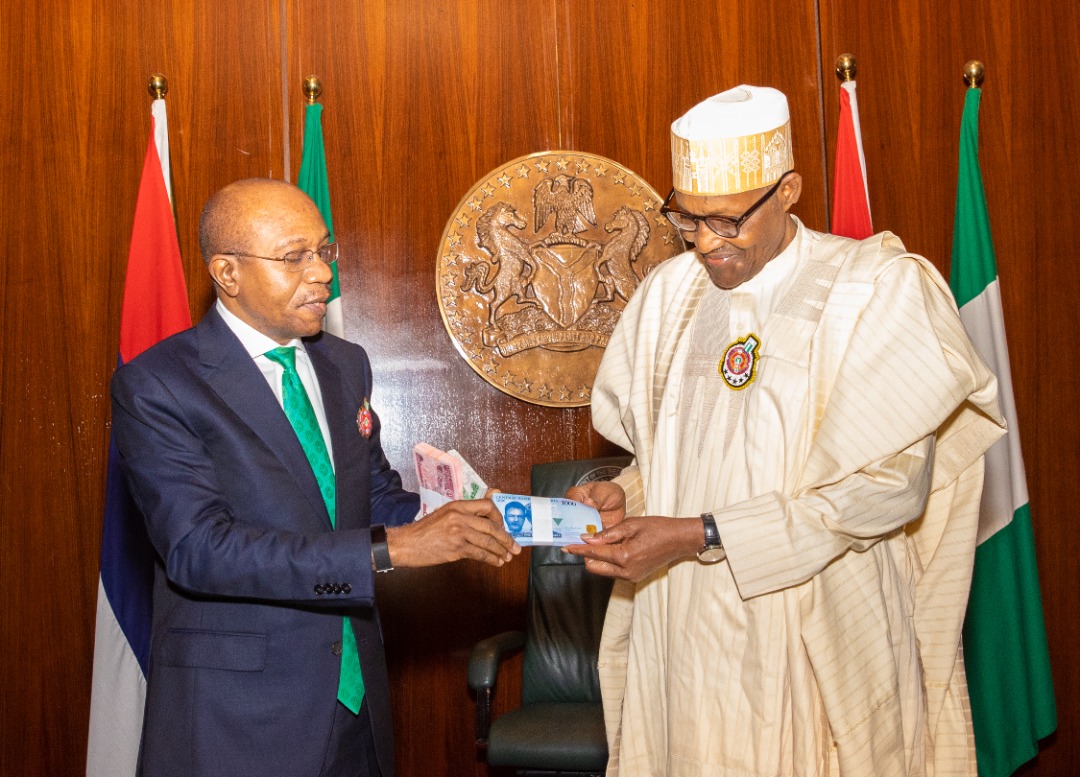
Two days ago, President Muhammadu Buhari unveiled the redesigned N200, N500, and N1,000 banknotes shortly before the commencement of the Federal Executive Council (FEC) meeting in Abuja.

Mr Emefiele, while speaking at the short event, thanked the President for his unwavering support for the redesign and distribution of the new notes, which he said would control inflation and also fight corruption.

He commended Mr Buhari for his insistence that the initial notes must be designed and produced within the country, further placing confidence in Nigerian Security Printing and Minting.

“Mr President, only a President of your esteemed and incorruptible stature, could have done what we are witnessing today,” he added.

The CBN Governor also noted that by international best practice, the redesign of notes should be every five to eight years, and the currency in circulation had been in usage for 19 years, with spiralling challenges on the economy, especially on security and counterfeiting.

He listed the benefits of the redesigned naira notes to include enhanced security, greater durability, attractiveness and promotion of rich cultural heritage.

On his part, the President stated that the “new Naira banknotes have been fortified with security features that make them difficult to counterfeit,” adding that the notes will help the central bank design and implement better monetary policy objectives as well as enrich the collective memory of Nigeria’s heritage.

Acknowledging that international best practice requires central banks and national authorities to issue new or redesigned currency notes every 5 to 8 years, the President noted that it is now almost 20 years since the last major redesign of the country’s local currency was done.

“This implies that the Naira is long overdue to wear a new look.

“A cycle of banknote redesign is generally aimed at achieving specific objectives, including but not limited to: improving the security of banknotes, mitigating counterfeiting, preserving the collective national heritage, controlling currency in circulation, and reducing the overall cost of currency management,” he said.

“As is known, our local laws, specifically the Central Bank of Nigeria Act of 2007, grant the Central Bank of Nigeria the power to issue and redesign the Naira.

“In line with this power, the central bank governor approached me earlier this year to seek my permission to embark on a currency redesign project. I considered all the facts and reasons presented before me by the central bank.

“There was an urgent need to take control of currency in circulation and to address the hoarding of Naira banknotes outside the banking system, the shortage of clean and fit banknotes in circulation, and the increase in counterfeiting of high-denomination Naira banknotes. On this basis, I gave my approval for the redesign of the N200, N500 and N1000 banknotes.

“While this may not be apparent to many Nigerians, only 4 out of the 54 African countries print their currencies in their countries, and Nigeria is one. Hence, a majority of African countries print their currencies abroad and import them the way we import other goods.

“That is why it is with immense pride that I announce to you that these redesigned currencies are locally produced right here in Nigeria,” he noted.


Economy

Police, Capital Market Regulators Partner for Nigeria’s Economic Growth

Published

on

IGP Egbetokun capital market regulators

By Aduragbemi Omiyale

The Nigeria Police Force (NPF) has promised to work with the Securities and Exchange Commission (SEC) and the Nigerian Exchange (NGX) Group Plc for the prevention of financial crime, and the reinforcement of trust and confidence in Nigeria’s capital market.

The Inspector General of Police, Mr Kayode Egbetokun, gave this assurance on Wednesday at the closing gong ceremony in his honour at the NGX in Lagos.

The police chief said, “A transparent and well-regulated capital market is vital to Nigeria’s economic growth. The Nigeria Police Force remains committed to working with regulators and market operators to prevent financial crime, protect investors, and uphold the integrity of our financial system.”

Earlier in his welcome address, the chairman of NGX Group, Mr Umaru Kwairanga, commended the leadership of the police in supporting market integrity.

“Market integrity is a shared responsibility. By honouring the Inspector-General of Police, we are reinforcing the importance of institutional alignment in protecting investors and preserving trust in our financial system.

“Strong collaboration between regulators, enforcement agencies, and market infrastructure institutions is essential to building a resilient and credible market that supports economic growth,” he stated.

The Director-General of SEC, Mr Emomotimi Agama, while speaking, emphasized the importance of coordinated enforcement, noting: “Investor protection is at the core of market regulation, and today’s engagement highlights how critical collaboration with law enforcement is to achieving that mandate. This partnership strengthens our enforcement capacity, enhances deterrence against illegal investment activities, and reinforces confidence in the Nigerian capital market.”

As for the chairman of NGX Limited, Mr Ahonsi Unuigbe, “A transparent and orderly market can only thrive where rules are respected and misconduct is addressed decisively. The presence of the Nigeria Police Force in this collective effort sends a strong signal that safeguarding the market is a national priority.”

Similarly, the chief executive of NGX Group, Mr Temi Popoola, stressed the importance of aligning innovation with oversight, pointing out that, “Technology and market growth must be supported by strong enforcement and investor protection frameworks. Our collaboration with the SEC and the Nigeria Police Force reflects a unified approach to preserving the credibility of Nigeria’s capital market.”

Continue Reading

Economy

NASD OTC Exchange Closes Green by 0.09%

Published

on

NASD OTC exchange

By Adedapo Adesanya

The NASD Over-the-Counter (OTC) Securities Exchange rallied by 0.09 per cent on Wednesday, February 4, amid renewed appetite for unlisted stocks.

This lifted the NASD Unlisted Security Index (NSI) by 3.18 points to 3,641.30 points from the previous session’s 3,641.30 points and raised the market capitalisation by N1.9 billion to N2.180 trillion from the N2.178 trillion quoted on Tuesday.

The bourse recorded three price gainers and four price losers at the midweek session.

The advancers were led by Air Liquide Plc, which went up by N2.04 rise to end at N22.53 per share versus the previous session’s N20.49 per share, Central Securities Clearing System (CSCS) added 97 Kobo to sell at N44.97 per unit versus N44.00 per unit, and Acorn Petroleum Plc appreciated by 2 Kobo to N1.37 per share from N1.35 per share.

On the flip side, Geo-Fluids Plc lost 55 Kobo to sell at N6.26 per unit versus N6.81 per unit, Nipco Plc depreciated by 48 Kobo to trade at N259.00 per share versus N259.48 per share, FrieslandCampina Wamco Nigeria Plc declined by 40 Kobo to N63.10 per unit from N63.50 per unit, and Industrial and General Insurance (IGI) depleted by 1 Kobo to 65 Kobo per share from 66 Kobo per share.

Yesterday, the volume of trades slid by 64.5 per cent to 2.5 million units from 7.0 million units, the value of transaction decreased by 53.2 per cent to N17.7 million from N37.9 million, and the number of deals went down by 47.1 per cent to 18 deals from 34 deals.

CSCS Plc remained the most traded stock by value on a year-to-date basis with 16.0 million units valued at N652.6 million, followed by FrieslandCampina Wamco Nigeria Plc with 1.7 million units exchanged for N111.2 million, and Geo-Fluids Plc with 11.7 million units traded for N76.1 million.

CSCS Plc was also the most active stock by volume on a year-to-date basis with 16.0 million units sold for N652.6 million, trailed by Mass Telecom Innovation Plc with 13.3 million units worth N5.3 million, and Geo-Fluids Plc with 11.7 million units valued at N76.1 million.

Continue Reading

Economy

Naira Rallies to N1,358/$1 at Official Market, N1,450/$1 at Parallel Market

Published

on

Naira parallel market

By Adedapo Adesanya

The Naira rallied at the different segments of the foreign exchange (FX) market on Wednesday as supply continues to outweigh demand, giving it an edge against the United States Dollar.

In the parallel market, the Nigerian Naira improved its value on the greenback yesterday by N5 to quote at N1,450/$1 compared with the previous day’s N1,455/$1, and at the GTBank FX desk, it gained N3 to trade at N1,383/$1, in contrast to Tuesday’s exchange rate of N1,386/$1.

In the the Nigerian Autonomous Foreign Exchange Market (NAFEX), which is also the official market, the Naira firmed up against the Dollar at midweek by N14.63 or 1.1 per cent to settle at N1,358.28/$1 versus the preceding session’s N1,372.91/$1.

Against the Pound Sterling, the domestic currency appreciated on Wednesday by N14.16 to N1,863.43/£1 from the previous day’s N1,877.59/£1, and gained N13.73 on the Euro to end at N1,606.03/€1 versus the N1,619.76/€1 it was exchanged a day earlier.

The strengthening of the Naira value has been driven by the injection of forex into the financial markets by foreign investors seeking attractive investments in the emerging markets, helping to boost Nigeria’s external reserves, which provide the Central Bank of Nigeria (CBN) with the capacity to support the local currency.

As of February 4, 2026, the reserves reached $46.59 billion.

The local currency has been able to find a solid path despite no indications of any intervention from the apex bank in recent week, strengthening the case of price discovery.

Policy moves by the CBN is also offering a backbone for the FX market as it considers some strategic reforms through a policy known as the Single Regulatory Window.

In its 2025 Fintech Report, the central bank said this scheme will significantly reduce time-to-market for new digital financial products by streamlining licensing and supervisory processes across multiple agencies.

Meanwhile, the cryptocurrency market was in red amid a broad sell-off in global technology stocks, with reports showing that liquidity was notably thin, amplifying price moves and contributing to forced liquidations. The decline followed a sharp sell-off in global technology stocks overnight, where concerns over the pace of artificial intelligence adoption and rising capital spending by major firms weighed heavily on valuations.

Bitcoin (BTC) lost 7.9 per cent to sell at $70,534.94, Ripple (XRP) declined by 11.2 per cent to $1.42, Binance Coin (BNB) slumped by 9.4 per cent to $689.70, Ethereum (ETH) crashed by 8.9 per cent to $2,072.46, and Solana (SOL) dipped by 8.7 per cent to $89.86.

In addition, Dogecoin (DOGE) depreciated by 6.9 per cent to $0.1008, Cardano (ADA) slipped by 6.8 per cent to $0.2792, Litecoin (LTC) dropped 5.1 per cent to trade at $57.56, and US Dollar Tether (USDT) went down by 0.1 per cent to $0.9980, while the US Dollar Coin (USDC) closed flat at $1.00.

Continue Reading

Trending