Connect with us

General

US Threatens Sanctions Over Voter Intimidation at Lagos Guber, Others

Published

on

voter intimidation Lagos

By Adedapo Adesanya

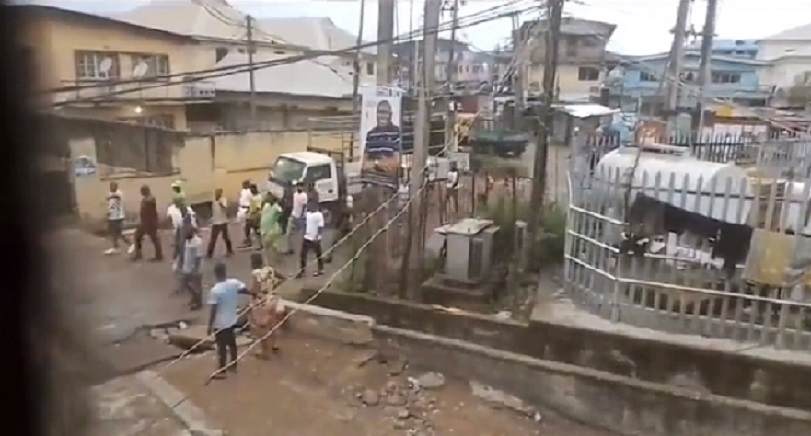
The United States government has condemned the disturbing acts of violent voter intimidation and suppression that took place during the governorship polls in Lagos and 27 states in Nigeria on Saturday, March 18.

The world power also said it would consider all available actions, including additional visa restrictions, on individuals believed to be responsible for, or complicit in, undermining the democratic process in Nigeria.

In a statement on Tuesday, the US diplomatic mission in Nigeria said it observed the elections in Lagos and elsewhere and witnessed some of these incidents first-hand.

It condemned “The use of ethnically charged rhetoric before, during, and after the gubernatorial election in Lagos,” which it said “was particularly concerning.”

“We commend all Nigerian political actors, religious and community leaders, youth, and citizens who have chosen to reject and speak out against such violence and inflammatory language, affirming Nigerians’ commitment to and respect for the democratic process.

“We call on Nigerian authorities to hold accountable and bring to justice any individuals found to have ordered or carried out efforts to intimidate voters and suppress voting during the election process.

“The United States likewise will consider all available actions, including additional visa restrictions, on individuals believed to be responsible for, or complicit in, undermining the democratic process in Nigeria.

“Following the February 25 national elections, the United States joined other international observers in urging the Independent National Electoral Commission (INEC) to improve voting processes and technical elements that experienced flaws in that voting round.

“The March 18 elections appear to have had significant operational improvements, as polling stations generally opened on time and most results were visible on an electronic viewing platform in a timely manner,” the statement read.

The United States used the opportunity to call on those dissatisfied with the outcome of the exercise to go through established legal processes to reclaim their mandate.

“We further call for Nigeria’s people to work together as they participate in and continue to strengthen the country’s vibrant democracy,” the statement added.

Business Post reports that the candidate of the Labour Party (LP) in the governorship election in Lagos, Mr Gbadebo Rhodes-Vivior, has promised to approach the court to challenge the exercise.


Adedapo Adesanya is a journalist, polymath, and connoisseur of everything art. When he is not writing, he has his nose buried in one of the many books or articles he has bookmarked or simply listening to good music with a bottle of beer or wine. He supports the greatest club in the world, Manchester United F.C.

Advertisement
Click to comment

Leave a Reply

Your email address will not be published. Required fields are marked *

General

Supreme Court Empowers Tinubu to Declare Emergency Rule, Suspend Elected Officials

Published

on

supreme court Nigeria

By Adedapo Adesanya

The Supreme Court has upheld the power of the President to declare a state of emergency in any state to prevent a breakdown of law and order or degeneration into a state of chaos or anarchy.

In a split decision of six-to-one, the apex court held that the President, during a state of emergency, can suspend elected officials, but within a limited period.

In the lead majority judgment, Justice Mohammed Idris held that Section 305 of the Constitution empowers the President to deploy extraordinary measures to restore normalcy where emergency rule is declared.

Justice Mohammed Idris noted Section 305 was not specific on the nature of the extraordinary measures, thereby granting the President the discretion on how to go about it.

The judgment was on the suit filed by Adamawa State and 10 other Peoples Democratic Party-led states challenging the propriety of the state of emergency declared by President Bola Tinubu in Rivers State, during which elected state officials, including Governor Siminalayi Fubara, were suspended for six months.

On March 18, President Tinubu declared a state of emergency in Rivers State following a reported attack on crude oil pipelines; and in the same breath, suspended the sitting governor and his deputy, Mrs Ngozi Odu. He then put in place a sole administrator.

This was challenged at the apex court by some states.

Justice Idris, in the earlier part of the judgment, upheld the preliminary objections raised by the two defendants against the competence of the suit.

In upholding the objections raised by the Attorney General of the Federation (AGF) and the National Assembly (the defendants), Justice Idris held that the plaintiffs (the 11 PDP states) failed to establish any cause of action capable of activating the original jurisdiction of the apex court.

He struck out the suit for want of jurisdiction, proceeded to also determine the case on the merits, and dismissed it.

However, Justice Obande Ogbuinya dissented and held that the case succeeded in part.

Among others, Justice Ogbuinya held that although the President could declare a state of emergency, he cannot use such powers as a tool to suspend elected state officials, including governors, deputy governors, and members of parliament.

Continue Reading

General

AI in Agriculture, Retail Sectors May Lead to Double Digit Growth by 2035

Published

on

ai in agriculture

By Adedapo Adesanya

High-impact sectors, including agriculture, wholesale and retail, will see double digit increases with the integration of artificial intelligence (AI) across Africa by 2035.

This is according to a new report by the African Development Bank (AfDB) developed under the G20 Digital Transformation Working Group, Africa’s AI Productivity Gain: Pathways to Labour Efficiency, Economic Growth and Inclusive Transformation, which establishes a strategic roadmap for unlocking the economic and social potential of AI across the continent.

The study, carried out by consulting firm Bazara Tech, finds that inclusive AI deployment could generate up to $1 trillion in additional GDP by 2035 equivalent to nearly one-third of the continent’s current economic output.

The report added that this is underpinned by Africa’s growing digital capacity, favorable demographics, and ongoing sectoral reforms, making it one of the most promising regions for AI-driven growth globally.

According to the report the AI dividend is expected to be concentrated in select high-impact sectors, rather than spread evenly across Africa’s economy. Analysis identified five priority sectors—agriculture (20 per cent), wholesale and retail (14 per cent), manufacturing and Industry 4.0 (9 per cent), finance and inclusion (8 per cent), and health and life sciences (7 per cent)—which together are projected to capture 58 per cent of the total AI gains, or approximately $580 billion by 2035. These sectors combine economic size, readiness to adopt AI, and strong potential to deliver inclusive development outcomes.

“We have set out the key actions in this report, identifying the areas where initial implementation should be focused,” said Mr Nicholas Williams, Manager of the ICT Operations Division at AfDB.

“The bank is ready to release investment to support these actions. We expect the private sector and the government to utilize this investment to ensure we achieve the identified productivity gains and create quality jobs,” he added.

The report also revealed that realising the potential of AI depends on five interlinked enablers: data, compute, skills, trust, and capital. Reliable and interoperable data forms the foundation for AI insights, while scalable compute infrastructure ensures solutions can be deployed efficiently across the continent.

It noted that a skilled workforce is essential to develop, implement, and maintain AI systems, and trust built through governance, and regulatory frameworks underpins adoption.

The report also noted that the enablers, together with adequate capital investment to de-risk innovation and accelerate deployment, would “foster a cycle of AI-driven growth.”

The report also outlines a three-phase roadmap toward Africa’s AI readiness: ignition (2025-27), consolidation (2028-31) and scale (2032-35).

“Achieving early milestones by 2026 will set Africa’s AI flywheel in motion,” said Mr Ousmane Fall, Director of Industrial and Trade Development at the bank. “Africa’s challenge is no longer what to do — it is doing it on time.”

Continue Reading

General

Crude Oil Tanker Seized Near Venezuela Not Registered in Nigeria—NIMASA

Published

on

MV Skipper

By Adedapo Adesanya

The Nigerian Maritime Administration and Safety Agency (NIMASA) has clarified that the crude oil vessel, MV Skipper, intercepted by the United States Coast Guard, in collaboration with the US Navy for its alleged involvement in crude oil theft and other transnational crimes is not registered in Nigeria.

NIMASA said the Very Large Crude Carrier (VLCC) SKIPPER with IMO Number 9304667 is not a Nigerian-flagged vessel, and its purported owners, Thomarose Global Ventures Limited, are not registered with NIMASA as a shipping company.

An analysis of the vessel’s movement carried out NIMASA through its Command, Control, Communication, Computers and Intelligence (C4i) Centre showed that the facility was last sighted on Nigerian waters on July 1, 2024.

“After departing Nigerian waters, the vessel continued on its international voyage pattern and was tracked operating in the Arabian Sea (Asia) and later in the Caribbean region, where the US interdiction eventually took place.

“Records indicate that SKIPPER, which was formerly owned by Triton Navigation Corp, has undergone multiple name changes over time.

The Director General of NIMASA, Mr Dayo Mobereola, reaffirmed the agency’s commitment to collaborate with all relevant stakeholders, including US authorities, in the ongoing investigations, noting that in a statement that criminality will not be tolerated on Nigerian waters.

Last week, US forces seized an oil tanker carrying a Panama flag believed to be the VLCC Skipper, after satellite imagery showed the vessel secretly loading over 1.8 million barrels of sanctioned Merey crude at Venezuela’s José Terminal.

The vessel had been transmitting falsified AIS positions during the operation, a tactic increasingly used by “dark fleet” tankers tied to Venezuelan and Iranian trades. It was later revealed that the seized tanker Skipper, was carrying crude contracted by Cubametales, Cuba’s state-run oil trading firm.

The seizure of the sanctioned oil tanker has sharply escalated tensions between the US and Venezuela. The US government also said it is preparing to intercept more ships transporting Venezuelan oil.

Continue Reading

Trending