Economy
Calm as Nigerians Begin to Get Cash at ATMs, POS Terminals
By Adedapo Adesanya
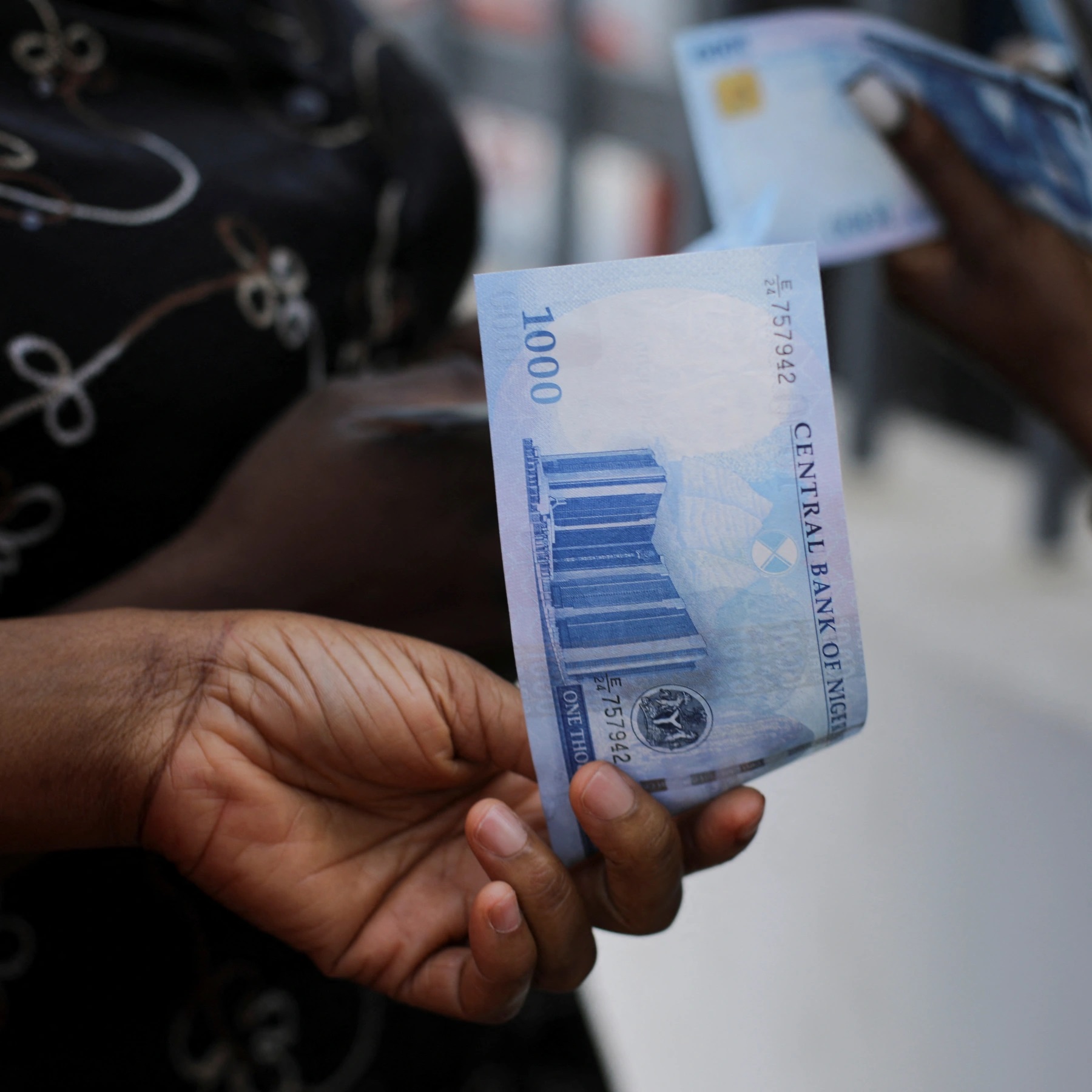
Relative ease has returned to the country as Nigerians have begun to get cash at automated teller machines (ATMs) and Point-of-Sale (POS) terminals, Business Post gathered on Monday.
Nigerians had to contend with a 30-50 per cent markup and N2,000 daily limit to get money at the agent bankers’ shops and N5,000-N10,000 at the ATMs and banking halls following a cash redesign and cashless policy drive of the government and the Central Bank of Nigeria (CBN).
But the new development has seen more cash in the system.
Recall that the Supreme Court judgement of March 3, 2023, extended the validity of the old N200, N500, and N1,000 notes as legal tender currency up till December 31, 2023, after many Nigerians and businesses suffered from the resultant cash crunch.
This came after over 15 state governments convinced the apex court to reverse the policy, with Justice Emmanuel Agim saying the correct process had not been followed.
“The directive given by President is invalid. Such directive is not just handed down after personal conversation with the governor of CBN,” he said.
The court also berated President Muhammadu Buhari for not obeying a previous provisional order to halt the policy until it decided the case. It said there was nothing to show that President Buhari’s directive for the release of old N200 until April 10 was implemented.
It wasn’t until March 13 that the decision was given the official go-ahead by the CBN, a day after President Buhari absolved himself of the delay in implementing the apex court ruling.
In the latest development, many Nigerians are finding solace as more cash becomes available, especially at the grassroots, where the policy was largely felt.
Speaking to our reporter, a POS agent, identified simply as Ruth, said she has to slash the cost of charges as money became available to them at the banks, eliminating the hoops they had to jump through during the peak of the cashless policy of the CBN.
Business Post gathered that although the rate was not the same as pre-policy, it was considerably milder than it was before. The base sums of N1,000 and N2,000 now go for N100 from N300 and N500 previously, while the sum of N5,000 now has a fee of N200 compared to N1,000 while operators now charge N500 for N10,000 versus N2,000 they earlier collected.
According to Boluwatife, an animator, “It is better now than before; at least now, we can get cash, and it is so much better than before. I have been managing the one with me, but unlike before, it is better.”
This was echoed by Oluwaranti, a marketer, who said, “In my area in Aguda, it is getting better because the charges have reduced drastically,” quoting figures that align with that of Business Post.
It is expected that as more cash gets into the system, the hardships faced by Nigerians will further reduce, and normalcy will return even as the policy aimed at taming inflation, kidnapping, counterfeiting, and vote-buying yielded little to no return.
Economy
Stocks Sheds 0.94% on Commencement of NGX Extended Market Session
By Dipo Olowookere
The Nigerian Exchange (NGX) Limited suffered a 0.94 per cent loss on Monday, April 27, 2026, which marked the commencement of an extended market session.
A few weeks ago, it was announced that trading activities on Customs Street would now be from 9:00 am to 4:00 pm instead of the usual 9:30 am to 2:30 pm.
This action was taken to allow market participants more time to explore the bourse and further make it robust, especially after the restoration of Nigeria’s frontier market status by FTSE Russell.
The NGX came under selling pressure, which resulted in 35 equities finishing on the gainers’ chart and 40 equities ending on the losers’ table, indicating a negative market breadth index and weak investor sentiment.
Trans-Nationwide Express, First Holdco, and UBA were the worst-performing equities after giving up 10.00 per cent each to trade at N7.11, N67.50, and N49.50, respectively. Access Holdings depreciated by 9.90 per cent to N28.20, and Fidelity Bank crashed by 9.87 per cent to N20.10.
The best-performing equity for the session was Abbey Mortgage Bank, which gained 9.26 per cent to N5.90, Zichis went up by 8.91 per cent to N16.99, Wema Bank expanded by 8.80 per cent to N34.00, NPF Microfinance Bank soared by 8.19 per cent to N5.68, and Coronation Insurance grew by 7.27 per cent to N2.66.
It was observed that the profit-taking was mainly from banking stocks, as the index shed 6.49 per cent. The consumer goods sector lost 0.41 per cent, and the energy counter depreciated by 0.24 per cent.
However, the industrial goods space improved by 0.85 per cent, and the insurance segment appreciated by 0.15 per cent.
But at the close of business, the All-Share Index (ASI) slipped by 2,120.20 points to 223,602.29 points from 225,722.49 points, and the market capitalisation shrank by N1.365 trillion to N143.970 trillion from N145.335 trillion.
A total of 678.2 million shares worth N44.1 billion were traded in 82,838 deals on Monday compared with 627.6 million shares valued at 44.5 billion transacted in 55,232 deals last Friday, representing a drop in the trading value by 0.90 per cent, and a surge in the trading volume and number of deals by 8.06 per cent and 49.98 per cent, respectively.
Zenith Bank was at the zenith of the activity chart yesterday with 76.1 million units sold for N9.5 billion. Wema Bank traded 49.9 million units worth N1.7 billion, Access Holdings exchanged 39.1 million units valued at N1.1 billion, Tantalizers transacted 30.0 million units worth N113.9 million, and AIICO Insurance traded 28.3 million units valued at N118.3 million.
Economy
Nigeria Boosts Oil Theft Curbing with Naval Drill
By Adedapo Adesanya
Nigeria has ramped up efforts to secure its oil-rich waters and curb maritime crime, deploying significant naval assets under Exercise Obangame Express 2026 to protect critical energy infrastructure and trade routes in the Gulf of Guinea.
Flagging off the exercise in Onne, Rivers State, the Chief of Naval Staff, Vice Admiral Idi Abbas, said the exercise is central to safeguarding economic assets and sustaining investor confidence in Nigeria’s maritime domain.
“The safer maritime environment has enhanced investor confidence, increased shipping activities and supports the Federal Government’s drive towards a sustainable blue economy,” he said in a statement.
The multinational exercise, coordinated with the United States Africa Command, focuses on combating oil theft, piracy, illegal trafficking and other threats that directly impact Nigeria’s oil revenues and regional trade flows.
The focus on maritime security comes amid persistent concerns over crude oil theft and supply chain disruptions, which continue to undermine Nigeria’s production capacity.
Mr Abbas emphasised that coordinated regional efforts remain the most effective response to evolving threats.
“OBANGAME EXPRESS provides a unique opportunity for participating nations to train together, operate together and build the trust necessary for real-time coordination,” he said.
He added that no country can independently secure its maritime domain, stressing the need for sustained partnerships to protect the Gulf’s strategic energy corridor.
Also, the Commander, Eastern Naval Command, Rear Admiral CD Okehie, said the operation reflects a strategic shift toward protecting high-value maritime assets.
“The Gulf of Guinea serves as a major global sea lane of commerce, making it indispensable not only to regional economies but also to international trade,” he noted.
According to him, the Navy’s deployment of 10 ships, helicopters and special forces is designed to strengthen surveillance, interdiction and rapid response capabilities.
With Nigeria’s offshore assets and export routes forming a backbone of national revenue, the exercise signals a renewed push to tighten security, reduce losses and stabilise the broader oil and gas ecosystem.
Economy
Why We Did Not Pay Dividend for FY 2025—Nigerian Breweries
By Aduragbemi Omiyale
When shareholders of Nigerian Breweries Plc gathered at the company’s 80th Annual General Meeting (AGM) in Lagos, on Wednesday, April 22, 2026, one thing they were sure was not on the agenda was the approval of a dividend for the 2025 financial year.
This was because the board did not propose the payment of a cash reward to investors for the fiscal year for some reasons, which were explained at the meeting.
The chairman of the organisation, Ms Juliet Anammah, told shareholders that the dividend payout was skipped to rebuild retained earnings impacted by prior macroeconomic shocks, particularly foreign exchange-related losses.
“We recognise the importance of dividend payments to our shareholders and sincerely appreciate your continued understanding.
“While we are not declaring a dividend at this time due to negative retained earnings, we are working diligently to restore the company’s financial position and return to dividend payments as soon as it is sustainable to do so,” she explained.
Ms Anammah noted that the board remains vigilant to external risks, including the Middle East crisis and broader macroeconomic challenges, which may impact the pace of improvement in the 2026 financial year.
She thanked shareholders for their continued support and reaffirmed that the company will build on its 2025 performance as it accelerates growth ambitions.
“We have a solid foundation built over eight decades, anchored on a strong portfolio of brands, an extensive nationwide sales and supply chain network, ongoing digital transformation, and most importantly, our people. These strengths remain critical to sustaining our leadership position,” she said.
Despite the non-payment of cash reward for the year, shareholders applauded Nigerian Breweries for strong recovery and improved profitability in the 2025 financial year, driven by disciplined cost management and a significant reduction in finance expenses.
One of them, Mr Eke Emmanuel, who is the immediate past Secretary of the Independent Shareholders Association of Nigeria, praised the board and management for steering the company through a volatile macroeconomic environment while strengthening its financial position, noting that the company’s resilience, at a time when several businesses exited the country, reflects strong leadership and a sound strategic direction.
“It is good news that we have been here for 80 years. There is no reason why we will not be here for the next 80 years with what we have achieved. To return to this level of profitability and cash position shows the Board has done an enormous amount of work,” he said.
Another shareholder, Mr Owolabi Opeyemi of the Noble Shareholders Association, confessed that, “We are proud of how the company has withstood the ups and downs of a challenging environment. The return to profitability and the reversal of the negative cash position recorded in the previous two financial years is commendable.”
-
Feature/OPED6 years agoDavos was Different this year
-
Travel/Tourism10 years ago
Lagos Seals Western Lodge Hotel In Ikorodu
-
Showbiz3 years agoEstranged Lover Releases Videos of Empress Njamah Bathing
-
Banking8 years agoSort Codes of GTBank Branches in Nigeria
-
Economy3 years agoSubsidy Removal: CNG at N130 Per Litre Cheaper Than Petrol—IPMAN
-
Banking3 years agoSort Codes of UBA Branches in Nigeria
-
Banking3 years agoFirst Bank Announces Planned Downtime
-
Sports3 years agoHighest Paid Nigerian Footballer – How Much Do Nigerian Footballers Earn