Economy
Nigeria’s Dollar Bonds Rise After Tinubu Inauguration
By Adedapo Adesanya
Nigeria’s dollar bonds rallied after President Bola Tinubu was officially conferred as the 16th president of Nigeria, a day that he announced plans to scrap the fuel subsidy programme, unify the exchange rate regime, as well as reduce high interest rates.
Bonds with a maturity date of 2047 jumped 3.3 per cent to 66.750 cents on the Dollar.
The debt instrument due in 2049 gained 2.9 per cent, and those maturing in 2051 advanced 3.5 per cent.
The gains came as markets in London and the US reopened following national holidays as well as a day after Mr Tinubu’s speech at his inauguration on Monday.
On fuel subsidy, Mr Tinubu said, “Subsidy can no longer justify its ever-increasing costs in the wake of drying resources. We shall instead re-channel the funds into better investment in public infrastructure, education, health care and jobs that will materially improve the lives of millions.
“We commend the decision of the outgoing administration in phasing out the petrol subsidy regime, which has increasingly favoured the rich more than the poor.”
He said that since there was no provision for subsidy in the budget from July 1, noting that the policy would be removed.
He also planned to bring Nigeria into a unilateral exchange rate regime to help staunch the continued FX crisis that has gripped investors and average Nigerians.
“The Central Bank must work towards a unified exchange rate. This will direct funds away from arbitrage into meaningful investment in the plant, equipment and jobs that power the real economy,” he said.
He also assured both local and foreign investors that his administration would move to reduce the high interest rate that has stymied faith in Nigeria being a destination for good investments.
“Interest rates need to be reduced to increase investment and consumer purchasing in ways that sustain the economy at a higher level,” Mr Tinubu said.
Economy
Nigerian Stocks Shed 0.38 per cent as Sell-Offs Persist
By Dipo Olowookere
A 0.38 per cent loss was suffered by Nigerian stocks on Tuesday on the back of continued selling pressure from investors embarking on profit-taking.
Data from the Nigerian Exchange (NGX) Limited showed that the contraction was influenced by the 1.78 per cent decline recorded by the insurance sector, the 0.24 per cent slip printed by the consumer goods index, and the 0.09 per cent drop posted by the energy space, offsetting the 0.75 per cent growth achieved by the banking sector and the 0.21 per cent growth recorded by the industrial goods segment.
Investor sentiment was weak during the trading day, as the bourse ended with 13 price gainers and 40 price losers, representing a negative market breadth index.
LivingTrust Mortgage depreciated by 10.00 per cent to N3.42, Multiverse also shed 10.00 per cent to N22.95, McNichols dropped 9.92 per cent to N5.45, Thomas Wyatt dipped by 9.87 per cent to N3.56, and Eterna lost 8.57 per cent to trade at N33.00.
On the flip side, AVA Capital improved by 9.94 per cent to N9.95, Livestock Feeds expanded by 9.71 per cent to N8.65, Neimeth increased by 8.43 per cent to N9.00, AIICO gained 3.47 per cent to settle at N4.18, and Oando grew by 3.30 per cent to N36.00.
A total of 1.6 billion equities valued at N28.7 billion exchanged hands in 54,160 deals yesterday versus the 923.0 million equities worth N37.9 billion traded in 72,544 deals on Monday, indicating a 73.35 per cent surge in the trading volume, a 24.27 per cent decline in the trading value, and a 25.34 per cent slip in the number of deals.
The busiest stock was Japaul, which transacted 904.4 million units for N2.7 billion. Sterling Holdings sold 54.0 million units valued at N431.9 million, FCMB exchanged 49.5 million units worth N545.9 million, Chams traded 44.9 million units for N199.2 million, and Neimeth sold 42.4 million units worth N327.8 million.
Business Post reports that the All-Share Index (ASI) gave up 927.70 points to 244,802.83 points from 245,730.53 points, and the market capitalisation receded by N599 billion to N158.016 trillion from N158.615 trillion.
Economy
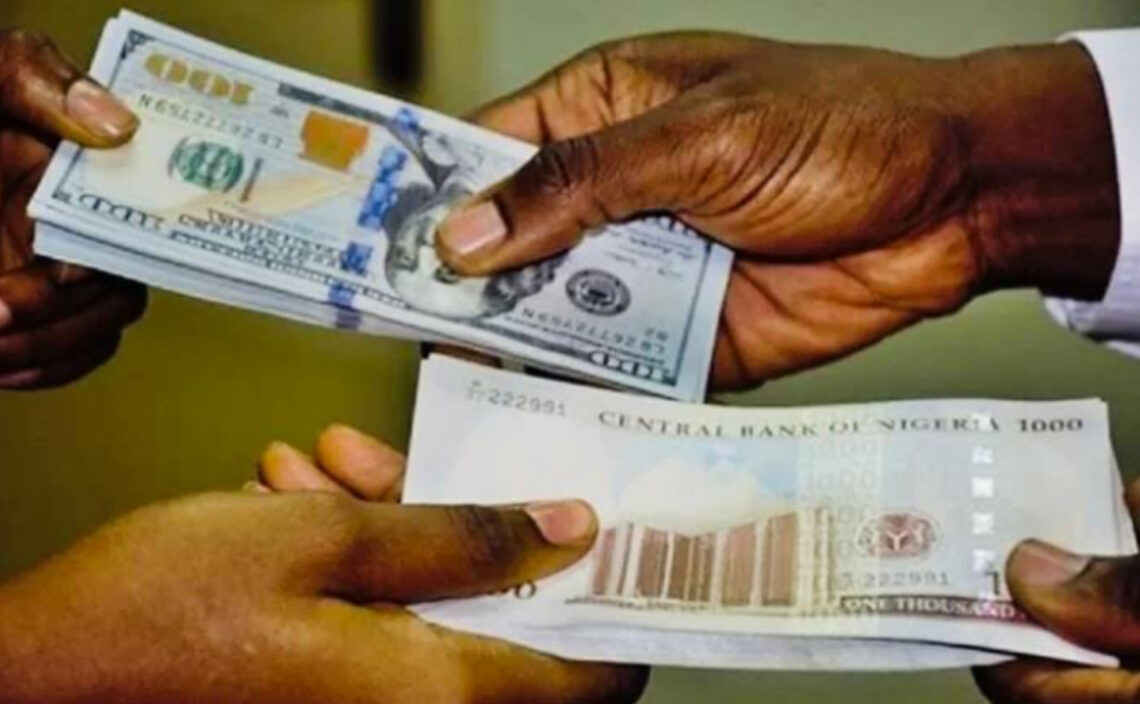
Naira Firms to N1,362/$1 at NAFEX, N1,400/$1 at Parallel Market
By Adedapo Adesanya
The Naira put up a better performance against the United States Dollar in the various segments of the foreign exchange (FX) market on Tuesday, August 4.
In the parallel market, it improved its value by N5 to settle at N1,400/$1 compared with the previous day’s value of N1,405/$1, and at the GTBank forex desk, it appreciated by N1 to close at N1,373/$1, in contrast to the preceding session’s N1,374/$1.
In the Nigerian Autonomous Foreign Exchange Market (NAFEX) segment, the Nigerian currency gained N2.28 or 0.17 per cent against the greenback to quote at N1,362.55/$1 compared with the N1,364.83/$1 it was exchanged a day earlier.
Also in the official market, the local currency appreciated against the Pound Sterling during the session by N6.48 to finish at N1,831.41/£1 versus N1,837.89/£1, and chalked up N5.22 on the Euro to sell at N1,568.71/€1 versus N1,573.93/€1.
Interbank FX transactions increased 14 per cent day-on-day as market makers’ activities raised total Dollar volume exchanged to $156.23 million, more than 132 per cent above $137.05 million in turnover at the previous close.
The interbank FX turnover rose despite a marginal rise in deals at the NFEM window as data from the central bank put Tuesday’s quote at 139 from 138.
As for the cryptocurrency market, major tokens were mixed as global stock indexes hit fresh records on renewed enthusiasm for artificial-intelligence-related shares.
With cheaper oil, easing rate expectations and a strong risk-on rally in equities supporting digital assets, analysts say crypto appears to be driven by internal market dynamics rather than macroeconomic factors, even as traders watch for a potential Strait of Hormuz deal.
It was reported overnight that Iran and Oman were close to an agreement to reopen the Strait of Hormuz, with an announcement targeted for Wednesday.
Binance Coin (BNB) grew by 1.8 per cent to $600.54, Bitcoin (BTC) rose by 0.9 per cent to $64,199.86, Solana (SOL) jumped by 0.8 per cent to $73.95, and Ethereum (ETH) advanced by 0.7 per cent to $1,867.21.
But Cardano (ADA) depreciated by 1.9 per cent to $0.1908, TRON (TRX) dipped by 0.6 per cent to $0.3268, Dogecoin (DOGE) slumped by 0.5 per cent to $0.0698, and Ripple (XRP) crashed by 0.4 per cent to $1.06, while the US Dollar Tether (USDT) and the US Dollar Coin (USDC) traded flat at $1.00 apiece.
Economy
Brent Falls Below $80 Per Barrel on Claims of US-Iran Talks Progress
By Adedapo Adesanya
Brent crude dropped below $80 per barrel, precisely losing $4.41 or 5.3 per cent to settle at $79.36 a barrel on Tuesday, after comments by officials from the United States and Qatar raised hopes for a diplomatic resolution to the Iran war, which could improve oil flows through the Strait of Hormuz.
Also, the US West Texas Intermediate (WTI) futures depreciated by $4.57 or 5.7 per cent to trade at $75.77 a barrel.
US Secretary of State Marco Rubio said on Tuesday there was progress in talks with Iran and Oman about moving more ships through the strait, but a final agreement was yet to be reached.
Also, Treasury Secretary Scott Bessent had said earlier on Tuesday that a deal with Iran to reopen the strait could come as soon as Tuesday or Wednesday.
Qatar’s Foreign Ministry spokesperson Majed al-Ansari said efforts to secure a diplomatic resolution to the war were continuing.
Qatar said it has discussed with US President Donald Trump ways to reduce escalation and converge viewpoints between the US and Iran.
Meanwhile, the latest round of US-facilitated talks between Israel and Lebanon began on Tuesday and will continue through Thursday.
Amid this, Iran still wants control over inbound shipping and visibility over outbound traffic through the Strait of Hormuz, with the ability to intervene if necessary, as part of a plan being discussed with Oman to reopen the strategic waterway.
Market analysts noted that the prospect of a diplomatic solution to the conflict has helped remove some of the geopolitical risk premium in oil prices. If negotiations between the US and Iran make meaningful progress, the market could continue pricing in a lower probability of supply disruptions.
Disruptions to shipping through the strait, through which a fifth of global oil and gas flowed before the war, have forced Middle Eastern nations to cut oil output sharply. The world has lost more than 2.6 billion barrels of oil since the Iran war began in February.
Shipping traffic at the key Gulf waterways of Bab el-Mandeb and the Strait of Hormuz remained unchanged at the start of the week.
The American Petroleum Institute (API) estimated that crude oil inventories in the US rose by 2.69 million barrels in the week ending July 30. Commercial crude oil inventories excluding the SPR have lost just over 58 million barrels over the last sixteen weeks, with US crude inventories down just 7.2 million for the year, according to API data.
Official data from the US Energy Information Administration (EIA) will be released later on Wednesday.