World
Russia and Algeria Open New Chapter For Bilateral Cooperation
By Kestér Kenn Klomegâh
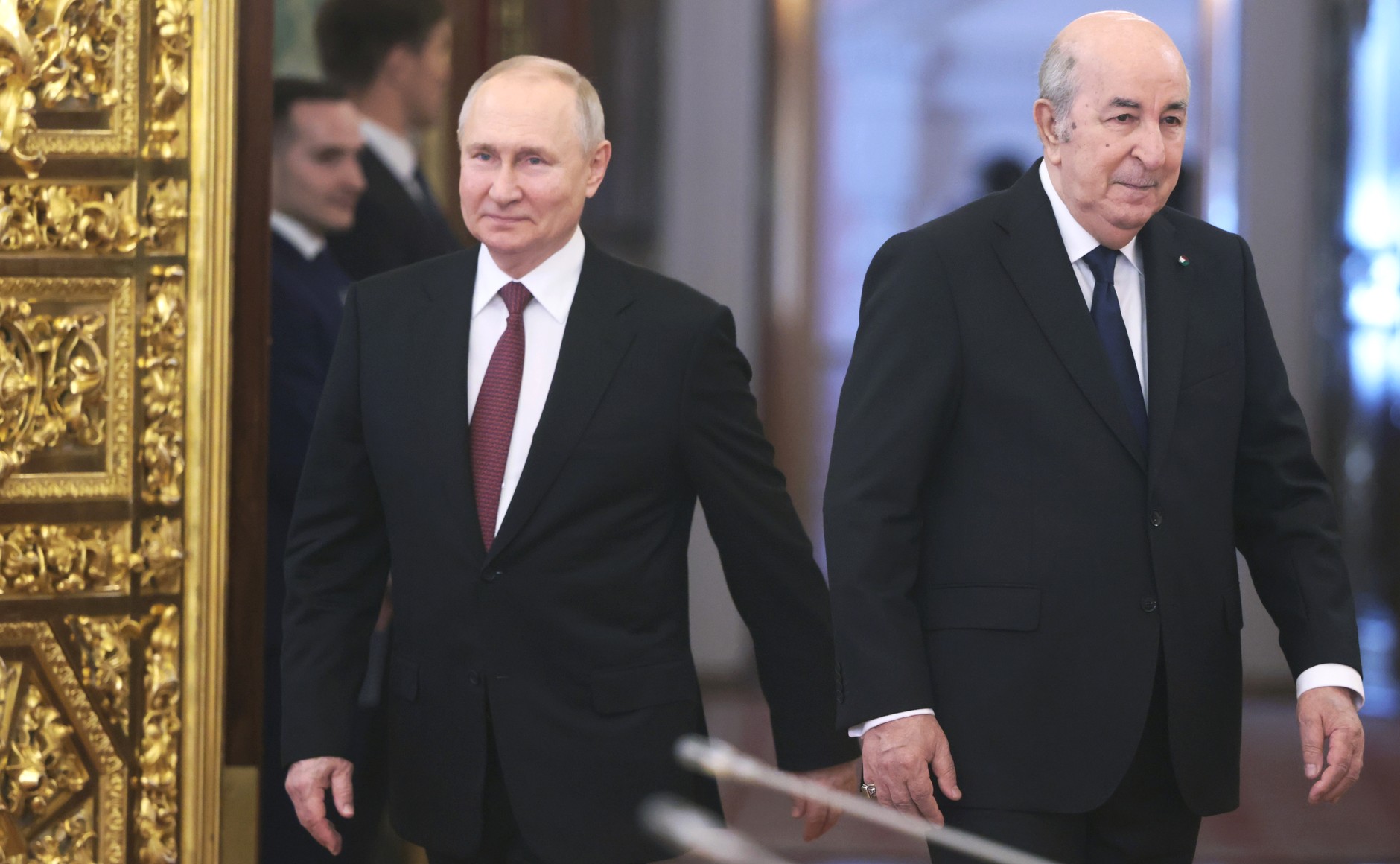
Algerian President Abdelmadjid Tebboune and his delegation visited Russia from June 14 through 16 to forge a strategic partnership between the two countries. He went to Moscow at the invitation of Russian President Vladimir Putin. This special invitation had been conveyed by Foreign Minister Sergey Lavrov during his visit to Algiers in May last year to strengthen relations of “friendship and cooperation” between the two countries. Some Algerian media have criticized the visit amid Russia’s war in Ukraine.
The Algerian leader brought an extensive ministerial delegation to attend the 26th International Economic Forum (SPIEF)held at the ExpoForum Convention and Exhibition Centre in St. Petersburg, the second-largest city in the Russian Federation. The significance of this visit is that (i) Algeria intends to convince potential Russian investors about the economic opportunities available in this North African country and (ii) to make conscious attempts at seeking support for its ascension into the BRICS, which includes Brazil, Russia, India, China and South Africa.
On June 14, Chairman of the Delovaya Rossiya (Business Russia) Association, Alexey Repik, at the Russian-Algerian business forum stressed that “Russian business welcomes Algeria’s application for admission to the BRICS+ format,” but the final decision would be determined on the basis, and criteria set the BRICS. South Africa will host the next BRICS summit in August in Johannesburg.
In addition to the above, Alexey Repik further noted that a number of measures should be taken to expand economic cooperation between entrepreneurs of the two countries. According to my research sources, Delovaya Rossiya comprises 72 regional and 43 sectoral unions. Its influence has grown substantially over these years. Evidence of this resides in the tangible results of its activities and, of course, in the growing role of industrial production businesses in the Russian Federation.
That’s quite a serious organisation. Therefore it is important that Russia keeps its competitive edge in this market in this volatile North Africa. Like many African countries, Algeria favours foreign investment, but its political situation restricts and drives away potential Western businesses. The country has experienced a wave of economic protests and demonstrations over the previous years.
There’s nothing to be afraid of, as risk management is part of the business. It implies that Russian business leaders from this organisation are desirous of exploring the geographical proximity, but still, there are doubts if investment be undertaken due to instability in the Maghreb region, especially in Algeria and Libya.
In particular, extending a visa-free regime to business representatives and expanding travel opportunities is necessary. This could be the first step to facilitating travel possibilities between Russia and Algeria. There are some more challenges, including logistics, trade preferences and customs tariffs. Delovaya Rossiya Chairman Repik stressed, during his discussions and with entrepreneurial optimism, that the potential for cooperation has not been fully fulfilled, primarily in agricultural exports: Russian grain and Algerian olives and dates.
According to reports, Russia 2021 exported $1.48 billion worth to Algeria, while during the same year, Algeria only exported $17.3 million, primarily tropical fruits, to Russia. More attention should be paid to projects related to innovation as an additional step to widen economic cooperation. It is, however, believed that “Russian technologies can help increase the competitiveness of Algerian products on world markets.”
Prior to their arrival in Moscow this mid-June, Advisor to the President of the Russian Federation Anton Kobyakov held discussions with Ambassador Extraordinary and Plenipotentiary of Algeria to Russia Smail Benamara. Kobyakov emphasized the noticeable strengthening of multifaceted strategic cooperation between the countries: “Last year marked the 60th anniversary of the establishment of diplomatic relations between our countries, and we can say with all certainty that the bonds of friendship and cooperation between our countries and peoples have stood the test of time. The People’s Democratic Republic of Algeria has proven itself a reliable partner. I am sure that the Algerian delegation’s participation in SPIEF will facilitate further all-encompassing Russian-Algerian cooperation.”
One important task involves increasing and diversifying trade between the countries. Algeria has been one of Russia’s most important trading partners in Africa for many years now. As of the end of 2022, Algeria ranked third in terms of trade turnover among Russia’s African partners, though great potential still remains for further commercial and economic interaction.
“It means a lot to us that Russian partners also attach such importance to our delegation’s attendance at the Forum and would like to develop relations between Russia and Algeria further. We will do everything we can to accelerate mutually beneficial projects,” Benamara reassured, as this constitutes one of his diplomatic tasks in the Russian Federation.
Algeria could become Russia’s outpost in North Africa and a partner in the global gas market in this changing geopolitical situation. Weighing the prospects for Russian-Algerian cooperation, Stanislav Mitrakhovich, an Expert at the Financial University and the National Energy Security Fund, named the field of energy as one of the top priority areas for joint initiatives.
“Algeria is one of the largest gas suppliers to the EU, and European politicians have been trying to convince this Arab country to increase gas supplies. However, domestic consumption there is growing and increased production demands large-scale investments. Algeria will increase liquified natural gas supplies, but pipeline exports are more complicated: Algeria is not happy with Spain’s position in the Western Sahara conflict, where Madrid supports Morocco. So, the gas pipeline from Algeria to Spain via Morocco has ceased to function as an export route to Europe; only an underwater pipeline from Algeria to Europe remains,” he told Financial Daily Kommersant before the presidents’ official talks.
“Under current conditions, Russia could potentially offer Algeria, if not complete market sharing, at least assistance in coordinating issues concerning priority export destinations and counteracting attempts by Western countries to introduce gas price limit mechanisms, as well as in fighting discrimination by (Green-oriented) European politicians against gas as an energy resource,” Stanislav Mitrakhovich concluded, adding that “Russia has proposals for Algeria on nuclear energy and on agriculture. Additionally, Russia, and previously the USSR, supported Algeria precisely on the sensitive issue of Western Sahara.”
On June 15, Algerian President Abdelmadjid Tebboune’s talks with Russian President Vladimir Putin touched on the strategic partnership and international issues, including the Middle East, the Sahel region, as well as energy cooperation within the OPEC+, the Kremlin’s information portal said. Russia and Algeria are working closely together as part of OPEC+ and the Gas Exporting Countries Forum. There was also a declaration signed which aimed at deepening cooperation. It bolsters Russia-Algeria relations.
“Cooperation between Russia and Algeria is now truly multidimensional and has considerable potential for further development. The declaration on deepening the strategic partnership between Russia and Algeria, which marks the beginning of a new, even more, advanced stage of our bilateral relations,” Putin said.
According to him, regular political dialogue plays an important role. “We are in almost constant contact with you; our colleagues are working,” the Russian president pointed out and added that Algeria is one of Russia’s three leading trade partners on the African continent. Speaking about the Russia-Algeria Business Forum, Putin said that he hoped the interest of both sides in such events “will only grow.”
Putin reminded that “relations with Algeria are of particular importance for our country and are of a strategic nature; we recalled that relations between Russia and Algeria began to take shape back in the mid-1950s and developed. We can say that they were already strategic in nature – without any exaggeration.”
Last year marked the 60th anniversary of establishing diplomatic relations between both countries. The USSR provided significant support during the liberation struggle, and in the early years of Algeria’s independence, it contributed to the formation of Algeria as an independent, sovereign state and the formation of its economy in a number of areas.
Regular political dialogue plays an important role, constantly working with colleagues: Minister of Foreign Affairs Sergey Lavrov, Secretary of the Security Council Nikolai Patrushev, and Chairman of the Upper House of the Russian Parliament Valentina Matvienko. An intergovernmental commission also coordinates the development in various spheres of mutual interest.
Algeria is one of Russia’s three leading trade partners on the African continent. “I would also like to note that Russian-Algerian coordination within multilateral formats and organizations is also at a good level. In conclusion, our efforts through OPEC Plus and the Gas Exporting Countries Forum contribute to stabilising world energy markets,” Putin said.
President Abdelmadjid Tebboune expressed deep satisfaction with this meeting. This testifies to the depth of friendship between Algeria and the Russian Federation. “First, we must preserve our independence – thanks to the support of the Russian Federation, which provides us with weapons to maintain our independence in these difficult conditions. Even before we started negotiations, we almost agreed on all the points related to the international situation. As you know, the situation is very tense. It is necessary that we speed up the process, that we enter the BRICS group and that we accept not dollars, not euros. This will be beneficial for Algeria,” he told Putin.
“As for the geopolitical situation, relations here, we must touch on the Libyan issue. Libya is a friend of Russia and Algeria, so we always want stability in this country. With regard to the Sahel region, we support the relations that exist between Mali and the Russian Federation. Mali is a neighbour of our country. In all conditions, we must talk and discuss all issues. We have an agreement called the Algiers Agreement,” he underlined in his speech at the Kremlin.
Russia previously signed agreements within the framework of the Joint Military-Technical Cooperation. Besides importing military weapons and equipment, Russia has little investment in its economic sectors. Most of Algeria’s weapons are imported from Russia, with whom they are close allies. For instance, in 2007, the Algerian Air Force signed a deal with Russia to purchase 49 MiG-29SMT and 6 MiG-29UBT at an estimated cost of $1.9 billion. Russia is also building two 636-type diesel submarines for Algeria.
Over the years, Algeria has been looking forward to expanding commercial and economic cooperation with Russia. The state dominates the economy, a legacy of the country’s socialist post-independence development model. In recent years, the Algerian government has halted the privatization of state-owned industries and imposed restrictions on imports and foreign involvement in its economy.
Considered part of the Maghreb region and along with the Mediterranean Sea, Algeria has an estimated population of 44 million. It has large untapped quantities of hydrocarbons. Algeria has the 10th largest reserves of natural gas in the world and the sixth largest gas exporter and since 1969 a member of the Organisation of the Petroleum Exporting Countries.
Gas-rich Algeria is in a delicate position regarding its long-standing ties to Russia. With drastically less capacity, Algeria is increasingly eyed by European countries looking to reduce their reliance on Russian energy amid the war in Ukraine. The North African nation has replaced Russia as Italy’s No. 1 energy supplier. Russia has long supplied Algeria with military equipment.
The theme of the 26th St. Petersburg forum: ‘Sovereign Development as the Basis of a Just World: Joining Forces for Future Generations’ and significant questions discussed were related to the key trends and changes in the Russian and global economy, aspects of the emerging multipolar world. Business issues were connected with Eurasia and Asian-Pacific region. As expected, Africa featured on the sidelines.
SPIEF is an annual gathering of influential Russian and international politicians, government officials, businessmen and representatives of the academic community. The St. Petersburg International Economic Forum was launched in 1997, and since 2006, it has been held under the patronage and with the Russian Federation President’s participation.
World
Russia Eyes African Students to Boost Strategic Influence
By Kestér Kenn Klomegâh
Russia’s system of foreign students’ admission is currently experiencing a completely different shape, due to the rapidly shifting geopolitical reality. The emerging trends are closely connected with increasing the number of highly interested applicants rather than the quality of education. The geopolitical shift is pushing Russia to make education for young Africans an ultimate priority. The quota campaign has already begun as the figure compares favourably with previous benchmarks but, to some considerable extent, noticeable challenges are currently affecting enrollment from Africa, Asia, and Latin America.
Despite that, general interest in Russian education among foreign nationals is increasing; the quota campaign confirms this trend. Last year, for instance, there were about 144,000 registrations in Rossotrudnichestvo’s Education in Russian system. The number has exceeded 160,000 in 2026. What is important here is that Russia shows preparedness to get more students from developing countries, especially from Africa and uses it as a factor for influencing its foreign policy in the region.
Regarding educational initiatives, the Russian Ministry of Foreign Affairs, in conjunction with relevant agencies and organisations are active in Africa. Noticeably, Russia is developing and expanding the existing, successfully operating cooperation in the sphere of education. In fact, priority is given to projects in the field of education and training of professional personnel for African countries. Currently, over 37,000 students from Africa are studying at Russian universities. Reports say a gradual increase in the number of scholarships for African citizens and the expansion of the range of professional training programs will provide a strong incentive for further promoting education at Russian universities.
This will continue to actively strengthen inter-university ties with African partners, including through specialised umbrella organisations such as the Russian-African Network University, the Consortium of Technical Universities “Nadra Africa” based at the Empress Catherine II St. Petersburg Mining University, the Russian-African Network Transport University, and the Consortium of Russian Universities Working in West Africa based at the NGO “Centre for Public Diplomacy.”
Reports further indicated that the Rossotrudnichestvo representative offices—the Russian Science and Culture Centres—operating in eight African countries, as well as the Open Education Centres operating under the auspices of the Russian Ministry of Education in 31 African countries, serve as a solid foundation for our humanitarian presence in Africa. They serve as conduits for the Russian language and culture on the continent. It is, however, hoped that their number would only increase in the subsequent years.
While addressing the staff and students at the Moscow State Institute of International Relations, Foreign Affairs Minister Sergey Lavrov reiterated Russia’s readiness to cooperate actively in the sustainable economic development and to strengthen efforts at training the needed specialists and professionals for Africa. After the collapse of the Soviet system in 1991, there were problems sustaining relations with Africa. Then, after more than a decade, Russia started to return to Africa. This process has been ongoing for the past 15 years, according to the top Russian diplomat.
According to Lavrov, these past few years have been characterised by frequent interactions between Russian and African Foreign Ministers, plethora of MoUs were signed that set out the broad parameters of cooperation. Russia’s Education Ministry and the Foreign Affairs Ministry have raised the quotas for many African countries, the highest given to Angola, Ethiopia, Namibia and Mozambique, and South Africa.
According to a report posted on the MFA website in August, for instance, some 1,120 Angolans have enrolled, on Russian scholarships or grants, at various institutes and universities throughout the Russian Federation. Figures for other African countries are available on the official information portal of the ministry.
Besides state-sponsored students, Russia’s Education Ministry has also launched a large-scale educational campaign targeting the recruitment of private foreign students into its educational institutions across the Russian Federation. The program is to be implemented until 2025, which has a website (studyinrussia) translated into different languages, seeks to boost the popularity and improve its image abroad.
Undoubtedly, Russia aims at strengthening the next generation of pro-Russian elites who will help promote its interests, including long-term ones in their home countries. With this in mind, the Ministry of Education and the Ministry of Foreign Affairs, ultimately, hope to improve the efficiency of “soft power” in Africa, though not to the levels during the Soviet era.
Understandably, Russia is now targeting Africa’s fast-growing population as a huge potential market for knowledge transfer and export education. Rossiyskaya Gazeta, a widely circulated Russian daily newspaper, reported that Russia has been focusing on the young population in developing countries of Asia, Africa and Latin America, targeting the elite and middle class in these markets for the export of education, which has great potential.
The newspaper reported on the advantages of multiculturalism and cross-cultural interactive activities paving the way for integration in Russian society. As far back as 2023, Russia’s Federation Council and State Duma (upper and lower houses of parliament) passed a bill. That bill was finally signed into law, allowing foreign students the right to employment, a replica of the work and study model in Western and European countries.
Professor Viktor Sadovnichy, Rector of Moscow State University and Chairman of the Russian Rectors’ Association, an organisation that unites more than 700 heads of higher education institutions, argued that education and demography are interconnected; developing countries of Asia, Africa and Latin America have growing middle classes. “This favours the export of our education; it has great potential cooperating in the education sphere, it could serve as a huge market – training young professionals that are in demand on the labour market,” Sadovnichy said, addressing a plenary meeting of the Russian Rectors’ Association at Peter the Great St Petersburg State Polytechnic University.
Professor Natalia Vlasova, Deputy Rector at the Department of International Relations and Cooperation of the Ural State University of Economics in Yekaterinburg, explained that many African countries are developing rapidly, and the African elites and the growing middle-class have great potential for sponsoring their children’s education abroad. “In the times of the Soviet Union, African countries were strategic partners, and now we should reactivate these relations because in the near future they will have big economic and political power. This could, indeed, be a huge market and has the business potential,” she noted assertively.
An educational survey released in September 2024, divided into five major groups, said Russia has made significant efforts at improving teaching (the learning environment), research, citations (research influence), knowledge transfer, and international outlook (staff, students, research) in the educational field, according to the Times Higher Education (THE) World University Rankings.
World
From Conviction To Execution: LEAD Launches Its Second Cohort In Rabat
By Kestér Kenn Klomegâh
One year after launching a continental initiative designed to make excellence in public governance the foundation of a new drive to transform Africa, LEAD, the Africa CEO Forum’s pan-African leadership programme, takes stock of its first cohort and announces the launch of its second class. Built around a community of senior public decision-makers committed to modernising the state and to the continent’s digital transformation, this new cohort gathers for three days, from 28 to 30 August 2026, on the campus of Mohammed VI Polytechnic University (UM6P) in Rabat, Morocco.
A second cohort that confirms the programme’s durability
For its second class, LEAD brings together 50 fellows, senior public decision-makers engaged in the design and implementation of the continent’s economic and social policies. Over three days, participants take part in collective and collaborative working sessions, peer exchanges and meetings with figures from the public, business and academic spheres, in order to compare their practices and build shared responses to the major challenges of governance.
Speakers include Mehdi Jomaa, former Head of Government of Tunisia, Donald Kaberuka, Managing Partner & Founder, SouthBridge Group, and former President of the African Development Bank, Serge Ekue, President of the West African Development Bank (BOAD), Sanjay Jain, co-creator of India Stack and Director of Digital Public Infrastructure, Gates Foundation, and Mauricio Cardenas, Professor of Professional Practice in Global Leadership, Columbia SIPA, and former Finance Minister of Colombia (2012-2018).
They share their reform experience, their public policy trade-offs and their view of continental priorities. Throughout the programme, the cohort benefits from the dedicated support of Mohammed VI Polytechnic University, Asafo & Co, BOAD, BCG and the African Development Bank, LEAD partners that have chosen to invest in the transformation of African public action.
LEAD, a pan-African community serving public action
Created by the AFRICA CEO FORUM, LEAD is a leadership programme whose ambition is to reposition Africa’s administrative elite as a driver of reform, of performance and of dialogue with all the continent’s stakeholders.
Designed for senior African public decision-makers, LEAD sets out to build a lasting community of public officials able to share their experience, compare their practices and build common solutions to the major economic, technological and institutional transformations under way in Africa. That community is structured around three pillars: modernizing the state, improving public services, and strengthening cooperation between governments, development institutions and private-sector players.
From fellows to alumni: a long-term initiative
Made up of 36 fellows drawn from a range of administrations and institutions and representing 24 countries across the continent, LEAD’s first cohort demonstrated the quality and the potential of this community from its very first year. In less than twelve months, six of its members have taken a significant step forward: two have been appointed ministers, two have moved into strategic positions at the highest level of the state and two have been promoted to chief executive roles. These moves, which account for 16.7% of the first class, show the role LEAD plays as an accelerator of impact within African administrations.
By bringing together a new cohort of fellows every year, each of them joining the LEAD alumni community, the initiative follows a long-term trajectory: in time, to unite several hundred African public decision-makers around a shared culture of transparency, performance and regional cooperation.
A first year devoted to public service and digital public infrastructure
Throughout the year, the fellows devoted their work to strengthening African public action, to make excellence in public governance a central lever of transformation. An awareness campaign, run as part of Africa Public Service Day, brought to light those who, within the continent’s administrations and institutions, are concretely transforming public policy and improving the services offered to citizens.
Members of the cohort also took part in a special round table held in Kigali during the ACF 2026, in order to carry their thinking to a wider community of public and private leaders. That forum reinforced LEAD’s role as a platform for dialogue between the administrative elite and the continent’s economic players. Digital public infrastructure (DPI) formed the main thread of this first year of work.
Discussions covered issues at the heart of the digital sovereignty of African states: digital identity, payments, secure data exchange, interoperability, governance and the protection of citizens. This work examined the conditions under which African states are developing, in some cases, and can develop, in others, shared, open infrastructure robust enough to improve the quality of public services while supporting local innovation and preserving the capacity of public authorities to set the rules of the game.
A white paper to move from consuming technology to creating value
This year of work concludes with the publication, in collaboration with BCG, LEAD’s Knowledge Partner, of a white paper on Africa’s place in the digital economy and in artificial intelligence. With the digital economy still accounting for around 5% of African GDP, against close to 15% worldwide, the paper calls on the continent to shift from a logic of technology consumption to one of value creation.
The white paper identifies three structuring priorities for African public actors:
- Building shared digital infrastructure that serves as the backbone of public services and private innovation.
- Pooling investment in order to reach critical mass and avoid the fragmentation of efforts across the continent.
- Favouring open and interoperable architectures, with trust and governance built in by design, so as to protect citizens while stimulating the entrepreneurial ecosystem.
The white paper is available here to all public decision-makers, technical partners and institutions concerned.
“LEAD’s first cohort confirms a simple conviction: Africa already has the women and men capable of profoundly transforming public action. Our responsibility, either with our partners, is to give them, at pan-African level, a space in which to compare experience, build common solutions and bring forward a new generation of public policy. With this second cohort, we want to accelerate the move from ambition to execution, in particular on digital public infrastructure and artificial intelligence, two decisive issues for sovereignty, for the effectiveness of the state and for value creation across the continent,” says Amir Ben Yahmed, President of the Africa CEO Forum.
World
Global Leaders Head to Addis Ababa for First World Public Summit in Africa
By Kestér Kenn Klomegâh
Africa is set to make history as it hosts the World Public Summit for the first time, with Addis Ababa, Ethiopia, welcoming global leaders and changemakers from July 29–30, 2026, for the landmark gathering under the theme “New World: Africa in Shaping a Shared Future.”
The inaugural African edition of the World Public Summit marks a significant milestone in the continent’s growing role in shaping international dialogue on governance, sustainable development, human-centred leadership and global cooperation.
Hosted by the World Peoples Assembly in partnership with African and international organisations, the summit will convene government officials, diplomats, business leaders, academics, journalists, youth representatives, civil society organisations and cultural leaders from across Africa and around the world.
According to Andrey Belyaninov, General Secretary of the World Peoples Assembly, “the Summit is not just a meeting—it is a space for unity. A space where the ‘values that unite us’ come to life: respect for people, openness to the world, responsibility for the future, and a commitment to creation.
“Today, we understand more clearly than ever: the future cannot be built alone. It is born in dialogue, in trust, in the ability to listen to one another and to act together.”
The programme begins on July 29 with a series of high-level roundtables and expert discussions covering Pan-African economic integration, civil society, education, scientific cooperation, cultural diplomacy and humanitarian partnerships.
The opening plenary, “Values, Development and Partnership as the Basis of a Sustainable and Just World,” will explore how African values—including Ubuntu—can help shape a more inclusive and sustainable global future. Discussions will also focus on youth leadership, innovation, civil society, ethical AI, public initiatives and international partnerships.
The summit will also showcase Africa’s creativity and innovation through the “Innovations for the Future” exhibition, the contemporary African art exhibition “Unity,” and the international exhibition “The World Paints Happiness.”
Another featured initiative is “The Zambezi River: Economy, Society, Soul,” an international interdisciplinary project exploring the river’s socioeconomic importance across Angola, Botswana, Mozambique, Namibia, Zambia and Zimbabwe, highlighting the shared heritage and development potential of one of Africa’s most important waterways.
The event will conclude with the adoption of the African Communiqué, reflecting the summit’s shared vision for stronger international cooperation, sustainable development and people-centred leadership.
Tsegaye Chama, General Secretary of the Global Black Centre, promised that, “The Summit will be delivered with exceptional distinction, reflecting the magnitude and spirit of the World Peoples Assembly. It embodies a unity that is not transactional, but purposeful and conscious, a unity that shapes new contours for a world that works for all peoples of the World.”
As delegates prepare to arrive in Addis Ababa, anticipation continues to build for what promises to be one of Africa’s most significant international gatherings of 2026—one that will place the continent firmly at the centre of global conversations about the future.