Connect with us

Economy

Official FX Rate to Hit N800/$1 Soon—EIU

Published

on

Nigeria's FX earnings

By Adedapo Adesanya

The Economic Intelligence Unit (EIU) has predicted that the Central Bank of Nigeria (CBN) will revert to heavier management of the exchange rate in late 2023 to tame rapid price rises, as evidence shows that the rates are widening across several windows after a float of the currency in June.

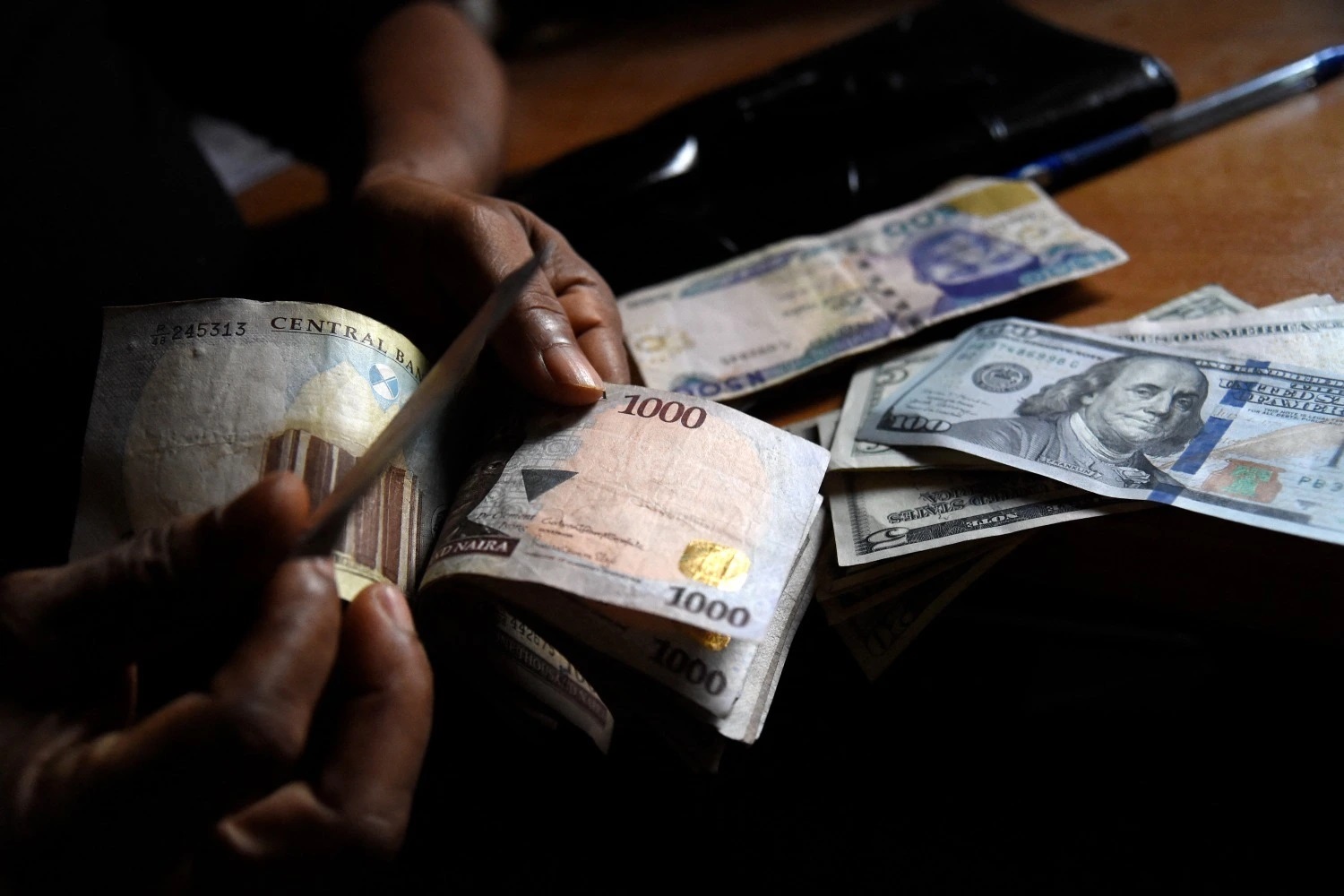
Business Post reported that the Naira closed at N775.76/$1 at the Investors and Exporters (I&E) window last Friday, while it sold at an average of N867 to a Dollar at the parallel market.

The EIU, which is an arm of London-based The Economist Magazine, stated in its Country Report on Nigeria, released over the weekend, that the wide gap between the I&E window and the parallel market before the FX unification is making a return due to illiquidity.

According to the EIU, “The new exchange rate is classed by the CBN as a ‘managed float’, but there are inconsistencies in application to a more liberal currency regime as foreign-exchange access restrictions still apply to an array of imports. This will unnerve foreign investors, and a backlog of FX orders the CBN failed to clear before opening up the market, and deeply negative real interest rates will keep liquidity tight.

“Along with high and rising inflation, the naira will be under significant pressure in the near term. The CBN lacks experience in conducting monetary policy under a float, and the need to control rapidly increasing inflation will become more acute over time.

“Our forecast is finely balanced, but we expect a return to heavier exchange-rate management from the second half of 2023 as the naira slides beyond N800:US$1, from N770:US$1 in early July.

“The CBN (according to official data) has the wherewithal to increase market intervention; 98 per cent of foreign reserves are liquid, and import cover is projected at 6 to 8 months in 2023. Based on this, we expect the currency to depreciate at a slower rate than fundamentals would imply over the medium to long run, given structurally high inflation.

“The average rate is forecast at N815:US$1 in 2024, sliding to N1,018:US$1 by end-2027, with a spread of 10-15 per cent against the black-market over the period.”

It also noted that rapid increases in inflation were expected from June 2023 as the price effects of market reforms transmit immediately into the system, even as it anticipated that the Monetary Policy Committee (MPC) would ramp up a monetary tightening cycle that began in early 2022, starting with the next meeting in late July.

“Interest-rate rises totalling 500 basis points are expected before end-2023, meaning 1,300 basis points will have been added since the cycle began and a peak rate of 23.5% – the highest level since 1993. However, this forecast is caveated with risks; the MPC attaches a large weight to economic growth in its decision-making formula, Mr Tinubu is opposed to high-interest rates, and the CBN’s independence is questionable.

“The small size of the financial sector (the private-sector credit/GDP ratio is just 22%) blunts the effectiveness of interest rates in countering inflation. We forecast that the CBN will maintain a tight stance until 2025, by which point disinflation and sustained monetary easing in advanced markets will justify aggressive interest-rate cuts to 14 per cent by 2026.

“Inflation will at all times be above the nine per cent target ceiling, but the CBN is expected to prioritise stimulus over its price stability mandate,” it added.

The EIU also forecast that Nigeria’s real Gross Domestic Product (GDP) growth will slow to 2.3 per cent in 2023 and 2.5 per cent in 2024, dragged down by rapidly rising inflation and a newly intensified phase of monetary tightening.

“Consumers and businesses will fail to adapt, causing domestic demand to contract for a second and third year running in 2023 and 2024, respectively. In a country with 2.5 per cent population growth, this marks an unusually long stretch of decline.

“Headline growth will be kept positive by net exports. Oil export volumes are expected to increase as security in the Niger Delta improves, complemented by the replacement of fuel and chemical imports in 2024 as a new refinery ramp up production,” it added.

In terms of the external sector, it noted that devaluation of the naira would support a widening of the current-account surplus in 2023 to 2.6 per cent of GDP, as import demand was compressed.

It added that without adequate FX supply and the Naira depreciating, petrol prices without subsidy could only go higher, adding that the impending protest and strike by organised labour may further worsen an already dire situation.


Adedapo Adesanya is a journalist, polymath, and connoisseur of everything art. When he is not writing, he has his nose buried in one of the many books or articles he has bookmarked or simply listening to good music with a bottle of beer or wine. He supports the greatest club in the world, Manchester United F.C.

Economy

Food Concepts Return NASD OTC Exchange to Danger Zone

Published

on

NASD OTC exchange

By Adedapo Adesanya

Food Concepts Plc neutralized the gains recorded by three securities, returning the NASD Over-the-Counter (OTC) Securities Exchange into the negative territory with a 0.27 per cent loss on Thursday, December 4.

Yesterday, the share price of the parent company of Chicken Republic and PieXpress declined by 34 Kobo to sell at N3.15 per unit compared with the previous day’s N3.49 per unit.

This shrank the market capitalisation of the OTC bourse by N5.72 billion to N2.136 billion from N2.142 trillion and weakened the NASD Unlisted Security Index (NSI) by 9.57 points to 3,571.53 points from 3,581.10 points.

Business Post reports that Central Securities Clearing System (CSCS) Plc went down by 50 Kobo to N38.50 per share from N38.00 per share, FrieslandCampina Wamco Nigeria Plc gained 29 Kobo to sell at N55.79 per unit versus N55.50 per unit, and Geo-Fluids Plc added 5 Kobo to close at N4.60 per share compared with Wednesday’s closing price of N4.55 per share.

Trading data indicated that the volume of securities recorded at the session surged by 6,885.3 per cent to 4.3 million units from the 61,570 units posted a day earlier, the value of securities increased by 10,301.7 per cent to N947.2 million from N3.3 million, and the number of deals went up by 146.7 per cent to 37 deals from the 15 deals achieved in the previous trading session.

At the close of business, Infrastructure Credit Guarantee Company (InfraCredit) Plc was the most traded stock by value on a year-to-date basis with the sale of 5.8 billion units for N16.4 billion, trailed by Okitipupa Plc with 170.4 million units worth N8.0 billion, and Air Liquide Plc with 507.5 million units valued at N4.2 billion.

InfraCredit Plc also finished the session as the most traded stock by volume on a year-to-date basis with 5.8 billion units transacted for N16.4 billion, followed by Industrial and General Insurance (IGI) Plc with 1.2 billion units sold for N420.2 million, and Impresit Bakolori Plc with 536.9 million units traded for N524.9 million.

Continue Reading

Economy

Investors Gain N97bn from Local Equity Market

Published

on

Nigerian equity market

By Dipo Olowookere

The upward trend witnessed at the Nigerian Exchange (NGX) Limited in recent sessions continued on Thursday as it further improved by 0.10 per cent.

This was despite investor sentiment turning bearish after the local equity market ended with 23 price gainers and 28 price gainers, indicating a negative market breadth index.

UAC Nigeria gained 10.00 per cent to finish at N88.00, Morison Industries appreciated by 9.94 per cent to N3.54, Ecobank rose by 8.53 per cent to N36.90, and Coronation Insurance grew by 8.47 per cent to N2.56.

On the flip side, Ellah Lakes depreciated by 10.00 per cent to N13.14, Eunisell Nigeria also shed 10.00 per cent to finish at N72.90, Transcorp Hotels slipped by 9.95 per cent to N157.50, Omatek shrank by 9.23 per cent to N1.18, and Guinea Insurance dipped by 8.46 per cent to N1.19.

Yesterday, the All-Share Index (ASI) went up by 152.28 points to 145,476.15 points from 145,323.87 points and the market capitalisation chalked up N97 billion to finish at N92.726 trillion compared with the previous day’s N92.629 trillion.

Customs Street was bubbling with activities on Thursday, though the trading volume and value slightly went down, according to data.

A total of 1.9 billion stocks worth N19.2 billion exchanged hands in 23,369 deals during the session versus the N2.3 billion valued at N21.0 billion traded in 21,513 deals a day earlier.

This showed that the number of deals increased by 8.63 per cent, the volume of transactions depleted by 17.39 per cent, and the value of trades decreased by 8.57 per cent.

For another trading day, eTranzact led the activity chart with 1.6 billion units sold for N6.4 billion, Fidelity Bank traded 31.0 million units worth N589.3 million, GTCO exchanged 28.3 million units valued at N2.5 billion, Zenith Bank transacted 27.1 million units for N1.6 billion, and Ecobank traded 21.9 million units worth N744.3 million.

Continue Reading

Economy

Naira Loses 18 Kobo Against Dollar at Official Market, N5 at Black Market

Published

on

forex Black Market

By Adedapo Adesanya

The Naira marginally depreciated against the United States Dollar in the Nigerian Autonomous Foreign Exchange Market (NAFEM) on Thursday, December 4 amid renewed forex pressure associated with December.

At the official market yesterday, the Nigerian currency lost 0.01 per cent or 18 Kobo against the Dollar to close at N1,447.83/$1 compared with the previous day’s N1,447.65/$1.

It was not a different scenario with the local currency in the same market segment against the Pound Sterling as it further shed N15.43 to sell for N1,930.97/£1 versus Wednesday’s closing price of N1,925.08/£1 and declined against the Euro by 20 Kobo to finish at N1,688.74/€1 compared with the preceding session’s N1,688.54/€1.

Similarly, the Nigerian Naira lost N5 against the greenback in the black market to quote at N1,465/$1 compared with the previous day’s value of N1,460/$1 but closed flat against the Dollar at the GTBank FX counter at N1,453/$1.

Fluctuations in trading range is expected to continue during the festive season as traders expect the Nigerian currency to be stable, supported by intervention s by to the Central Bank of Nigeria (CBN)in the face of steady dollar demand.

Support is also expected in coming weeks as seasonal activities, particularly the stylised “Detty December” festivities, will see inflows that will give the Naira a boost after it depreciated mildly last month, according to a new report.

“As the festive Detty December season intensifies, inbound travel, tourism spending, and diaspora inflows are expected to provide moderate support for FX liquidity,” analysts at the research unit of FMDA said in its latest monthly report for November.

Traders cited by Reuters expect that the Naira will trade within a band of N1,443-N1,450 next week, buoyed by improved FX interventions by the apex bank.

Meanwhile, the crypto market was down as the US Federal Reserve’s preferred inflation gauge, core PCE, likely rose in September—moving in the wrong direction. However, volatility indices show no signs of major turbulence.

If the actual figure matches estimates, it would mark 55 straight months of inflation above the US central bank’s 2 per cent target. The sticky inflation would strengthen the hawkish policymakers, who are in favour of slower rate cuts.

Ripple (XRP) depreciated by 4.5 per cent to $2.08, Solana (SOL) went down by 3.8 per cent to $138.11, Litecoin (LTC) shrank by 3.1 per cent to $83.23, Dogecoin (DOGE) slid by 2.5 per cent to $0.1463, Cardano (ADA) declined by 2.1 per cent to $0.4368, Bitcoin (BTC) fell by 0.9 per cent to $91,975.45, Binance Coin (BNB) crumbled by 0.9 per cent to $899.41, and Ethereum (ETH) dropped by 0.7 per cent to $3,156.44, while the US Dollar Tether (USDT) and the US Dollar Coin (USDC) closed flat at $1.00 apiece.

Continue Reading

Trending