Economy
Naira Closes Stronger at Official Market, Weakens at P2P, Black Market
By Adedapo Adesanya
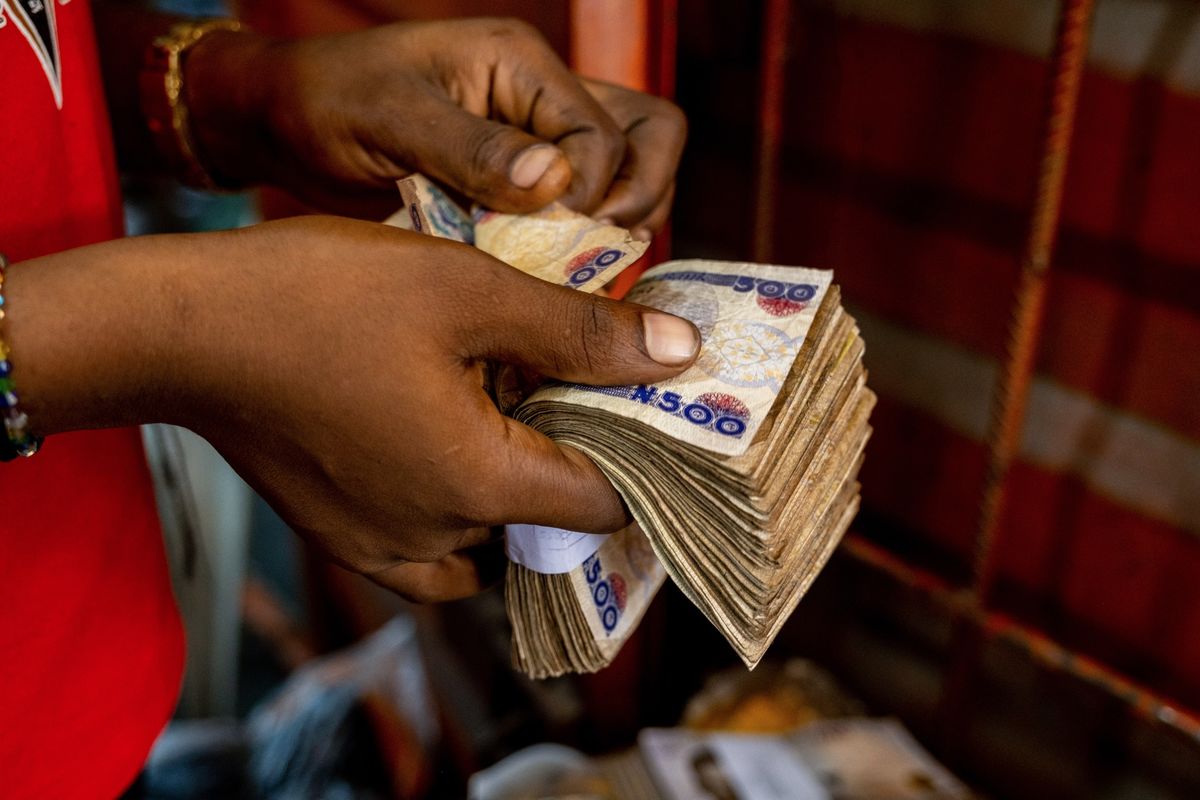
The Naira closed on a strong foot against the United States Dollar on Friday, gaining 4.3 per cent or N33.43 at the Investors and Exporters (I&E) segment of the foreign exchange market to sell at N743.07 versus the N776.50/$1 it closed on Thursday.
The Nigerian currency was strengthened at the spot market despite a significant rise in forex turnover during the last trading session of the week.
Data from FMDQ Securities Exchange showed that trades worth $121.08 million were executed yesterday compared with the $44.43 million transacted a day earlier, indicating an increase of 172.5 per cent or $76.65 million.
However, in the Peer-to-Peer (P2P) forex window, the value of the Nigerian currency closed downward as it lost N2 against the Dollar on Friday to sell at N882/$1 versus Thursday’s exchange rate of N880/$1.
Also, in the parallel market, the domestic currency lost N9 against the greenback to quote at N890/$1, in contrast to the preceding day’s value of N881/$1.
In the official market, the local currency appreciated against the Pound Sterling yesterday by N15.57 to wrap at N958.99/£1 compared with the previous day’s N974.56/£1 and improved its value against the Euro by N11.57 to trade at N827.70/€1 versus Thursday’s rate of N839.27/€1.
A look at the cryptocurrency market showed that the ecosystem gave up its gains on Friday, with Bitcoin (BTC) earlier falling into the $28,900 level in the afternoon before recovering something.
However, it still lost 0.5 per cent to sell at $29,042.48, Ethereum (ETH) weakened by 0.3 per cent to $1,829.27, Ripple (XRP) shrank by 6.7 per cent to $0.6208, Solana (SOL) depreciated by 1.3 per cent to sell at $22.69, and Litecoin (LTC) fell by 1.1 per cent to $82.07.
Further, Cardano (ADA) recorded a 0.8 per cent loss to $0.2913, Binance Coin (BNB) declined by 0.5 per cent to $240.70, while Dogecoin (DOGE) appreciated by 1.0 per cent to $0.0749, with Binance USD (BUSD) and the US Dollar Tether (USDT) trading flat at $1.00 apiece.
Economy
Nigerian Stocks Rebound by 0.98% Despite Lower Trading Activity
By Dipo Olowookere
Lower trading activity could not tie down Nigerian stocks on Thursday, as they rebounded by 0.98 per cent after the previous day’s loss caused by profit-taking.
The growth recorded by the Nigerian Exchange (NGX) Limited yesterday was driven by interest in Guinness Nigeria, First Holdco and others.
Guinness Nigeria and Zichis gained 10.00 per cent each to sell for N365.20 and N26.95, respectively, Access Holdings appreciated by 9.98 per cent to N29.20, First Holdco jumped by 9.91 per cent to N120.90, and UPDC REIT soared by 9.38 per cent to N14.00.
Conversely, Mecure lost 9.96 per cent to trade at N62.40, FTN Cocoa depreciated by 9.16 per cent to N8.63, Omatek slumped by 7.89 per cent to N1.75, Africa Prudential crashed by 4.44 per cent to N12.90, and Cornerstone Insurance fell by 4.35 per cent to N5.50.
A total of 36 stocks appreciated during the session, while 28 stocks depreciated, indicating a positive market breadth index and strong investor sentiment.
Customs Street experienced lower trading activity during the trading day, with market participants transacting 782.4 million equities for N56.3 billion in 46,273 deals, in contrast to the 1.3 billion equities worth N118.2 billion traded in 47,458 deals on Wednesday, representing a drop in the trading volume, value, and number of deals by 39.82 per cent, 52.37 per cent, and 2.50 per cent, respectively.
Bargain-hunting was seen across the key segments of the bourse, with the banking index up by 3.92 per cent. The industrial goods space rose by 1.27 per cent, the insurance sector appreciated by 0.75 per cent, the consumer goods counter improved by 0.63 per cent, and the energy segment grew by 0.04 per cent.
When the closing gong was struck to announce the end of trading activities for the day, the All-Share Index (ASI) advanced by 2,413.03 points to 247,831.40 points from 245,418.37 points, and the market capitalisation added N1.575 trillion to close at N159.894 trillion compared with the previous day’s N158.319 trillion.
Economy
Brent Hits $100 Per Barrel as Red Sea Attacks Stoke Supply Fears
By Adedapo Adesanya
Brent crude jumped over $100 per barrel on Thursday, rising by $6.62 or 7 per cent to $100.69 per barrel, as Yemen’s Houthis attacked two Saudi oil tankers in the Red Sea, causing further global supply disruptions following a near-halt in trade through the Strait of Hormuz.
The international crude oil benchmark has now climbed roughly 20 per cent in about two weeks as repeated attacks on commercial shipping, renewed fighting involving Iran, and mounting export disruptions have steadily erased expectations of a quick return to normal oil flows.
Also, the US West Texas Intermediate (WTI) crude chalked up $5.36 or 6.2 per cent to settle at $92.19 a barrel.
Houthi claimed that the group struck two Saudi oil tankers in the Bab el-Mandeb Strait after declaring a naval blockade of Saudi exports earlier this week.
Several vessels reportedly altered course or delayed transits through the chokepoint, threatening the export route Saudi Arabia has relied on to bypass disruptions in the Strait of Hormuz.
Market analysts noted that the escalation adds to the near-halt in Hormuz traffic and the sharp reduction in Iranian exports, intensifying concerns over near-term global availability.
Analysts estimate that the Strait of Hormuz and Bab el-Mandeb carry the equivalent of roughly a quarter of the world’s oil supply.
As a result of fewer shipments exiting the strait, loading activity within the Gulf has fallen to 2.5 million barrels per day over the past seven days, compared with 6 million barrels per day over the past 30 days
However, following the attacks, two Chinese supertankers carrying a combined 4 million barrels of Saudi Arabian oil managed to exit the Red Sea via the Bab el-Mandeb Strait on Thursday.
Meanwhile, US President Donald Trump promised “major military punishment” for Iran and its Houthi allies.
Goldman Sachs said Brent might exceed $120 a barrel in the fourth quarter and average $100 next year if the strait remains disrupted through 2027, with further upside if the Bab el-Mandeb Strait and Suez Canal also suffer persistent disruption.
Kazakhstan has begun cutting oil production after drone attacks shut down tanker loadings at the Caspian Pipeline Consortium terminal on the Black Sea.
Amid this development, seven core members of the Organisation of the Petroleum Exporting Countries and its allies (OPEC+), namely Saudi Arabia, Russia, Iraq, Kuwait, Algeria, Kazakhstan and Oman, are likely, when they meet on August 2, to increase their output target by about 188,000 barrels per day for September.
Economy
Insurance Bill Will Strengthen Regulation, Attract Investment to Nigeria—NAICOM
By Adedapo Adesanya
The National Insurance Commission (NAICOM) has said the passage of the National Insurance Regulatory Commission Bill by the Senate will unlock greater investment in Nigeria by strengthening regulatory oversight, enhancing investor confidence and creating a more transparent and accountable insurance industry.
Describing the development as a significant milestone in efforts to strengthen the regulatory framework of Nigeria’s insurance industry, the commission particularly praised the leadership of the Senate and the Chairman of the Senate Committee on Banking, Insurance and Other Financial Institutions, Mr Adetokunbo Mukail Abiru, for their roles in securing the successful passage of the Bill in the Red Chamber.
According to NAICOM, the proposed legislation will enhance regulatory oversight, improve transparency and accountability, and boost public confidence in the insurance sector.
The commission said the bill is expected to attract greater investment into the industry, promote sustainable growth, and deliver benefits to policyholders, insurance operators, and the wider economy.
NAICOM also noted that the Senate’s commitment to advancing reforms in the insurance sector would support the modernisation of insurance regulation and strengthen financial inclusion across the country.
It added that the passage of the Bill reflects the legislature’s resolve to protect the interests of citizens while promoting the stability of Nigeria’s financial system.
The Commission reaffirmed its readiness to ensure the effective implementation of the new legal framework once the Bill receives presidential assent, pledging continued collaboration with industry stakeholders to position the insurance sector as a key driver of national economic development.
Earlier this week, the Senate passed the much-anticipated bill to repeal and re-enact the law establishing the National Insurance Commission (NAICOM), paving the way for the regulatory agency to be renamed the Insurance Regulatory Commission (IRC).
The legislation, titled the Insurance Regulatory Commission (Establishment) Bill, 2026, was passed after the Senate considered and adopted the report of its committee on banking, insurance and other financial institutions.
According to lawmakers, the outgoing National Insurance Commission Act 1997 is outdated and does not adequately address the emerging economic growth, needs and development of the country’s insurance business and projections.